Someone to Believe

Hello from a Mediterranean Coffee Shop,

We are down to hours left in the class portion of the semester and finals begin on Monday. I remember customarily feeling both anticipation and exhaustion as I faced the impending end of every semester. Part of it was pouring everything I had most of the time into every class. Averaging 18 credits a semester certainly contributed to my feeling spent both mentally and physically. People inquire why I might choose such an arduous path to my bachelors degree, but the answer is simple. I needed to be I was capable; being dismissed academically, and having only a 2.8 or something like that from high school, my previous academic record brought little confidence that I would succeed. Even though my military service demonstrated that somewhere I had both the intelligence and the ability, there was little, or more accurately nothing, to predict I would now be looking back on almost 30 years in the academy. I am not sure anyone (including myself) believed in such a possibility. I say it this way, “I needed something or someone to believe in.” I needed to dig deep and believe that someway I could be of worth, much like what Homer heard from Dr. Larch in Irving’s novel, The Cider House Rules. And yet, much like Homer, I had little idea of how or where. Furthermore, most times I felt like I had little support. This is not to say support was not there; rather I had little idea if it was or how I might use it if it became apparent.

Certainly, if you follow this blog, the idea of hope is a pretty contrast thread. Believing in something or someone is quite similar to hope. When I grew up my father impressed upon me that adage “your word is your bond.” He would follow that with stating rather emphatically, “if you do not have your word, you have nothing.” Simply, he returned to the basics of trust and faith. I wish I were half the man he was. I think I have done pretty well; however, while I have the best of intentions, but I do not follow through as well as I wish. This has been a malady that has plagued me throughout life. I am quick to offer before thinking of the time commitment or effort my offering might entail. I am getting better, but I still feel I could improve.

As I reach the age of being as old as dirt, or so it seems (I thought those with a 50th high school reunion had to be that old, and I am here). I wonder at moments what those who see us now saw us as ancient as we saw our predecessors. I think back to some of my high school teachers, and imagined them to be in their 50s. Wow, that seems like a yungin’ (and I do not mean the rapper) now. This morning, as I have done since the 1980s, I was up incredibly early to watch the coronation of King Charles III in London. To think he was 4 when his mother was crowned at the young age of 26 and he now becomes the oldest monarch to be crowned in British history. I am always amazed and fascinated by the legacy that is the crown. I wonder what it feels to follow the 70 year reign of someone, and even more so when that was one’s mother. He has witnessed so much, experienced so much, and has been under the microscope for his entire life. Much of the commentary (and while I appreciate Michael Strahan, today I found him embarrassing) noted how much one of King Charles’s duties would be to maintain the relevancy of the crown. That is no easy task in our continually changing world. It is this profound change that seems to be increasing in speed and degree that makes much of what one might considered typical or appropriate no longer either.

It is a week or more, and I am still attempting to complete this post. It is now Mother’s Day, and it is once day post-commencement. As I generally do, I attended our Bloomsburg Campus’s second commencement ceremony. It is typical that the faculty process in their regalia and the students are assembled to receive their hard earned diplomas. The beginning of the afternoon festivities started in their typical manner. It was a bit different that graduate diplomas were also awarded. In the past that was a different event, but I believe the integration precipitated the newer development.

As the two colleges (College of Arts, Social Sciences and Humanities and the Ziegler College of Business) awarded the diplomas, and students crossed the stage to typical hollers and adulations, followed by the typical pictures. Up to this point it seemed normal. Then things took a different direction. Beginning with the very first graduate student, who I happened to know from when we was a freshman, she did not return to her seat, but left the stadium. The majority did return to their seats, but an hour or so into the ceremony, the number of students just leaving looked like someone had called for a mass evacuation. By the end of commencement, there were so few students left the recessional was abandoned. I am still somewhat shocked a day later. Some of my colleagues’ feelings varied from shock to anger. I found myself feeling mostly perplexed; however, this is the COVID freshman class. Little about their undergraduate process has been normal, so perhaps their “I’m done! Outta here!!” response should not surprise anyone. And yet, my idealistic, process-centered self is profoundly boggled by what happened. What is typical? Where can I pin something that will provide that sense of stability, something or someone to believe in?

It’s a new week, and again it is flying my usual May focus on health issues are, significantly more problematic than they have been for some time. I have disclosed that I was diagnosed with late-onset Type II diabetes about 5 years ago. It seemed manageable with medication and an additional medication until recently (last couple months). Working with a CGM system, I can see my sugar levels at all times. That is an amazing thing, but also a bit disconcerting as you see the peaks and such immediately. I was not aware that I had some of the possible numbers I have experienced this week. The ironic thing is I do not feel badly, which is a blessing, but I do feel some increased stress. I received more information and things to consider yet this afternoon. I will research some more medications options this evening that will work with the new Ozempic that is now part of my regimen. I am frustrated; I am a bit frightened; and I feel I just got another reality check from all that has happened to my body from Crohn’s. I am not sure how all the pieces fit together, but I sometimes doubt they do. I wish I could anticipate some of this before it occurs. There is that desire to control things again rearing its head. I do realize how I have been blessed in so many ways, but during the last couple weeks, I have been pushed to imagine a lifestyle that is much different than I have lived, in spite of many limitations since I around 30. In a number of ways that seems beyond ancient, but again it is over half my life ago. While that first surgery in December of 1986 seemed substantial it seems like a walk-in-the-park compared to what has occurred since. I remember my seminary advisor noting I had gone through major surgery. I did not see it as so profound, though I guess it was. I think what is more profound is what my body has done since. Ten more surgeries, and complications I could have never anticipated have been more of a family member than a distant acquaintance. Those experiences have developed a sense of resilience and the belief that I can overcome anything, but I think I am getting tired. I have been there before and turned it around, and I am working to get there again, but this one seems a bit more serious and formidable. I can only take each day as it comes. In my own piety, prayers are welcome.

And yet, as much as I would like to manage otherwise, it seems my life is being offered help through pharmacueticals. I spoke with another physician yesterday, who is a genius on so many levels, and he said that Ozempic is sort of the wonder-drug of the time. He also noted that my having access to it is a miracle in itself. The first day, after taking it, there was some GI distress, but certainly manageable. Whie my glucose levels are what I consider ridiculously high, there does seem to be some leveling out from the extreme numbers earlier in the week. I am hoping additional dosages will do what they are intended to do, and we can get this more regulated than I am currently. Life is such an amazing, and yet tenuous, gift. And I am reminded that not everyone gets to realize that or experience that giftedness. I have been reminded of that as I prepare for that auspicious occasion of a 50th anniversary of a graduation. There are a significant number of classmates who are no longer in this world to attend. That is the harsh reality of our fragility. It is a reminder that we are provided opportunities each day, regardless our station, to make a difference in some small manner. Sometimes that difference is through an act of kindness, a reminder to another that they matter. How often do we simply bypass an opportunity to provide a ray of hope in the midst of someone’s struggle to manage their day? I dare say, too often.

This is the something or someone I want to believe in. I want to cling to the hope that we have some sense of goodness in us that is ready to comeout at a moments notice, offering a positive tone to their yearning for something even microscopically better. I’m am too familiar with those who find it difficult to be optimistic. I have been too affected by those who wallow in a sense of it’s-never-enough. I want to believe in the possibility of goodness and kindness. I want to surround myself with those who find that kindness can always overcome dismissal, who believe that every day is a gift regardless their situation (and this is not some idealism, though some might argue otherwise). It is hard to believe another academic year has come and gone. I was blessed beyond words by a group of four incredibly talented young women who together grew, managed adversity, and will make our world a better place. It is their picture that graces this blog. To share dinner with them as a sort of graduation present was beyond enjoyable. They are people to believe in.

Something to Believe in

Thank you for reading. If this is the first time, welcome, and I hope you will come back.

Dr. Martin

When Dates Matter

Hello from my office at home,

In the next week, students will finish another semester of classes, finals will be completed and for some, the 13th of May will be a significant date as they receive their diplomas, some the night before, the 12th, when they will receive their Masters or for some a Doctoral degree in Audiology. In the last post, I included a picture of me with my first diploma from kindergarten. I do not know that date, but it was probably June of 1961. When I examine the diplomas, which adorn the wall in my study, it was forty years ago that I graduated from Dana College; it was 35 years ago that I graduated from Luther Northwestern seminary; and it was 50 years ago I graduated from high school. All in the month of May. As I have registered for that 50th reunion, planning to return to my hometown in August, I am both excited and curious what will happen. My class was the first graduating class from West High School in our reconfigured school district. When I graduated from Dana, I knew I would be moving to St. Paul for an intensive summer Greek program, and upon graduation, call, and ordination, I would be moving to a town that is, ironically, only barely over an hour of my present home.

This afternoon, I had the opportunity to speak with someone I deeply admire and appreciate, and we chatted about the time I was in Menomonie, and how that is almost 15 years ago that I left there. We chatted about plans, goals, and how those things come to be, how they are accomplished, and why having both plans and flexibility are important to our world (and ourselves). When I think about how it is I got to where I am, I am continually amazed, both by the curcuitious route I have traveled as well as how many times I have been blessed by people, events, and circumstances. That does not seem to change. When I am unsure of where my meandering path might happen to go, something or someone crosses my path and makes a difference. In my piety, it is a firm conviction of mine that somehow through the Holy Spirit, God continues to change what I imagine, or more likely make me aware of possibilities I could not imagine. People, many who are such incredible individuals, influence me in ways I could never anticipate. As I told my beautiful friend this afternoon, there have been moments in my life, generally because of my own actions at some point, that precipitated a choice, a significant decision, which would create a drastically different path than I anticipated. Some of those included leaving the Marine Corps, traveling on a Lutheran Youth Encounter team, returning to Dana from the University of Iowa, moving to Pennsyvania (both times), pursuing a PhD, finding a path after resigning my ordination, and there are more, but I think you get the idea.

What we do in those decisive moments is not as profound as what we do after the choice is made. What I do hope my life will show is that I made the choice somewhat wisely, but as importantly, once the choice was made, I did whatever I could to make the path chosen as successful as I possibly could. Choices are an integral part of our humanity. Facing that choice with the best possible information, and then deciding are necessary if we are to make progress of any sort. Without the willingness to choose, we are paralyzed . . . we are either unwilling or incapable of facing the unknown. And undoutedly, the unknown can be frightening. That is the nature of the unknown, but it does not have to result in paralysis. Earlier today I was engaged in a conversation with someone who is struggling, believing that having any limitations means they have failed. Nothing could be farther from the truth. What they have accomplished from the beginning until now is unparalleled. There are situations that are not within their wheelhouse. They are not particularly adept in certain things, and while those isssues can prove important, there are so many other things in which they are profoundly outstanding. I know it because I have witnessed it first-hand. Indeed, there have been bumps, but so much has been accomplished. I am trying to step back and figure out what is possible to assure them all is not lost or doomed.

We are such fragile animals. We are so remarkable, so marvelous at moments, but those moments of extreme satisfaction are fleeting. Perhaps it is because we would not appreciate them as much as we should or could if they became commonplace. It is like that Prayer of St. Francis notes, it is often in doing the opposite that we get what we really hope to receive. I think it was a combination of fragility and the struggle to see one’s life as many others saw, which led to the passing of my younger sister, Kristina (Kris). It is 15 years ago today I was driving back to Sioux City after learning she had paassed away early on that April morning. I remember the phone call as if it were yesterday. Certainly, there were the physical maladies that contributed to her death, but I think all the things that created those maladies were due to something much more insidious. Kris struggled with a sense of self-worth, though she was beyond proud of becoming a mother. The verbal, emotional, and physical abuse we received affected us very differently. I somehow found the courage to fight it. She, on the other hand, believed the damning message it carried. It created immeasurable damage and much of it was unmanaged because it temained unspoken. In fact, the only time it came close to being dealt with openly was squashed when our mother refused to continue family counseling.

To this day, I believe Kris might have been the most intelligent and capable of the three Martin children. She had a creativity both in language and in her artistic ability, which with the proper support and venue could have made her a well-known and successful individual. I believe that with all my heart. Her daughter exhibits some of those same skills. While I do not underestimate what I have achieved, I believe it is because I have been put into places where I received the support and encouragement to prosper. I have been provided opportunities to grow, expand the possibilities, and finally to be allowed to explore and learn from experiences, be they positive or negative. Certainly, I have not always been perfect in that growth, at times living the proverb of one-step-forward, and two-steps-back. And yet, here I am. I wonder what Kris would think of the last decade. I have no doubt she would have opinions. As a lesbian, environmentalist, as a creative and yet brooding genius, I am sure she would be chomping at the proverbial bit to use her place to speak out against injustices, against the disregard of so many concerning climate change. While I think my younger sister and I probably had more in common than most would believe at a glance, what was probably most different is she would be at the front of the crowd protesting, and I would be sitting in the comfort of my office writing about it. She would not fear the comments or the actions of those who would rail against her. Simply, I think she was more courageous than I was or am.

I would like to believe I have taken some of her and instilled it . . . I am not as shy or worried as I once was, and how did such a metamorphosis occur? I think it was because I finally got beyond the very abuse referred to earlier. It is because I have learned (to a great degree) to be comfortable by myself. It is because finally I have learned to believe that I am okay. This is not to say I do not still fall short of things. It is not to believe that I have it all figured out. Everyday, my students remind me there is so much yet to learn to be effective. As another person I spoke with today noted, it is (I am) a process. As someone who has come to realize their appreciation for process, that is freedom producing; it is life giving. Each day has the possibility of becoming a significant date, a day that matters in a consequential manner. Again, this weekend, and yesterday, the 29th of April, mark 15 years since I received the phone call that my younger sister, my only total blood relative had passed from this world. It is an occasion to feel some degree of sadness because I wish she were here to see her grandchildren and her daughter as an adult. I wish she were here to chat with and listen to her thoughts about so many things. It is a moment to take specific time and remember her brilliance and creativity, to celebrate the gifts she had, in spite of the difficulties she endured. It is simply for me a date that matters because she mattered, and she still does. I wish you were here to listen to this song and we might chat about it. I do love you.

Thanks as always for reading.

Michael (the older brother)

Fortunate Happenings

Hello from Panera,

It is early evening on the first day of another week of school. The close of the semester is rapidly approaching, and just as I thought I had planned well external events moved things around, changing my trajectory significantly. For the first time in 50 years, I had an auto accident that I am at fault in. What is interesting is in the 3 weeks since, my fear of another is through the roof (so to speak since the new Beetle is a convertible). Seriously, though, I am incredibly more reactive to anything that happens around me. If someone stops and I am even close, I find myself hitting the brake pedal. . . .

My intentions to turn this blog around quickly have dissipated (or failed miserably). It is now three weeks later and every time I have been hoping to write, either something called me away, or more significantly, I felt I had nowhere to go in terms of what I wanted to do. And yet the title of the blog is still relevant. Yesterday, I attended the Annual Scholarship Luncheon, hosted by the Bloomsburg University Foundation. It is an opportunity for donors who give to the university to support students the possibility of meeting some of the very students who is benefiting from that gift. While my student was not in attendance because they are in Germany (I tried to get them to fly me to Germany to meet them, but it was not in the budget), the stories, the gathering, and the presentations from both a donor and a student were outstanding. Attending the university is a much different financial undertaking then when I first attended Iowa State University some 45 or so years ago. The cost for room, board, and tuition for an in-state student living on campus was $226.00/quarter (that did not include books). I actually made money attending college. And I squandered that opportunity failing out. I think back to that, and my retirement age persona still asks. “what was I thinking?!!” Even with a tuition freeze for the past four years, and the possibility of the fifth, going to Commonwealth University of Pennsylvania – Bloomsburg Campus, and receiving a Bachelors degree will cost approximately $100,000. And that is considered affordable! Amazing.

What is stunning to me is the how differently we view that degree today from when I graduated from high school, which in barely over a month will be 50 years. That too is stunning to me. One of the assignments I have in almost all of my classes is the creation of a Google Map/Memoir. In it, students are asked to create a Google map that explains to their future children who they are, what the world is presently like, and to offer some sense of what sort of world they believe their future children might live in 25 years from now. Through people, places, and events they deem significant in their lives, they have to explain all the things we perhaps wished we might have asked our parents. What was the world like for me 50 years ago. I am think about the country song, “1980 Something,” but I would need a decade earlier. Words like Vietnam, Nixon, Watergate, Détente, SALT, OPEC, and soon things like Resignation, Withdrawal (from a geographic place) were nightly news vocabulary. The thought of technology or even the personal computer was still a decade away. Attending college for this lower middle-class kid was a dream, and something I hoped enlisting in the Marine Corps might make possible. That time in the Marines affects me to this day. I had no idea what I had done, but I was determined to do it. It is that determination that has perhaps served me most profoundly.

Throughout my life, I have been told I was not capable enough; I was not tall enough, weighed enough, looked old enough; and too often I allowed those evaluations or comments to restrict me. Yet, when things were really pushed and things seemed to matter, I found the fortitude to stand up and believe enough in myself to attempt whatever it was, in spite of the admonishment to do otherwise. In fact, the more one told me no, the more likely I was to prove the opposite. So that determination, that stubbornness, that unwillingness to believe that negative answer has served me well (and least sometimes.). Just this morning, I have spoken with two different students encouraging them to not give up, and I think there will be a couple more before day is out. I’ve spent significant time considering why it is we often lead with the negative of something rather than the positive. Why is it we find the shortcomings so much more easy to point out rather than the positive things? Why is it we believe that focusing on what we do not have is more helpful than appreciating what we have. Maybe, for me, it is that I was so fearful of being around that all the time that I made both a subconscious, and somewhat conscious, decision to do it differently. That is perhaps the most fortunate happening which has occurred in my life. I am not some unfettered idealist, that is long gone, but I hold on to the optimism that provides a continual glimmer of hope, of light, that there can always be something better.

Working to make something better is laborious; it can be tedious and overwhelming. It can seem like we never get there, but that presupposes we know where there is or what there is. We do not. Too often we achieve something only to jump to the next thing, thereby never really celebrating the accomplishments completed. There is no real hope if the only destination has no stopping places along the way. I have known, and presently know, incredible people who have attained unparalleled success on numerous fronts, but they are not content. Contentment and complacency are not the same thing. Complacency is not something to which I subscribe, but contentment is. Contentment is taking time to believe in yourself in a manner that allows you to feel positive about what you have done and see the difference you have made. I think of Lydia. She would be 99 years old this coming August. After she retired, she began a bit reclusive, and yet she had an incredibly giving heart. I am reminded of the time she paid the outstanding taxes of a neighbor who was on the verge of losing their house. And yet she did not want people to know what she did. She and her husband came to the United States with two suitcases and $100.00. When she passed, she had accomplished becoming ABD in international economics. She and George owned about 1/3 of the entire circle she lived on. She had one of the most amazing houses in the entire town, and she was well respected both in the classroom and in town for her understanding of economics. And yet, she was content to be in her house. She once told me, if people wanted to see her amazing home, they would not be allowed to do so, but if someone was not all that amazed, she would offer them access. For those reading who knew her, I am sure you are not surprised. And yet, there was a sadness because I am not sure she ever felt it appropriate to be proud of herself. Again there is a difference between pride and arrogance. Again, why is it the things we should feel positive about we are afraid to do so?

I think there are many reasons, but I would like to say unequivocally that most of them are garbage. Take the time to realize the good things and be happy about them. Never become complacent, but realize the fortunate happenings in your life and celebrate them. Too often we allow those around us to sap our ability to celebrate. Sometimes those are the people closest to us, and that makes it even more difficult, but we have choices. We can allow those around us to undermine us; we can allow them to create a sense of doubt or incapability, but do not let that happen. I have been there and I lived a sad and frightened life, a life that seemed destined for simply existing, going through the motions of life without living. There is nothing positive in that. I find myself realizing that some of the difficulties I have faced helped me look for the goodness that I believe is always there. The picture above is my kindergarten graduation picture, the first of what would be many graduations, though I did not know it. I was happy in that moment. It is difficult in our present world, with all the acrimonious sounds and actions to find that glimmer of hope, but I pray you can find it. The positive in life is worthy of focusing on. It is worth celebrating. Certainly, do not sit and wait for life to come to you, but take time to believe in yourself and the possibilities the world offers. Good luck as you finish the semester or whatever task you are attempting. While the video below might seem seasonal, I believe the message fits for everyday.

Thank you for reading,

Michael

Lonely as a Cloud

Hello at the end of a long day,

I have been in my office most of the day working, and there is more to do, but my eyes are tired. Working to review student’s submitted work can be exhilarating and exasperating in the same moment. I am excited when I labor through a cover letter or resume and see their professional person take shape, while simultaneously lamenting that much of what I have offered, honestly attempting to provide genre-expected, best practices is not considered. I find myself hopeful when I look at the hard work evidenced in their documents, and still often shocked by things like never having a part-time job, or learning at college graduation many do not have a drivers license. It is a different world from the life I led or the things that seemed normal practice at 16, and definitely by 21. Undoubtedly, the reasons for such changes are complex, and perhaps never having children of my own is, in part, responsible for my lack of awareness, but I am still significantly blindsided when confronted by such realities.

As I compose this, it is 4:30 a.m. and it is a couple days after I began this post. That pattern is not uncommon. I will often come up with a theme or idea, believing it has promise, but still not completely sure how to attack it. Since I started this (on the Friday of Spring Break), we are back in session, I have road-tripped 1,000 miles in one direction, driven in mesmerizing heavy snow through the Keweenaw darkness, and kept up with student emails and other communication. . . . It is early afternoon and Max is doing prospective student things, and I am working on my own things. It snowed steadily this morning and I found that Bruce and a bit of snow on hills is not a great combination. Thankful for a strong 17 year old with both some weight and some strength. It is both comforting and a bit disconcerting to see all the changes. It is stunning to step back and realize I arrived in the Upper Peninsula 30 years ago. It would be another 3 years before I would find my way to Michigan Tech and embark on a path that would push me to where I am today. I often note that my life is the real-life version of the cartoon, Family Circus. I know there is a destination, but I am still uncertain what it is. That might sound a bit unsettling for some, but I find a particular comfort and freedom in the opportunity to imagine the possibilities. There is so much I still want to learn, to know, to anticipate. Is that wrong? What is it that makes us believe we need to follow the accepted plan, and I do understand the reason for order. As I have noted, and as those who know we well will tell you, I love order and structure. It is how I manage my life on a daily basis. And yet, I am content to leave where I am going up to chance (at least to some degree). I believe that moving forward toward a new possibility is order; it has direction and it requires thought. It is in the thought that I find the most comfort.

William Wordsworth, the English Romanticist, who along with Samuel Coleridge (the same Coleridge noted in Dead Poets Society) are credited with launching Romanticism in England, wrote a poem titled “I wandered Lonely as a Cloud.” It is he considers what can bring someone solace in their solitude. He ponders what a beautiful field of daffodil’s might offer for that person who often finds themselves in their vacant and pensive moods. When I wonder in a pensive way what I will do, too often I find myself falling into the swirling abyss of expectation. Is it wrong to reject the expectations of conventional wisdom? Sometimes I wonder what I might do if I actually played the about lottery and won an F-ton of money? Most often I ponder who I would use most of it to help other people, and allow myself the opportunity to live comfortably, but just focus on what I might do for others. think perhaps the most difficult thing would be too many people would learn, unless I could do it all anonymously. However, I realize more and more that stuff will not create personal happiness. I realize that I have so fortunate just as I am. It is not about things, and at times, it is not about people. It is about having choices; it is understanding the uniqueness of the moment. We are provided chances to do something that matters. What is perhaps important to me is the occasional latitude that we often miss or fail to realize. Sometimes things happen that cause a change in our plans, and certainly those changes can seem insurmountable. At times those significant changes occur in the blink of an eye, in the glance in the wrong direction. The picture at the outset of this blog is such a consequence. Two years ago, after a long period of looking, I found the most amazing VW Beetle. It had a Fender sound system and sub-woofer stock. I had about every imaginable option. One moment changed the existence of Bruce as I called him. He is now a vehicle that will be used for pieces. And I did get another one, a newer one, not nearly as tricked-out, but newer and a convertible. I have named this one Bella, short for Bella, the Blue Beetle. So here they are: Bruce in happier days; Bruce on the way to a post-mortem; and now Bella.

One of the things I was reminded of in the midst of the last three days is the sort of dichotomous saliency of this blog, the actuality of life, and the truthfulness of this blog’s title. Even this morning, I was speaking to a dear friend about the reality of life as someone who has been single for more than two decades. I am in the midst of people daily, seldom, and some times too often, I am more comfortable alone in the solitude of my little space. I love that I have learned to find a sense of balance managing the two differences. Clouds are for me one of natures most creative things. I am always amazed by the shapes, the motion, and the way clouds can telegraph to us what is happening, perhaps as much in our world as in our lives. When I was a small boy living at my grandmothers, I loved to lay on my back in the soft and cool grass, staring up at the sky. In the distance from her hill I could see the elevators of one of the feed companies in our town. I believed that I was seeing into the heavens, and that those amazing towers were from heaven and the clouds had parted, providing me a glimpse of eternity. I watched and marveled at the clouds as they danced and floated across the panoramic vision I had from my grassy carpet. What made this event so significant that I am writing about it more than six decades later. I think it was both the sense of wonderment and the sense of beauty and peacefulness I found. In the memoir I have created I note my penchant for wandering. Perhaps that wonder and that wander began with Wordsworth’s line, I was living a poem I did not know. Wordsworth writes:

I wandered lonely as a cloud.
That floats on high o'er vales and hills,
When all at once I saw a crowd,
A host, of golden daffodils;
Beside the lake, beneath the trees,
Fluttering and dancing in the breeze
.

William Wordsworth “I Wandered Lonely as a Cloud

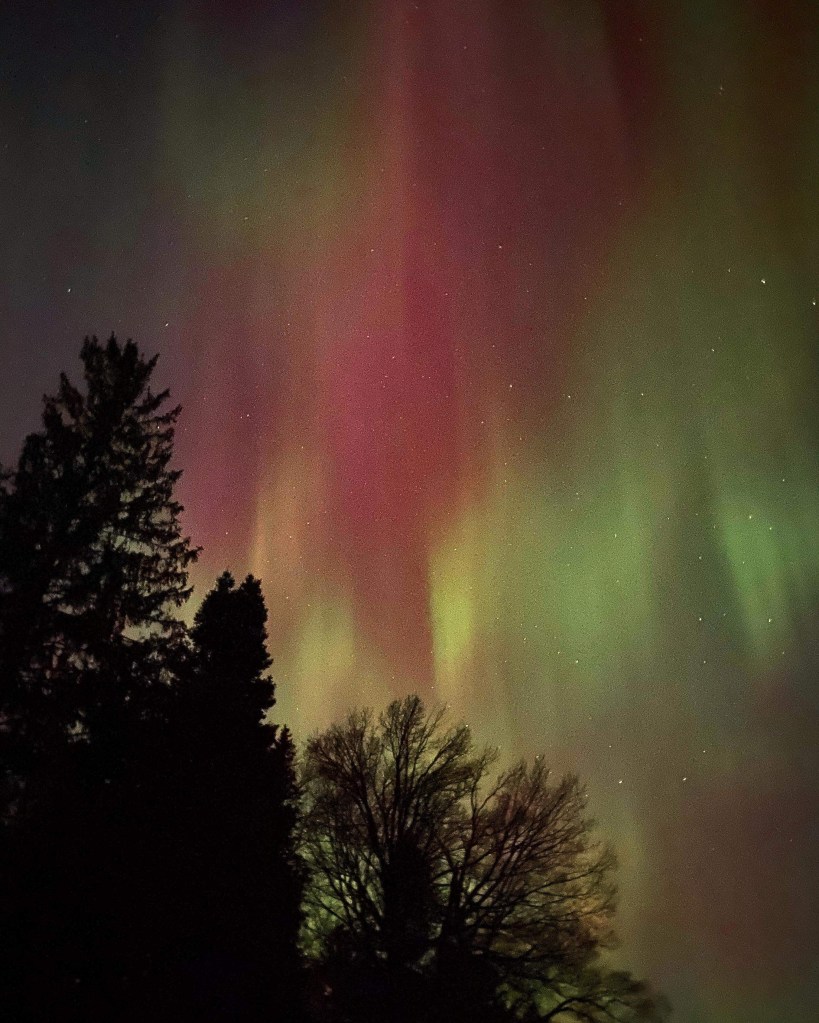
I think what intrigues me about clouds is their seeming freedom to come and go as they wish. They are controlled by the winds, they are controlled by barometric pressure; Cirrus clouds are made of ice crystals, and given the Latin name that means a curl of hair or known as a mare’s tail it is not surprising they are affected by the wind to the degree they are. Additionally, they often forecast a warm front, which, of course can mean all sorts of things. What I have learned is as I walk, undoubtedly, I will find myself looking up at the clouds and determining what images I might find. Last week, a day late, and what it seems happened throughout the northern section of the country, the widespread area that exhibited Aurora Borealis. I had just returned from Michigan, and my good friend, Susan was sending me things at 3:00 a.m.; the Northern Lights lit up the sky for almost an hour. They are not cloud, but they are characteristic in they come unannounced and they come and go as they please, surprising we earthly inhabitants. Sometimes I feel that way, I am able to come and go as I please, moving in and out of spaces, even situations from time to time, and wondering what I might do in a year or two versus what do I have to do.

In the meanwhile, I am back to commenting, grading and managing life. At times it is easy to believe life is too complicated; it is too unpredictable, and it can certainly be both, but it is not unmanageable if one take the good with the unexpected. It does not have to be overwhelming if we keep the goal in mind and work intentionally toward it. One of my dearest friends got hit with so much more in terms of the unexpected this week than I could ever imagine. I know this will work out for them because they are tenacious; they are capable; and they do not quit. None of it will be easy, but please remember you are not in this alone. I am reminded of the song about clouds, titled “Clouds,” and recorded by Joni Mitchell, who ironically was just awarded the Library of Congress Gershwin Prize.

As always thank you for reading,

Dr. Martin

Understanding Identity in our Technological World

Hello from my corner of the Little Bakery,

It is Wednesday, but it seems like it should be Friday. I have spent more time working: prepping, grading, Zooming, interpreting, studying and believing in myself, yes believing I want to do the best work I have ever done with my classes, be a class I have taught before, whether it be a class that has one student or many, a class that I was assigned or I inherited. There is so much to do, but there is more I wish I knew how to do. I am never content with the work I have done. Is that a good thing? I am honestly not sure. What I know is I want to improve each and every day at what I do.

Teaching, professing, is such an amazing thing to be blessed to do. Every day I am offered possibilities to make some small difference in the life of someone who has bought into the idea that a college degrees a reasonable thing to pursue. Even that reality has changed so much since I graduated in the first class of West High School in Sioux City, IA. I grew up in a seriously blue-collar area of my town of 100,000 people. Most of the people in my section of town did not attend college for two reasons: it was expensive, and they did not have the money, and second, college was not considered essential or required. If my figures are still accurate, 40% of my students are first-gen students. They come to college both excited and fearful. They hope with all their strength that they will one day walk across that stage to receive a diploma, serving up a dream they one day only imagined. They fear and tremble with much more trepidation then they perhaps even realize, wondering if they are prepared, but not wanting to go home saying they did not make it. And yet, the world of academy is changing rapidly. That change is necessary, but it too is alarming.

I have noted for my students the consequence of technology, and what my mentor, Dr. Daniel Riordan, called the rhetoric of technology. He was an incredible mentor to me, helping me navigate a difficult time in my own career as well as supporting me after I left Wisconsin. What I realize is he became another academic advisor of sorts, and I have embarrassed his curiosity and zeal for trying new things. His philosophy was simple: “Be curious! What you learn is yours forever” (Olson Funeral Home). Technology offers opportunities to learn in ways we seldom fathom. When I relate my experience of buying my first computer (A Tandy whose memory topped out at 640K) and what it would cost in today’s dollars (between 5 and 6K) and that it was on 1987, they are stunned by what little I received as well as how much it would cost. And the reason I asked to borrow money from a Great Aunt and Uncle was also surprising to them. I already felt like I could not compete with my classmates who were technologically ahead of me. That poor Riverside boy did not have extra money, and even though he was married, we barely had enough money to live. I think Susan made 5-6 dollars an hour. That computer made my senior year in seminary much more manageable. And more importantly, it pushed me into the technological world that was barely beginning, and it changed how I understood my abilities as a student. It changed my identity.

From graduate school, as I moved into parish ministry, our church was trying to understand how to create a computer-based office, and how would we get information from one terminal to the other. Networking?? Oh my . . . by the time I would return to do a second masters and soon a PhD, the computer lab in the Walker Building on the MTU campus had a Mac side and a PC side. It was called CCLI. I learned so much about technology in that lab. A summer of Computers in Writing Intensive Classrooms (CIWIC) with Drs. Cyndi Selfe and Gail Hawisher would change my relationship and understanding of technology in a way that was mind and life altering. Those changes would be fundamental and be important in my obtaining a tenure track position with my first application. Nothing I expected to happen. Technology has created more than a profound change in daily life; it has created an identity for its users. However, one must ask about the accuracy of the identity created, and at what cost? While my late 20th and early 21st century technology usage was role changing perhaps, I am not sure I allowed to to change who I understood myself to be. Social media would establish another layer of usage, but again, I am pretty sure I did not wish or attempt to change the image or the person I believed myself to be.

Perhaps that is because I did not have to navigate my world online as the prepubescent, undersized, and frightened junior high school (now middle school) person I was. We managed things face-2-face with those around us. I did not have to worry that what happened in school would be broadcast far and wide. I was rocked to my core as I read about and watched the video of a 14-year-old girl pummeled in her school halls, and subsequently committed suicide. Certainly, there are many pieces unknown; undoubtedly, the number of levels this story is tragic or wrong are legion. I have since listened to the clips of a school board meeting where parents and students seem to indicate this sort of behavior is commonplace at this New Jersey district. I think there is more of a connection between our technology-laden existence and this tragedy than we are willing to consider. Let me offer a couple of observations. When you text someone in the house rather than call out to them or even walk up the stairs to speak with them: stop it. When you are in the same hall, the same house, the same building (within a bit of reason), go to the person rather than text, snap, or TikTok them. The importance of communicating face-2-face seems to continually lose its value, but that is an incredible mistake. As I tell my students, we are more connected now than ever before and simultaneously more isolated, and the past three years have only complicated that reality. From quarantines and isolation, from closed schools and businesses, my students admit they do not know how to interact with each other, even in class. They lament the fear they feel when required to be in a class or a social situation. Even as I write this, my brain is filled with ideas and concerns.

Those who know me well know that I am not against technology, and for the most part, I embrace it; but what have we created and what are the consequences? It is not by accident that two of my blogs lately have posted on technology. I am wise enough to know that it is not going backwards. As I write this a few days later after its inception, banks have failed, questions about how we manage our lives, things like AI and Chat GPT are on the minds of students and professors alike. Daily I read something about the consequences and concerns of this newest technology that will affect the masses. For those unaware, Chat GPT is an open source AI software (more than software I believe) that creates “a language model [and is] developed by OpenAI, [which is capable of] . . . respond[ing] to text-based queries and generat[ing] natural language . . . ” (chatgpt.org, 13March23). The concern about this ability is palpable. And yet, we should be afraid of it . . . fear generates anger, and anger generates rejection. We cannot merely reject technology because we are not sure what it will do. We cannot unplug from the world we have created. That is the verity of where we are, but is there a way we can manage it more thoughtfully? Too often it seems we have shiny object syndrome (and that is an SOS), chasing after whatever comes believe it is some panacea. I do believe what we have accomplished in the area of education has been primarily positive; however, I am willing to admit there have been unexpected consequences that have created pain, often straining the ability to achieve the outcomes that serve both student and professor most efficiently. For the most part, that efficiency, that effectiveness, is hampered by our willingness to no longer communicate effectively. When I ask students to come and see me during office hours, too often that invitation is interpreted as merely that, an invitation, something they can RSVP to or ignore. I do not believe they are impertinent; and, conversely, I believe most of them are good people, but they do not know how to be a student. That is an incredible statement, particularly in this country where being a student is what they do for 14 of the first 18 years of their lives. In my conversations with colleagues, it is apparent that my view is not unique to me. There is a great deal that makes us social animals, and the importance of our ability to socialize has been severely hampered by the limitations placed on us by COVID.

Before you think I am against all of those restrictions, I am not. On the other hand, it is possible we made mistakes individually, as a country, or as a globe . . . there is no doubt that is the case, but we did not know what to do. As I think about our world three years ago, we were stunned by what occurred in a very short period of time. We were stunned by the idea of being isolated, masked, locked-down, afraid to go anywhere. And yet, our government did what they believed best. The number of articles I have read in the last two weeks about consequence all have something in common. We perhaps went too far . . . we perhaps still needed to do much of what we did, but perhaps for not as long . . . we still do not have it all figured out. The world is different as a result. Technology and its effect on our life is much more profound than we might have anticipated. There is so much more we will continue to realize as we analyze what the global response to COVID was. It is my hope that we learn for the next time. There will be a next time; I believe this with all my heart and head.

In the meantime, I wonder what we will be as a society. I wonder how we will continue to integrate technology or it will begin to integrate us, perhaps. I wonder who we will understand the world to be as we are affected by the technology we use and develop. Perhaps the Styx song from 1983, Mr. Roboto. The song caused significant controversy when it was released, and its intention was the topic of a great deal of conversation. Perhaps it was more prophetic than we want to realize.

Thank you for reading, and I hope all is well.

Dr. Martin

Critical, Thorough, and Intentional

Hello as I wonder yet again,

It is shortly after midnight, and feeling exhausted earlier, I laid down. I feel asleep and awoke more than once listening to the news of the day. Now I am as wide awake as if it was time to get up in the morning, after a restful night’s sleep. As I’ve laid here, my mind has thought of one person after another, wondering how they are, and, in some cases, if they are. I reached out in a couple of cases. I am cognizant of how life seems to continue on, much like a rambling running post-winter stream — cold, and yet beautiful in its own way. We have not had much of a winter thus far, with it feeling more like late March for a couple weeks. I think I have had the shovel out only once the entire season. And yet perception and experience can be so varied. My two young, kind, and intelligent Ecuadorian house guests noted earlier how much they hate the weather. And that was their word at dinner this evening. Of course, I learned when there in early January, it is almost always 28-30 degrees Celsius and humid. So 0 degrees Celsius for them is quite a departure from their continual equatorial experience.

This week we will finish the first third of the semester, and after having an additional class added to my plate a week ago, I am feeling like I started over. I am working diligently to get up to speed, but managing another person’s class with no relational context and no sense of how their CMT was designed as it is has proven to be a challenge, and that is an understatement of gargantuan proportion. And at this point, my want to figure it out is more about the students depending on me than my personal desire to place this jigsaw puzzle into some recognizable image. Later this morning, it is my plan to drive to Mansfield, another of the branch campuses to our new Commonwealth University. It’s a 90 mile drive, and there is a chance the weather could be a bit dicey. So we’ll see what happens. Should make for an adventure. . . the adventure of Mansfield was a adventure of snow-covered highways on my return trip. It was a wonderful trip there, and our (my) colleagues on that campus are wonderful. It has been a wonderful beginning of the semester overall, and I feel like I am just managing whatever gets thrown my way.

What continues to alarm me, however, is how many people struggle with language and writing, but more so that such struggles are just to be expected. The number of students who note the following, with little sense of a need for change, confounds me. The most common statement I hear about writing from my students, at almost every level is: “I am not a very strong writer.” or something to the effect, “I don’t really like to write, and I have never been very good at it.” Either statement is difficult, but what is more consequential is they are not readily aware of what such a lack can create. I do understand some of the reason for their difficulty, but I do not really understand the belief that it is not really something they should be concerned about. Writing is one of the things that make us uniquely human, and I believe writing is what offers us an opportunity as humans to make sense of our thoughts, of our emotions, and even of our hopes. The more I witness our commitment to writing in daily life, in our public schools, in our universities, and even within our professional situations the greater concern I have. Writing is the way we move beyond the surface. Writing is how we make sense of complexity. And yet, even in my daily world, the amount of difficulty expressed by people when you ask them to write thoughtfully, analytically, and with an eye toward some sense of integration, the amount of trepidation that comes from such a request is beyond palatable. What allows someone to claim they are educated? Is it a piece of paper? Is it because they attended classes? It is because they have a particular position? Personally, and with a serious sense of conviction, I will assert it is none of these. I believe education is about what we did with our brains. I think it falls back on the ability of someone to think critically in any given situation; I believe it is the realization that one must engage in thorough analysis of that situation; and finally, I believe it is a commitment to intentionally integrate what is learned into the larger body of knowledge that makes the individual who they are. Sometimes their fear is not wanting to make a mistake. In the beginning of February is the birthday of the German theologian, Dietrich Bonhoeffer, the person who is the basis of my dissertation. That is the reason for his quote at the outset of this post, as well as it is germane.

An ability to think beyond the obvious requires someone to push themselves into that place unknown, proceeding with some fear, but also with some assurance that this is necessary. Thorough analysis comes from thinking, and realizing there is more than meets the eye; there is more than what initially comes to our minds. Again, it is being willing to realize the initial limits of something and wonder how we can achieve more. Too often we are content to take whatever comes, failing to imagine possibilities. And after the fact, we move quickly onto the next thing, seldom considering how it all fits together. I think it is at the minimal some appraisal of what has happened that allows for a different choice the next time. It is contemplating what my responsibility in the outcome is. We have become a world of blamers, of victims, abdicating our own free will when it is convenient and then complaining that we have it or we someone is taking it away when we want to claim it. It is the proverbial “wanting-the-cake.” When I think of some things I have done earlier in life, and then lamenting the outcome, I needed to step back and ask myself honestly what was my responsibility in that situation. Let me be brutally honest about the concept of accountability: it sucks! However, more importantly, it is real.

I remember arguing quite adamantly with my younger sister at one point. She really should have gone back to college as a veteran. She was a brilliant person, much smarter than I am. I believe that with every fiber of my being. However, when she graduated from high school (barely, but knocked her ACTs out of the park), she attended college. But it was private school and she had loans. She dropped out and went into the service, and probably could have received deferments on her loans, but failed to do the paperwork. When she got out of the service, she could not get Federal Financial Aid because of her delinquent loans, but she did nothing to fix it. Her SSN made her accountable. That number makes you easy to trace. In fact, a few years ago, I read an article about people whose SS payments were being garnished to pay their student loans. Consider what that says . . . things have a way of finding us, and with what we can do with technology, the idea of hiding is really quite impossible. Even today conversations with students, comments from students, demonstrate the reality of accountability in our lives. The reality of the legal age of accountability is different than the drinking age . . . 18 opens the floodgates of responsibility in a manner that many are not ready to face. One of the ways I see this on a college campus is with drinking. It is a different world, but if one thinks critically and honestly analyzes the consequence of that beer, that bong, or that briefly pondered action, I believe that many would take a different path. Our willingness to ponder any sort of reverberation of our actions is not something most of us are able to do. And yet, perhaps that is not avoidance as much as it is we are not well versed in how. We are so coddled. Perhaps too often, believing we are protecting the other, we actually make them more susceptible to getting their proverbial come-upense . . . consequence should not be something we fear, but rather something we understand. What does it take? “How many times will it take to get it right?” Luther in his Small Catechism seemed to understand this in the way he offered explanation. His mantra “We are to fear and love God so that . . . ” looked at both the difficulty being the saint and sinner that Luther believed us to be. Indeed, considering the Apostle Paul, he understood the issues of accountability. He understood the concept of hating the sin, but still loving the sinner. What happens in this reality is profound; it is freedom, the incredible freedom to be human. If we have the freedom to make mistakes to learn, then the critical, the thorough, the intentional offers safety. We have an opportunity to push the envelope of being incomplete, imperfect, but willing to make a difference. How do I allow my students the freedom to fail, to make the mistakes without judgment? What can I do to open the doors to growth, growth that does not merely happen, but happens intentionally . . . completely? If I can figure this out, I allow them to be educated, world-changing, individuals. I help in some small way to make the world a better place. That is the most profound pay one can offer. This video reminds me of how hard it is to be true to ourselves at times. Understanding who we are is where it all begins.

Thanks for reading as always,

Dr. Martin

Rethinking, Reimagining, Revising

Hello from Starbucks at the Library,

As I sit in my corner, when I look up all I see is students waiting for their morning caffeine. Certainly, I am not one to argue one’s intake and their need for caffeine, particularly earlier in my life (I remember too many late nights in Perkins during my seminary years). I have limited my intake of coffee or other caffeinated beverages for some time, and my sleep process has been much more consistent over the last two years, mostly since I moved into the Mini-Acre. I do still hold office hours in Starbucks one morning a week, and I think my students generally appreciate that opportunity to meet on the Quad versus my office, though I get compliments about my office also.

Since returning from Central and South America during the holidays, I have been rethinking my retirement process, project, and the idea of what I want pretty extensively. What is reasonable? That is an unanswerable question at some level. The idea of reasonable is a moving target, even when who you are considering is constant. If you are looking at multiple entities, understanding reasonable is nigh impossible. Perhaps my hesitancy is parallel to one’s cold feet prenuptial. Perhaps it is as much about never feeling prepared, feeling stable enough; believing I can manage anything that might occur, landing on my feet regardless the circumstance.

If I step back and look at the reality of being able to imagine the variables of a decade plus, that is a tall order, even in the best circumstances. I would not have expected it of my younger self, but perhaps therein lies the problem. I did not plan well enough. I did not imagine the possibilities. And yet am I merely speaking about a revision or it is something more? As I ponder this idea my thoughts go back to my teaching, and one element of my teaching, which is being a compositionist. One of the most difficult concepts for most writers (and student writers) to practice is revision. Revision is a global process that requires a writer to step back and reimagine their paper. It means one needs to restructure and literally re-vision their paper, reconsidering purpose, audience, and adding or throwing things away. When my students hear they might need to throw something away, they are stunned. I work carefully to help them realize that revision is about improvement.

I also work diligently to help them realize they revise their lives more than they know. When they decide to transfer from one university to another; when they decide to change their major or area of study (and sometimes quite drastically); even when they breakup with someone, they have chosen to revise their life. I could carry this metaphor even farther when arguing perhaps those paper revisions are not as clearly thought through as carefully as they should be, and, in fact, many times student do not know how to approach revision. The same is true when it comes to revising life. We sometimes fail; we fall down unexpectedly, and we are not sure how to get up. I think of two particularly painful moments in my life. The first is sort of a two-part event. I did not manage a situation well with a former spouse, and the consequences of our inability to work through a death, the reality of my own health situation, and the actions of my own family would result in my losing my ordination. The snowball effect of all of that almost crushed me. There were some dark days. While I had something to hold on to in that moment, even that was uncertain. The second incident was when I had to move from Wisconsin back to Pennsylvania. Leaving Lydia, whom I had promised to care for, and knowing that change would be incredibly stressful for us both, caused tremendous guilt and fear.

While there is significantly more one could write about in each situation, the point is each event would cause significant revision, profound reimagining, and unexpected reconsideration of both my life and my ability. I am not aware of anyone who has not be had something unforeseen occur, some perhaps mind boggling event that flew out of left field, knocking the sense of what was planned into oblivion. Sometimes it’s not that plans fall apart; it’s more there was no plan from the outset. That reality characterizes my life more often than not, and yet, as important as the truth in that statement, is asking the question why? I believe it returns me to that foundational, underlying, aspect of my childhood, the feeling of never knowing who I was, of where I belonged. I believe now to reimagine something is always possible, but to believe the revision, the reconstruction of one’s actuality requires some sense of knowing what the revision will do. This is not to say some new path will not unfold, will not occur, but rather there is no clear vision or goal. The goal is often change for the sake of change. Additionally, this view is not necessarily some pejorative sense of said process, but rather it cannot be cast in some pollyannaish alls-well-that-ends-well. In fact, it is precisely that in-between place of neither positive or negative, and as such flys in the face of our Western dualism.

One of my graduate school mentors tells me regularly that they’re astounded by both my resilience and my optimism. I wonder about this assessment because I am not always sure about this supposed idealism or elation; is it something feigned or is it some perceived positivity? Even as I compose this at 4:20 in the morning, I am unsure. What I am sure of is my determination to continue on, hoping to do something to make life fuller, happier, and more meaningful. It is perhaps that resolve, that certain implicity (is that a word? Am I allowed to coin it if it isn’t?) that pushes me forward, even in the midst of uncertainty. That would be my supposed optimism (the very thing my mentor believes about me) working its magic. I would like to simply leave it at that, but that would be too easy. So, remembering the inquisitional aspect of one of my counselors, who asked in a very first meeting, “[d]o you do anything the easy way?” I find myself wondering if my optimism is simply cosmetic (returning to a recent post’s thematic concern). I can see one particular person reading and relating to this more than I wish they might. Perhaps it is something different; just possibly it is still continuing attempt to figure out where I belong, where I will find contentment, or in a more profoundly, existential way, where I can accept God’s grace. What’s a much more significant question then I expected to come out of this missive. Once again, I am standing in Parnassus, 2/3s of my life ago, listening to and standing before the all-knowing gaze of “The Pope.” Much like my own father, he continued to remind me of what seem to be important truths, “as immutable as gravity,” to use a line from a recent movie.

So perhaps my penchant for revision is merely my way of trying to find my individual path, my infamous destiny, if you will. I have often compared my life to the cartoon, Family Circus. I am so much the little boy trying to get from Point A to Point B. And along the way I’ve been distracted. Some of those distractions, as significant as they were (and perhaps still are) filled in a significant number of squares to my personal quilt, my own technicolored dreamcoat. I am certainly not Joseph, though I might have some aspects of him. Some of those iterations in my path were ill-advised, but to use the words of John Ylvisaker’s amazing hymn, “I rushed off to find where demons dwell.” And praise to God for omnipresent protection, I survived. Perhaps my reality is life is revision; it is reimagining. Perhaps the lack of a foundation provided my openness to possibilities. As I have written in my own Google map/memoir, “life has been unpredictable and never boring.” Falling down is inevitable, but getting up is not. Resilience is the power that allows me to get up. Hope is my revision.

Thank you as always for reading.

Dr. Martin

It Simply Fades Away

Hello from another Saturday of Working,

What is becoming my new semester weekly process, I am back in Panera, although this time in Buckhorn, sitting at my corner table where there is an outlet. However, I am missing my Panera study-buddy, and reflecting on how many mornings, afternoons, and sometimes a weekend we accomplished so much sitting here. Last evening, I found my memories flashing back to the 10th of February in a hospital waiting room. It was even about the same time in the evening. My sister-in-law, my mother and I had been asked to leave my brother’s hospital room as he endured yet another seizure, a serious Grand Mal seizure. They were happening regularly I was informed. I had come back to Sioux City earlier that day; it was the first time I saw my brother after his fall at work and subsequent brain hemorrhage. It had been almost 5 weeks, but I had remained in Ames, where I was supposed to be going to class. I remember the lines of stress and the incredible fatigue I saw on my sister-in-law’s face. She was 25, and I was 21. She epitomized the sort of hold-over hippie of the late-sixties. In spite of birthing three children, she looked as if she had no children. Her willowy stature, her long hair, and her incredible eyes were all still there, but she looked dazed and overwhelmed, and I felt inadequate. For many reasons, I had no ability to be the support she needed.

In less than an hour after leaving his room, he passed away . . . I was even more inadequate now. How could a simple fall of less than 10 feet end up in this way? I remember struggling to understand God in that moment; I found it difficult to believe that the God of love I had heard about all my life existed. My feeling fluctuated and moved from anger to remorse, from confusion to sadness, from selfishness to despair. I knew I was flunking out of college; I knew I had not spent the time with my brother I should have. I knew that I had little idea of where I was headed or even why I might if I had an idea. He was barely 26, and he had a wife and three small children. There was nothing fair in what was happening. I knew such things were possible; I had read about them or heard about them, but this was not merely reading or hearing about it. This was my family . . . one of the immediate consequences (and to this day most profound) was seeing my father cry. That had never happened. Seeing his tears stunned me, not in someway that said he was finally human, but instead, it was the first time I ever saw him vulnerable to something. The year was 1977 . . . that is a long time ago. As the decades pass, it is difficult for me to remember as much about my brother’s intricacies . . . his mannerisms. I certainly remember his general traits, his abilities, and somewhat what it was like when I was in his presence, but so many things fade away . . . we did not have the ability to take photos, videos, or other things to capture the moment as we do now.

I wonder what it would be like to chat with him today, almost a half century later. He and Kris were much closer to each other, or at least that is how I see it now. They had the ability to stand up against things they disagreed with much more immediately and intensely than I did. I had the same feelings, but I was more hesitant to express them. My fear of my mother was powerful and many times created a paralysis. What I thought and what I did were very different. I think he would still be disgusted with many things that have become commonplace in our world. I think he had a sense of social justice that was much more developed than many would have understood at the time. I know my sister did, and I think that might have been one of their many connections. The other thing I would love to do is talk to him about so many things that I understand so much more at this point in my life. I wonder what he would think about my being where I am. I remember he was stunned when his little brother enlisted in the Marine Corps. I have noted in other blogs that if he had been drafted, I am sure he would have migrated north.

I remember standing in the cemetery at his committal service and sobbing. I was overwhelmed and felt lost. Fortunately, my grandmother held me in her arms as I stood there in the Iowa winter. I remember this day, the 11th of February, she and I were at my brother’s house caring for three children as Carolyn and my father worked to make arrangements for a funeral that would occur the next day. Carolyn’s father would arrive from New Jersey later this day, all those years ago. There was the attempt to explain to three children that their daddy would not be coming home again. Two of them will make it to their 50s this year. That too is stunning to me. It is easy to understand why some things fade into the background as we fill our lives with more things than needed. In the time since, there are experiences, emotions, and parallels that keep some things from fading away however. There is more of my brother in his eldest son than that son probably recognizes. His love for mathematics, for things that require order and thought, and yes, even his proclivity for being a bit reclusive come from the father he hardly knew, the father he does not really remember. Those memories were not cemented into his life, and so it is impossible to fade away. My experience is completely different. His daughter is such a profound blend of her parents. I sometimes wonder what it was that attracted Carolyn to my brother. Was it his unwillingness to play by the rules in the Music Department at Morningside College? He would fail his sophomore jury because he was too busy (I am assuming) with his extracurricular gig playing in the rock n roll band, the Board of Directors. I have little doubt why my brother was attracted to her. She was smart, personable, and beautiful. My niece sounds so much like her mother (which has also continued to the third generation of a daughter, my great-niece). So . . . what keeps things from fading away?

Perhaps it is when multiple senses are affected by something, but additionally, and more significantly, there is repetition. Every time I hear Carolyn’s voice, I hear her daughter and vice versa. Every time I hear Rachael’s disarming laugh, I know exactly from where that comes. Every time I see Jennifer’s alluring smile, her eyes which are magnetic, I see the generational connections. Therein is the repetition, albeit from different entities. One of the other things that connects me to all of them is their similar and incredible vocal ability. They all have musical ability inherent in their DNA. Carolyn and my brother studied music for a reason. My brother was an excellent trombonist. Carolyn excelled both in piano performance and in vocal acumen. Again, in the recesses of my memory, I remember he and I practicing our instruments regularly. And there were even a few times we tried to do something together. That was a special time for me because I was the pain-in-the-behind younger brother. When he took time for me, I was both stunned, but grateful. Somehow, my propensity to remember random dates stuns me too. As I sat here working on this post, and perhaps unconsciously connecting the idea of music to somewhere in my ridiculous memory for things, I looked up and connected that in the date between my brother’s passing and his burial, yes, today, 11 years ago, Whitney Houston passed away. I never connected that to my own significant dates until this moment. How is it things can fade into the recesses of our memory only to come to the surface when least expected?

Yesterday I had a wonderful conversation with my Dominican brother about faith, Luther, and God . . . is it God’s incredible omniscience that makes us that “crown of creation, little less than angels,” the creature that can remember the past and imagine the future? It is God’s protection that allows some things, albeit significant things, to fade into the recesses of our memory. Perhaps. For if the pain of loss did not recede, how would we continue on? Perhaps this is why our memories of that person also become more opaque. And yet I long to imagine how different my nephews and niece would be if their father would still be alive. I wonder how Carolyn’s life might have been different. I believe that would be the most profound difference. Would there have been more nephews or nieces? Indeed there were, and I have relationships with additional people, and there were two more children. Are “what if” imaginations helpful or are they simply another thought that fades away? What allows some things to remain and others to disappear: thoughts, people, events, experiences? As I find myself at a time my brother never realized; as I find myself at a time when half of my siblings did not reach; when I look for answers to the why, and I walk away knowing there is no answer, I realize three generations of incredible ladies have blessed my life in ways too countless to enumerate. Carolyn, Jennifer, and Rachael, thank you for keeping things from simply fading away. I imagine singing this song with and to each of you. I love you all.

Thank you as always for reading.

Dr. Martin

My Relationship with BOLT

Hello from the corner of Panera,

It is after 5:00 p.m., and I have been in the corner here in Hazleton’s Panera since around 8:30 this morning. I have been just plugging away at work all day. If you are wondering what BOLT is, it is the Bloomsburg University’s name for their Course Management System, which is part of the Desire to Learn platform, which is a Canadian-based software company that is global. The company has received numerous awards, and I have worked with it off and on for almost 20 years. It was used at the University of Wisconsin-Stout, and in my second year here at Bloomsburg, they move from Blackboard to it, so I was back to it. I must admit, the widgets and functionality of it has been quite impressive on a number of levels. Certainly, it is a much more robust and capable tool then when I was first using it in the two-thousand-aughts. I am still grateful to a couple of former Stout employers for making me much more capable than I would have been . . . Lexi and Sasha, I am forever indebted to you both. At my current institution, Renee and Jon, during my time here, you are the duo who have made me a much better user of this tool. Thank you.

Undoubtedly, COVID had significant consequences for our online presence, and my use of BOLT during that time transformed how I used this particular CMS to this day. One of the things that I have done to make my shells more effective is a weekly road map that connects things by links (making it easier to navigate) and being more thoughtful about how it all fits together. One of the things that I have noticed, which is not a surprise is how students will interact with what is in the course. Students confess unabashedly they do not read, so putting in more course content to help them is not as effective or useful as it might be, but their engagement does have a marked effect on their grade. During my winter course, the person who accessed and used 100% of the course content had the highest grade in the course. Not surprisingly, those who accessed less than 70% had similar grades, and it was similar the lower one engaged with the course content, the lower the grade. I remember a student back in Wisconsin who came to me because they were failing a class. When I showed them they had not logged in for the last 4 weeks, I asked, if you did not go to work for 4 weeks, what would happen? He noted he would get fired. That was the first time I used the phrase, “It is not by accident that fire and fail begin with the same letter.” What has technology done for all of us? It has made us more transparent and more accountable to each other. When we first left into our isolated world of COVID, I actually liked it. It allowed me to focus, to be more intentional, to think more carefully. And yet, it also forced me to think about how what I wrote was useful, engaging, or helpful. It is often the case that what I believe and what my students believe are not the same. The reasons for that are varied, but I think much of it has to do with their waning desire to read or engage. I do not believe this is all their fault. Additionally, I do not believe it is the result of technology. I believe there is a lot more complexity to this . . . to the point, I am not sure I can articulate it. Suffice it to say reading is not at the top of their priority list, which is fundamentally different now from when I was that age. I had a public library only two blocks down the street, and it was one of my favorite places to walk. The number of certificates I had for reading the requisite number of books every summer was quite impressive, or at least I thought so. I loved to read because it helped me escape some of the difficulties that were my childhood. What I know now is it prepared me for much of what my future life would require. Communication is key to managing any part of our life. Technology has only made that more significant, and more immediate, which means thinking on the fly is more likely than it was when I was a child.

Technology and our dependence on it has changed how we understand ourselves and how we understand our place in the world. Globalism is here to stay, much at the chagrin of some, and with a backlash from others. It is often the case that young people are immersed in their technology, busily trying to define themselves online, influenced by the latest fad, and struggling to spend any time introspectively because their hand-held device beckons them 24/7. And yet, if they are victims of our technologically immersed world, as educators, even in the postsecondary world, we are no different. Perhaps victims is not quite accurate because we have bought it more readily than we would like to admit. From ACUE certifications to Zoom, from acquiescing to the requirements of administrators to the requests of our students to Zoom them versus meeting them face-2-face, we have jumped on a SOS bandwagon with the utmost speed. And, yet, as I noted earlier, there is a part of me that was beyond comfortable with our “pivot,” the term used at my university when we have had to run back to a week of online delivery in a previous semester. The significance, at least for me individually, is to understand why I found it so comfortable. Perhaps it is not that different from when I would disappear into my books as a child or middle-schooler. It was safe. It was me and my words (and now images, design, and thoughts). There is something to be said for focusing on each element of what goes into my courses. There are also drawbacks for the OCD side of me, but more on that to come. The puzzle, the image of the course that is created is like a type of art. There is so many rhetorical aspects to ponder. I wish there were something to speak back to me before it is released to my students. Much has been written, both online and among my colleagues about ChatGPT, and how it will revolutionize what we do. This sort of artificial intelligence that will permeate our world is yet another unleashing of technology. I have read the pros and cons, and, at least presently, I am not worried. It is because I am 67 and in the twilight of a professional career in the academy or is it because I have always been able to walk the line between my technological usage and that SOS that I referred to already?

While I cannot claim to be a science-fiction lover by any stretch of the imagination, I am reminded of a presentation by three of my mentors at a Organization for the Study of Communication, Language, and Gender (OSCLG) Conference. Looking at the “linear narratives” and the “illegibility of familiar embodiment,” their work examined the consequence or involvement of technology on relationships. There were two specific elements of their presentation that amazed was their ability to deconstruct what we find typical. I have started to watch her, a movie about a 20-something who found himself fascinated by his AI assistant, who he has named Samantha. In fact, in spite of beginning twice, I have still not finished it. I remember thinking it was bizarre, but as we continue to create AI that is capable of changing, learning, evolving, are such things that far-fetched? Strange is certainly true; unconventional? Without a doubt is probably an understatement. And yet, as I see more and more people creating an identity by what they post, are we doing anything all that differently? As my students sometimes ask: Dr. Martin, where do you come up with these ideas? My response is: this is what happens when I wake up at 2:00 a.m. . . . what are the consequences of our obsessions with our machines (as Dr. Michael Wesch, the KSU anthropologist questions)? As I walk across campus today, there is little acknowledgement of the person coming toward me because their heads are buried in their phones. Between air pods, ear buds, or other listening devices, even if you greet someone, they might not hear you. As we seem to extend and broaden our solitude, in spite of our interconnectivity, what are the consequences on our relationships. As someone who has been continuously single for two decades, I find myself wishing for, while simultaneously avoiding, any kind of relationship that knocks me off my solitary perch. Even in spite of imagining the possibility, it seems I have little idea how to venture into such a situation. Indeed, I find myself being more comfortable in front of my screen doing my school work. More than I perhaps realize, I feel a connection through my writing for the class, for my responding through my fingers and the keys than being physically involved with other humans. That is a profound thing to say. While the daily interaction with BOLT, our CMS is expected, the amount of time spent is not mandated. Why and how did my use of this system become both habitual and comforting? Am I more connected to my work because of the technology or because because the technology has its own rhetorical possibilities? To use Dr. Wesch’s query, am I using the machine or is it using me? I cannot honestly answer that question as I write this blog on yet another piece of technology. As I compose yet another blog, I am connecting through what I hold in my hands. I wonder if the time will come when my devices, like Samantha, will find some other way to exist. Will retirement, a change of usage, a modification of daily routine leave me wondering who I am? Will some significant revision in my life create a sense of solitude that pushes me to imagine life differently? Certainly, I am not where Tom is in the clip from her posted here, but where will AI take us? Will we be willing to go or will we have a choice?

Thanks for reading.

Dr. Martin

Reaping and Sowing

Hello at the end of Winter Break and Winter Term,

I am home and my mind is flying filled with thoughts of no particular order, for no specific reason, and with such randomness and speed that sleep, at least presently, is unlikely. How does this happen? Why does it happen? And what comes from it? All questions without answers. It was a good day overall; I accomplished more than I expected, and all in spite of a trip to Philly’s airport. And before turning in, or going to my room, I even diced potatoes and have them boiled for the beginning of potato soup, which is on the menu tomorrow. I saw people that matter and spent time with two incredible people, those whom I was with in Ecuador 10 days ago; they are now here. They both give me a sense of hope. Marco y Andrea, este pequeño párrafo es para ustedes dos. Gracias por honrar mi hogar con tu presencia. Disfruté mucho nuestro día juntos en Guayaquil, y estoy muy feliz de que hayamos hablado sobre su viaje pendiente aquí a Bloomsburg. Como les dije antes, es un honor recibirlos a ambos en mi casa. Estoy entusiasmado con las conversaciones que podríamos tener, y espero que el tiempo que pasen aquí, en las próximas semanas y meses, sea productivo, memorable y tal vez, un cambio de vida.

Last night in an effort to be ready for today, and in spite of working diligently this past week as well, there is a feeling I have a foot in two worlds; I got up at 1:00 a.m, and I worked until about 5:15. Then I went to sleep for an hour and a half – and then I was back at it. I was in my office at 8:00, have met with a dozen different students today, and there will be more tomorrow. There is one last three hour class tonight and then the main part of the day is done. Office hours over the next couple of days, and the sort of tweaking housekeeping that I am prone to manage for my sense of being on track. I do feel more prepared and focused this semester than I have for a while, and it is a nice space to be in. Sometimes it is safe being here in my office, hiding to some extent on the hill here in Bloomsburg. It is easy to seem like the rest of the world is out there, and there is little that can penetrate this world at 400 East Second. However, I know better, and that dream is certainly not true. When I listened to my students today, it is hard to not wonder what all the things they are trying to manage are as they begin another semester. Do they have their books? Do they have the finances? Do they have food? Do they have support from their family or friends? I understand this more than they might believe. When I was first at Iowa State, I had no idea how to manage what I was doing. I had a GI Bill, but that did not really teach me anything. This is not to undervalue what that check did, but there was so much more to what I needed to understand.

And then in the spirit of what I noted at the outset, I find myself wondering why a 72 year old man would choose to kill 10 people on the Eve of perhaps the most important day of the year for Asian people? I think about the issue of tanks and whether or not the Ukrainian people (or their military) will receive what is honestly needed to manage their situation with Vladimir Putin? It seems each day, there is another decision or counter-decision. And yet when I think of the consequence for the Russian people, I cannot help by think of the family I care for so much who are there in Russia, and how their daughter is like my own. We have chatted recently, and there is much to worry about. What have we sown in our world in the last century since the end of the First World War? It seems we could be characterized as egocentric, arrogant, and parochial in so many ways. Certainly, the country I call home is both a beacon for hope, and a country that imposes its will on others, through either military assistance or financial manipulation, often under the misguided notion that we have some corner on moralism or faith. Our quest for, and our belief in our spirit of self-determination too often has led us into a path of selfish individualism. I read an article recently on the concept of Christian Nationalism. This philosophy is an abomination of what a life of faithfulness is truly about.

While I was not an Elvis fan by any stretch of the imagination, I remember the day he passed as I was headed to Kansas City with my sister-in-law, her friend, and her three children. This was shortly after my brother had passed. We heard the news on the radio as we drove south on Interstate 35 from Ames. Some years later, I remember watching Dallas as a student in seminary, and being enthralled with Priscilla Presley and her beauty. Yet again, while I do not regularly use Elvis as someone I listen to, I remember a video that I saw with Elvis and his daughter, who now has been the latest of tragic losses for that family, where they remastered and dubbed them as if they were singing together. The first time I heard it I was amazed by the brilliant way they intertwined their voices so effortlessly, but when I saw the video I was stunned even more. Using Elvis’s well-known song “In the Ghetto,” the harmonies created are haunting, but the images are heart breaking. Why? Because they have pushed us to see how the society we have created, a society that seems even more divided than every, has a dark and tragic side that seems to be part of what we have sowed because of our obsession with our rights. The video was released to commemorate the 30th anniversary of Elvis’s passing (Elvis Australia). The proceeds were used for transitional housing, and it was filmed in New Orleans after Hurricane Katrina (Elvis Australia). It would be one of three songs that would be recorded, but it is the most profound of the three, at least for me. The lyrics are about a child growing up in Chicago, which still suffers from some of the most profound violence of any American city. Over 3,000 people were wounded in gun violence in Chicago through the first 10 months of 2022, and those totals were actually down 20% from the previous two years. That is staggering. Most 600 people died in gun violence during the same ten months. Again, I am not against gun ownership, or more accurately, I am not anti-Second Amendment, but what in the world? And that is one city. When a six year old (and I realize he has difficulties) can get to a gun on the shelf and take it to school, and shoot his teacher, I am at a loss. I know all the arguments on both sides. Enough!! How did we become so cavalier in our response to gun violence? I am sorry, but this has to stop. I have some incredibly important people to me who will argue the 2nd Amendment side, and I know their rationale, but more guns in more hands does not equal less violence. You cannot convince me that this is what will happen. We are reaping what we have sown . . . the right to own a gun with inadequate control, be it background checks, mental health issues, red flag laws, and whatever else you want to add to this list. The consequence is two fold: more dead bodies and hand-wringing about how does it happen. Yes, I have heard it more times than I have fingers and toes,”It’s the people and not the gun.” The problem with that is still the gun. If the person did not have such ready access to the gun, perhaps a few more people would be alive. This is not a rocket science question or understanding for me.

As I write on the next morning, the news notes that a person used a registered gun, and did not have any red flags. This raises for me the question that I believe our 2nd Amendment is really asking: do you want a gun or do you need a gun? When guns and violence with guns is so prevalent, it is not surprising that more people want a gun to protect themselves, but what is not asked is why do we believe resorting to guns is the answer? This week I asked my students in their writing for their introduction to one of my classes what is their biggest fear in the world? The great majority of them noted safety and gun violence. That is, in part, the impetus for this post. When the majority of my 19-22 year olds believe the most fearful thing in the world is begin the victim of gun violence, what does that say? Who have we become? What have we become? In 24 days there have been over 2,000 gun violence injuries, and there have been 1,200 killings (and that does not include suicides, which are even higher) (Gun Violence Archive). That is incredible. There is so much more one could write, but who will listen? Does it matter? Have we become incredibly numb? Perhaps. I leave you with the video that stunned me the first time I watched it. It still does. It is an incredible commentary on who and what we are. What have we sown?

Thanks for reading, and I am willing to listen to other’s thoughts. I will buy the coffee.

Dr. Martin