Learning Albeit Slowly

Hello from my little corner,

The mornings and days have begun to find some consistency, some beginning sense of process, and for me that is important. The past week, however, seems to still to be a roller coaster of sorts. From learning of some significant health issues to the typical dramatic flair that too often characterizes one of the things that have been an element of life, I am reminded that first, I have health choices (and choices in general) , and second, there are those who seem to need to immediately jump on anything or everything versus stepping back and examining, even when asked to do so. The consequence is generally less than ideal, and the fall out has much longer-term repercussions. My foolishness is somehow believing the infamous cat is a not cat even when I see a cat. This has happened before, and I still want to believe there can be a different outcome. If everything is stripped away, that is all on me. It matters not what they ask, if you follow through with the request, there is trouble. If you step back, the likelihood of still getting a less than satisfactory result is still likely, but the overall dilemma might be less. The only way to keep out of the way an any flying shrapnel is completely disappear. The sad part is even that has some painful result.

Over the last half of the year, I have struggled to manage my health. While this is something I do not really like admitting, there have been enough things, and some serious and ongoing, that I am forced to face them versus brush them off. Eye issues are the most immediate, which should be remedied by cataract surgery on both eyes. The issue with Crohn’s and its complications seems to be reasserting itself, and perhaps the number of other concerns, are merely the reality of a premature birth and the lack of gestational process that occurred. From some struggle with memory to an inability to hydrate, it seems all of the things are arriving at the same time. All of it is beyond frustrating for me. I am feeling more vulnerable and it feels more unsafe to merely go about some of my daily tasks. I feel less organized and it’s been more arduous to attempt to manage it.

I am hoping that my getting a space to begin to call mine, even though it is small, is a good first step. While I am in my heart committed to my bus plan, there have been moments of doubt and that is difficult. I feel like a failure at the moment, which is not something I am used to feeling. Things that I have generally managed seem more overwhelming, more of a struggle, and they should not be. Best laid plans or intentions have been turned upside down and the consequences have been painful. As I prepared to retire I thought I had planned well, that I conducted some strong research of what I needed to do and plan. More often than not, it seems I did not do an adequate job. Again, it’s easy in hindsight (that terrible reality check) to say what if . . . There is so much to ponder and the struggle for me is the amount of hurt I see all around me. Is it more apparent in this season, in the bleakness of the cold? It is because I am not as occupied as a retired person?

Christmas as a season of giving is relatively recent (given the two millennia inception). It was a story by Charles Dickens about a poor family with an unhealthy son that transformed the “religious” adding the aspect of charity and kindness. It is never too late to learn about kindness and charity, and I recently noted there is no seasonal aspect to giving care to the other. Certainly, it can be elevated as it is in this season, one called the “season of giving,” but never should it disappear on the 8th of January, and put on the shelf or in a tote box like we do with the holiday decorations, placed in moratorium until the day after Thanksgiving next fall.

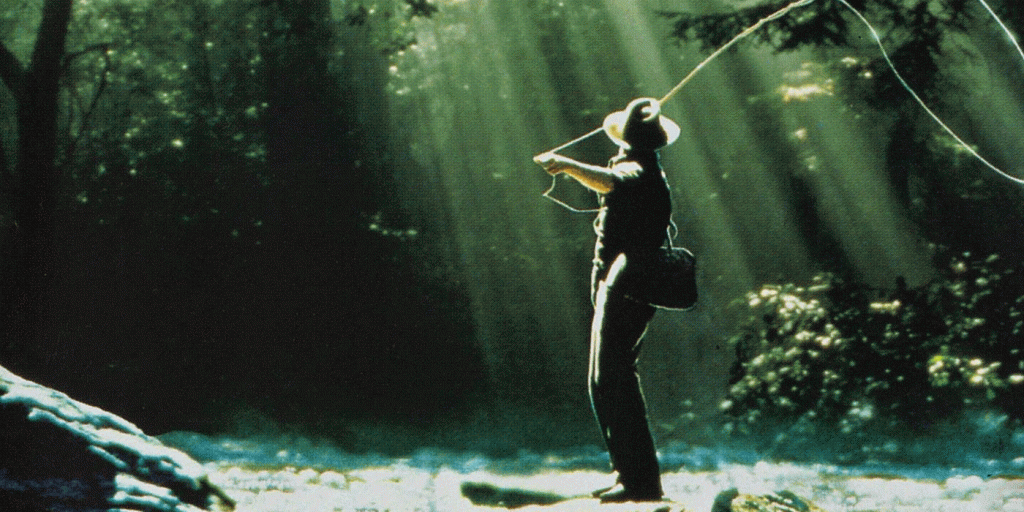
What I have been compelled to recognize recently is how a change in role, and perhaps in status, causes a difference not only in how I see myself, but in how I believe I am seen. Am I mistaken and it is all on me or is it a real thing? I know there are books on retirement; I know there are seminars, but I not sure one can take a class or prepare. And then there is the reality of solitude. As noted, I have grown not only to appreciate my singleness; at times I crave it. My tolerance for drama and for noise that is little more than noise has greatly diminished, and I find myself stepping away more willfully and intentionally. The struggle is learning what I can manage or more likely am willing to manage. I see an evolution in who I’ve become and that takes some learning and thought on my part. One of my favorite characters in any movie is Norman Thayer in the movie On Golden Pond. In fact, one of my former students, another for whom I officiated their wedding, calls me Norman from time to time. Is the curmudgeonly gene something which comes with aging? I have noted my father’s eldest brother-in-law from time to time. Clare Swaby, born in 1896 (yes, you read that correctly), was a widower the last three decades is his life. He was stubborn, opinionated, cursed like no other person I have ever met, dropped out of school in 5th grade, was a bugler in WWI, knew more about plants and animals than anyone I ever met, drove my mother crazy, was our weekly Sunday dinner guest, argued Chester Gould, the creator of the cartoon Dick Tracy, drank what he called “squirrel whiskey,” and had one of the most giving and generous natures of anyone I ever knew. I have felt more and more like him in my solitude, and even compared myself to him as the person now invited so I am not alone. What I have learned albeit slowly is to appreciate his complexity more and more.

What I am learning even now is that often what I misunderstood about people was their actions were often about boundaries. I have struggled to make boundaries with people throughout my life, too often because I did not want them angry with me. Too many times, I gave and gave at my own detriment, believing they would appreciate or understand my generosity. What I’ve learned, albeit too slowly, there are givers and there are takers. Generosity is not wrong; caring is not wrong; and being willing to go above and beyond is most often a positive attribute, but giving, caring, helping without boundaries is not positive because it is not healthy. Learning that the boundary is not static either in time or circumstance is complicated, but it is important. Making changes, even when it requires significant reconsideration, is not easy, but it might often be the healthiest thing to do. Perhaps the infamous New Year’s resolution arrived early. I often say I am a slow learner, but I do learn. In the past couple days, Facebook was inundated with memories of the passing of Dan Fogelberg. He was one of my favorite musicians. The video is one of my favorite songs.

Thanks for reading.

Michael

A Requiem

Hello on a cold December morning,

The weekend was a difficult one, both personally and societally. The country and the world is aghast at the loss of life from those who lost their loved ones or are praying for the recovery of others on an Ivy League campus or a country immediately responding to strengthen gun laws at the horrific killing of a number of people, targeted because of faith on Bondi Beach down under. Then on Sunday night America and beyond were stunned by the news that Rob and Michelle Reiner were found murdered in their house in the famous Brentwood area of Los Angeles. The number of things noted on Facebook or other social platforms is innumerable.

It reminds me of some almost 30 years ago when I was coming out of a church service in Mass City, Michigan, where I was just beginning what would be a lengthy supply position at three little parishes in the Upper Peninsula. We heard for the first time that the Princess of Wales, Diana Spencer, the former wife of the present King of England, had lost her life in a car accident. For the next week, the entire world became British, at least for a bit. as we watched, somewhat with a morbid sense of care for the loss of such a dynamic and notable human. The outpouring of global grief was unlike anything I had ever seen, nor have I witnessed anything like that since. I remember trying to prepare my sermon the next week, perhaps the third week I would be preaching at those three small, aging parishes, realizing something needed to be noted, but still wishing to speak to the texts and the needs of those people, a wish to be exegetically aware and appropriate. While looking back at the lectionary for that Sunday, which was a Labor Day weekend, what I remember was trying to address the proverbial “large item in the room” honestly, but I noted that there were also people who were not as well-known, people not making headlines, and loved ones of those lesser-known to the world, who also lost loved ones that week, who hurt and mourned as deeply. And the God who in the week’s lessons that noted our need for community in even difficult circumstances (the Gospel lesson of the day) cared as deeply about those as God cared for those loss of the Princess of Wales. I remember working with even more diligence than usual, wanting the sermon to resonate, and when a parishioner said to me at the end of the day. “We’re glad you are here; that was a great sermon. We were worried because you are a doctoral student you might be boring.” I knew the Holy Spirit was alive and well.

The world around us, even as we are shocked yet again by the scope of violence, continues to occur, but as much as focus is on Providence, Bondi Beach or Los Angeles, my heart is aching for the loss of one of the gentlest, strongest, and most caring of men I have ever met. A remarkable friend, someone I admire and love beyond words, and someone I did not get to see the last time I was in Menomonie because of his decline, passed away from his battle with cancer. It was a battle that he and his wife chronicled, both in their own incredible ways. It was a battle he faced with the same grace, thoughtfulness, and wonder as he seemed to do with everything. As I told one of them recently, together they created the most amazing couple I have ever met. I was blessed and honored to officiate their wedding about 15 years ago, and over the years their presence, friendship, and care meant more than I think they ever began to understand. The love I have for them as a couple out distanced the love I had for them individually, snd that says a lot because I loved them both deeply. I think that might be the most profound and precious thing I understood over these past years. I do not know of any other couple that affected me in such a manner.

Carl was an incredibly deep thinker, a pondering and observant person, a master with words, and unparalleled in his ability to create and build anything out of wood. In his quiet, but ever-present manner, he was always able to understand and manage any circumstance with a simple manner that comforted anyone around him; he and Amy were a match that was meant to be, something I believe to be divinely connected and that was and is something I believe deeply. While never one to make much noise, his Dutch Reformed pietism never left him, he was tall and slender, and his steady presence would bring a sense of calmness to any situation. I remember with great appreciation the last time he and I spoke by phone and we shared some of our common thoughts and experiences. I remember his gentle and always warm or affable way of sharing his thoughts and his love about people or life in general. Somehow he had two first names (Carl and Charles), and I referred to him as Charles. I am, to this day, not sure how that happened. From working on projects for the house to building things to support Amy’s work, from working in the garden to doing things that supported friends or Simon, Carl was always ready to make difference, and that difference was always profound in some way.

He epitomizes the life one would hope to lead. His ability to change the lives around him always for the better made (and will continue to make) him someone to admire and revere. The important liturgical verse “well done good and faithful servant” seems too little for such a profoundly good person. While the news of most places will be focused on others, Carl in your gentle manner you affected the world from the Western side of lower Michigan to all of Western Iowa, and from Menomonie to Bloomsburg. We mourn today your loss, and I will miss you beyond words.

Thank you always for reading.

Michael

Colorless Christianity

Hello from my small, but tranquil corner,

As I ponder the reality of Advent and its implications for faith, as I reflect on the spirit of Christmas, I like many want to focus on the simplicity of the season, even when everything around me seems anything but. The purely driven snow reminds me of the power of nature to cleanse the damage we do. The beauty, the texture, and the fragrance of a Christmas Evergreen can instantly return me to my childhood and the belief that there is goodness and charity in our world. The ornaments that remind us of earlier times, or the wrapping of homemade gifts or sweets transport me back to my grandmother’s bakery and the carols playing quietly in the background remind of candle light services, choirs, and small children standing in their bathrobes with towels on their heads to be a shepherd in the church Christmas program.

The spirit of love and kindness that is indicative of our Christmas memories is what we want to believe about Christianity, but it seems the Christianity we practice and have come to embrace is an elitist God-is-on-the-side-of-the-winners or those in power have God’s ear or an inside track to receiving God’s grace. Such an inclination is not only absurdly non-sensical; it is not scriptural. When we consider the actual person, for whom the clichéd “reason for the season” refers, Jesus of Nazareth; he was probably not more than 5’5” or 5’6”, with olive-brown skin and brown or black hair. He was Jewish and practice Jewish customs. As an itinerant craftsman, he was probably slight, lean, and strong. The reality of Jesus’s disciples is even more complex with some coming from Galilee and others from other Semitic backgrounds, but it is generally accepted that they were all practicing Jews. Certainly different ethnicities and cultures have attempted to lay claim on a Jesus that fits their own ethnography, but my research seems to support Jesus was probably closest to what today would be an Iraqi-Jewish person (Taylor 2018, 2019). And then there is our scriptural claims that we have the red-lettered words of Jesus. Again, when we consider the complexity of scripture, languages, and translation (as well as the fact that Jesus spoke Aramaic as his common language), the arrogance that many claim in their adherence to the King James Bible is quite pitiful.

If we focus on the greatest of the commandments, the importance of loving the other is unavoidable. It is simply and straight forward commanded of us. It is the basis of the Biblical message to all who claim to be Christian (it is a love that is all encompassing, a love that sees beyond color, beyond our definition of worth). It is an agentic love (and not in an AI sense of agentic). It is purposeful and autonomous, and yes, its goal is to achieve a peaceful, harmonious, and giving creation. It is a faith and love that requires profound movement away from our selfish needs. It is an unconditional practice in a conditional world. There is nothing easy about it. I struggle to be faithful, to turn the other cheek toward those who hurt me. Where is the line in being thoughtful and protective, while still giving at the same time? If our giving is out of obligation is it giving? If our love needs something in return, is it love? I want to be the person who is unconditional in his generosity, who is colorless in his acceptance, and whose life demonstrates a life of gratitude and giving, but so often I fall short. Even when I work diligently to give more than I take, I find myself struggling to be as philanthropic as I wish I could be. I have taken some time to reexamine the things provided us in the scripture, and while I know this is simplistic in its consideration, what struck me as I looked at the actions of this person, the one we refer to by names with profound implication, he focused on the other and how power and privilege often excluded them. The actions of Jesus, the person so many claim as salvific, as their personal savior, throw power and privilege out the window. So there is an incredible irony when people of privilege want to claim that Jesus is on their side, or they’re so blessed to have what they have. Before you think I am against success, that is not what I am saying. What astounds me is when so many feel their money equals entitlement at the expense of those less fortunate. I think the example of the Thomas family and St. Jude’s Children’s Hospital demonstrates what one might do with wealth and fame. What the hospital does for children throughout the world is remarkable. When people who have little still give then I believe we begin to see the gospel in its truest form.

Dietrich Bonhoeffer envisioned a church, a Christianity, he referred to as religionless. It was a church that spoke out against injustice, against inequity, and against the abuse of power that too often happens in the name of Jesus, or in supposed acts of faithfulness. Faith is most effective when it makes the life of the other more manageable, more hopeful. Our co-opting of Jesus for our own, often at the exclusion of the other, our use of pious language or dogma when it works to eliminate the other, our use of tradition or structure to create division among all people is not what an inclusive gospel proclaims. When we look carefully and intentionally at the life of Jesus, I believe most often we will find ourselves uncomfortable in our comfortability.

My reflection on the themes of Advent, of peace, of hope, of joy or love seem to call on us to awaken from our slumber, of our disillusioned believing we have a corner on the gospel, or that Jesus loves us more as shown by one’s wealth, privilege, or power. I am reminded of the final scene in the movie Schindler’s List. It is powerful when he realizes he could have saved more, he breaks down and weeps. Sharing the love and hope of Jesus and a Creator is not just something that happens in the four weeks of Advent or the 12 Days of Christmas. It is daily, and it is for all people. That is our calling. Blessings as you proceed through this sacred season.

Thanks as always for reading.

Michael

Real or Memorex

Hello on a Friday evening,

It’s a chilly December evening, typical of the penetrating Pennsylvania cold, which I always say is worse than Wisconsin cold. It’s been a longing couple weeks as I have battled a yearly cold, which kicked me more than usual. Fortunately, I am mostly beyond it, and recently noted I am somewhat settled into my little space. I have gotten a little more semblance of control over daily life, though there are a couple major pieces on the horizon. All the clichés about life are beyond me at this point; I don’t need to hear them I just need to manage each day, each moment, each situation to the best of my ability. I think that is where my learning is just part of my daily response to whatever comes my way. The difference ways that people respond to a given situation is always something that astounds me. I am one to step back and ponder or analyze, even when it causes me some emotional distress. Others respond instantly. The consequences, both long term or short, of waiting versus an immediate response can be extreme.

The reality of human interaction is simultaneously predictable and unpredictable. We all have our personalities, our propensities, and our preferences, but when you mix different personalities or experiences into a confined space, what happens can almost always leave us speechless. What is the catalyst? What is it that prompts some to desire, to initiate drama and some to abhor or avoid it? As I age, I see how my own life has transformed to become one who wishes for a sense of serenity. And yet, there are more times than not I am closer to the antithesis of peacefulness than I would ever hope. I need to ask the simple question: why or how does it occur? After some recent events, I need to be thoughtful and examine each circumstance, looking for common denominators. In each case, I believe there is a piece in each circumstance that works as a sort of ignitor. Certainly more could be examined or questioned, but there is a degree to which that is not necessary. The question is not why it happens, it is merely that it occurs on a somewhat regular basis.

The title of this post is a motto that was a common question in an advertisement generation or more ago. It was before the recording of things was digital. It is in the long ago time of taping things with devices that used tape (e.g. reel-to-reel, cassette, or other magnetic tapes). The idea was to get a recording that sounded so authentic that went it was played, you could not hear the difference. I remember people using those words in other situations when we questioned the authenticity of something or someone. It seems too often the present world creates an atmosphere that requires a certain sense of wondering this need again. We have created a technological reality the has a questioning of anything is real, or is it merely a creation?

Perception is a powerful, necessary, and dangerous thing. As I really remind people, perception is reality for someone until proven otherwise. And when people jump to conclusions based on emotion or perception the consequence is often less than stellar. Additionally, it causes damage and division that is not easily remedied. It creates mistrust and a lack of understanding because of fear. In the last few years, and even more so in our post-COVID world, the increased level or fear has resulted in anger and resentment, which in turn has fostered resistance and rejection. What is the answer? Whatever the answer, or if there is one, I do not believe any substantial movement toward a more accepting, sensitive, compassionate world will be difficult. How can we be authentic when we are enveloped in a world of mistrust, division, or the demonization of the other? If being real only creates vulnerability, perhaps the closest thing we will ever get is Memorex.

There is a profound cost in a world that makes being authentic so dangerous. I believe we see it in all sorts of ways. From transforming our physical selves to hiding behind our profiles; from believing that anything someone does always has an ulterior motive to mistrusting anyone’s good intentions; from believing that everything written or imaged has to be AI generated, have we come to the place where we can no longer believe anything is real?

My reality has evolved over the last 16 months. What I believe to be necessary or important continued to change. Plans, even the best intentions, have been intrinsically altered, creating both a sense of uncertainty and fearfulness. In spite of trying to organize as well as be flexible, the number of times requiring a Plan B, Plan C, or maybe a letter much further into the alphabet seems likely. My reality has been to expect the unexpected. Undoubtedly, retirement has been more than simply a new experience. From managing projects to understanding the intricacies of Medicare or Supplemental Insurance, from stepping much farther outside my comfort zone than expected to experiencing a significant change in identity, what is real seems to be a moving target.

So where does that leave me as I face the end of another calendar year? 2025, the year I have reached 70 had been one that defied all expectation. And, at least in the moment, I am unsure if I believe the cumulative result falls on the positive side of the ledger. From health issues, which have always been a major element, to feeling grounded; from a constantly changing game-plan to a seemingly out-of-control world, it might seem nothing is real, and I am not sure the taped version is any better. However, as noted in a couple of recent blogs, and as I have told some of my former students who are now parents with their own families. They give me hope. From a former student in Wisconsin, who in spite of significant changes in life is an incredible parent, the student who was in my class my first year at Stout or my first year here at Bloomsburg, both who are unbelievable moms, and have beautiful marriages, or a couple here in Bloomsburg who come from profoundly different cultures, but have established a beautiful family, I glimpse what is real and what is of importance. They bless me and provide that needed sense of hope. It is those things; it is those people I need to hold on to if I am expecting our world to survive. They allow me to dream for a reality that is beneficial to all and not merely those with an unlimited income or unfettered power. And yet, it is only when we surround ourselves with a positive reality we can live authentically.

In this season of hope, peace, and love, I wish you a sense of comfort and a place where you feel that you can be real. I wonder what Mary must have thought at the annunciation? Could it be real? Could there be such miracles in her world? This song always forces me to imagine beyond what we can know or understand.

Thank you as always for reading.

Michael

Memories of Love

Hello from my new space,

It’s been a good day and a half, and a great deal has been accomplished. Since returning from the Thanksgiving trip to Iowa, I have worked to recover from a serious cold, and packed in the various remedies, including homemade Chicken Noodle soup. I still have a cough, though productive, but I think I am almost beyond it. It’s amazing to me how dependent I am on space for a sense of wellbeing. I do not need a lot of space, but I need organization and structure to manage any sense of security, any feeling of comfort. While this is something of which I have been well aware, it appears that this requirement for my psychological homeostasis is even more profound as I age. It is sort of a full-circle thing, so so it seems.

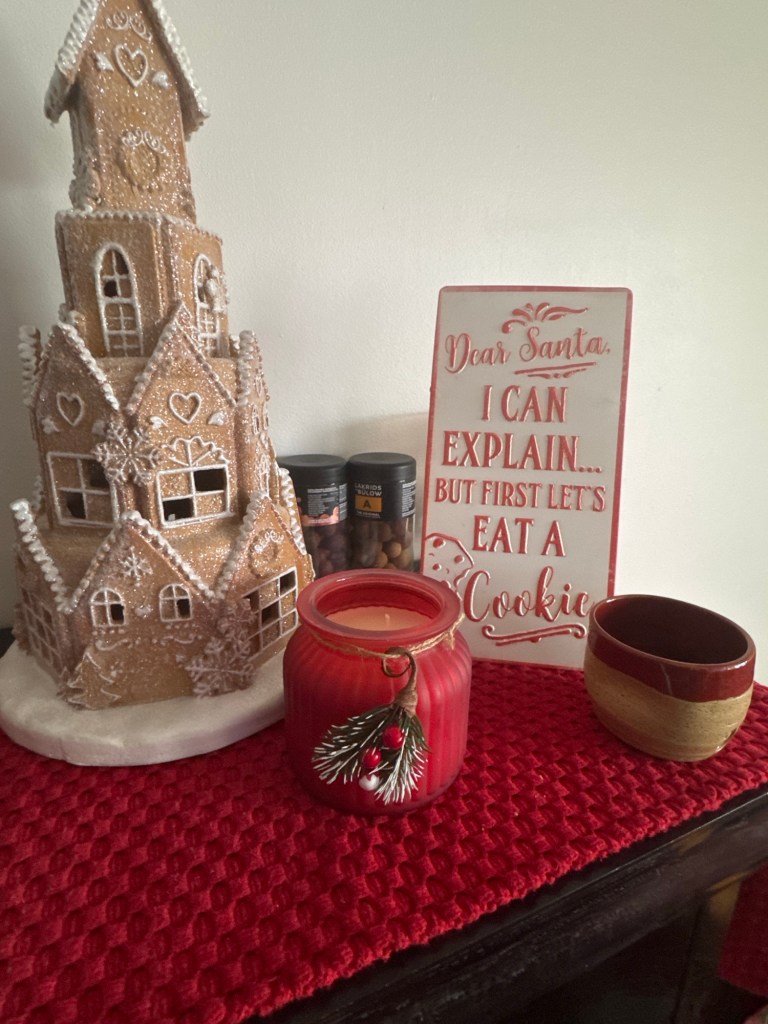
As I move into my little space, and I am grateful to more than one for this, the first thing I needed to do it make it feel welcoming. And those who have spent any time in my first little apartment, the Acre, or even the mini-Acre know well, this time of year, the need for some recognition of the Christmas season is who I am all about. Anastasiia, the young person I refer to as my first exchange student calls me Santa, and I believe that is her moniker for me in her phone. What is it about Christmas that changes people, even if it is only briefly? From where and when did the sense of giving (and as difficult as it might be to ignore the commercialization of the birth of a Savior – for those who wish to focus there, and for that I have significant appreciation) originate? From where did the most endearing things that create memories find their beginnings? Much like our language, which we have borrowed from most everywhere, our Christmas traditions are a hodgepodge of acquisition. Yesterday, when speaking with the owner of a local business, one who has a European heritage (and recent), we shared those memories of the holiday season that are most memorable, most important to our emotional understanding of Christmas. For her it was baking with her mother and sisters, it was the carolers who strolled their neighborhoods, and later her own caroling for others. As such as what she shared, it was the look on her face and the tone of her voice as she reminisced on that earlier time of her life.

When I think back to the holidays, spending time at my Grandmother Louise’s house is where it all begins. Her house, as recently noted, was the last house at the end of 46th and Harrison in the small suburb of Leeds, located on the northern boundaries of Sioux City. I believe there was about 3 or 4 acres of land, with two significant hills on the acreage. Her house was simple, and a detached garage at the end of the property had been a house barn at some point. I wish I had pictures of it. Again, she was adamant that Christmas be celebrated at her house, and her elder sister would come down from South Dakota a couple days in advance to help with the cooking, (and I imagine the decorating). The Christmas dinner was traditional, but the rolls, breads, and pies that were available were unparalleled because she owned a bakery. When we arrived, usually late morning, presents in tow, as we entered the house and into the large country kitchen, my glasses would invariably steam up from the heat of the ovens, and the warmth in the house. Yet, that warmth was nothing in comparison to the welcoming joy that met us as we stepped into the house that had been my home from ages 2 to 5. Indeed, it was always coming home (as I sit and write, I am listening to Brahm’s Ein deutsches Requiem auf Deutsch). We would take our wrapped presents past through the dining room where the table was impeccably set, the buffet covered with nuts, candies, relish plates, cheeses, all spread out on the Doillied runner that covered her beautiful dining set (matching table and china hutch also adorned the beautiful sun-lit dining space). We would enter the long parlor like living room, with the beautifully lit tree adorning the one end. The number of presents surrounding the tree, beautifully wrapped, and taking up every available space was always stunning to me. We added our offering to what was already there, and then we would return to the car to get our instruments (more to come on that).

The same people would always be there, Grandma, Great-aunt Helen and her husband, Melvin, Cousin Martha and her sister, Edith, Martha’s daughter, Pat, Great-aunt Martha, who the night before might have served Lutefisk, oyster stew, red cabbage, lefse, and other Norwegian baked goods, and Uncle Clare. My brother, Bob, my sister, Kris, and I were generally the only children. Remembering each of them reminds me of the profound Norwegian heritage of the Martin/Hannestad family. Once dinner was served, it seemed the items passed never stopped or slowed down. Both my grandmother and her sister were accomplished cooks, and having grown up both on a farm and becoming adults during the depression, they were masters at making everything delectable. I think of the line from Dicken’s A Christmas Carol, my grandmother and her sister were the “founders of the feast,” and a feast it was. Every protein and side was perfectly prepared and the accompaniments, from rolls, breads, jams, or relishes created an inquisitive culinary, and yet home-cooked yet lavish Christmas meal.

While the pies and treats that followed were beyond anything imaginable, we would sometimes wait, allowing for some digestion. Following the cleaning of the table, we three kids would prepare to led the company in the singing or Christmas carols. My brother on trombone and me on trumpet (cornet actually), could play two parts, and my sister, Kris would serve as choirmaster. While I was not always excited about practicing before this all happened, it seems everyone grew to look forward to this part of our Christmas celebration. Looking back, I think it was important for my mother to feel she had given something to the day, even if it was the three of us doing it. Nevertheless, the singing of carols before the opening of presents became an important part of Christmas and something I appreciate so much more now.

Certainly, the effort my grandmother put into every aspect of Christmas was about her wanting to give us life-long memories, which this blog shows she was successful, and over the years, there are presents that stand out (e.g, my first cassette/player recorder and radio, sweater that I kept for many years after her passing, a book on Sioux City history she signed, which I still have), but a family gift of a wooden toboggan is still one of my favorites. It provides hours of sledding for family and friends. My older brother, who was incredible model car builder, and meticulous, would take Johnson’s Paste Wax and seal and buff the bottom yearly, so it glistened, and it was velocious; nothing could be it down a hill. And yet again, it was not the presents, it was everything she did not make it all happen. Much like my friend here in her bakery, the weeks before Christmas had to be unparalleled in the time demanded, the countless hours needed, and most of them on her feet. Her delivery schedule did not slow down and the quantities of grocery deliveries certainly increased as holiday demands for special breads, pies, confections, and cookies also spiraled up. And she was often at work from before 7:00 a.m. and did not get home until perhaps 8:00 p.m.. so preparing the home, shopping, wrapping presents, and turning Christmas into the fairytale that greeted us was on top of that. It was the way she pulled out all stops in every way imaginable that now shows through; Christmas the unmitigated time we seem to show love and kindness for others, was my Grandmother’s holiday. It was when the way she lived life in general found new heights. Yet, it was not only for her grandchildren, she would go above and beyond for her loyal workers. The ladies in the bread room, her delivery drivers, the bakers and pastry people, her front store workers, one of whom I have been blessed to somewhat reacquaint with decades later, each of them knew of her goodness and gratitude. As I have noted over the years in this forum, Louise, my grandmother, was the epitome of elegance and beauty. This showed in so many ways, but particularly in her Eastern Star events. She was the embodiment of style and grace toward those she encountered, regardless of when or where; and she was, is, and always will be the paragon of love for her grandchildren. She lived Christmas for sure, but not only then, but always.

I wish for each of you an opportunity to create new and lasting memories this blessed season. I wish for all who read you can find peace and forgiveness that is really what the incarnation offers. Thank you, Grandma, for the memories and for teaching me about love.

As always thank you for reading.

Michael

Imagining a Permanent Advent

Hello from the couch,

I am back in Bloomsburg, and along with visiting relatives back in the Midwest, I got one piece of the nomadic past year back in my semi-permanent space. I think the next piece will be to load up bus components in Tennessee and get them back here also. I also managed to find a cold and bring it back with me; it is the complete full-Monty, though not desired. I have fought a fever, now have the sore throat, stuffed head, watery eyes, and my voice has found an octave that might rival a 88 key keyboard. A shopping trip yesterday meant the purchase of cold necessities, and when I got home I made Chicken Noodle soup, that I roasted a chicken and shredded as well as made stock to base it. It turned out quite edible. While I did sleep a tad better last night than the night before, coughing and sweating does not support a restful night. So I am listening to Celtic Woman Christmas music and lying in the couch at the moment. A hot shower and washing my hair did some to make me feel human.

As intimated in my blogs, especially over the last two months, retirement has thrown some unexpected curveballs and sliders. The infamous cliché of hindsight is alive, present, and well, staring at me around every corner and visible on each precipice I seem to encounter. While I have been working to recalibrate my life a bit, the bus project is still viable, but on a new timeline. Health issues, beyond the present cold, need to be attended to before I can reasonably leave Bloomsburg again. This necessitates finding something more permanent for a home. While I have been working on that, I am still waiting to sign a lease for the next year. Heading into the winter months will affect the process of getting things back, but it is something to get organized sooner rather than later. Getting a plan in place will be an important element for me.

As I lay here listening to one of my favorite groups singing Christmas, for the first time since coming to Bloomsburg some decade and a half ago, I have no space to decorate, and it saddens me. Any of you who have followed me for some time know I love the holiday spirit and transforming my space into a fairytale of sorts. I do not really know where it started. While I remember the front room Christmas tree at my grandmother’s home, there were not a lot of other decorations and nothing outside the house. My mother did some decorating, but there was not a theme of any kind. I am not trying to be unfair, but that was not her strength. Reflecting on my desire to create a space that reflects both the memories and beauty of the season, I believe I desired to transform a person’s perspective, even for a bit, to embrace the hope and peace that form the basis for Advent. The idea of a peaceful snow covered village that shows the pureness of the heart we are born with, to decorate a tree with lights and ornaments that evoke the reality of everlasting life in the perpetual green or the memory-giving fragrance of the pine, I collected snow people and Santa Claus figures that reminded me of childhood and the resilient hope that the goodness of those play times.

The themes of Advent are hope, peace, love, and joy. Certainly without hope, life cannot be lived to its fullest. Without love, there is seldom peace or joy. Loving the other is never simple nor is it without risk. I have been reminded regularly, and recently focused on what it means to love, what true love requires? To love another is both profound and dangerous. It is so much more than the passing of infatuation, being enamored with someone’s intelligence or beauty, and it’s amazing how many people believe a mere comment or even a glance that appreciates the gifts of the other means something more. Even honesty about one’s feeling or thoughts can be misinterpreted in a space that seems safe. This is a lesson I am still learning, and it is painful. . I think the reason for this is more than enculturation. I think it is an ethical issue. The belief that we are all teleologists is inaccurate. There are some deontologists, but that is not common. However humanity in general seems to practice life contrary to the idea of love, which truly believes first in goodness, which is the primary message of Advent, is impossible. Can we prepare our hearts to acknowledge or accept such a profound love? With a belief that everything is conditional, the answer is simply “no.” We cannot fathom that there is such an unconditional possibility for us. But what is we merely did our best to try? I want with all my heart to believe in the promise of Advent; in the reality of an eternal unconditional love that establishes a foundational care for not only what what we might become, but what we could achieve.

In a mere four weeks, less than 8% of the calendar year, Advent calls us to believe in the eternal love of a creator, one who would give in a manner incomprehensible, to reveal a compassion and connection to creation and creature unimaginable. I realize for some this seems idealistic, and this realization, for me, comes from something more than a MDiv; it takes me beyond growing up in church or going to a Lutheran Liberal Arts College. It pushes me beyond serving as a parish pastor or being a campus pastor. While all of those things inform or influence, it comes from my struggle to be faithful, and it wells up from the painful experiences I see or feel among those I encounter daily. I wish for something better; I want to believe that something is possible and realistic. If there is a time in the year we can feel the incredible love of a Creator, Advent is the perfect time to experience it.

While I am certainly missing the going to get a tree with my friends this year; while I am still waiting to move into my own space, and though it be perhaps the smallest space I have had since moving to Bloomsburg, I am very excited to be there, and finally, in spite of the post-retirement struggles to acclimate to a new reality, the consistency of the liturgical calendar is comforting. As we are a week into this sacred season, as we move toward the shortest day of the year, it is time to recommit to a life that is based in loving and giving versus focusing on what has been less than positive. It is time to believe that love can and will create a world that will move toward caring for the other versus maligning them, speaking with them versus about them. We see so much of this at all levels, individually and societally. I hope for a world where peace and honesty, love and kindness result in a joy that is immeasurable.

Blessed Advent, peace, love, and joy be to all. Thanks as always for reading.

Michael

The Consequence of Location

Hello from yet another coffee shop, now in Marathon WI,

I was back in Iowa for the Thanksgiving holiday, though at the other side of our state. While it is a growing metropolis of sorts (pushing 400,000), it is still Iowa. Between there and Iowa City, the home of the University of Iowa, there are some small towns, but many of them are now bedroom communities. Much different than when I grew up in Northwest Iowa 50 to 60 years ago. When I grew up, Sioux City was the third largest city in the state. Even though it has lost population, perhaps more than 20,000, it is still the fourth most populous city. Sitting at the confluence of the Big Sioux, the Floyd, and the Missouri Rivers, it was a meat packing town with the third largest stockyards, in terms of area, but the largest in terms of receipts, in the country. It was once referred to as Little Chicago. It was actually the perfect size town to grow up in the 1960s.

When I first arrived in Sioux City, as someone barely two, I lived in Leeds, a small blue-collar area on the north border of the city; when I was adopted, shortly before I turned five I moved from Leeds to Riverside. It was another very blue-collar area of the city, and some in the town referred to those of us who lived there as river-rats, a pretty disparaging moniker. What I know now is that the people in my neighborhood worked hard, stood up for each other, watched out for each other, and everyone had numerous friends on their block. We had numerous parents who as watched out for us, and yes, when the proverbial street lights came on, you knew it was time to go home. Riding bikes, playing in our yard, which was a sort of neighborhood playground, were common everyday events. As I look back with a certain degree of openness, what I realize is my parents worked very intentionally to give our friends a place to be. As I grew up, again unrealized, I could walk to school until my senior year, when we got new high schools, in under 10 minutes; most everything I needed from a grocery store, a pharmacy, a clothing store, or fast food (which was a treat upon occasion), was in our neighborhood. You knew who lived next door, and even their parents’ first names, though we were not allowed to use them, as well as pretty much everyone who lived within a two block area.

If I had misbehaved somewhere, my mother generally knew about it before I got home. I remember my first address and phone number, which only had 5 digits (33205), and I can still tell you the names of all the people who lived within a few houses of us. Hattie made the most incredible chocolate chip (with chunk chocolate) cookies. The Browns, down the alley on the corner, had a children whose names worked their way through the alphabet. The Lynch family next door had a gorgeous flower garden, with a row of irises, that served as a boundary for our side-yard football field. The Wards behind us had people who were the same age, and the amount of time we spent playing was significant. Across the alley, on the other side of our house were the Lund girls. They were all older than I was, and so while we spent time playing or our parents watching out the other family’s children. The youngest, referred to now as my”Sandbox Buddy” is actually my closest remaining friend from our neighborhood playmates. What is interesting about that transformation was in high school we did not hang out because I was three years younger. She was someone I admired from afar because I was too much younger. It was not until I was in my 20s and into my 30s that our friendship blossomed into something so treasured. She is so incredibly intelligent and insightful. Our mutual interest in history was a surprise, but something I so appreciate.

What reminiscing and reflecting upon our neighborhood, which has disappeared, was how connected we were to each other. I remember as a 7th or 8th grader attempting to shoplift some candy to give to a girl I had a crush on. The salesclerk was one of the mothers on the block. I was not a successful thief (my face probably telegraphed my stupidity). She told me to put it back and no not ever do it again. I was profoundly embarrassed, but more than that, I was petrified she would tell my mother. That consequence would be extremely painful. The salesclerk was so kind when she pulled me aside, warned me to never do that again, and told me she would not tell my mother. She saved me from a serious beating. I cried as I explained why I did something so stupid, and she told me that stealing to impress a girl was not a good plan. What is significant in my little story it the clerk knew me and realized if she made me accountable on her terms I would learn a lot. I can say I never tried to shoplift again. What age has revealed to me is how many people did so much behind the scenes for all of us. Long before Hilary Clinton spoke about a village, we grew up in it; it was our life, our experience. We had more parents than we realized. No one had to feel alone or unprotected. The safety net around each of us was broad, and it was strong. While it was something seldom intentionally pondered, it was intuitively known. That crested safety in a way that could not, and now cannot, be quantified.

The picture of the house above is the house my family moved into in 1965. The previous three years, my father worked out of town (over 450 miles and almost 8 hours), and he worked 7 days a week and 12 hours away. I do not think it was until recently I realized he did that to save money to buy this house, one that gave each of us our own room. While the move was less than 1/2 block, it changed our lives substantially. This is what people did. They worked hard in our neighborhood; seldom did they complain or did they try to compare themselves to the people around them. They merely did what they believed necessary to make things work.

The only thing I wish is that perhaps they would have shared with us, even later in life, some of the lessons they learned. Their discipline, their foresight, their willingness to go without themselves were things I never realized until much later. I wish they might have taught me budgeting, spoken to me about the differences between wants and needs. As I look back in this season of Advent, in this season of giving, in this season of preparation and promise, I am still learning how fortunate I was to grow up on the corner of Boies and LaPlante. The first album I ever purchased was Jethro Tull Aqualung. Of course, some of the lyrics did not please my mother. Imagine that?? I remember buying it at Uncle John’s, which also did not please my parents. Oh those were the days.

To all my childhood friends who might read. I hope the memories are good ones, and as always, thanks for reading.

Michael

Wishing or Needing?

Hello from Millworks Coffee Shop,

I am in the Quad Cities on the Iowa/Illinois border both to visit family for Thanksgiving as well as complete a major piece of collecting and managing what has been a fragmented first year of retirement. A moment in a coffee shop brings back so many memories from writing a dissertation in Stillwater, MN or Eau Claire, WI; from meeting students for office hours in the Andruss Library to collecting demitasse cups throughout Europe. I cannot even estimate how much money I have spent over the years or decades. Starbucks has been a place students would become surrogate sons or daughters from those office hours, and now I have officiated weddings for them. I have seemed to accumulate quite a family over the past 15 years (and actually more than that). Much of my existence, regardless the location or specific place of business, there is seldom a time it is not related to a student experience or the specific person.

What does it mean to be a student? This easy to say they are learners; they are often in classrooms; they are in an intentional situations. I can look back at my own classrooms at Riverview Elementary School, be it in Mrs. (as referred to then) Yeaman’s third grade class or Mrs. Hagen’s 5th grade class, the picture of George Washington and Abraham Lincoln on each side of the clock that was above the blackboard, the desks, which had opening tops, in straight lines, and the teacher’s deck in the middle front of the room. The enormous windows in each room and the hanging fluorescent lights in long rows. Perhaps there was a fish tank or some other terrarium along the shelves at the back of the room. Each room and the hallways might have two colors of industrialized paint, but there was little chance for anything outlandish. And we had our assigned seats, and we hoped and prayed we sat by someone we liked. The move to junior high was something different for me as I attended a Jr/Sr high school that had 7-12 grades in the same building. That is an incredible disparity in terms of age, maturity, and size, and being one of the smallest set me up for some significant teasing. Seventh graders were initiated, much like freshmen in college, and I somehow got initiated for three years instead of one. I did not weight 100 pounds until late in my 11th grade year. And yet, for the most part I remember student life with a fondness, not because I was an outstanding student, but rather because I found learning enjoyable and being around other people was generally a positive experience.

I do not believe I have ever reached my potential as a student. Perhaps a shocking statement for someone who has been in higher education and a student the great majority of his life. And yet, as I spoke with someone I admire a lot, they noted we are always a student, we are always learning. I told someone this week, someone I have know from when I was first a tenure-track professor, I evolved, becoming so much better at how I conducted, managed, and/or engaged with my classes or students now than I was when I first arrived in Menomonie. And again, a student I had that first year in Wisconsin told me if it weren’t for me, they would not have ever graduated. They have a Masters I believe, and they are an astounding parent. Much of my being a student these last years was in being willing to learn how to be more effective and efficient in what I did to prepare my students for life beyond my classroom. I remember when I came to Bloomsburg I spoke with my colleagues about the importance of integrating technology and writing. My work with the renowned Drs. Cynthia Selfe and the late Gail Hawisher were significant, but understanding composition theory and learning from the brilliance of Drs. Elizabeth Flynn, Diana George, or Marilyn Cooper as well as realizing the complexity of rhetorical theory and communication from the unparalleled intelligence of Dr. Patricia Sotirin or Dale Sullivan, the appreciation for language from another profound scholar in Dr. Victoria Bergvall still resonate in all I do. I am still realizing how I sat in the presence of incredible brilliance. And yet they were normal people who gave to their students selflessly.

Wishing for something versus needing, it is an interesting dichotomy. I believe that most healthy humans wish to make a difference. I believe it is fundamental to who we are that we hope and wish that what we do somehow makes a difference, has a positive consequence for the other. It is something quite different to need that, and yet, I believe that there is at least some degree of that also for us. Wishing points outward, I believe, whereas needing points inward. Too often, if we think of the inward direction, we automatically have been conditioned to believe it is selfish. Whereas wishing, if I’m correct, is an outward direction, we’ve been conditioned to believe that is generosity. The tug-of-war, the pushing and pulling in the opposite direction, often cause us to question what is appropriate? Is it possible to be both generous and self-serving simultaneously? Are the two things diametrically opposed? I’m reminded of the admonishment I received from my cousin, Jim, at a particularly difficult time in my life. We were standing face-to-face in their kitchen, and gently placing his hands on my shoulders, he looked me straight in the eyes. He said, quite emphatically, “You need to learn to think about Michael first. If you do not take care of you, no one will.” It was as much the tone in his voice, as what he said. His tone was both strict and imploring. He knew me well. I struggled to set boundaries often at my own expense. It is a difficult thing to ask for what we need, particularly when we’ve been taught there is a price for everything.

When is wishing merely idealism versus a reasonable expectation? I am not sure I have that figured out yet. As I have watched my life unfold this past year, there have been more lessons than I have fingers and toes. Maybe even more than both you, the reader, and I have cumulatively. I think to some degree unexpected lessons are almost always painful to some extent. Yet, at the same time, they offer possibility, an occasion, for learning and growth. I’m back to being a student, to being a learner. There are the small daily lessons, which I happen in our routine life. Sometimes they are overlooked. Then there are the other lessons that seem more paramount because they so influence our process, our understanding of our world, and how we understand ourselves, our abilities or limitations.

I was blessed to spend time with my great-niece, Rachael, as well as her mother, my niece, Jennifer today. Rachael is a Doctor of Chiropractic, but as important as her professional acumen is the amazing young woman she is. Our trip to the coffee shop this morning was beyond enjoyable. She is intuitive, thoughtful, and demonstrates a profound goodness. In her late 20s now, she has become such a complete wonderful person. She and her mother are really so similar. Jennifer, the second eldest of my nieces and nephews, is also incredibly thoughtful, intuitive, and personable. She never stops amazing me by her skills. She can cut your hair, side your house or drywall your kitchen; she can also help you with computer programming or figure out supply chain needs. And all those things are literal. They are both precisely what you hope and wish for your next generations.

Spending time this holiday season with family is something I both wish for and need. I love seeing how my family has grown and become such wonderful people, but it is also something I need. I think this is even more the case as I have aged. Holidays are a combination of wishing and needing for me. It is always wished that the connections and love of family might be deepened. It is something needed by me to add memories, creating a greater understanding of family. Tonight I had a great conversation with Jennifer and John. Tomorrow is Thanksgiving and another opportunity for memories. I wish each of you and you both wish and need this holiday season.

Thanks for reading, and blessed Thanksgiving to each of you.

Michael

Life in Every Breath

Hello at the end of the week,

It is difficult to believe we are almost into the year holiday season. This coming week I will fly back to Iowa to spend Thanksgiving with family. Certainly, holidays are a different time for each of us; they bring back memories, which for some are blessed and bring back the important moments of those we have loved and lost, bittersweet of sorts. For some, those memories are painful because of the inevitable changes that occur as we age. The idea of thanksgiving is so much more than those grade school programs where we did our best to address the idea of harmony in our costumes that we had often created out of colored construction paper, presenting to our parents and grandparents as they sat on the hard benches in our school auditorium. As we grow we learn how complex the idea of thankfulness really is. What does it mean to really be grateful for what we have, for what we have experienced, or even the reality that we are still here for yet another holiday season? The reality of life becomes painfully apparent for many when they move toward this season and someone deeply loved is no longer present. I think of my former colleague who recently lost his wife, and childhood sweetheart after 69 years. In spite of her passing probably being a blessing, the lost is unparalleled. What makes a life fulfilling? That is something I have pondered as of late. What is it that offers a sense of contentment, a feeling of accomplishment, not in an arrogant manner, but rather feeling it’s been worth it?

What I have realized, particularly in the last year, is the degree to which we need validation, but too often that validation comes from others. How it is a person might find that sense of completion at every turn, even when the outcome is less than hoped for? I think it has to do with a sense of faithfulness, believing that everything we have offers opportunity and blessing. One of the things I find intriguing is how faithfulness allows for a sense of serenity, a feeling of direction and purpose even in the midst of the most trying of times. The Japanese practice of Bushido, the living code of the feudal lords of the Samurai that focused on loyalty and honor, of discipline and fear of nothing, save defeat, is both something that real and mythical, but I believe there is something to appreciate in its code. The movie, The Last Samurai, is probably by favorite Tom Cruise movie, even more than either his MI movies or Top Gun. When his character, Captain Algren, meets in the garden and Katsumoto notes, while searching for the perfect blossom, the importance of “life in every breath.” Each time I have watched the movie, I find myself drawn to this statement. I see a parallel between what was happening in Japan in the 1870s (what was referred to as a struggle for the soul of Japan in the move toward modernity), and what I see happening in our country at the moment, but that is for another time. The idea of seeing my life in every breath compels me to consider my own path, my own commitment to life as something more than merely going through the motions. As we find our daily life being pulled toward a word of technology that offers instant answers, as we find a world that seems to have lost its moral compass, as it appears the reality of care for the other is something of the past, I find myself struggling to find my own path forward. Where to I belong or in what can I find a place to believe? If I simplify to the idea of every breath matters, that it is a gift as foundational and profound as life itself, perhaps it is there I might find hope in this world that seems more crazy than planned.

I am not sure if it is age, if it is retirement, if it is the profound change that retirement has created, but I find that I take nothing for granted at the moment. There are no guarantees of anything (in spite of the death and taxes cliché – not even understanding the taxes and how it all changes) except that I will die at some point. That is not being morbid, again, but rather merely reality. I remember the first time I worried about mortality. It was when I was in Lehighton, and I was flying to Arizona for a specialized and complex surgery (it was actually two surgeries over a three month period). My Crohn’s was so active that I had no quality of life, and I was in my 30s. I remember planning my funeral service. I still think of some of the music that I chose, and I would still choose. Will life be something that was a quest (considering the well-known song from the movie, Man of La Mancha, which ironically opened on Broadway 60 years ago yesterday), and if so what makes it so? I think too often we worry about what will happen versus what is happening. This is not to say planning or imagining is inappropriate, but rather living in the moment and cherishing what we have in that moment seems more relevant to me at this point. We are foolish to believe there is something more that we have some sense of control over. How do we appreciate the moment? It is possible to live in the present and imagine the future simultaneously? I think this is where I am presently wrestling. I spent so much of my time living in the present semester during the past three years, concomitantly planning for what was to come. It was the reason for the teaching year round, taking overloads. And to be sure, it did some of the things I hoped, but was I read for the other side of August 2024? In spite of all that planning and imagining, I was not ready. Before you think I am detesting retirement, I am not, but there are so many aspects of it that have surprised me.

Possibly there is no adequate preparation for life after routine; is it conceivable that what our job/vocation was becomes so much of our identity. I think that is certainly the case for me. I am reminded of it daily when people refer to me as Dr. Martin. Surely, I have earned that title, and I lived a significant portion of my life being that professor, and just this past week, an unexpected crossing of paths, offered the opportunity to speak with a former student. His words were both appreciated and gratifying when he noted two different assignments were important to him even now. What I realize is much of my life as a professor was living in the moment. It was being there in the moments for my students; it was realizing that what I did could make a difference for those in my classroom. By the time I retired, I had learned how to work together with my students in a way that demonstrated they mattered. They were the reason I was there. Every moment had meaning; it had (and always has) the potential to make a difference. This is the daily philosophy I used in my teaching. Again, to be fair, that is something I evolved into. I did not always see or manage that early in my career. There is learning that occurs on both sides of that blank stare, that is for sure. I have often said, I should probably go back to those students in my first couple years and apologize, though even then, I know there are some with whom I succeeded.

Someone asked me recently if I was afraid of dying, and I easily answered no. I added, I am much more afraid of hurting, being in pain, for dying slowly as a burden. The actual reality of no longer being in the world is not something I fret over. I see life as a gift certainly, but I see death as a normal part of the process. I remember as we move into Thanksgiving week, it was the day after Thanksgiving that my father received a diagnosis of multiple cancers in his body. He died only three days after Christmas. It was swift, and while not painless, there was no sort of lingering waiting for the inevitable. There is something kind in all of that. I remember my sister calling to tell me she believed she should take him to the hospital that Saturday afternoon because of the intensity of his pain. I told her to do what she believed best. He died less than 24 hours later on that early Sunday morning. I was heading out the door to travel and preach at a three-point parish. I held it together pretty well, until the prayers. Then I broke down and began to cry. This morning, I spoke with one of the morning group. He recently lost his wife, and he noted that he was working on something around the house the other day and just broke down. First, I told him it was good to do so, and then I thought about this blog. That is living in the moment and realizing the frailty of life. It is living in the moment: life in every breath. We have an incredible gift daily, hourly, even to the second, but we take so much for granted. I am no different. How can I live in a way that demonstrates that gratitude for the life I have been blessed to have. In this time of Thanksgiving, it seems I can dedicate myself to the love of the other, realizing that in every breath I have an opportunity to make a difference, if I only take the time to consider it. What wondrous love we have been given and need simultaneously to give. It is one of the songs I want song at my funeral. It is a reminder that we were created in love, we have been nourished by love, and it is in loving that we are allowed to live a life in every breath to its fullest.

Blessed Thanksgiving to you all, and thank you for reading.

Michael
Why am I Fascinated?

Hello from Main Street,

I am back in the only official town in the Commonwealth of Pennsylvania, the place where I first moved in the late summer of 2009. It is a typical Main Street of small town Americana, and like many small towns, it has experienced the growing pains of a changing culture, the location of huge box stores taking up what were once fields, the changing realty of once thriving factories that are now memories of the elderly, and the reality that technology and online shopping are the preference of Millennials or Gen Z-ers. As I listen to the morning breakfast crew and ponder their reminiscences, as I read the ever-increasing impulsiveness or internally-contradictory behavior of American daily life, I wonder why I am so fascinated by politics, even now in our present state. I do believe there is an irony that I am so geographically close to Philadelphia and Gettysburg, two significant places in the reality of American democracy.

As recently noted, I remember the first televised Presidential Debate between Senator John F. Kennedy and Vice President Richard M. Nixon before the November 1960 election. I was barely 5 years old (by 10 days), but somehow I was fascinated. I remember my parents (who were Democrats) musing about the fact that Senator Kennedy was a Roman Catholic, and questioning if they should become a concern. Somehow, I realized the significance of that question. What I know now, over six decades later that somehow I was enthralled (not a word in my vocabulary as a 5 year old), I was captivated, mesmerized, by the process of politics.

My parents like many of that “greatest generation” took their voting privileges seriously, and I do not believe they ever missed an election, including off-years. In fact, I remember on one particular election where the weather was prohibitive, I drove my father to his polling place. At the time I had a 1972 Chevelle with a 454, loud exhaust and a louder stereo (an 8-track). He lamented on the drive over, “I am not sure what is worse, the mufflers or the music.” Regardless the “Uber” of the time, he was going to vote. I believe that election would have been 1976, and of course, America had experienced the resignation of both a Vice President and a President during the previous four years. President Ford had become the only person to serve both offices and never be elected to either. One of the anomalies and miracles of our political system. Again, a reason for fascination. Some almost 50 years later, our experiment in democracy is still here, and depending on to who you speak, the current “State of our Union” is a topic of intense discussion. And yet, when I was in Europe last summer, my exchange student’s father saw our current atmosphere as still something to be admired. I remember listening with captive interest at the perspective of this Danish national, a third generation attorney.

What I realized in his insightful comments was how another country perceived the profound intricacies of our checks and balances, of our regularly scheduled elections, of the way we decide the direction of our country. Certainly, these things are noted in a rather broad-stroke brush manner, but it is still foundationally part of what the writers of the Constitution intended. When I was in the Marine Corps, I remember standing guard duty at a secured area. A LCDR, without the need-to-know, attempted to walk through that area. I was an E-4 at the time, so a low grade Noncommissioned Officer. When I informed him that I would not allow him access the area, he became incensed. I was frightened, but I respectfully held my ground. I calmly repeated my refusal, while on the inside I was shaking. When he attempted to move forward I stood in his way and informed him that I would lock and load my weapon. I actually implored him to not push things to that point. Again, to be honest, I was petrified. Long-story-short, I did not get in trouble for doing my duty, and, in fact, was commended for my handling of the situation. I suspect it did not go as well for the LCDR.

One of the amazingly genius things about our country is its Constitution and that every federal employee, service person, or elected official takes an oath of allegiance to that document, to that ideal of democracy. Certainly there have been profound struggles to maintain that Republic as Benjamin Franklin anticipated there would be. Certainly, we have been pulled in opposite directions from time to time, be it because of slavery and the subsequent discrimination of others. We have from the beginning tried to find a balance between States’ Rights vs. Federalism, and we still do not have it figured out. We seldom agree with the role nor do we have a consensus about the role of American in the world. And yet it is fascinating to view and ponder. Politics is something we say we should never discuss, but wherever two or three are gathered, you HAVE politics. That is our human reality. We actually should always discuss, ponder, and understand our political process and what it does. That is what democracy is.

Sixty-two years ago, on a sunny-kissed autumn day in Dallas, I believe the idealism that many Americans, and perhaps the world, held to was shattered with the assassination of a young President, a President who brought the country and the world into the Oval Office to see his children hide under the resolute desk. A President who toddler son would salute his casket. And yet even in that tragic moment on a plane, the transition from one person to the next occurred with an oath to that same Constitution. While I was only in third grade, the loss of a President shocked this 8 year old, and I remember reading everything I could to understand. Our fascination, even to the level of morbidity, continues 6 decades later. A Gallup Poll on the 60th Year of Remembrance of that 22nd day in November revealed 65% of Americans believe there was a conspiracy. Much could be written, argued or asserted about our propensity to believe in CT, but suffice it to say, the Kennedy family and its tragic role in American politics is unparalleled.

Now as a person retired, that five year old’s fascination with the way politics affects Main Street has never left me. I look it all much differently now, but nonetheless, I am continually amazed how humans can treat the other based on ideology. I am reminded of the words of the narrator in the novel, The Book Thief. I am [both fascinated and] haunted my humans.”

Thank you for reading,

Michael