Nie koniec; Tylko początek

Dzień dobry z UJ i Krakowie.

Yesterday I took two parts of a final exam at the end of an intensive Polish course. We crammed about 15 weeks into 17 days and I will be honest, my head is swimming. This morning, after a significant nap yesterday and a pretty substantive night of sleep I can see patterns for adjectives and nouns that yesterday were no where to be found in my head. I have realized a couple of things about my learning pattern as a 60+ person that I am not sure I realized or struggled with as a 29 year old the last time I did an intensive language program. I also better know what I believe is necessary to learn such a different language now. While I understand the grammar quite well, at least in terms of requirements and patterns, understanding the philology of Polish or Slavic languages is another issue. Yet I would not trade this past month for all the złoty I could fit in my pocket. This last month was the first focused part of a plan to come and teach in Poland in two years. There will be more pieces to that learning puzzle and it will take more concentrated work during the in-between period of time. The next two summers will require my residence here in Kraków for 6 weeks, but it is my hope to be through level B2 by the time I would be here. I will here this phrase “krok po kroku” in the voice of Dominika for the rest of my living days. That voice with her infatigable excitement and genuine passion for teaching Polish is something that will draw you in and make you want to learn. When you are tired or your brain wants to stop, she will pick you back up. Beata goes about it differently. She is steady, calm, and pushes you when you might not realize she is pushing. I told them yesterday that together they were the ideal pair for beginning learners. Their strengths compliment each other well and a month later I am genuinely grateful to both of them for all I leaned. I know that it has not even begin to really sink in how much I learned. Their integration of listening in class, speaking to us 95% of the time in Polish, our field trips through the park where we had to ask questions, our scavenger hunt of sorts from the university to Kazimierz, their beginning questions and the intermediate two exams created an impressive learning environment, but more importantly, an effective one. As an older learner, there were advantages and disadvantages. I realized I needed the listening and pronunciation sessions more than I anticipated. That is where not living in the dorm took it’s toll. I did add a pronunciation tutoring session, but I should have done it from the beginning. There were three students in particular who were phenomenally impressive. The one, a linguistics student from Wisconsin, blew everyone away with a 99% average for the summer, and he walked in with no Polish. His roommate, who I was fortunate enough to do my oral section of my final with, and I believe has a Polish parent, was also outstanding. The third student, a graduate student at Harvard, and who has an extensive Yiddish background, really mastered things. Her note taking and study habits were impeccable. What is most impressive is we did not lose a single student in either beginner section. That is a testament to how well the course is managed in spite of the intensity. I also learned that some of the sounds in Cantonese are closer to Polish than in our English language, so often the students from Hong Kong had less problems with pronunciation than the American students.

As I am finishing my month in Kraków, the memories from this summer will last a life time. While I have found Kraków beautiful around the holidays with the Christmas market and the snow-covered trees and roofs, it does not hold a Christmas candle to the beauty of the river, the flowers, and the atmosphere of the summer. It does get warm, at times quite humid, and an umbrella is a must, but nonetheless walking among the tourists and the multitude of languages is a cultural experience in and of itself. While I certainly have gotten some walking in when I was here with students, the number of Kilometers or miles walked in the last month is probably more than I walk the rest of the year. Something I plan to change when I return to Bloomsburg tomorrow. There is also something about having to walk to the grocery store every couple days and all the meat must be used in 24-36 hours (except for kielbasa or bacon). The fruit and vegetable markets are wonderful. As I walked an average of 6-7 miles a day I took the time to notice things I would have never noticed on the tram. In thirty days, I took my first Uber out to a nearby town to have lunch with Kasia and the other evening I did take the tram back to the city center because it was raining and I had my final documents from the class. Fortunately, when I got to Teatr Bagatela the rain had stopped and I was able to walk home.

. . . It is now Thursday and I am down to less than 24 hours before I am on the on the plane in Kraków z Warszawa z JFK. I packed some things this morning trying to figure out if I am overweight, and it is possible. I might decide to leave somethings with Kate and then I will have to pack less, or I might go to the post office and purchase a small box and send some things. I have a few hours to decide. I have learned that like in the United States most servers are college students trying to make money during the summer. Today I met a new student who has a great command of English with almost no accent. She wants to become a translator. Her name is Kamila. I am always intrigued by people’s stories. I guess the concept of storytelling has been something that I have found helpful, regardless of which side I am on, listening or telling. Stories identify and help us create identity. The longer we live the more complex, and hopefully, interesting the story becomes. It really is a fundamental part of who we are. I have realized through the years that whether it was a sermon when I was a pastor or when I am trying to make a concept clear in classes today, I resort to telling a story I hope will explain what I am trying to teach more effectively. Not long ago (within the last 6 weeks), I participated in a former colleague’s podcast, telling my story of living with Crohn’s Disease. As I return to America, I have new stories and the experiences of the last month has certainly done something significant in my understanding yet again who I am (smiling as I write this because I am in the airport in Kraków and listening to the Eagles and “Hotel California.” Seems ironic on more than one level. As I listen to the announcements here, I can now understand them in two languages. That was not the case four weeks ago.

Reading the news today, I realize that President Trump was in my neighborhood last night. I am afraid that I am content I was not around to witness the hub-bub that accompanies such visits. Nor did I have to listen to him support a U.S. Representative who has failed to meet even once in a town hall style meeting during the entire time he has “served” as our Representative. It had been an interesting morning in that I have noted things in Polish, texted a former Dana classmate who is currently living in Norway, and spoken to my winemaker friend from California, who is with his family in Italy for the coming year. Astounding what we can do.

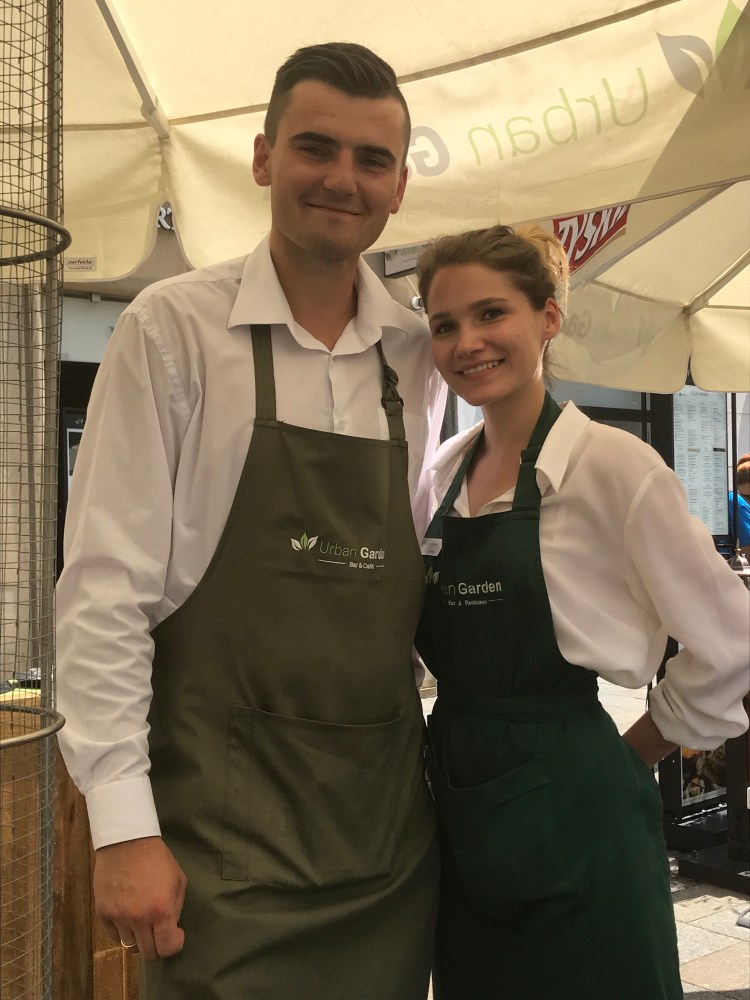
Seems I might have to leave my phone on as I am unable to save the work I have done on this blog because it noted an error while saving. Now it is in a loop. I have decided to plug in a bit until our flight departs, which is a bit longer than anticipated because of a short delay. Fortunately I do not have a quick turn around time in Warsaw. It is a beautiful day. I am still stunned by how early it is light here in the morning. It is before 5:00 a.m. and, in fact, when I first arrived it seemed closer to 4:00. Now it is certainly closer to 5:00, but that is so early compared to Pennsylvania. I was up before 5:00 this morning and had everything managed well before my 7:30 Uber time. Well it seems as I ready myself to board the plane, indeed, there might be a chapter closing, but I prefer to see it as the prelude to a much longer chapter just beginning. Thank you to Katarzyna (both of them) for meeting with me, as it was wonderful to see you again. To the second or newer one for being an impeccable host. I will see both of you in December. To Tomasz for being a wonderful flat-mate for a few days or David for 10 days. To Anna for taking time to have dinner with me and help me with my Polish and to spend an evening chatting. To the newest people I have been blessed to meet: Beata i Dominika, for your great instruction. To Andrzej, Nataly, Kamila, and Lublana (sp) all at Urban Garden. To Mariusz at Costa and Dr. Martyniuk and Dr. Prizel-Kania. I am grateful to you all for making the month something beyond my most hopeful imagination. What a wonderful reality it has been. It is time to fly. The picture is of two of the Urban Garden servers.

Thank you for reading.

Michał

So Now You’re on Vacation

Hello from Kraków, Poland,

I am sure you are now convinced by my salutation that I must surely be on a vacation to the EU, eating more than my share of pierogis and drinking Polish vodka. Well, one of the three is correct. I am doing my level best to consume as many kinds of pierogis as possible, but when I am not doing that, I am taking an intensive Polish language class by the immersion method: four hours a day in class and five days a week including a four hour class this past Saturday. Therefore, with the exception of a couple of glasses of wine in the first two weeks, pije nie wódkę (and my instructor would be proud that I remembered to use the accusative case that changes for feminine nouns).

Why? you might ask would I choose to take an immersion class in Polish when I have no Polish heritage? Why would I choose to spend 4 weeks cramming in a language that is probably harder to pronounce than any language I have taken (and I have taken five not counting this one). I am not a language and cultures professor; I am an English professor, who directs a Professional Writing and Digital Rhetoric program. While there is certainly a personal interest in all of this, it is a step in a long-term research project that I am intent on doing.

One of my research areas, which began in graduate school and continued when I taught in Wisconsin, is to understand how technology affects the writing process. I am indebted to Dr. Cindy Selfe and later to Dr. Daniel Riordan for sparking this interest for me. The past four years I have traveled with a number of students in a Study Abroad program to Jagiellonian University, where I have been fortunate to meet a number of scholars here. The Director of the School of Polish Language and Culture has graciously invited me to teach here for a semester, or possibly even a year. While I would teach my classes in English, being competent enough to speak with my students in Polish as well as make my way around the city in daily situations using the native language would certainly be appropriate.

What would I research and what might I teach? First, my research question is related to technology and the differences one finds between the United States and most other countries, but in this case, specifically Poland. Second, experience in my travels here have demonstrated there are differences in how technology is used in the classroom. It has raised questions: are the differences determined infra-structurally? If not, are there pedagogical choices or reasons, and again if so what are the consequences? Another question concerns how we prepare students who might be traveling either direction? These are questions that will require time and commitment in my Bloomsburg classrooms as well as preparation for my eventual residency in Kraków. The classes being proposed are things I also teach in Bloomsburg: Writing for the Internet and Writing for Multiple Media.

As noted, my classes will be taught in English. Yet I am not in front of students all day and I need to make my way through a daily life while living here. In addition, it would certainly behoove me to be able to converse with my students in their own language. Those are two reasons for beginning my Polish studies, studies that will need to be incorporated into my life on a regular basis for the next two years. This means I will hope to improve those skills even after returning in August and continue to increase my fluency before a second and perhaps third immersion class, all before I would begin. While I am here I see small evidence of progress daily, and yet I can say today was a kind of “hit-the-wall” day. By the end of today’s four hour class, I felt like my head was going to explode. Amazing what an afternoon nap did. I am going to spend a couple hours on Rosetta Stone this evening to help my struggling pronunciation. Tomorrow will me a day-long study session and Sunday will be a small break to visit a friend, who lives here outside Kraków. Then in the afternoon I will be back at it. I want to be completely prepared for Monday’s exam. Yes, I have to do exactly what I tell my students. I need to work at it regularly, intentionally, and seriously. So am I on vacation? I guess it depends on your definition of vacation. I am busy studying; I am thoroughly engaged in learning this new language. Yes, I am in an incredibly historical and beautiful city on the Wistula River. Walking two miles each way to and from class each day is an experience in and of itself. Today I heard five languages spoken in less than 50 meters. So I am vacationing. More importantly, I am involved in preparing for my classes, engaging in my scholarship, and expanding the reach of what we do as professors teaching at a PASSHE university. I am proud of what we do. I am proud to represent my department, my college, my university and our system.

Cześć,

Dr. Michael Martin

Pages and Chapters . . . How do we Measure?

Hello from the corner chair,

I have a lovely chair in the corner of my room. I think I should probably spend more time here than I do. It is a comfortable place and it has wonderful lighting, especially in the morning when the sun comes streaming into the bedroom windows. It is a chair I can sit and rest and ponder in. My room, while the largest of the three upstairs rooms is not in anywhere really huge, but it is a decent size to not feel confined or cluttered. The walls are a sort of medium dark sage color and the color makes the space quite welcoming. The chair is a padded somewhat high back chair with just enough space to sort of lean back. There are times I believe a small footstool might make things more comfortable, but I am not sure if I want to add anymore pieces to the room. Perhaps you ask why I might focus such energy on a simple corner chair in my room, but it is about realizing what makes us feel comfortable or safe.

One of the things I have spent a lot of time trying to do with my spaces is make them comfortable, inviting, or safe. I think there are many reasons for that, but most of all it was because I struggled for a sense of safety as I grew up. I have spoken (or more accurately written) about that in various posts, but even in my office at school students, colleagues, and others have commented that walking into my office is like walking into someone’s living room. As I look at some of the various artifacts, coffee cups from various countries, books from various times in my life, art pieces from places I have lived or collected, each thing tells a story. From travels to places lived, every item has meaning and significance. Each time I look at a particular item adorning my office space or my home I am taken back to that page. Sometimes the memory is about a brief moment or merely a day. Other times it is about a year or more, a significant time of growth and change in who I was and would become.

I think perhaps the most interesting think I now realize is I am not sure I have ever had a sense of who I would become. It has more often been about who I am in the moment, and how might I become something more, something better, someone more helpful, more able to make a difference. I am trying to imagine what the past four or five years have accomplished. I know I have seemed to finally catch up with what I imagine life is for someone my age and where I have imagined (for whatever that is worth) should be. The where here is not about location as much as it is about a sort of proverbial having my ducks-in-a-row. One may ask, and rightly so I might add, why it took me so long. I tease on one level that I am a slow learner. I have also noted, and my good friends, Lee and Judy, can attest to this, that I am not one to go about things in the generally regular manner. Those two things have made my life interesting to say the least. In addition, there are two other things that created a somewhat different trajectory for my getting from point A to B. I think having no children of my own certainly keep me from needing to assume that mindset or responsibility that someone else’s life took priority over mine. There are both the evident and not so evident consequences of that for me. The second is managing the health concerns that seem now to have been part of my entire life. I certainly had symptoms as a child, but did not know that my seemingly ever present canker sores in elementary school or before were the harbinger of something much more serious. Along with being profoundly premature, underweight, I imagine bordering on being a probable victim of malnutrition my first two years of life all played a significant part in my underdeveloped immune system and being a poster child for developing an IBD, or in my case Crohn’s.

While I have attempted in the past to measure my life and experience by decade, I think there is a different way, a sort of episodic division. Yet, that requires a sort of recollection that tries to make sense of a life that often seems nonsensical. Yet, here is my attempt. The nonsensical part of my life begins at birth. How and why am I still here? Weighing a mere 17 ounces at birth is extraordinary even now in a world of NICs and of advanced medicine. When I was born there were incubators. There was little understanding of things like prenatal vitamins, fetal alcohol syndrome, or the consequence of smoking during pregnancy. In fact, I was born when thalidomide was used for morning sickness, so I am fortunate to have avoided that possibility. A mother who was 15 at conception had little understanding of what she was in for, and probably little understanding of the consequence of multiple pregnancies before she was 19. This was following by cross-country treks and an eventual removal from the birth home for my sister and me before I was 2. The next three years included the death of my paternal grandfather, who served as my surrogate father, shortly before I was three and the alcoholism of my grandmother who now had two small children, a business, and facing all of it as a widow in her mid 40s. That would lead to another home before I was 5, albeit to a distant relative, and that new home would have even more consequence for the person I would become.

I believe my life with the Martin household has had more profound denouement and import than I am capable of understanding even today. While that might sound a bit ominous, and there are certainly elements of that ominicity, not all the results of growing up in the two houses in Riverside were negative. In fact, let me begin with the positive. I know that Harry and Bernice, the Martins wanted my sister and I to feel safe. They wanted us to have an expectation, some guarantee, of a place that would be there daily, monthly, yearly. This was important because up to that point we did not have that experience, and whether we could articulate such a need as a four and three year old, I am sure there was more apparent in our actions and responses than we realized. As noted in other blogs, receiving private music lessons, singing in various choirs and other options like attending summer and winter children’s theatre workshops offered me both socialization, but an appreciation for the arts that continues to this day. While some of my struggles with my upbringing have been written about at length, I would like to focus on the positive things that have come out of my being adopted. While I also do want to disparage my younger half siblings, I know my adoption offered me opportunities they did not have, from everyday schooling to going beyond. Certainly my parents did not understand what it meant to prepare me for going to college, at least they understood and encouraged its relevance for a contributing to a better or more opportunity-filled life. I am quite sure I have not always pictured my growing years in this way.

The next episode is probably a relatively short one in the picture of a three score plus soon to be three years, but it was a time of gut-wrenching reality checks. It was the period that includes my time in the service and my floundering around afterwards until I ended up on a Lutheran Youth Encounter team and then enrolled as a student at Dana College. During that time I was a poster boy for impressive success and astounding failure. There was little in between. I listened to very few and ignored the wise counsel of most. I drank too much; I smoked an unbelievable amount of pot; and I ignored people who had been my foundation for all my life, most importantly my grandmother. I went to and dropped out (got kicked out) of college. I should have or could have ended up dead more than once, and most importantly, I was forced to face the loss of people I loved, and for which I was totally unprepared. I did well in the military, but came to understand that military life was too regimented, not because of the routine, but because I saw too many Staff NCOs who could not seem to think for themselves. I wanted to use my brain more than what I deemed possible as an enlisted Marine. Do not get me wrong; I do not regret being in the service and it still serves me well to this day. Yet, I needed more. Yet out of the service, I had no structure and seemed to discard most of the discipline I had learned. I must give credit to a few people for seeing me through that time. First, it was my sister-in-law, Carolyn, who had her own struggles of trying to parent three small children as a 25 year old widow. To this day I am grateful to her. Second is a family, and each of them played a significant role in my survival, though they did not realize it at the time. The Peters family had come to Riverside from Germany, though there were NW Iowa roots. Fred was called to be the pastor of my home congregation. He ended up being called upon in more ways than one to be my surrogate father, and he did that task marvelously. Ruth, his wife, was a force to be reckoned within her own right, and she probably did me more good than I ever realized. She had more of my respect than perhaps anyone I ever met. David become an important friend and even though I was older, his ability and intelligence inspired me. His friendship sustained me then and his presence remains in my life until this day. Barb is the one I was the closest to in terms of personality and demeanor. I am not sure I always realized that. She was smart, funny, talented, and simply gorgeous. She was the first person I ever loved, but I had no idea how to be a boyfriend. Much happened, though not as much as some might have believed, but I know that to this very day she will always be that first-love person. I have been richly blessed that we are Facebook friends after all of these years. The third person is actually a second cousin, Diane, who had a profound effect on my making a choice to clean up my life. They were in Sioux City and a Sunday meal which turned into an amazing friendship and spending time with all of the Wiggs that would change my life in many ways. If it were not for Carolyn and the Peters family and Diane, only God knows what might have happened.

A year of travel and the meeting of four others and the staying with amazing host families still influences me today (the mention of Lee and Judy above).

I think the next episode would have to be my formal post-secondary education that has gone beyond what I ever expected, but it has both changed and become my life. I think I will save that. As I write this I am in Kraków, Poland taking an intensive four-week Polish course and I need to study for the remainder of the day. So I will sign off and pick up again soon. There is so much it seems as I reflect on even the significant things.

As always, thank you for reading.

Michael

Sent from my iPad

Drive-ins, a 70 Gran Torino and My Schwinn String Ray Apple Crate

Hello on a Father’s Day morning,

Yesterday I was out on the Harley riding to a college graduation party of one of my traveling students. She was on the Poland trip 2 1/2 years ago. I took the scenic route, or what the GPS on the Harley calls the twisty route.

Somehow the last 24 hours have been a walk down memory lane of sorts. As I followed a spotless white 70 Gran Torino, with chrome dual-exhaust, glass packs, and raised-white-letter tires, my on ride yesterday I also passed a functioning drive-in. What a throwback in time. My thoughts moved both to Clint Eastwood’s classic movie from a decade ago and memories of my 71 Chevelle that my father once lamented that we was not sure what was worse, the mufflers or the music. My memories of the drive in included those Friday or Saturday nights as a small child where we went to the screenings with our jammies on so when we fell asleep before leaving, my parents could tuck us in with much less hassle. I remember my going to the drive in when I could drive myself and having a much different experience than when I was a child. Somehow, I did not want to be in the front row or by the snack bar, contrary to the sketch by Cheech and Chong (how many of your remember that piece?).

It is often noted that life was simpler then? Was it? What constitutes a simpler life? That is a phrase I hear often: things were simpler then. I am not so sure there is truth in a comprehensive sort of way, but I do think we might have imagined a simpler possibility because we were more focused on our own personal, parochial, localized vision of our world. Going to the drive-in was great entertainment and it did not cost you that much. You could bring your own snacks and pay no more than the price of an entrance fee, which was determined by car and not the number of people, at least, I think that is how it was. The price of a gallon of gas in 1970 was .36 cents a gallon (before you flip, if you adjust for inflation, it is about 2.19 per gallon, so it was not that much cheaper and mileage of less than l0/gallon might get you to rethink that. I am always a bit shocked by the incessant need of many people to return to their youth, or even their younger days, and I do believe those are separate wishes. I would not want to be 13 or 14 for any amount of money offered. Those who knew me then know I was one of the smallest, if not thee smallest, for my age. That certainly had some drawbacks. What I would say is I was probably bullied, but I did not really feel that way at the time. I certainly received my share of teasing and being sort of physically tossed around because of my size. People did not really hurt me, though I ended up in more than one embarrassing situation from time to time. The second option noted would merely allow me to experience some of the nostalgic things, but not be that difficult age. That is why I have included the list that is the title of this post.

Cars were a significant part of most 16 year old’s world, certainly that was the case in Northwest Iowa in the late 1960s and early 1970s. It amazes me how different the attitude toward getting a license or owning a car is today. I was stunned when a few years ago three of my graduating seniors (from college, mind you) did not have their drivers licenses. They spoke to me about job internships and how to manage transportation. I encouraged them to get a license as soon as possible. My first car was a 1964 Impala. While it was not a super sport, it did have a 327 c.i. engine and would move right along. Well enough that I receiving two speeding tickets in less than two hours. My mother was not pleased. My second car, out of the service, was a 1971 Chevelle SS with a 454 c.i. engine that could pass anything but a gas station. My pastor’s wife once asked, why I found it necessary to noise pollute the neighborhood? I do not think she liked the Chevelle that much, and she was even less pleased that I took a serious interest in her 16 year old daughter. I think it is most assuredly true that she might hold at least some small remnant of a grudge even today 40+ years later. I think what made things seemingly less convoluted is we had two ways to communicate: phone or interpersonal communication of the face-2-face variety. I think it made things much less likely to be overlapping or misinterpreted. The last on my list above was the Schwinn Stingray Apple Crate. That bike was my pride and joy. I rode it everywhere, around most of the town of 100,000. It had a back sissy bar that was higher than my head. With reflectors and other trappings, I felt pretty rachett (yes, I actually used that term). The point of most of this is simple, pun intended. To paraphrase a movie that considered this same time for me, though I would have been an elementary student, “Simple is as simple does.” It is us who choose to make our lives complicated. We take on more than we should. We create dilemmas because we find it impossible to say “no.” We clutter our existence with stuff, literally and figuratively. In each case, rather than simplifying, we confound even our best attempts at relaxation or leisure.

So are things really more difficult? We have more options to communicate and stay in touch with people who matter, but we seem more isolated and lonely than ever before. We have access to more knowledge than any generation in history, but we seem to have no idea what we know or need to know. We have, at least in the States, managed to so fragment our society that difference is believed to be wrong, and the different is observed with suspicion and disdain. Disagreement create enemies rather than debate and an increase in understanding. It is no wonder things seem more difficult. We cannot or will not attempt the most rudimentary of human attributes: to listen, to think, and to care.

For those reasons, maybe going back to when I was a senior in high school, 45 years ago might need renewed consideration. Here is a video to ask something about other things we might ponder. It seems this is becoming a very apropos song in these times.

Imagine

Thanks for reading as always,

Dr. Martin

The Truth and Tragedy about Racism

Hello from back in PA,

As I spent the evening trying to catch up on the unending stream of craziness that seems to dominate the world, but what we call news, the irony of the day was as Starbucks closed its doors for a corporate training on what they euphemistically called implicit bias training while one of the top rated shows this season, the reboot of Rosanne was summarily canceled for a rather explicit bias and seemingly-untrainable tweet about Valerie Jarrett by Rosanne Barr herself. Earlier this evening I read a really thought provoking and painfully truth piece by Joy-Ann Reid, a political analyst, who today wrote, “Being black means constantly rendering yourself unthreatening to white people. [and she also states,] “To be white in America is to assume ownership of public spaces. To be black is to live under constant threat of removal” (NBC Think 29May18). Both of these statements will offend some; they will resonate with others; but regardless of how you respond, it is probably most important to search in your heart for the truth contained in them. As a 60-something while Anglo-Saxon Protestant male, there have been times where I wanted to argue the infamous reverse-discrimination card, but about four years ago, I wrote a blog about being confronted by a student and significant person about my privileged status. I remember feeling offended because I had worked hard to achieve what I had. I argued that no one gave me anything. Yes, while I had received help along the way, working as a GTI, managing a restaurant, and being a full-time doctoral student was no picnic and so I was not willing to be labeled as privileged. Certainly, I have received more help than some, but at least through school, I merely worked.

Now four years later, in a country where division and disrespect seems to be the rule rather than the exception, we have elected a President who seems to show little respect for anyone, anything, at anytime, and his election seems to be a direct consequence of the fact we had a black President preceding him. I also believe, in part, it was because the Democratic candidate was both female and named Hillary Clinton. I also believe those are all separate issues. President Trump’s remarks at Arlington National Cemetery were both discouraging and disgraceful. As I ponder the place we seem to stand as a society, as the melting pot created from the Grand Experiment, I am not sure I can give the founders of this country much credit for establishing a society where life, liberty, and the pursuit of happiness included all people. Without a doubt, Abraham Lincoln stood tall, literally and figuratively, in an attempt to create a more equitable country with both the Emancipation Proclamation and the 13th Amendment, but until the quest of Martin Luther King, Jr. and the Civil Rights Legislation of the 1960s, there was not concerted effort to really accept the true racism of separate, but equal doctrine that was a fundamental element of our mid-20th Century America. I believe I was as naive as the next who somehow believed the election of Barack Obama signaled we have turned a corner for real. Finally, as a country, I thought we realized the racial inequality that held our country in our own collective stocks and put our democracy up for sale to the highest bidder. When President Obama used his office to ask us to thoughtfully reflect on the killing of Trayvon Martin in February of 2012, I again hoped his being a Black President might help us see the difficulty of what young black, Hispanic, Asian, or other non-white males endure daily. Unfortunately , after some initial reflection, it seems it accomplished little, or I might even go as far as to say it was probably counter-productive. I would add this was little fault of the President, but rather because we have such an untruthful and chicken-shit racist underbelly to our country that few are willing to honestly and thoughtfully call to task.

I have stated this before, but I think I write it with more emotion than I have in the past. If you see someone who looks, acts, speaks, worships, or loves differently than you and that is how you first view them, or you consider that to be the most distinguishable quality about them, you are mostly likely acting in a discriminatory manner. The person who can honestly say in their heart they do not notice or even consider the difference is a rare individual. For the great majority of us, we are more likely to be that implicit racially biased person, and that is if we are lucky. The present atmosphere in the country, where disagreement makes the other the enemy, means most of us have probably moved beyond the implicit to the explicit. When we hear about daily incidences of rancor, disrespect, and downright hatefulness from the White House to the neighbor, can there be any surprise that corporations are requiring an entire workforce to receive training about their innate (but actually taught) prejudices or a company that is part of the Magic Kingdom of Disney cancels one of its two most popular shows. What does it say when one of the most popular sit-com people of a generation can refer to the senior advisor of a President as the cross between the Muslim Brotherhood and the Planet of the Apes? Not only has what she tweeted reprehensible, the fact that such stereotypes are still promulgated is tragic beyond compare. It is those very stereotypes, the jokes, the whispered humor (which is anything but) that we allow to go unchallenged that keeps such bigotry alive. It is the stares seared into the psyche of our minority students in the small Pennsylvania town or warnings given when the monster truck show comes to the fairgrounds admonishing our black or biracial students to not be alone on the street that illustrates how pathetic our thoughts, words, or actions can be. It is when a avowed Nazi can run for Congress unopposed in Illinois, ironically both the Land of Lincoln and Obama, that should cause us pause as ask, what the hell are we thinking? . . .

It is now 24 hours since I was writing here and pretty well every news source has pontificated on the situation. SHS, who boggles me beyond compare, went on her own rant of why other forms of racism have not been called out to the same degree. I guess the positive is they did not support the egregious comments, but, as usual, deflected to argue something else was as terrible. I am continually stunned by the rhetorical strategy of the White House. Some will argue there is no strategy, but I will disagree. It is like being consistently inconsistent. The President calls our values, morals, and standards into question daily through his seemingly off-the-cuff tweets. Make no mistake, his questioning of all standards, standards which generally support a status quo as well as offering support for some sense of equality and justice, allows some of those who have been supposedly marginalized by this same status quo to believe a President listens to them and speaks their language. Nothing could be farther from the truth. The scripture of notes even the dogs get the scraps from the master’s table comes to mind. . . . Another day and another version of America or the global community doing a collective smh. If you do not know this acronym, which I did not until perhaps a year ago, it means shaking my head. The unprofessional or completely void of decorum comments about an ally or Prime Minister of our closest ally as well as showing up late (twice) as well as leaving early from something that affects every citizen in our country. Issues of trade, cooperation, national security, and most everything that requires international give-and-take seems to have been ignored by our President. Where is the line between “America First,” the established Trump Doctrine, and America as a global leader? Between withdrawing from international agreements and the suggesting the re-inclusion of Russia in the G-7+1, what has the President actually done? The global order is changing, and the move to globalization itself has created an interesting backlash. This is also an interesting sort of discrimination. The global identity has often been those who have (the United States, Canada, the EU, and, yes, Russia) and those who do not (third world countries-most of Africa or Latin America, still developing countries from the former Central or Eastern Europe, and other geopolitical places left behind for whatever reason), but that might not be the most significant malevolent consequence of globalization, nor the most complex.

What about a disappearing middle class in the haves and a much less likely possibility for those in the countries of the have nots? I believe many citizens in a number of countries of the EU or in parts of the United States have joined the bandwagon of the rising nationalism because they believe nationalistic philosophy somehow gives them voice. While there might be some truth to this, I do not believe in the long run, nationalism serves any one country. Furthermore, when nationalism becomes the rule rather than the exception, those who have power will have more power and the ideal of democracy becomes more difficult to maintain. While Hitler was elected as chancellor in 1933, his consolidation of power and what he did from 1933 until the outbreak of WWII upon his invasion of Poland on September 1, 1939 is well documented. Perhaps it is time many read. When power is consolidated, those on the outside become powerless. When countries are so busy working to protect themselves, everyone else becomes the other. Certainly what has been demonstrated lately is being the other is not a good place or position to hold. It still stuns me that the number of Latinos/as, blacks, LGBTQA, Muslim, dis/abled individuals, (and there are people in each of these groups) still believe that the policies put in place recently will not hurt them, from trade, to tariffs, to taxes.

Issues like the #MeToo movement,the #BlackLivesMatter , the #OscarsSoWhite, #RapeCulture, or #NationalAnthem all  demonstrate that we are on a verge of a very substantial paradigm shift, but to where are we shifting? What is positive in the conversation and what is not? This is part of the struggle. There is so much more that we need to ponder and understand. From where did some of the actions, the attitudes, and the practices we now find so abhorrent originate. I listen to a number of veterans most mornings. They are a good group of people, but I am quite sure that I am the only person who did not vote for our current President in that table of 10 or 15 people. Some of the things said will shock me from time to time, but what I realize more and more is that I am pretty liberal in a very conservative area. I am not liberal in my own practices, but more so in my attitudes. What I know is while I might not agree with them, I still respect them and their opinions. I can see beyond some of the differences, and I can still sit and even disagree at times. Most of my disagreements are posed and what about another possibility. I believe we have lost the ability to speak about the other whether it has to do with race, politics, religion, socio-economic class, education, ethnicity or any other thing that might create a difference. Rather than seeing difference as an opportunity for growth, our nationalistic, xenophobic, homophobic, sexist, or any other ism that elevates difference, we see the other as the enemy, something to discount, disavow, disrespect, discharge, and, somehow hope they will disappear. The resulting fragmentation of who we are as people is certainly not what I believe our heritage has been most held up to be. The words on the statue of Lady Liberty seem to have been ignored. The problem is very basic in understanding what it is, but incredibly complex when it comes to changing it. Most of us are afraid to admit, or too ignorant to realize just how racist most of us are. Until that changes, we are relegated to hashtags and outrage.

With that in mind, I offer this video and thank you all for reading.

Michael (the summer person who is not teaching for once)

When or How did it (or What Just) Happen(ed)?

Hello from the acre,

Today I spent some significant time at Starbucks in a neighboring town working on a couple of important things. It was a bit of a long weekend as my wonderful fragment of a GI track seemed to demand more attention than I was prepared to provide, but it won out as it usually does. It is shortly after 9:00 p.m. and I am already in bed for the night. I am quite the exciting person, let me tell you. It seems after finally getting grades turned in, and letting up a little, my body noted a reprieve and went into shutdown mode. This was a common occurrence, especially when I was an undergraduate. I remember how my mother would be so angry that I was ill most every time I came home for break. She could not comprehend that I had actually worked that hard at college, or that college could be so stressful and exhausting. She had no idea what cramming 164 credits into four years did or managing to double-major and double-minor with a 3.7 grade point required. This past year it was not the GPA or majoring or minoring, it was chairing committees and revising a complete program. It was serving on statewide committees and union events that took time. It was reimagining courses and just basic life that made things more exhausting. It is the reality that all those things first mentioned happened in my twenties and I am no longer in that decade.

That is the first part of the title coming to roost. When did those decades from 20-something to 60-something happen? Where did that time go? It is hard to believe it will be 30 years ago in a month or two that I flew to Allentown, PA to be driven to a little borough called Lehighton, Pennsylvania to interview to become one of their two pastors. I remember being told by a stately woman on the call committee I did not look my age. I remember clearly going back to graduate school at 40 to begin another Masters and eventually roll into a doctoral program. I remember being in Wisconsin and having a 50th birthday where I celebrated both a decade and a dissertation. How did it happen that I am an age where retirement is a reasonable conversation? Well, I guess it is all the things above. Certainly some of that aging is because of the Crohn’s and the substantial and frequent complications that have necessitated more surgeries and other care I would rather forget than remember.

Along the way there have been people come in and out of my life, much as anyone else’s life, some by choice (both mine and theirs), some by change of location, and some because circumstances change and the reasons for holding on seemed too much of an effort to exert. There is another group who have taught me a difficult but important, lesson in trust, and that consequence has made my life somewhat difficult, but I am hoping to overcome that difficulty as quickly as possible. It has taught me an unequalled understanding of too many people’s commitment to their word. The lesson has been painful on a number of levels, but I will figure it out. Some of that will require sacrifice on my part, but again, it’s manageable. As I move into a sort of new phase of my life, I am reminded daily of how blessed I am.

Over the past almost 20 years, I have found that being single has had a number of benefits. Being single and never having my own children has also had benefits, and some sense of loss from time to time also. As I move into this new phase of imagining something new on a number of levels, there is both excitement and fear. I think that is always how it goes. I have spent a good part of my life, and long before these last two decades, trying to control the variables. I have been successful at times and failed miserably at perhaps as many moments. I am reminded of the words of a counselor I had all through graduate school at MTU. I owe my life to him. He was probably the one single person who did more to keep me going than any other person in my entire life. He and I spoke often about the seeming unending tension between my personal and professional lives. I use the plural intentionally. It is hard to believe I left Houghton 15 years ago and how much has happened in that time.

What stuns me even more at this point is how a happen-chance meeting on a sidewalk has so profoundly affected my life now. That is the third part of my question in the title? What just happened, or more accurately, what is happening? While I have mentioned being married (and it is twice for those counting), and I have at times noted some interactions with them as a sort of tangential topic from time to time, I say very little about them. While there are a myriad of reasons for that, suffice it to say, I learned a lot from those times in my life. In addition, I must surely shoulder some blame for the failure in each relationship. I think what I have learned most profoundly is what I could or should have done differently as well as taking accountability for my part in those failures. What I also know is I have tried my best, for a great deal of this 18 year period, to take as few chances as possible. The one chance taken was not a mistake and I learned some valuable lessons yet again. I think the past 18 years have provided an opportunity for me to learn a great deal as I have watched others. It has provided me an opportunity to reflect and analyze both who I am and what I value in a significant other, if you will. I think I would be a much better pastoral counselor today than I was 30 years ago. I think I would be a much better spouse than I could have hoped to be earlier in my life . . . and it is not rocket science . . . in fact far from it. Communicate with the other, trust the other, and never ever lie, even little white lies, to the other. I know I failed at all three of these things in my previous marriages. That is nothing of which I am proud, but I need to be honest. I have always struggled to admit my failures and my mistakes because they so devastated me. I was both embarrassed and felt unworthy, regardless the degree or level of failure. I was too afraid to lay it all out there, which is so foolish. During the last 6 months or so, I have been blessed to be able to change that. During the fall, I made a decision to let a number of situations that caused me a lot of stress to go by the wayside. There is certainly a consequence in making that decision, but my heart feels better by doing so. I have to thank another perchance meeting of a colleague on a Friday afternoon for helping me achieve that. While her conversation was about one specific mutual former student, I did it for all who had the same situation. It will prompt some other changes this coming week, but again, it is all good.

What has been most amazing is how helping another has created a gift in my life that I never anticipated. Through texts, conversations, phone calls, and some driving, it seems I have stumbled upon both an academic and personality soulmate. Through sharing thoughts about assignments, readings, classes, and even food (all things that geek me out) I find myself more joyful, more content, and more capable than I have felt for many years. I am not sure what has happened, or even what is happening, but I am more able to merely take each day for what it is than I have been in anytime of my life. I have learned more about myself through the daily pondering of topics and conversations than I ever remember doing. What just happened? has been a question crossing the internal screen in my head more times than I have fingers. And , uncharacteristically, I do not need an answer. I do not need to know where or why. I am not concerned or afraid that I do not have it all figured out. The most important thing that seems to be happening is I am content with my life on a grander scale than I have been for years. Are there still issues or irritations with things I wish I could control? Yes, but they have to do with other circumstances, specifically ones alluded to in the earlier portion of this post. Most of them will be managed if I can sell the Harley. Those of you who know me, know that is a difficult pill to swallow, but that is the consequence of my deciding to let some other things go. I will survive that and it will save me both significant money each month and I will be a little safer. Almost 900 pounds cruising down the road it a lot of weight. There are some health things that make this decision more palatable also.

So as always, there is a lot happening. I will be beginning my 10th year in Bloomsburg later this summer, and so much has happened. The picture that is at the beginning of the post is a testament to some of that time. Two former students, who were once in my freshman writing classes graduated with advanced degrees over the past couple weeks. One stayed with me last fall during her pharmacy rotations, and she received her PharmD from Shenandoah University. The second, who also lived with me for a summer, received her MS in Instructional Technology. I was honored to be invited to the hooding of one and to actually hood the other. This summer I am not teaching for only the second time since arriving at the university. I plan to spend the summer working on writing articles (hopefully three), learning Polish (in an intensive language program) and spending significant time seeing where my life might go next. I am excited about all three things. I am richly blessed and I know that I can only do it all one day at a time.

As always, thanks for reading.

Michael

But I need an “A”

I need to take a walk before I get caught up in this little writing project. It is gorgeous outside and a perfect day of sun, little wind, and a moderate temperature that makes you want to lie in a hammock and do your best Rip Van Winkle impersonation. The past few days have been a veritable smorgasbord of experiences with weather from exceedingly gorgeous, a monsoon for COLA graduation, to sufferingly humid to London type fog and drizzle. I am currently sitting at a table waiting for an Amtrak to take me to Philadelphia, where I will catch a ride and get back to Bloom about 11:00 this evening. I plan to do work on the train. This is a somewhat first experience for me because I have not been on a train since 1994, and that was from LA to San Diego. I have some grading to do, but I am hopeful I can complete it today. . .  Not as much done on a blog as I would have liked, mostly because I was trying to manage some other technological issues and that was not as successful as I might have hoped. Today, which is now Tuesday, feels like Monday and I am trying to manage my grading completion, a workshop at noon and other handy things that are on my plate. Seems I have more irons in the fire than fire, but it will get done.

Over the last few days, like many of my colleagues across the nation, we have been grading, commenting, and trying to finish up a semester and another academic year. I am sure I am not speaking only for myself when I say that I am continually amazed by an increasing number of students who believe that merely coming to class and sitting in their seat most of the time constitutes participating in class and that they are engaged in the class. I am pretty sure I am not speaking only for myself when I say that many students read only a minimal percentage of the reading, the course content in the course delivery tool, or even the syllabus, but they want you to respond to them as if they are an engaged, critically thinking, or thoroughly analyzing student in your class. Finally, I am pretty sure that I am not the only person who wonders why are these basically good people willing to spend someone’s hard earned money as they sit lackadaisically hour after hour both in class and in their room more interested in their phone, the latest story additions on Snap, or posting something of great importance on Instagram. That is a really profound way to invest the 100,000.00 they will send for their Bachelor’s degree. And then, of course, as grades will be released today, I will get emails or phone calls, texts or tweets asking why they did not get the grade they need. Somehow they need an A. This past week I met with a student who is an advisee. He has managed to accumulate 89 credits (which is one credit short of being a senior), but is not really close to where he needs to be to be able to enroll in the specific program he had decided to pursue. Doing some thoughtful and careful analysis of a transcript and after a few questions, I asked the student, honestly and carefully, “Why are you in college? What do you want to do?” To his credit, he responded, ” I am not really sure what I want to do or why I am here.” This is after about 3+ years of course work. He noted that his father wanted him to have opportunities and not be like him in terms of having to break his back and knuckles at what he did everyday. First, I understand the father’s desire to have his son go beyond what the father was able to do. That is what parents do. Yet, I believe the son would have been better served, after speaking and listening, by going to a technical college and doing something with his hands and mind.

More significantly, at this point, for the son to graduate with what he hoped to do, it would take a year of classes at least, and achieving all As to get his GPA where it needed to be before he could even get into the program. In addition, if he got in, it would take two-two and a half more years to finish a degree that has very little wiggle room in terms of getting things finished. That would be three to three and a half more years another 50K minimum for an undergraduate degree that would not pay him nearly enough for the loan debt he would incur. I asked him to go home for the weekend and think about options and come back on Monday. He did and we are pursuing a different track and some different options. There are more than enough articles about the value of a college diploma, but there is certainly not enough being said about what happens when students come to college undeclared and then seem to find it so much easier to merely sleep-walk their way through that degree, hoping it all falls into place somehow. He noted that his parents were asking questions, but he did not even have anything to tell them yet. That raises an entirely different issue. What makes college worth the investment of time and money? Who decides? I believe there are some people who are not ready to come to college. Simple as that. They have no focus; they have not real plan; and they have little sense of discipline as to why they will move toward some degree in something. While some undeclared students are much more savvy about what they are doing, and, therefore, can move toward something even when they are not sure what it is, most are wasting a lot of time and money. I was such a person, and, as some know, both if you have known me throughout my life or have read my blog for some time, I flunked out of college the first time I tried to be a student. I was not ready, either mentally or emotionally, and it requires both. To get this student into a path that both he, I, and my department chair thinks will both serve him as well as allow him to graduate, it took phones calls, visits, reconsideration, a moving around of a number of pieces and more phone calls and pondering, but it appears to be a possibility. And even yet, that guarantees nothing. It will take specific hard work and focus on the part of the student and something he will have to do in every class for the remainder of his time at Bloomsburg. There are no promises of As or of even graduating. It takes discipline and hard work. To do less than that means you might end up here longer; you might (will) spend more money than you care to do; and finally, you will learn hard lessons about what happens when you merely think needing the A will result in the aforementioned A.

In conversations with my colleagues, I believe we have some similar ideas about how students fit into being a collegiate trying to finish a degree. Some are simply not ready to be in college. The age of 18 does not guarantee success; neither does the legal age of 21 guarantee that someone can drink responsibly. They should stay home and work for a year or two and realize how much better off having a degree might be. There is a second set of students who are just smart enough to be here, but they come from an underprivileged situation and an underprepared background, but they understand the opportunity, and while they will have to work hard to maintain, they are willing to put in the necessary effort to continue to improve. I love these students because they are passionate. They are academically often underprepared, but that is not their fault. This is a difficult group because they walk such a fine line between hanging in there and being overwhelmed. Yet, they are aware of the tremendous opportunity that is there for them should they succeed. These are the students who are the most gratifying in some way. Depending on the mission of the system and the support of the university, these students can make a significant difference in both their own life and the life of others. There were a number of these students who walked in graduation this past Saturday with a sash that said “First Generation.” These are some of those students. Most students I meet are capable students, but they still need discipline and they need to be willing to work hard. This is the majority of students, but the difficulty is they have never had to be that disciplined or work that hard. There are a lot of reasons for that, but that is for another time. The problem with many of these students is they are just lazy. My colleagues and I find them the most frustrating. They want something (everything) for nothing. These are the students to come to class unprepared. These are the students who wait until the last minute to attempt to write an assignment or a paper. These are the students who are unwilling to look beyond the obvious to understand or think about something. They are, to use my one of my closest colleague’s terms, phoning it in. They made an appearance, showed up, stared at me in class, and left without as much as a single um during the entire class. If that only happened in one class, I could chalk it up to a bad day. However, it seems they have a bad week or a bad semester, or a bad college career. Two years ago a student missed class for 6 weeks. No note, no email, no contact, but he managed to show up the last week. He noted that he had been sick for those six weeks, but he did not go to the doctor. When I told him he could not pass class and did not need to come back, he looked shocked. When I told him he could retake the course, I doubted he would, and he hasn’t

The point of this paragraph is to question the rationality of going to college. I know that might sound a bit stunning being as I teach college, but I do not believe everyone needs to go to college. I do not believe we can serve everyone well simply because they come into our classroom. There is another group of students I did not mention that I have. They are the smarter than average students who have a clear sense of why they are here and what it means to work toward a degree. These students have taken the values and the discipline they have from home and are willing to put it to work. I have met some of these students in class and I have met some of these students on the travels to Poland and the other Central and Eastern European countries I have been fortunate to travel to over the last four years. This past week, a student, who had worked very hard and was set to graduate, was involved in a tragic auto accident. It left her with a TBI and she has been rehabbing ever since. She was at graduation to receive her diploma. While there is not guarantee how things will go for her, it was a testament to her, her family, and her caregivers, that she was there. If only we could all realize how fragile we all are and how every opportunity we have – yes, even college – is a gift that should not be taken for granted. It is something to take on and work toward with every fiber of our being. For us on the other side of that blank stare, we realize more than you might know how important what we do is. Too often you think we are picking on you, being unfair to you, asking too much of you when we are not content with you turning in work that demonstrates less than you are capable of doing. We are not trying to be anything, but honest and fair. Too often, and even more so at private colleges, at State Universities, students and their parents are treated as customers. I apologize, but I do not see you as such. You come to college to be educated. That means you are learning how to think more critically than you have before. It means you are learning to analyze a situation more thoroughly than you have before, and it means you must be able to synthesize education and experience to be the best possible citizen and employee you can hope to be. Your money buys you the opportunity to of that, and that is all. What you do with that opportunity is entirely up to you. I will provide the best I can. I am human and so some days I will not be perfect, but I will admit when I need to improve and I will be honest when I have failed. I ask the same of you.

Sincerely,

Dr. Martin

When Geography Becomes a Place

Hello from Starbucks,

I am in another Starbucks and I know that it is more than merely another trip to the green mermaid branded coffee shop, in spite of that fact I have not been in this individual Starbucks before. As I walk in I see the familiar colors, the familiar layout, the typical board of options and even similar bathroom layout. The look is similar to one in one I have visited in PA, CA, VA, WI, UT, MN, IA, or IN. Yes, NYC, IRELAND, POLAND, CZECH REPUBLIC, AUSTRIA or CANADA. I think you get the point. They want us to feel at home, to feel familiar and welcomed, in spite of the fact that they got into some serious boiling water for their lack of welcome in the City of Brotherly Love not long ago. Branding is something all of succumb to whether we realize it or not. I believe some of the more successful branding campaigns in history include the aforementioned Starbucks; others include Apple, Microsoft, Hershey, or Harley Davidson. I am sure there are others you can name, but these are the ones that immediately come to mind for me. Terms like “the Big Three” referring to General Motors, Ford, and Chrysler once powered Detroit, but that is no longer the case. Companies that were standards of my childhood like Sears and Roebuck, J.C. Penney, or Montgomery Wards have fallen by the wayside of clothing or tools giants and now even the behemoth Walmart must be trying to figure out what to do with Jeff Bezos and Amazon as they seem destined and determined to become the one-stop-online-shop (OSOS) of everything. It seems the only thing that can rival them are the things they need like Google or other technology to support their continuing growth into most anything and everything. The reality of entrepreneurship on steroids seems to characterize what Bezos is doing. Of course, it can be argued Warren Buffet did the same thing, only 30 years earlier, and did it more by beating the pavement than wiring it together by technology. While I must admire their foresight and ingenuity, I cannot help but be concerned about the consequences. Where will the convenience and the OSOS cost us more than save us. Perhaps it is appropriate that the acronym includes an SOS.

I sort of went on a roll there, not realizing how all of that fit together for me. I think I find myself questioning more frequently and more critically some of the things I see happening on a regular basis. At times it makes me feel like a curmudgeonly aging white male, much like the uncle I have mentioned in a previous blog or two. The irony of that questioning for me is I will not have to deal with the consequences as long as my students. I will not see how the consequences might fundamentally change daily life as I have known it, or they know it now. Certainly technology has fundamentally changed how we communicate – or fail to – how we write, how we manage information – or fail to – how we shop, how we believe what we see or hear – or don’t. Again, I could go on, but you get the idea. I believe that technology must be seen as one of the profound contributors to the discord, the lack of decorum, civility or general lack of manners that seems to be plaguing us today. Or more accurately, our human addiction to our gadgets and the subsequent usage. Yet, I do subscribe to the belief that there is a rhetoric of technology. All I have to do is observe students anywhere on campus. Before they are out of a classroom as class is dismissed, their phones are out and they are consumed as they try to see what Instagram post or snap story they have missed in the last 50 minutes. They can see their way forward as if their cell phone is a seeing-eye dog (service animal) helping them get to their next class as they wander around like zombies in that 20 minute interval. They can walk up steps, down steps, between people or order without looking up as if the phone is their brain in their hand. Yesterday, I inadvertently left my phone somewhere on campus, and I realized shortly after it happened, and even had some sense as to where it was, but I did not follow up and get it until this morning. So I was without it for almost 24 hours. In the spirit of full disclosure, I did have my iPad at home and I did search out it’s location last evening and saw that it was probably where I suspected. I did get an email this morning that it had been turned in. So there was some surety that it was not stolen. That is helpful, but I did not feel like I was at a disadvantage with no phone. The continuing growth of the technological influence on communication and writing is something I ponder almost daily, and while I could say much about that, I will wait for another post to speak about that.

While I noted in my last blog I do not want a do-over, and that stands, if there is something I wish I might have done earlier, it is sort of two pronged. I wish I would have growth up in a time where learning other languages was encouraged. That was not something that was ever mentioned in my household. I had a great-aunt who could speak Norwegian and prayed in her native language, but that was the extent of any exposure I had. Related to that, I wish I had been taught about the importance of travel and experiencing other cultures. Certainly part of that ability was having the financial resources, and that definitely was not the case. What I am grateful for is that I enlisted in the Marines out of high school. That certainly offered me opportunities to learn about places outside of Sioux City, my NW Iowa town of 100,000, which I believed was a pretty big place. The second thing that did a great deal to broaden my horizons was to meet the Peters family. The pastor and family that came to Riverside Lutheran Church as I was getting out of the service. They had been in NW Iowa before, but this stop of the itinerant pastor’s existence included time in Germany before returning to the Midwest. It was their use of German in daily conversation, as well as a son who became a great friend and a serious crush and more on a younger sister, who is also still a treasured friend, that started me down the road of loving to learn language. It is now 40 years later and this summer I will enroll in the second intensive language program I have ever done. This one is a speaking language, however; the last one was Greek and I crammed two years into 12 weeks. This was much more about reading and writing. Yet, I remember the first time I heard Dr. Craig Koester read Greek in a Johannine Theology class. It was like listening to a story teller. His ability to read Greek as if we were reading English with inflection and tone, pauses, and appropriateness was unlike anything I had ever heard. I could have listened to him all day. What I learned in all of this, which I am just now really coming to terms with, is how much I was fascinated by language. I have said more than once, I wish I had gone into linguistics.

In the second half of my life, I have traveled much more frequently than in the first half. While I was 25 when I went to Europe the first time, the trip that changed my life and my perspective of what Europe was and how important it was to my understanding who I was as an American, I did not make a second trip out of the country as a civilian until I was almost 30. That trip was during the time I was in seminary and I went to then what was known as East Germany. It was a country behind the iron curtain, and it was an experience that revealed to me things I have seldom seen or experienced since. That first trip through Checkpoint Charlie is an experience that changes one’s life. While I have noted this in earlier posts, what still stuns me the most is how quickly I acclimated to the restriction of travel, ability to shop where I chose, or eat whatever or wherever I wanted. I remember how completely unprepared I was when I asked a East German seminary student I met to write me after I would leave and he said that was not possible. Perhaps more importantly, I remember when the wall came down later and he wrote to say hello and to tell me how they would have to be taught and learn about the concept of freedom. We take so much for granted. This past January, while traveling with the Eastern European Study Abroad group, we went to Lviv, Ukraine and sat at the border for 3+ hours. All of this freaked out our students a bit, but my memory of a much more serious investigation when we went into East Berlin in 1985 told me this was not nearly as ominous. Yet each experience when you live it causes a reality check that colors our understanding of the other person. What still causes me pause is how we are all human beings, but we seem so affected by our contextual situation that we can view what we deem apropos or tolerable in such profoundly different ways. It begs the question why and how? Again, I do realize some of this because of the same journey to what was then the Eastern Bloc. Thomas, the seminary student who could not write to me, noted when he could that he would have to be taught the concept of freedom. If one never has something, it is difficult to realize what it means. It is the same overall concept I am trying to convey in this post. It is one thing to see a country on a map and realize it exists. It is also something to see it in pictures or videos when another person has taken them or posted them. It is something entirely different when you have gone there and experienced it. There is an issue both in the contextual situation and then the experience of language. I think it is when the two experiences, which affect most of our senses, that we are compelled to see how we move from geography to place. It matters not whether it was German, Danish, Italian, Spanish, Polish, and most recently Ukrainian (which adds a different alphabet to the mix), there was always some point where I felt overwhelmed by the experience. It is interesting how we try to accommodate, or perhaps not for some, the other, particularly when we are in their country. I have always found it necessary to attempt to use their language and show deference to their customs. As we age, however, we are more aware of how we can Anglicize most any language with our unique American accents. I had this conversation with someone just recently as we were addressing the idea of how we  acquire another language more completely, which is so much more than learning vocabulary and managing to read and comprehend.

Too often, I hear students or others say, I took ______ (you can insert the specific language), but I cannot really use it. What they are implying is they cannot speak adequately. Yet what does that mean? For most, it is a combination of both vocabulary and accent. What does it take to sound like a native speaker versus a person who is merely trying to string some words together in another language? What happens when we struggle with the language so much that we are merely trying to pronounce the words (lacking both structure and inflection)? The first thing that happens is fear. The second thing is we no longer try because we become overwhelmed or embarrassed. As someone who has three different languages using Rosetta Stone on their computer, it has become more and more apparent to me why they manage the lessons as they do. Learning a language is all about employing all your senses because each sense affects your cognition in a different manner. It is where you begin to see the geography as a place; it where you begin to see the people as an individual. It is where you begin to see the complexity of the world in a way that makes it more about exploration and learning than comparing and contrasting. What I have realizes is the best way you can spend money is by travel. The more you travel, the more you realize how people have the same basic needs regardless of language, culture, location, or any other noun you wish to add to the list.  We want to be happy, healthy, and somehow make a positive difference. Time to grade some more as the end of the semester is upon us once again. As far as a video, I have decided to use Enrique Iglesias. Amazing how passionate the Latino/a culture is.

Thanks as always for reading and I hope your semester ends successfully.

Dr. Martin

I do not want a do-over

Hello from the corner of my room,

I am sitting in the chair in my room, which is a comfortable and thoughtful place in my home. It is a sort of safe place too. I have learned that I am a person who needs a quiet and safe place. I am not sure I have always been cognizant of that desideratum, but I am pretty sure it has been a requisite from early in my life. While I have absolutely no inkling, memory, or shadow of any recall of life with my biological parents, their neglect probably affected my sense of security or my need for contact in ways I have never connected to any particular event. It is also interesting how it affects others. Certainly, it always seemed to have affected my sister more than me. There is an irony to that because if we were at our grandparents’ house by the time I was two, Kris would have been less than 9 months old. Yet, she was entirely more obsessed than I was when it came to finding those very parents who neglected and left us alone for hours. I also imagine part of that was because our adopted mother was so much harder on her than she was on either the older brother or me. It is quite logical that she hoped somewhere else might be safer and she would be treated better. Part of reason she is on my mind is the 10th anniversary of her passing will be here in only a few days. So much has happened in the decade since I got that stunning phone call at about 5:30 a.m. that Tuesday morning. Hearing my niece sort of blurt out that they found her dead on the couch is still more clear in my mind than I perhaps wish it was. More to say about that.

I did not know I would be leaving Stout and Wisconsin at that time. I did not know that I would come back to Pennsylvania and resettle myself barely over an hour from where I first became a parish pastor, which is 30 years ago. It is also even more than that when I address my initial graduation from high school or undergrad (which have a LCD of 5 also). I wonder how that can be the case that things in my life seem to happen in years that are in multiples of 5. In a mathematical purist way, the only thing in my life divisible by 5 is the year I was born. It is also the point that in terms of family heritage, I would become the only surviving member of my immediate family. So much has happened in a decade. Yet, I believe that is how life happens if we truly try to live it with all the hope and involvement we can.

That brings me back to the title and what I have been pondering these past few days. I imagine such rumination is the yearly occasion of impending graduation, the watching of another group of students, who a few short years ago were wide-eyed freshman. Yet, now they find themselves even more unprepared, or aware of complexities of life in a more profound manner, which can feel as if they are underprepared. However this present ocular unsophistication is more about accepting responsibility for themselves in a much grander, more consequential manner, and they are realize the safety net that is college is no longer an option. There is grad school, and a few move in that direction, but with a average debt load approaching $40,000.00 for undergrad, many to not believe that adding to that is a reasonable path forward. If you have been reading this blog for any length of time, you will know that I have noted I did not expect to become a college professor. I have stated regularly I had little idea what I would become or do with my life, and certainly that has not changed (which may seem like a strange admission for someone in their 60s). And, in spite of where I am, or even the path it took to find myself as a tenured professor, there is little I would change. Veritably voiced, I do not want to go back, even knowing all I do, and try it all over again. I can wish that I had not been born with Crohn’s as they now believe I was. I can wish that I had lived a more non-peripatetic sort of adulthood. I could try to imagine how it would be had I somehow been given the opportunity to have actually fathered a child. Any of those changes would have significantly altered the life I have lived. Certainly, I ponder the what ifs as I noted in my last blog, but that does not mean I need or want to go back and do it all over. It reminds me of my first host family, Lee and Judy, two of the most phenomenal people I have ever been fortunate enough to meet. They are somewhat accidental in that I ended up on a Lutheran Youth Encounter team sort of last minute. They were my first host family, which is also more random than some might realize. For me, that randomness is anything but. It is the Holy Spirit doing what the Holy Spirit does. Intercession and intervention when we are mostly or totally unaware. What Judy would share on a later visit, much after that initial week, has always remained. She once noted that relationships have more to do with context and timing than emotion. Those were not her words, but the foundational belief in her words. As I have continued to age, I have understood the profound truth in what she said. Her advice or reflection, and my father’s warning about placing expectations on something, ring true for me and serve as thoughtful and careful warnings. Warning is not a pejorative term here, but a sort of safety net.

There have probably been consequences for that sort of shying away from any kind of relationship that involves something long-term. There have been other factors that have kept me in my own sort of tower, but I have generally been comfortable in that solitude. So again, would I change any of that which has already occurred? Not in anyway that immediately seems apparent to me. I have learned that sometimes the best things happen unexpectedly. That reality aligns with my father’s wisdom about all relationships. Whatever happens with happen. This is more accurate than l often imagined possible. Perhaps that is why I have lived most or my life without expectation. Perhaps that is why I am a firm believer in grasping onto the present and not imagining the future as much as some might think I do. I also realize a sort of incongruence, but one I can somehow find comfortability with, regardless the oxymoronic presence in this situation. Perhaps some of that living in the moment has been because of health issues. Some of it harkens back to the adopted child in me. There have seldom been guarantees in my life, and while I believe that is true for most, I was told that in so many words on numerous occasions. The impact of those words created more than one existential crisis for me. Yet I am blessed to be where I am and in how my life has evolved. I know this in ways I could not have imagined. One of the things I have managed is the ability to overcome most any difficulty in my life. To learn that there are always options and learning from our life challenges is an opportunity to move beyond whatever that obstacle might be. We always have a choice: to quit or move ahead. I have noted that there are moments I seem to learn a bit slowly. More accurately, I am being stubborn. If I allow myself to realize my accountability in any situation and go beyond. I am probably going to be alright. Listening to the counsel of those we trust is an important part of that learning. Sometimes those teachers, those sages, if you will, often insight and clarity when we least expect it. Sometimes we are offered profound wisdom from another when we did not even see it as a possibility. I have been blessed to have such a person (and there have been a number of them) throughout most of my life. What is needed from such a person is the ability to trust and believe in their intent, and the willingness to be vulnerable with or before that person. That has happened again in the most unexpected way and with a sense of timing that defies logic. Yet, what I am realizing is I should not be surprised. This is because it seems that most of the things that have created a positive outcome for me were not planned, or at least did not happen in a manner that illustrates a long term structure to create said outcome. Getting into Michigan Tech or returning after I left would be two examples. Meeting a present colleague at a previous institution, which would lead to a return to Pennsylvania, is yet another. Meeting someone as a sort of by chance encounter on a sideway during a summer day seems to be the latest thing that has me scratching my head by the initial randomness, and the subsequent path it appears to have taken. I am a firm believer that something larger than I watches over me in ways too amazing for words. God, Holy Spirit, guardian Angels, something other: not sure what it is, but for it I am grateful. It is for all of these diverse and random things that I need no do overs. It is for this sort of always in the middle of things that I have no desire to start again and imagine something different. What I am quite sure of is I am more than blessed and where I am at this point is beyond what any adopted little NW Iowa boy could have ever imagined. The two siblings with whom I grew up did not have the opportunity to see such a long life. Bob, my eldest brother, died at 26. While he was a father, something I have not experienced, I am often reminded that I have a number of surrogate offspring. As I write this, it is 10 years to the day that my full biological sister passed from this world. That was a stunning day for me and I remember over the next days trying to figure it all out. So much that contributed to her being barely in her 50s when she passed on. In the time since, I have faced the reality of being the only living member of the family with which I lived my childhood on more than one occasion. I have had family members reach out and some back away. Families are living, breathing entities that get caught out in their own individual lives and time and distance can do a number of things to those relationships that they claim are thicker. I am not sure they are as thick as we might want to believe. That is not a value judgement for me, but rather experience. Certainly adoption played a significant role in all of that for me.

What I know now is I am content. I am not sure where things are going, but I am blessed by the presence of others in ways I could not have imagined. I am blessed by having a job that means more to me than I can express in words. I have people in my life, both family and friends, that remind me of what is important. I have people who have taken the time to really get to know and accept me. There are no words to express my gratitude for that gift. I have learned so much in the last weeks and months, both about myself and what I might hope to yet accomplish. There are really no do overs, but what I know is I do not want or need one. As the amazing musical, Rent, notes so well: there is no day but today.

Thank you as always for reading,

Dr. Martin

The Fear of What If?

Good early morning,

This might be a no sleep night if the way things are going now does not change . . . and the consequences of hydration, diuretics, and vasodilators might make the attempt to sleep a moot issue. I am seriously debating getting dressed and going back to my office. “Being of some use,” in a Homer Wellsian sort of manner makes more sense to me than lying in bed and staring at the ceiling, not to say there are not times that such a practice might be reasonable. It is just that I do not generally do so. In fact, most often when my head hits the pillow, soon afterwards, I am on another plane. There have been times in my life that I struggled to rest, like my last year of graduate school, or when I went through the divorce from Susan. I believed that I was managing things well, but I know now that was pure fiction. During both times of my life, I turned to music to calm me down and make sleeping possible. To this day, the sounds of Peter Kater and R. Carlos Nakai, in their work, Through Windows and Walls, is my go-to listening. I used it more times than I might realize in the past 17 years as my sleep aide . . . It is still the same day and I did take an hour nap or so around 5:00 this evening. The day was busy and continuous from about 7:30 this morning until I left campus around 4:15. I got quite a lot done and wrapped my head around a couple of issues, meaning I have a plan to move forward. There are still some things to ponder moving toward that hoped for end result, but time will tell.

It is hard to believe I have known for 9 years today that I would be coming to Pennsylvania for a second time. It is 30 years ago this fall I first made my trek to the Northeastern Pennsylvania Synod of the ELCA as a newly ordained pastor. Ironically, that is not that far from where I live now, but I was quite sure when I moved to Michigan to begin my life as a campus pastor and beginning academic in August of 1992, I believed there was little chance I would ever call myself a Pennsylvanian again. Now it is the state in which I have spent the longest continuous period since I graduated from high school almost 45 years ago. I remember being simultaneously excited and frightened each time I found myself packing to move to the upper middle Atlantic. The first time I knew little about what NEPA, as the acronym was offered, had in store for a 30-something year old pastor, who had not been married all that long. I learned about Pennsylvania Dutch, scrapple, and how the cold here, while much less frigid, was much more penetrating and uncomfortable. I learned and incorporated words into my own vernacular like tissues or sneakers, phrases that might include something like “did you outten the candles?” Or “are you goin’ with?” Then there was the ability with a little different voice inflection to make every statement an interrogative. In fact, there were moments in the 21 year hiatus that people would sort of both inquire and state, ” you used to live in Pennsylvania (you can insert either a period or question mark and be correct.). So certainly something in my speaking tipped them off to that fact.

As I came to Bloomsburg, there was a different fear the second time. I had somewhat failed in my previous tenure-track position. I had failed in not only the marriage that was part of my first Pennsylvania experience, but had gone through a second marriage also. The health issues that had manifested themselves completely the first time I was in Lehighton had wreaked havoc on my body in numerous ways over the ensuing two decades and I returned with a permanency that had been a temporary during my time in Lehighton twenty years before. In fact, when I had left Pennsylvania in August of 1992, what I believed to be my situation with UC was only beginning and what I really was fighting was a much more difficult and serious issue of Crohn’s. I still had much to learn and a great deal more I would have to experience. I have learned so much in the 1/2 my life where surgery has left me with a modified digestive system. I have learned about the struggle between the public and private. I have learned about how my image of myself so affects what I imagine others might think of me. I have learned some about the complexity that affects those who suffer from IBDs and how too many, even those afflicted, believe it is either a positive consequence or a negative consequence. It is so much more and exceedingly tougher.

I can honestly say that it has been both the questions and conscious support I have received in the last months that I can imagine life differently than I have imagined it for the last 18 years. While there have been some moments and one or two people who have made me feel accepted in the time period, nothing like I have felt in the more recent past. I do not believe I have ever taken a picture of myself with my ostomy, and while I have not shared it on any small or grand scale, the fact I could even consider a picture was to move beyond something that has frightened me since I first had that as a temporary companion. To actually take the picture is like move from looking at a ledge from across the room to walking up to the ledge. I know there are additional things one might consider, but both of these steps are beyond anything I had ever imagined a few short months ago. The power of image when it comes to our bodies is not a male, female, trans issue. It is a human issue. It is not a while, black, brown, or Asian issue; it is a human issue. It is not a rich, poor, educated, less-educated, extrovert, or introvert issue. It is something we struggle with from the time we can imagine other people’s response to us to when we are beyond our youthful wonderful eat-what-you-want, I-won’t-gain-an-ounce, to the middle age gravitational-reality faze (which is not gender specific) to being told I remind someone of their grandfather now period of my life. Regardless the point at which we find ourselves, we hope that we can somehow make a person take a second look. Part of that is physicality, but I believe much more of it has to do with simple desirability. We want to believe that somehow we matter in a personal, in possibly an intimate way (and there was many types of intimacy); we want to know that we can be remembered in a way that someone will value us when we are in a different place. Even after we are gone, be it metaphorically or in reality. I think every human fears being forgotten or trivialized to the place there seems to be little that can or needs be said.

I have noted this in previous blogs, and because I live a very different life than my Uncle Clare did, I do not see us in the exact same position or the same light. However, I have said on more than one occasion that I feel at times I am turning into him. I am that somewhat elderly single person, who can be curmudgeonly, who people are inviting because they do not want me to be alone. Ironically, to specifically not be like him, I have turned down some invitations at times and spent a holiday alone. Treating it much like any other day. I do not confess this to illicit sympathy, but more in the spirit of disclosure. Disclosure is always frightening. I have confronted more fears of late than almost anyone knows. Surprisingly, it has not been nearly as difficult as one might imagine, and certainly more freeing than I could have ever anticipated. Yet fear never really disappears. And fear is powerful; it is also paralyzing. Henry Ford once wrote, “One of the greatest discoveries a [human] makes, one of [the] great surprises, is to find [they] can do what [they] were afraid [they] couldn’t do.” Fear can cause us to pity ourselves and it can breed a sort of complacent comfortability creating a banal reality that robs us of a more fulfilling and meaningful life. The longer we make our excuses, the harder the change to something else becomes.

I know that I am great in justifying why I did not get around to something, complete a bit more of something, or why I merely passed up an opportunity. Somehow I find myself considering possibilities or imagining what ifs with more optimism or hope than I have in some time. While that too is a bit out of my comfort zone, and it causes me some fear, I believe imagining for once in way beyond a proverbial blue moon or even a super blue moon, seems to be better than not imagining. For the first time, it is not imagining or trying to control or steer something, but is is merely managing the moment, and it is not so much managing as it is living in it. This is not how I usually do things, so I am learning as I go along. Is there a fear of the “what if?”. You can bet the bank on it. Yet, I am not afraid. I am content. I am enjoying the hypothetical, the theoretical. Sometimes it is more enjoyable than I could have ever fathomed; in fact, it is incredibly stimulating. I am pretty simple in some ways. I was even told I was a bit innocent in a recent conversation. Not a word I would generally use, but as usual, they were (and seem often to be) correct. I actually appreciate that. There is a certain comfort in when something is offered it can be believed. Especially when in the world we watch and listen to on a daily basis is more “fake” than the faker would ever understand. Having a place of truth and honesty, while always important, seems to have even more value in our post-2016 world.

So as I finish my thoughts for the moment, I am staring down 10 days of classes left. As I do not have finals in my classes, that is it. Actually I have 9 days of actual class. I have more meetings than I can shake a stick at. I have a boatload of work in these two weeks and other things to complete and manage, but a bit of focus and I should be okay. Tonight the new and old mentors for the COB LC came to the acre for a cookout. Some are graduating, some are continuing, and some are just getting started. There is so much to learn and realize from their amazing abilities and the important and honest work they do. I am so grateful for what they teach me. They are honest in their fears and address their what ifs with a sense of purpose. Some are headed into internship summers. Some are considering more school. Some are working as they always do. Yet they move forward. It is all anyone can do. For me, these past weeks and months of moving forward has been both a bit fearful, but much more exhilarating.

Good luck with the end of the academic year, and as always, thank you for reading,

Dr. Martin