A Wonderful Job and Some Amazing Students

Hello from my little office on the acre.

Many times it seems we have a tendency to only verbalize the negativity we see and feel. I am not sure if it some makes us feel better or if we believe people will somehow feel sorry for us, but I think we are profoundly mistaken on both accounts. I am guilty of this at times also, but I think I generally try to find the positive in most everything I do and in most things I experience. I have a smart ass saying (those of you who know me have undoubtedly heard me say this at times). I believe all learning is positive; when it goes well it is positive; when is sucks, I am positive I do not want to do it again. So there you have it. When I was a seminary student, we were required to do a unit of Clinical Pastoral Education (CPE) and, of course, we were required to take a number of pastoral care and counseling classes. When someone had just finished their upper level pastoral care and counseling course or had finished a unit of CPE, you would hear some specific phrases (known as active listening responses) come out of their mouths (e.g. It seems I heard you say . . .  or did I understand you to say . . .  or when you said this, _________) and we would respond in our best pastoral voices, “Shut the F up!” There you have it: pastoral care at its finest. While that is all true, what it helped us all realize is that we are not really good listeners. Another acronym we came up with, particularly after a really difficult day in clinical or perhaps after failing a Greek or Hebrew exam was that was another AFGE . . . . which stood for Another F-ing Growing Experience, and certainly life is full of those. I smile as I think back on those times because I was fortunate to have some of the most outstanding seminary classmates: Tim Christensen, Karsten Nelson, Steven Blenkush, Kathy Vitalis Hoffman, Tim Quarberg and Sandy Van Zyl, Sue Volden Gunderson, Wilbur and Deborah Holz, and the list could go on. To this day, 30 years later, I am blessed by their presence in my life. Some certainly more than others, but I am still in touch with them. I am amazed that it was 30 years ago (plus a few months) that I found my way to Pennsylvania the first time. It was a bit of a shock for this Midwestern boy, and a much greater shock to my former wife. Being a pastor’s wife was not quite what was expected and I certainly did not always do the best job of being a husband when I was trying to balance being a clergy person to the 3rd largest Lutheran church in the NEPS and being a husband. I had a lot to learn.

It is hard to fathom that I have been back here, but this time in Northcentral Pennsylvania for almost 9 1/2 years. It is the longest I have lived in one place since I graduated from high school. When I left Pennsylvania in 1992, I was pretty sure I would never come back to the Keystone State, not I am not quite sure I will ever leave. Not that this is a bad thing, but it is certainly not where I expected my life to go. However, I am here at Bloomsburg for that long, and I must say it has been the most amazing and wonderful experience of my life – and I think I can say that both personally and professionally. That has been a pleasant surprise. It has also taken some hard work, but anything worth holding on to is worth working for. Sounds too cliché, but it is certainly true in this case. When I came to Bloomsburg the summer of 2009, I was excited and petrified. I was also feeling tremendously guilty for leaving the little tornado in Menomonie. The move was precipitated by both my inexperience as a tenure track professor and a dean who had decided I was the bane of his existence. Nonetheless, because of a wonderful previous Stout colleague, who would become a present colleague, and even more astounding friend, I was given a new lease on my academic career. While there have been moments of doubt and frustration, the overwhelming feeling I have had since coming to Bloomsburg is simply to be blessed. The department is full of incredibly talented and thoughtful people. They are both strong in the classroom, but there are some prodigious scholars in their particular fields, from Renaissance Literature to a Writing Center and from American Literature to Creative Writing. I still feel like a duck out of water sometimes with my Professional Writing and Rhetorical background, but there has been progress. On the larger scale, I have been involved in committees from the department to the college to the university level. I have learned so much and been fortunate to be exposed to so many remarkable scholars across the university. In my work with the union, I have been put in situations where I am asked to look at issues of labor and fairness and learned the complexity of people’s lives. Every day there is something new to consider and ponder . . .  and yet that is not even what I do most of the time.

As with any faculty person at a comprehensive university, the great majority of my time is spent in the classroom, preparing for the classroom, or grading what comes out of the classroom. Yet still there is more . . .  there is advisement, there is more counseling that one might think as a student struggles to figure out more often than not why they are in college in the first place. I am not sure we have done this generation of students much good by insisting that college is the only way to become a happy, successful person. There are some people who either are not ready for college at 18 or others who should consider other options. Many of the students, however, are merely trying to understand and do the best they know how. Most of my students are good people. Most of them feel an almost staggering level of pressure to perform well . . . and understandably so when someone somewhere is ponying up 100K for their undergraduate degree. That is a breathtaking amount of money for a possible piece of paper that might find them a job. Yes, you read that correctly. There is no guarantee. Yet, they come, much like the mantra in the movie, Field of Dreams.

This semester I have five preps and five sections. That is an overload in more ways than one, but the classes are not full, so overall, it is pretty manageable, and two of the classes are distance, which is an entirely different experience. Much more could be said about that, but there is a time and place for those classes and my Technical Writing class this semester is such a time and place as I have primarily nursing students who are in clinical two days a week for most of the day and beyond and then have a full class schedule besides. This semester, even though we are only into the third week, I have been really pleased with the level of engagement and commitment of the students across the board. It has been one of the best semesters I have experienced in that way. Many of the students are “claiming their education,” which is a foundational article I have them all read. I thought about discarding it because I have been using it for a while, but I hear again and again how it makes students rethink their educational process, which is the intent. So for now, it stays as a required reading. The nicer thing of having a few less students this semester is that I have been able to write more thoughtful and insightful response to their blogs and I hope to do the same with the work they will be turning in.

During the Winter Term, I wrote pretty copious comments on their work for my distance technical writing course and people were please with what they heard and what happened in the class. I have found it you will take the time to let students know you are really paying attention to their work, even when you raise the bar, they will generally rise to the occasion. I was able to do that well, while at the same time traveling around Poland, Italy, and Spain. It was really rather enjoyable. I would get up in the morning and have things commented on before they were up. Then when they looked at things there was usually something there on a daily basis. It worked well. Students are complex people, no different than their professors. We have lives outside the classroom also. The difference is that we are supposedly better as we grow older of balancing things. That is not always true. Furthermore, if we think about it logically, when they do not do something, they affect themselves, perhaps a group from time to time, and then there is some disappointment I imagine from the people who have sent them to college, hoping against hope, they will succeed. When we fall on our noses, which does happen at times, we affect 50, 70, 150, 250 people. Failure to answer an email or grade something in a timely manner is much more overwhelming and disconcerting for our students than we sometimes realize.

What I know from just three weeks into the semester, I have been blessed with some extraordinary students this semester, but that is not a one time thing. I have some magnificent students every semester. I have had wonderful students, whose ethnic background is Columbia and speak English as a second language. I have had a student who is has now earned a doctorate in pharmacy, and is Egyptian and Sudanese. I have been blessed with students from rural Pennsylvania with graduating classes of 50, and they come and work hard and conscientiously hoping to make a difference. I have been blessed to travel to Poland, Ukraine, Czech Republic, Hungary, and Slovakia, who are studying political science, nursing, biology, business or Russian and they grow up so much in the three weeks they travel. I am blessed to have had students from Spain, Greece, Sudan, Russia, and other countries and I feel sometimes they teach me more than I could ever teach them. I had no idea when I was growing up that I would become a college professor. In fact, I do not think such a thought even crossed my mind until I was in my early thirties. Then when I realized that was where I might actually go, I was probably as petrified as I noted at the beginning of this post. I was not smart enough to be a college professor. At least that is how I saw it. Now I lay awake at night and wonder about why rest is a verb most often even though we call it a noun. I wonder why we cannot do some things that would make life so much easier. I wonder what I can do to merely be better tomorrow than I was today. Why? Because my students deserve that sort of pondering. I am so extraordinarily blessed to be at Bloomsburg in a department of phenomenal colleagues and in classrooms with curious and fundamentally good students. Here is my idea about all of that. I am always trying to imagine things, so in an appropriate way, in spite of the fact I have used it before, I offer this (it is however a re-mastered video from their collection).

I hope you enjoyed pondering and thank you for reading.

Dr. Martin

When Times Were Simpler . . .

Hello on a bitterly cold night,

As I lie here in my warm bed and my house is heated to a comfortable temperature, it is impossible for me to get the news headlines and stories out of my consciousness of people throughout the country who stand a real chance of freezing to death because they have no where to go to stay out of the cold. Then there are those who are indoors, but perhaps have little insulation and even less money for heat. The university has closed tomorrow because of the cold, requiring only essential workers to show up, keeping heat and other essential services available as students are still on campus and buildings and such need to be heated. As I crawled into bed I could hear the wind and I could actually feel the cold in the walls of my house (welcome to an old farm house). I have certainly done things to the house to manage some of that 1905 plaster and draftiness, but there are still issues. I have felt like it I was transported back to Wisconsin, Minnesota, or some of the previous climes in which you needed appropriate clothing and a hearty breakfast before heading out. Yes, it seemed that even though I survived that sort of cold, it was not nearly as dangerous, and I did not read headlines like I did this morning that a University of Iowa student died in that cold. Those things hit close to home for me. I was a student there and I have a great niece who attends there now. It is not some far away place (well it is in terms of distance at the moment), but it is a place I have walked around, a place I know all so well. News stories note the air temperature in Iowa City was about -21 at the time the student was found and the wind chill was -55. What a tragic ending for a student, a family and a community. I remember frost on the insides of windows when I was in the Upper Peninsula. I remember playing in the snow when it was very cold, or at least it seemed cold. Was it that I did not understand the complexity of that cold as a small boy? I remember driving across South Dakota and Minnesota in whiteout conditions and being a passenger in car on Eastbound I90 when the driver of the car slammed into the back of another car that just plain stopped in the lane of traffic because of visibility. Maybe it was I felt more invincible then. Maybe I have gotten a wee bit wiser in my older age.

Yesterday as I sat in my office, at one moment I looked out the window and it was cold and windy, but bright and beautiful. In less than five minutes it was snowing so hard and the wind was blowing just as hard and I could barely see outside the window. It was a crazy day and as I had to walk across campus, depending on the direction, there were certainly some marked changes in how difficult and painful that walk was. I remember cold and wind again as a child, growing up in the upper Midwest, we know about negative temperatures and wind chills. Some of the places I have lived since have somewhat typical wind chills of -35, which on a January morning is not uncommon. Where I went to graduate school, the average winter snowfall is 270 inches or so, or about 9 meters. That is serious snow blowing and shoveling, and to prove, perhaps for once and all that I am abnormal, I rather enjoyed all that snow. In fact, I just Facebook messaged someone about how I missed it as I looked at their pictures. Even as a 40 something, being out with the snow blower on winter mornings in Laurium, Michigan with Don, the retired school superintendent, and Mack, my media mogul neighbor, was like three little boys cavorting, while building snow forts. As soon as the sun was up, we were at it. It was simple and clean (though a bit noisy, and perhaps not as clean as I would like with our gas powered engines.). . .  the end of the week got to me with business and an office that had a ceiling leak and now no heat, so things were not simpler on the first floor of Bakeless. So, it is early on Monday morning and we are into February already. I want to try to finish this before I leave for an almost insufferably long day. It is my normal Monday (and that is for most semesters). A three hour Monday night course makes for a long day, particularly when I am usually awake before 6:00 a.m..

We are already into the beginning of the third week of the semester, and it does not get simpler for either professors or students about this time. We are trying to get students to perk up and engage and many of them are still in holiday break mode, sometimes sort of sleepwalking through their first few classes, hoping against all hope that they will not miss anything. There are a couple of things that contribute to that in terms of schedule also. Since we do not begin classes until Tuesday, the MWF classes miss a class in the first week and the shortened week makes it easier for students, and sometime professors, to buy into the so-called “syllabus week.” My students are not so fortunate, but I have found that while I enjoy teaching the winter term, the finishing of that class, while simultaneously beginning the spring semester is a bit brutal. I think that is where the simple got lost in childhood. As small children, and even as what they now call middle school, we have a rather Pollyanna-ish understanding of time. We have so much time on our hands, there is little that demands attention, and there is always tomorrow. Procrastination is instilled because there is little consequence for waiting or taking things a day at a time. In fact, we are generally encouraged to not be in a rush. Don’t grow up too soon. Allow yourself to relax, you have the rest of your life to work. Now before you get to upset, believing I am all about child labor, that is not what I am espousing. Where is the happy medium for teaching the value of time and still allowing someone to be their age? I think it probably varies from person to person (of course, says the man who has never had children).  I have noted at other times in my blog that my favorite and happiest times when I was a child were at my grandmother’s home. Perhaps it was because she made things simple . . .  not unrealistic, however. She was up early every morning to get ready to go to the bakery. Even when we stayed with her, she made us breakfast, which is today still my comfort food (two soft poached eggs, a piece of toast, and a half of grapefruit), and we were out of the little house on Harrison Street before the sun was up. She would stop at two grocery stores on the way to the bakery in the morning, both to front things (straighten her sections where the bakery items were sold), and to take inventory for that day’s anticipated orders. In addition, we would be at the bakery until almost 6:00 p.m. at night as she would sit at her office desk and work on the business aspect of being a bakery owner. We seldom got home before dark and the reverse of the morning would happen on the way home. We would, again, stop at the same two grocery stores to manage her inventory. As I grew, got my drivers license, and did delivery for her, I would do much of this on my own. So really, there was nothing simple about owning your own business, but her cheerful attitude and the inexhaustible storehouse of love she had and exhibited for my sister and me sure made it seem simple.

What amazes me as I write this is the profound change I have witnessed in my life. That is not unique to my generation and what has happened to the generations before me. Certainly the industrial revolution had 20th century consequences that were beyond the imagination, but as we continue with the technological revolution, which I believe we are still merely beginning to understand (e.g. AI or VR), I cannot even fathom what my students will experience in their lifetimes. About two weeks ago, the mother of my sandbox buddy, as we have often called other, lost her mother. She was 103 years old. That is an amazing age. She was born in the middle of WWI. She graduated from high school in the middle of the Great Depression. She has daughters who are now retired themselves. In the century of her life, she witnessed incredible change. However, did all we have done and created to make our lives more convenient make them simpler? I am not so sure it has. We certainly have gadgets to make our lives more convenient. I can tell my phone to turn lights off and on and even set them to a certain percentage of brightness. I have someone ring my door bell and tell who they are because I can see their picture. I can connect my computer to my other computer and my phone or my television. I can turn on speakers in my house to manage sound and music that comes from my phone or computer . . . and the list goes on. No, I have not gotten an automatic vacuum cleaner or a robotic maid (yet), but one never knows. The fact that I have only recently finally updated my phone was surprising to some and even though I call my residence the technologically savvy farmhouse, I still enjoy being away from it all at times. Those who know me are painfully aware that sometimes I leave my technology at home or in the office or in the car. Those who know me are sometime excruciatingly exasperated when I fail to get back to them in a timely manner because we are to be connected 24/7. Then there are other times when I am grading and commenting at 3:00 a.m. So is it all simpler. I think the jury is still out, but it is not looking good. We certainly have more access than ever. We can find out most anything by our handheld futuristic Alexander Bell devices. We are more connected to the world in which we live than my friend’s mother could have ever anticipated as a girl. Simultaneously, we are more isolated. Instead of speaking with someone in an interpersonal manner, we will text them. Instead of calling someone to come over, we will snap them or FB them, or Instagram them.

This past week I had a student come to me noting that they were surprised to be on academic probation. They had a difficult first semester to put it rather mildly. When I asked about their situation at some point I asked, do you have friends here? They answered, “No, I have no friends: I am alone.” I do not think they were being hyperbolic and that answer cut me to the core. No wonder they are struggling to do well if they are completely alone in the middle of 10,000 other people. No wonder they cannot succeed academically if they go back to their room and shut the door and stay in their room overwhelmed and all alone. There is much more I could say, but I need to be careful to not reveal too much, but this student is not unique. What have we created societally in causing students to believe the only way to succeed is to excel in college, and only if you are willing to spend 100K on something that guarantees nothing can you find happiness and success. That is ridiculous, but we have surely drank that Kool-Aid. And I say this as the college professor. That does not make life simpler. So, what are the answers to a simpler life? I think it is not simple, but I know that the time in my life that was most simple was when I knew I was loved and that someone had my back no matter what. Now, six decades later, I do not think the answer is much different. Perhaps I wish I realized that so much earlier. With that, I leave you this song. Those of you who know me well, know I have a sort of melancholy side to me, in spite of my general optimism. I leave you with this, one of my favorite songs.

As always, thank you for reading,

Dr. Martin

Tomorrow, Tomorrow (Hopefully Less is More)

img_0304

Good early morning from the acre,

As has been the case since returning a bit over a week ago Thursday morning, my body is working to acclimate back to being on Eastern Standard Time. At this point, the latest I have been up is 9:00 p.m. as after that it seems neither my brain nor my eyes want to function with any degree of efficiency . . . . In fact, that lack of efficiency, and the onset of the semester, has had me busier than I can even find a metaphor to adequately describe. At least one that is not more than a cliché. So, as per usual, I will clear my head of competing thoughts so I can get to work on the pressing matters at hand. The weekend needs to be one of incredible productivity.

There are three things that rise to the front of my thought processes in our ridiculously divided world at the moment. While they might seem random, unrelated, and disparate, they are not. The first is the number 29. This morning as I woke early -yes – around 5:00 a.m., I read with sadness that Fatima Ali had lost her battle with Ewing Sarcoma. If you are unaware of her story, look it up. She was a world quality chef who competed on the series Top Chef, and after learning her diagnosis, remission, and reoccurrence of this devastating terminal form of cancer used her voice and social media to document her final battle. In many ways she was at the top of her game when she was diagnosed with this virulent form of cancer. Making it the point of even competing on Top Chef is a testament to the long hours, unparalleled dedication, and passion with which a person tends to an art that many of us could only dream of attempting. While she did not win (I think was 7th out of 15). She was awarded the fan favorite of the year’s competition. Her indefatigable spirit and the joy she exhibited won her an innumerable number of admirers, both professionally and on a more personal level. There are always the questions of fairness regarding such struggle and ultimately the loss of the battle to remain alive. Cancer at any age is unfair, if there is even such an option in life, but when it happens to one of my former students who is in her 20s, it seems so impossibly brutal. My father was diagnosed at 82, and from diagnosis to passing it was a total of 32 days. There was barely enough time to prepare, but I have often thought perhaps that was better. I remember going home to see him after he received this news. It was both sad and a bit comical. He was in the advanced stages of Alzheimer’s, though I have learned since, there is so much more, but regardless. When I got home to see him, he asked why I was there. When I told him he was sick, his response was, but I will be okay. I told him that this time that was probably not the case. A day or so later when speaking with his primary care physician, he noted that he was told he had cancer, and he could remember that it was in his liver and in his kidneys, but he could not remember the third place (it was his pancreas). He sort of stared at the ceiling, however, and then looked squarely at his doctor, telling her that was the one that was going to send him down the road. He was so matter of fact about it that it made us all speechless. Somewhere in that deteriorating brain of his, he had figured it all out. Cancer, while much more manageable than it once was, is simply a brutal sentence.

The second 29 that seems to matter at the present moment, at least for me, is the Freshman United States Representative from the Bronx, who already has her own moniker AOC. Representative Ocasio-Cortez has certainly created a stir, from her unlikely win in a primary election against a well-established and high ranking Democrat to all she has had to manage since being elected to the House in November. She has been scrutinized perhaps as much as the President himself. As I noted in my rhetoric class notes for the week, there is more similar about them than perhaps meets the eye at first glance. They are both outsiders who won unexpectedly; they are both from NYC. They are both willing to use social media to promote their message. They both are strongly opinionated about the direction they believe the country should go, and those opinions are based on their differences: gender, social-economic background, ethnicity, and I believe they have very different ethical or moral compasses. One of the things I believe AOC has demonstrated is quite a bit of grace and moxie under scrutiny. Certainly, there have been some gaffs, but I think she has purported herself extremely well considering. It is a bit of a stretch from bartending to make ends meet to ending up in Washington, DC as the youngest person elected to the House. And regardless of whether I agree with everything she says or the stance she takes, I do believe she is thoughtful and considered in what she says and why. More so, I believe she is a strong example of what it means to actually represent your district. That is what, at least presently, I admire about this young woman.

The second issue is the shutdown and what has happened in terms of the consequence for 800,00 people,  but that is only the tip of the iceberg. I noted in one of my last blogs that a former student, friend, and fellow-caregiver for Lydia had been working with no pay as a member of the United States Coast Guard. I am sure his view of the shutdown, the reason behind it, and the reality of what it did is quite different than mine, as he is significantly more right-wing than I am liberal, but nonetheless I respect what he believes and why he believes it. For me, the fact that we have gone 35 days with the partial government shutdown and we are basically where I noted we should be in a previous blog somewhat stuns me. I am not a politician. I am not a wealthy one-percenter. While I am certainly blessed, I also work hard and put in many more than 40 hours a week. I am fortunate enough to go to a job I love every day and I am paid quite reasonably for what I do. What astounded me most this past week was the unparalleled cluelessness of the administrations Secretary of Commerce, who had the audacity to assert that furloughed workers should just take out loans, but the Federal Credit Union, which falls under his purview is charging 9% interest on those loans. He addition, he claimed he could not understand why federal workers, who had been out of work for 32 days that the time of his comment, would need to use food banks. This is a person worth 700 million dollars. Well NO SHIT! that he would not understand. What an arrogant ass!! It should be noted that inflation is at 1.9 % so a 9.0% loan rate is pretty outrageous. Then Eric Trump’s wife, Lara, intelligently responded to the shutdown with the following auspicious remark, “It is a little bit of pain but its going to be for the future of the country. And their children and their grandchildren and generations after them will thank them for their sacrifice right now” (Huffington Post 1/23/19). This is beyond stunning. Again, it explains more about the President and his family and how out of touch they are with the average American. Many of the very people who voted for him were those most likely to be hurt by this extended train wreck. What concerns me about this is the conservative base of the Republican Party took the President to task over this and too often he seems to worry about that base support than any rational action that might be the best way forward. Before you think I am against border security and working to make sure that we admit legal people, I am not against such a proposition, but again, the idea of a wall or barrier, or steel girders or whatever you choose to call it is not the be-all, end-all. Certainly reinforcing or repairing what is there seems logical. Building where there is nothing merely for the sake of saying you built something is beyond ludicrous. It seems much more logical to employ people and technology. Again, the figures seem to indicate that there are fewer people trying to get across, and if I think logically, the increased scrutiny on the border for a whole variety of reasons would seem to support why the numbers trying to enter are down substantially from their high point, during the GWB years. Just look at the figures. Second, allowing people in who want to work and contribute does not seem like a losing proposition to me, it seems like it would be precisely the opposite. Where all of this ends up is anybody’s guess, but hopefully both parties in Congress will get serious and actually try to hash something out that creates a reasonable way to manage the border, that creates a way to support immigration that is legal and helpful, and that works to manage the 100s of 1000s DACA individuals in moving toward citizenship. It is not amnesty. It is allowing those who know no other country a change to become contributing citizens of the place they have already been contributing to since birth. Taxes is not the only way to contribute. Money is not the only way to contribute. Using one’s God-given talents to help the other is not a waste of time or effort. It is time to embrace and create a system that rewards those who have spend their life here under any circumstance and allow them an opportunity that they have probably worked harder for than most of us realize.

The third issue is the reality of how what happens in Washington, DC affects our average daily life in so many more ways than we often consider. As I noted earlier, we are represented by the people we elect. This is why we call our democracy a representative democracy. We elect people to actually watch out for us and listen to our concerns and our hopes and dreams. We believe that somehow our vote matters and what we believe and support is what citizenship is all about. This past week, ironically on the day we remember a non-violent, but profoundly significant figure in our nation’s history, we saw an event take place that epitomizes the divisions that seem to more aptly illustrate our American fabric than many of us wish to admit. Before I note the event, let me offer than I think there is more to this complex day that either side seems willing to admit. Nevertheless, the viral video of a high school student wearing the dreaded MAGA hat and the Native American, who was chanting, demonstrated all too clearly that the media on both sides was ready to put out their own spin on something that had much more to it than the lack of spatiality between two distinct and seemingly unconnected individuals. I am quite sure that an 16 year old (I think that is what he is) has had his life turned upside down in ways he does not even understand at this point. I believe the elder Native American, who understandably has a boatload of reasons, finds himself in a situation he did not intend either. During the week, I have watched, read, and did my own research into the background of Covington Catholic High School. For the students who go there and were not at the event in Washington, I am sure they are mortified by all the attention this event has created. I am sure graduates are not as apt to want to say they graduated from this place. I should note with some of the things I have read, I would not want to be associated with this place either. If you do a bit of your own research, you can come to your own conclusions. The irony of some of what I saw and have read and the fact they were marching in Washington, DC on MLK Day has not gone unnoticed by me. The fact that the students were wearing MAGA hats are an entirely separate and problematic issue for me. Additionally, the President’s statement, which seems rather Charlottesville-esque, was also, unfortunately characteristic.

So what does all of this have in common? It is indicative of the incredibly pain that seems to be in all directions of this country, but simultaneously, the sun rises, the moon sets, sometime in an incredible manner like the eclipse this week. In spite of the things we hear regularly about how screwed up it all seems to be, we need to take heart that there are still people who care. There are still people who want to make a difference. Why do I know and believe this? Because I see them every day. I work with them. From the secretaries to the maintenance people, from administrators to faculty, I see people who care in their daily lives and work to the best of their ability. That is the amazing reality of where I spend my days. From people who support every aspect of the place we call Bloomsburg University. I have spent most of my weekend working on my classes, but it has been a good weekend, a productive weekend. I am blessed to be able to get up in the morning and go back to work where I believe I somehow make a difference also. So, I will close with a thank you for all who remind me that not all is lost. There is so much more to what is good and positive if we take the time to notice. Here is my thought and video for this post. Heart is certainly one of my favorite bands, and I dream and believe that we can find a way to come together more thoughtfully and more completely. So I offer their song Dreams. I love the sort of Salvador Dali sort of vibe to it.

Thanks as always for reading,

Dr. Martin


Being Grateful is both Singular and Plural

Good morning as I move toward the end of another journey.

The past few days have been packed with activity, and I have been blessed to spend time with a friend Who hearkens back to when I had barely begun my time at Michigan Tech. I am sitting in the airport in Alicante, continuing my culinary love affair with local cuisine. It seems I find something gastronomically inspirational from each place I visit. Breakfast of eggs, potatoes, and Iberian Ham, with one more cappuccino fit the bill as I begin the two day journal that will return me to the Acre. It was a bit more expensive than Rome’s airport meal, but so much cheaper, and with so much more quality than my American airport experiences. As I have posted over the part three weeks, I have been so fortunate to be treated so kindly in every single place I have visited. However, being treated with kindness is not a surprising thing, in spite of the current tenor that seems present in many more places than the United States or Washington D.C. Trying to learn enough to greet someone in their native tongue, to say a simple please and thank you in their language is neither difficult or overwhelming. In fact, I will assert it is simple common courtesy, or should be. It is what we were taught (hopefully) soon after we learned to speak at all. While gaining access to the other’s language at one point took some effort, it is so easy today with apps and your phone, to not do so is incredibly lazy, and, at least in my opinion, insufferably rude. Each place I visit, I take the time to read about their history and their customs before arriving. Again access to such information is only a swipe or so away. It’s not rocket science, and it demonstrates some sense of appreciation for the welcome and the kindness you are bound to receive. Seriously, I have been treated with incredible kindness and with a willingness to assist me if needed. I think there are times I surprise people because I greet them upon arrival in their language and I try hard to listen to understand as much as possible. I have been asked twice in the last 24 hours if I was Spanish, Polish, or American. When I hand them my American passport and say, dzień dobry; jak (pan/pani) się masz? (hello sir or ma’am, how are you?) the double-take is always amusing to me, My phenomenally kind host in Ascoli Piceno FB messaged me and noted that I was polite and kind. It is what my grandmother taught me as a small boy. One was to use their manners always, no exceptions. In fact, the one thing that might have caused me to see her angry was if I had been dishonest or had been rude to someone. As a small boy, the one thing I was forbidden to say was to tell another person to “shut up.” While I was not aware of the infamous F-word yet, telling someone to shut up was probably as egregious to my grandmother.

This really does get me to the crux of this posting. Gratitude is to me a sense of profound thankfulness. It is understanding that the kindness you receive is not owed, but rather freely given. Gratitude is something I believe each of us possesses and it is a gift, a gift which we are tasked, if you will, to provide to/for another. It is not by accident that I start with the idea of giving someone this gift rather than being the recipient of someone’s gift of gratitude. When we choose to be grateful and display that feeling of gratitude to another, what we say indirectly is that we have been blessed by that person. It creates an interaction that can serve to uplift each person. There is also another important thing here. If it is something given, for gratitude to work as a gift, there is always the other. Like any gift unless given and received, the giftedness does not happen. What astounds me is how difficult it appears expressing gratitude has become. I hear the word entitlement thrown around like the blinking line in that initial game of pong, but most often it is aimed at those who fall into my students’ demographic. Yet one must ask from where did they learn this? Furthermore, I have some incredibly hardworking students who demonstrate graciousness on a regular basis. From where one learns this sense of always being the customer or that they are always right comes from example. We are not born with a sense of greed or entitlement; we are not born with a sense of privilege; in fact, our habits and our attitudes, each and everyone of them are learned. I could go into the social-psychology of all of it, but suffice it to say, we have created our own problems when it comes to how we treat, act toward, or encounter the other. Our seeming lack of decorum, civility, and complete inability to act in a gracious way has been learned by those around us.

Our sense of privilege or the argument that has been posited, and rather summarily rejected this past few days, that Western Civilization (as well as some other terms) is the only valuable, or most valuable, in history or the correct one is certainly one of the more egregious examples of this sort of behavior. For some time I have found the actions of the United States Representative from Iowa’s fourth Congressional District appalling. My justification for my attitude was not only the incredible insensitivity and intransigence of his speech, but the fact that he was from the state in which I was raised, and I was not raised in any way that could find his statements palatable. I remember raising my concern in the past. While I have not been particularly ardent in my support of most anything Republican, I am impressed that the Minority leader in the House and the Republicans stripped him of his committee assignments and there is move afoot to censure if not move toward his expulsion from the Congress. That is a significant move, and while it still causes me some personal embarrassment for my home state, I will be more impressed if he is sent packing. Again, gratitude and goodness is not only a Western thing; gratitude and goodness is not only a Christian thing; gratitude and goodness is not a male or female thing; and it is certainly not an American thing. It is a human thing. More importantly, it is the correct thing.

Today as I was sitting in the Schippol airport in Amsterdam on two separate occasions, a stranger reminded me of something or realized something I had not. In the first case, I would have left my credit card. He caught me before I have even moved and I thanked him profusely. In the second case 20 € had fallen out of my pocket and a person behind me realized my loss and let me know. In both cases, neither person was American, they were simply doing the gracious thing and in both cases I told them thank you more than once. They smiled and told me they were glad to help me. I could tell from accents that one was probably Dutch and the other perhaps Spanish. As I noted in both a FB posting and in a previous blog, each place I spent any significant time during this journey, I was provided the most wonderful support by persons I had met earlier in my life, some as long as two decades ago, some within the last four years. Yet, again in each place I was introduced to still more people who blessed me with their kindnesses day in and day out. This trip I was both on my own, but never really alone long. In fact, today was the day I have been most on my own. As I write this, we about to land in Kraków. It is after 10:00 at night and I have one last ride to my hotel. We have just been informed it is 0 C and snowing, so it is the January Kraków I know and love. Indeed, it looks much more like winter than when I left only about two weeks ago. My Uber chauffeur said it had snowed quite a bit the last two days and it was supposed to snow for a couple more. However, by the time I got to Warsaw, the snow was gone. Perhaps one of the things I have found l perhaps less appealing about travel is the actual flying. I remember when, once upon a time (and it certainly feels fairytale like) that getting on a plane was exciting and rather sophisticated. Those days are gone for sure. I think the change post-911 has a great deal to do with that. In addition, navigating lines, smaller seating with more people and quicker turn around times all seem to raise the stress of this formerly exciting adventure. Today I am on a truly international flight as the plane is AirItaly, but the flight is managed by Polish Lot. We are on an Airbus 330 and it is an incredibly full flight. As I write now we are about 6 hours into a 9 hour flight. Perhaps 45 minutes off the coast of Newfoundland. I think I have been aboard a flight of the most restless individuals ever. The man behind me, who is a towering presence, and whose son must me next to me has spent more time standing in the aisle with his hand on the back of my seat than sitting. When I got up to go to the bathroom, it was impossible to get by him and he stood there and is so mammoth, he really could not move out of the way. He could have sat back down, but that did not seem to occur to him. On the way back to the bathroom, I encountered the same issue twice and when I returned to my seat, I waited in the central emergency door area waiting for the same man to move away from my seat. Twenty minutes later I finally returned and had to softly say, Proszę, paproszam. Seems what I wrote a few hours ago has come back in spades to quote the saying. I think it must be exponentially more difficult to serve as a flight attendant when there is so much expected. To be continually gracious when the majority of those encountered are not takes some terrific discipline. Again they provide a gift of grace and gratitude as they often attend some who are less than graceful and absolutely less than gracious.

It is still about 6 hours or so before I will make it home. It is usually the case that I am up about 24 hours on these westbound trans-Atlantic hops. I remember two years ago being pulled over by Pennsylvania State Patrol because I wandered across a lane marker at 1:00 a.m on an early Saturday morning. Both Dr. P and a student were with me. I was 2 1/2 miles from my I-80 exit. Fortunately, I think this is where age assisted me. I told the trooper that I have begun the day in Poland and was a bit tired. I noted I had crossed the line. He took my information and when he returned he noted my insurance card had expired the week before. He was certainly gracious and issued no tickets. I was polite and thanked him for his kindness. Tickets, troopers, and traffic stops are definitely a time to use your best manners. I can say with the no milking of doubt that I have never gotten rude when being pulled over. It does not happen often and even less often as I have aged, but being gracious has saved me dollars and points in my license. In fact, twice in the State of Kansas, it probably kept me out of jail. Seriously!! Amazing how fast 280ZX could travel on flat open highway at 3:30 a.m.. I have made it home and it is about 1:00a.m. and contrary to the immediately prior sentence, there was no reason to pull me over. I am a bit more judicious about my driving at this point in time. In the spirit of transparency, there was a time I did end up in jail because of a traffic issue and even then I was told as I was released that I might have been the most polite temporary inmate they ever had. Even later when I dealt with the fallout of that transgression, I was honest about the circumstance, and polite, and the city attorney responded that he was sorry he even had to charge me. He was incredibly understanding and allowed me to postpone the reduced fine and sentence for 6 months in order to manage other issues I needed to manage.

The point of this post is simple, but, in light of our present national atmosphere, also of utmost urgency. What will it take to become a country, where currently anger, vitriol, and figure pointing are the order of the day, to return to a place where manners are commonplace, that even spirited discussion can create a common goal, or we choose to look for goodness rather than discord is the norm rather than the exception. It is something we are taught early on to be polite, to listen first, to question, but do so respectfully. What happened? I think the answer is complex and multi-faceted, but I also believe it begins at home. Teaching tolerance and acceptance, modeling love and gratitude, demonstrating charity and generosity are a beginning; then expecting that it be practiced (and that means required) regularly would go miles in reorienting our present national direction. I believe in freedom of speech and the right to assemble, but when what comes from such speech or assembly is ranting and unrest, it only exacerbates the problem. Too often mob mentality becomes the rule, but it goes back to this idea that gratefulness is a gift to be given. Anything we have has been given; yes, you have worked for much, but someone offered you the opportunity to work, regardless your station. You have perhaps saved and gone without, but someone helped you along the way. None of us gets where they are (if you have moved forward) alone. Somewhere someone helped you. Someone was gracious and gifted you. If we might all begin to gift back, what could we accomplish? Who might we collectively become? Not the usual sort of musical offering, but there is much more to Marley than some think.

Thanks for reading as always,

Dr. Martin

Making Sense of Immigration as I feel like One

Buongiorno dal mio piccolo caffè mattutino ad Ascoli Piceno,
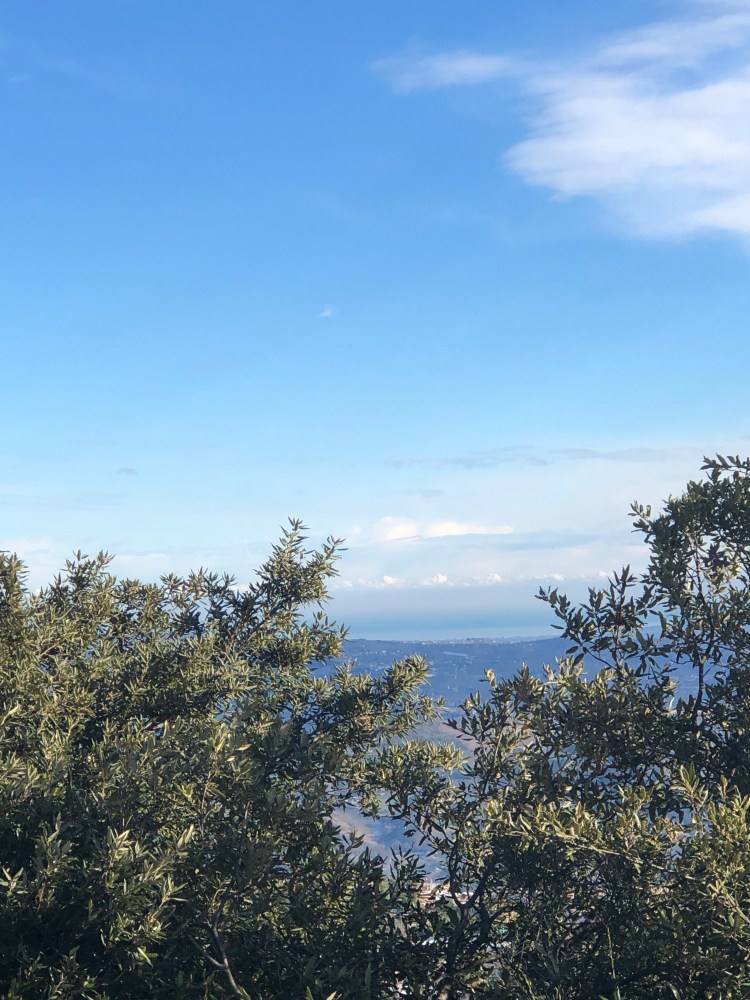
I am back for my morning cappuccino, shot of water, and croissant. It must have rained during the night or earlier this morning, as there were puddles all around and the stones were beyond a little slippery for this aging person. However, as I walked down the main thoroughfare from my little place and through the Piazza del Popolo, there was a clothing market set up. I can imagine a few people having a heyday browsing through this morning. In fact, I sent a picture and a note to let them know they were thought of.

It is about a day or so later and I am on the bus to the airport in Roma. I have been stunned by the beautiful as we travel laterally across this peninsula known as Italy. The number of tunnels as we make our way through the central mountains is staggering. The civil engineering needed to complete the passageway/highway had to be extraordinary. I am taking pictures as I ride the bus, but there are some relatively low clouds so it is impossible to see these mountains in all their grandeur at the moment. Currently I am in a tunnel that is over 10km in length or about 7.5 miles. While I can make much more sense of what I read, perhaps not as much of what I hear, I still work to use my manners and my greetings spoken in Italian. My Air BnB person told me I was both polite and kind. That means more to me than money. It is what a grandmother taught me as a pre-schooler. Manners and appropriate behavior were not demanded, but they were expected. That eventually became a self-expectation. The older I become the more it is ingrained in the fabric of my being. Those of you who know me know I have a smart-ass side to me, but if you know that, either you have had me as a professor or you know me quite well. As I write this, I am in the aeroporto in Roma. It will be a very long day by the time of get to Murcia, but I am excited to see Elena and meet there in her hometown.

I believe that Rome might have the cleanest, most accommodating airport I have ever been in. From the bathrooms, which were spotless and smelled pleasant (yes, truly did), to resting couches to free charging areas everywhere, it was the most enjoyable time I have spent in an airport, perhaps ever. I had an incredible meal, the most attentive service and an astonishing price for what I had. I think there are a number of airports who should take some lessons. As I traveled through the airport, I think, once again, I saw the most diversity in one place I have ever experienced. From Africa to the Middle East, from Northern Europeans to those from maybe Serbia or Montenegro, from Americans to Russians, I think there was a bit of it all . . . and the airport was efficient from baggage, through security, to boarding. Again, impressive beyond words. The thing I found most mind-boggling was the politeness of every person I met.

It is that diversity and politeness that is worth considering. As an American, we have long prided ourselves on being that beacon of diversity, of welcome, of opportunity. I grew up as someone proud of claim citizenship in one of the most beautiful, significant, and incredible democracies the world has ever known. Certainly, there was more of a veneer to what I saw than a child of the 60s realized, but nonetheless, the American dream with hard work and persistence was achievable. My parents certainly epitomized the example of wanting their children to succeed beyond what they had, and as blue collar people, they were successful. They bought a house and a bigger house in time. They were not ones to spend foolishly, but they did save for the rainy day, and, as I have noted, while I did not have everything I wanted growing up, I always had what I needed. My father worked overtime, sometimes from a distance, but always had a work ethic that I have grown to admire and now one I hopefully emulate. It is interesting for me to ponder what he might think of our present political situation. I know he would be incensed with the shutdown and hardworking people being thrown out of work. As staunch of a Democrat as he was, I am sure he would have some choice words for our current administration and even more so for our President. He would tell all in Washington to get their proverbial “caca” together. I know this, he would have no use for the arrogance, the bullying, and the lack of truthfulness that is currently rampant from 1600 Pennsylvania Avenue.

Over the past few weeks I have found myself also more incensed with the shutdown and the politics of Washington (that is a bipartisan statement). While I have honestly tried to give the President some benefit of the doubt, it becomes harder to do so daily. He had an agreement in both houses of Congress before the shutdown and he pulled the plug, backing out at the 11th hour. In a meeting with then Minority Leader Schumer and Minority Leader Pelosi, and yes, now Speaker, he arrogantly said he would take the mantle of the shutdown (I should note every time I have written this word, the first two or three times it typed out as “shitdown” – hmmmmmmm). Now he says it could be weeks months, or years, and walks out of a meeting in the last 24 hours because he is told no. There is money for extended and additional personnel and electronics. Even people in Texas, the longest-length border state, are not completely, supportive of this wall. The Republican Representative from Texas who had chaired Homeland Security is not supportive of the President’s actions. In the meanwhile, a person for whom I have the deepest respect (and his remarkable family whom I love) is unpaid because he is in the United States Coast Guard, which falls under Homeland Security rather than the DoD. Not fair. We are a country of immigrants, and yes, primarily legal ones. Studies, and there are numerous, but I am flying so I cannot access them, that illustrate that illegal immigration is actually down. Certainly the more robust work of ICE (which is another issue for another time) and border control has made a difference. Again, studies show that more illegal drugs come through actually ports of entry or tunnels, which a wall would not stop, so that argument the other night rings empty. Simply, we have a bully in the bully pulpit. We have a tantrum-throwing 72 year old toddler occupying the most powerful office on the globe.

What if we opened the entire government, with the exception of Homeland Security (sorry Nathan) as a first step. Then fund the Homeland Security Department for 90 days. There is a reprieve for all of TSA, the Coast Guard and whomever else the department affects (FBI, CIA). What if the Congress (both parties) work on an immigration compromise until they actually get it done, with the following caveat. They cannot pass any other legislation until that is accomplished. In other words, get it down, immigration, DACA, border control. All of it. If they do not come up with something in 90 days, I think that explains just how out of touch they all are. I actually feel badly for all the new members of Congress; they must feel like what the hell is this?

It is again another morning and I am in another country. My former student from over two decades ago, and now friend, Elena, was kind enough “to fetch” me from the airport at 11:30 at night and take me to my hotel in Murcia. I fell asleep relatively and got in reasonable time. Murcia is a metro area of a little more than 400,000 and we spent some time walking around the city center. One of the more fascinating parts of the day was visiting an archeological site discovered when they began to clear an area for a new parking ramp. In the process, they discovered a centuries, in fact almost a millennium old Muslim village, including a boarding house, two more aristocratic “mansions,” more simple dwellings, a cemetery, and a mosque. It is an active dig, so we were able to watch both experts from a company hired to manage the site along with archeological faculty and students from the Universidad de Murcia. They explained how they were determining issue of age of the remains by DNA testing, isotope testing and a number of other incredible things. I thought of Dr. David Fazzino back at Bloomsburg over and over and imagined him working here. We walked this tour with a group of professional tour guides so it was interesting all the things they heard to be able to lead others. Elena translated for me, but I was able to understand more than I expected.

The connection to immigrants here is the Moors or Arabic people occupied this area for a long time before the Christians had come southward, but the conquistadors and eventually Ferdinand and Isabella we’re determined to wipe the Muslim influence from the area. The significance of the Mosque they are unearthing is that it is probably the only mosque not destroyed and then to have a church built in its place. The significance of this Arabic culture is found throughout Murcia and it is astounding and beautiful. It reminds me of the beginning of movies like Robin Hood. Please do not judge me on that, but I am reminded of how little we know about the Arabic culture in American and what a terrible lack that is. Second, there have been terrible consequences for our lack of knowledge. We stereotype and believe things that are actually completely contrary to what Islam is all about. It brings up, however, another important concern.

The belief that Christianity could be the only true faith has a long history of atrocity, all implemented under the guise of faithfulness, using an incredibly arrogant interpretation of the great commission. Often immigrants themselves, they used the money and power of the church to socially or militarily conscript people into accepting the faith. Ironically, the means used were not all that in line with the greatest of all of the commandments. Perhaps a greater, and even more problematic “sin,” if I am be so blood, is the seeming evangelical take of the Christian Right today is much of the same: preach what serves your needs and ignore things that are glaring contradictions to a gospel that is supposedly good news. The Rev. Dr. Chuck Currie, the university chaplain and assistant professor of religious studies at Pacific University, claims this “blind support is theological malpractice.” I found a myriad of article that claim the inconsistency between belief and the President’s glaring moral turpitude is beyond stunning, and I agree. More importantly the idea of loving your neighbor is nowhere to be found. At some point, even within our own borders, we are immigrants. If I were to pick up and move lock, stock, and barrel to Montana, I would feel like a foreigner. If I were to move to Texas, even though I was born there, I would feel alien. If I begin a new job in a new place, simply because I wish for a better life, I would be the “newb” trying to fit in. I would be an immigrant. As I have noted before, and at the beginning of this blog, I am not against legal immigration. Let’s do the humane thing, let’s try to actually love the other. Let’s open ourselves to making democracy truly democratic and not merely for the rich. As I was reminded so poignantly a few years ago, I am privileged, but I do not own that privilege. As I have traveled and tried to speak, listen, and learn, I am reminded of how much of the world is more accepting and open than a country that was initially created as we conquered those there before us. We were a nation of immigrants hoping for something better. Our idealistic idea of pilgrims and Quakers is not as benign as we want to believe. Our present administration’s practice of implementing and creating a systematic hate or fear mongering of those (a great majority who are simple people) hoping to find safe haven in a country that has long been the beacon of opportunity and fairness is wrong and it is against my reading of the gospel. Kryie Eleison!! I remember when I first heard this song and Dr. Donald Harrisville Juel and I spoke about it so many times and listened to it together. I still miss you Dr. Juel.

Thank you as always for reading my thoughts, written as an American citizen, a professor, a traveler and former Lutheran pastor.

Dr. Martin

Back after 38 Years

Hello from my flight to Amsterdam,

This will be my first time to be in Amsterdam in an fashion. It is a city that I have always wanted to visit, and yes, for many of the reasons everyone hears of, but it is another country to add to my list of places traveled. As I have noted at other times, I was not a traveler as a child. There were numerous reasons for that, but it was most often because of money or time. The very first time I would board an airplane would be in June of 1973 on a flight terminating in San Diego, California and then a short bus ride to the infamous yellow foot prints of Marine Corps Recruit Depot (MCRD. I was the closest thing one might be to Gomer Pyle sans a North Carolina accent, and perhaps even more frightened. My life I’d travel, outside the military, would begin in the last days of December 1980, when I traveled as a member of Dr. John W. Nielsen’s interim travel class of that year.

Traveling to Europe that year after two semesters of taking Dr. Nielsen’s inspirational and, at least for me, life-changing humanities class, it is ironic as it is, I spent the morning at the Museum of Archeological History here in Ascoli. It was like walking through my Hum 107 class in person. The artifacts in this museum dated back to the 10th century BC. I thought of some of my classmates and how the Humanities sequence was such a difficult thing for them. I found it fascinating and certainly that first trip to Europe, which included Italy and Spain, two of the countries where I am presently traveling, made it all real to me. That was, as I have noted previously, when I learned that learning was experiential and not merely memorizing. Learning was being a sponge as I say . . .  it was soaking it all in. Yesterday I walked up a set of steps to a university that had stones in the walls that were inscribed with upper case Latin letters. Some of the writing I saw in the archeological museum today came from as early as 2500 BC. It is a cross between a script and pictographs. Some of the writing looked like it was Elamite in form (look for Elamites in the Old Testament). However the upper case Latin script was probably from the early Renaissance and those stones were probably excavated and reused. There are medieval churches here on Ascoli that have incorporated standing Roman columns into their architecture. Today, I say pottery, metal works, jewelry, tools, burial items and a host of other things from as early as the 10th century BC until the Roman Empire period. It was fascinating and stunning for me to realize that I was walking among where there had been civilization for 3,000 years. It made me feel very miniscule. My 3 score + 3 is not even a blink of an eye in all of that. Later this week I will be in Spain, in an area that will be new to me yet again, and once again, I am fortunate enough to know someone who lives there. It makes the travel so much less stressful and enjoyable to share all that will happen. It is like having a personal tour guide. I know Elena has provided some things already that I am incredibly excited to see. I think the area of Spain to which I am going has a rich and glorious history of its own. Murcia was established in the 800s by the Moors it seems. It is known as the orchard of Spain, so I have a feeling there will be a lot of fruit eaten in the next week!! That makes me happy. My reading about it shows it has a rich history and a rather multicultural foundation and the wars between the Christians and the Muslims were difficult on the area during that time. It has a very temperate climate and speaking with Elena, it has been in the low 20C the last week, which is in the 70s. That will be a change. She noted it also has gotten to about -7C in during the night, so that is a significant range in a 24 hour period.

Today in Ascoli, the weather was pleasant, not warm, but also not any sort of biting cold. I did not wear gloves nor a hat and I was not chilled at all. Again merely walking around and looking at the buildings and the streets is a treat. There was a significant earthquake here two years ago, and many building now are reinforced to keep them from crumbling. It is quite interesting. I will post some pictures on my Facebook illustrating this engineering feat. Today, I think there were two things that amazed me. First, it was simply that there were artifacts from 3,000 years ago and they were from this area, so that explains how far back civilization in this part of Italy goes back. For a reference point. It is about the same time that David was the king of Israel. This is one of the things I note in my Bible as Literature course. That the Hebrews were not the only people in the world and what was happening to the Hebrews was in a larger global context. The second amazing thing was listening to Gia and Carlo after they came home from school and listening to everything they are required to do each day. Gia has learned to write cursive, and she has beautiful handwriting already, and she spends significant time on her Italian and mathematics. Carlo has learned to speak Italian quite well also, and they certainly do not sound like Anglophiles with their accents. It is really quite wonderful to see how they are absorbing the language. I asked Gia if she was dreaming in Italian, and her response tickled me. “Yes, she responded, but they are nightmares.” I hope she was kidding, but her father noted that sometimes in her restless dreams she is speaking Italian. Language is such an incredible process and tool. When I was in the museum today, there was a graphic that illustrated the connecting threads of ancient alphabets to the succeeding languages. It was fascinating to me and I thought of our amazing linguistics professor back in Bloomsburg, Dr. Angelo Costanzo, and how I wished he were standing next to me. With my rudimentary Spanish, it was interesting to see the connections to Italian and I wonder how all of that happened. Certainly, I wish I would have had the opportunity that Gia and Carlo have now. They have no idea how this will change their perspective on life, themselves, others, and travel in general. It is great fun to listen to Marco, who  is quite proficient as we go from place to place.

While I am sure that Italy and Spain have changed in the 38 years that have passed since I came to these two countries as a college student; I imagine I have changed more. Italy has such a rich and robust culture that dates back to the beginning of our Western Civilization as we understand it, but as I learned today, it has so much more before that. When I was in Barcelona in January 1981, Franco had not been dead that long (six years or so) and the militaristic aspect of Spain was quite apparent. I still remember being stopped on the border as we crossed from France and being searched because I was sniffling, had long hair, a beard, hiking boots, a down vest and blue jeans. I spoke no Spanish at that time and I was petrified as they searched all my belongings. I think my introduction to Spain this time will be quite different. Being a sexagenarian probably has its benefits at this point, and the gray hair and white beard (which more often than I would care to admit) has some calling me Santa – and that is not just those who know me and do it in jest. Oh well . . . again what astounds me is the sense of history that surrounds every step I take, every breathe I take (and I am not trying to quote any song at this point). Each day I see something new; each day I find myself pondering the fact that I am walking where people have walked for 1,000s of years. And I began this blog thinking 38 years was a long time. Certainly it is when it comes to a proportion of my life, but it is merely a blink in the eons of time that I am traipsing through on my own little journey. That is also the great thing. It has been quite a journey. I have been richly blessed by so many things, experiences, and people. Little did I know that a visit to a winery in the foothills of the Sierra Nevada Mountains in California, and north of Sacramento would still be affecting me today. Little did I know that a class I took in college in the Spring and Fall of 1980 would prepare me for some of the things I observed today. Certainly the farthest thing from my mind as a graduate student, teaching a second semester writing class to an entire class of foreign students, would create the opportunity to have an amazing connection with a student who is now a student with a PhD from Sudan, or to stay in contact with an astounding engineering student from Spain, who has now welcomed me to visit her and was kind enough to visit me in Poland two years ago almost to the day. Quite unexpectedly, life comes around and things that happen have long-term ramifications. One of the things I have always tried to do is maintain those relationships. Certainly, it does not happen with everyone, and there are times people move on and out of our lives. That is normal; then again, there are times where those past experiences create the foundation for new ones.

So once again, I am traveling and learning. Once again, I am connecting with the gifts, the people, who I was blessed to meet sometime earlier. One of the things positive about all of this social networking, including this blog, has been the ability to stay in touch in meaningful ways with those from my past. All the way back to my roots in Riverside, I am fortunate to be in touch with so many people. Life continues and the journey for me has never been boring. It has been a life of learning and pondering. It has been a life of wonderment and adventure. It has been a life of challenge, but also a life where I have been gifted by amazing people who have helped me with the challenges. I think of Lydia once again. She took an enormous chance with George to come to America, leaving behind the relatives and world she knew, but she survived and thrived. That is what challenge and opportunity offer: a change to survive, a change to thrive, the opportunity to change and grow. I hope I will continue to grow and learn about this amazing world in which we live. There is so much more to be thankful for and as Americans it seems we have lost some of that ability to see what the rest of the world offers. Perhaps we will find it again. The picture at the beginning of the post is looking out over the city of Ascoli Piceno. The video is my hope for the world in which we live. While the later part of this amazing musician’s life was clouded in controversy, the message of this song rings true. Please take the time to watch the video; it is a bit idealistic? Of course, but as I watch two amazing little American children learning Italian, I want this for them.

Thank you as always for reading and I wish you a blessed new year.

Dr. Martin


Prayers Answered

Hello from Costa on ulica Karmelicka,

It is always interesting to return to somewhere you have been before. The change in perception that occurs from familiarity is a difficult thing to quantify, and if the return is more than once, understanding the changes that occur go beyond mere perception to emotion. I think of how Riverside, the blue collar suburb of sorts where I grew up in Sioux City was my home for the great majority of my childhood. Yet, in a sort of reverse of what I am alluding to, it has been so long since I spent time there that some of the memories of places that no longer physically exist (like my grade school). How much of our emotional, spiritual attachment is based on the physical experience? How is it that memory is evoked by movement, sight, repetition? These are things I lay awake sometimes and ponder. I am sitting in a coffee shop I came to my first time in Kraków. However, a barista from my summer work here who worked at a Costa I had immigrated to is now at my original Costa hang out. Each Costa carries memories with it. I was unaware that Mariusz had transferred, but he saw my Facebook post and let me know. It was nice to connect a familiar face from my extended summer to the Costa of the past 5 years.

More importantly is how my geographic awareness of Kraków is so much more acute than in my previous visits. It is interesting to me how summer for me leaves more lasting impressions for me. Is it because of language? Is it because I walked so extensively and spent so much more time taking in things. I also think the light of the summer and the longer days also affect my ability to assimilate things. I think part of it is that I am happier and more energetic.

However, as I walked to Dom Profesorski this morning, the memories of students from each year I have been here came teeming back. To see some of my own students on this year’s trip as well as long-time colleagues here for the first time was quite a boost to my morning. I am only here for not quite a week, but even the few days of refacing my summer steps in the winter season has come something to assimilate this Krakówian (a sad attempt to connect Polish with an English adjectival ending) experience even more. As I sit in Costa and work on my last blog of 2018, I realize things still do not slow down.

Yet, I cannot remove the poignant memories of my first visit to Kraków and Poland. I had left Wisconsin and said an incredibly emotional final goodbye to an amazing woman who had become my mother and so much more. I was coming to the ancestral country of her husband, a person I had not met. I remember Lydia’s Christmas Eve Polish conversation with the spirits in them corner of her room. I had asked her if George (Zdzislaw) was there. She nodded in the affirmative. I then asked her if she was ready to go home. She shook her head decidedly and sternly in the negative. She knew what she wanted to the very end.

Four years ago I was wandering across center city Kraków for the first time being shown around by Robert, Maria’s father. Ironic, how a student connection created what had become an integral part of my life. It was a day much like today, a bit grey an while chilly and damp, not anywhere really cold. We went into the church where Saint Pope John Paul II had served as the Archbishop of Kraków. I lit a votive candle and prayed. I actually took the time to reach out to George specifically in the prayer. I asked him to convince her it was time to come home. It was the first time in my life I wanted to let someone I do loved go. It was the first time in my life I remember reaching out to someone I believed to be beyond the bonds of this life to request their intervention into the world I knew. In spite of my theological foundation, I wondered the how, but believed more in the reality of its possibility. As I raised my petition, i remember my eyes filling with tears, but also feeling a sense of calm, believing it was time to let her go. Again, for the first time in a very long time, I prayed for what was best for the other. I remember telling Robert what I had done as we left the confines of this holy space. The remainder of my day was preparing for a New Year’s Eve that would be spent with the Paras.

What happened in the next 24 hours or so still amazes me. I would go to sleep on the first of January, ready to imagine a new year. I had not been long when my cell rang. It was Nathan telling me that Lydia had passed away. It was still January 1st in Wisconsin. To this day, and particularly on this same day of the year, four years later, I am as convinced as ever that my being in Poland, George’s ancestral county an in the parish of the former Archbishop had consequences for the simple, yet fervent, prayer of a dutiful, surrogate son. This fall my Bible as Literature students asked me how I understood the workings of faith. When I am asked such things in that class, my default is to remind them it is not a religion class, but rather a literature class. Yet much like my confessions professor in seminary as we pushed him on his opinion about something about the Lord’s Prayer, I allowed for an answer. I said both simply and humbly that faith for me is best understood through the single verse out of Hebrews. “Now faith is the assurance of things hoped for, the conviction of things not seen” (Hebrews 11:1). This has been my foundational verse for most of my life, and even more so as a seminary student, pastor, and beyond. To pray requires faith. To pray requires both a sense of assurance and of hope. To pray to that unseen requires a strong conviction (or maybe even a simple one) that your words actually are heard and make a difference. Then there is a belief that what happened in the next 24 hours were a consequence of the said prayer. The very fact that I am recounting it four years later illustrates that somehow I have the assurance of this thing hoped for.

Today as I sit in Costa, I cannot help but remember the various student groups who have been here in this amazing city on the last week of December into January. My first year, there were three students in particular. Joe had been a student in my Foundations class and would go on to graduate school, not just anywhere, but in Israel. I am quite sure that what he learned from Dr. Annamaria Orla-Bukowska had a profound influence on what we would study. The next sure I was fortunate to come along in a different way, as part of the faculty-led program. Again, some of the most amazing students were on the trip. I think of a veteran military student who would come back in Krakow the following summer to study Polish and work on his dual citizenship. I think of another student with aspirations to go to work in the Peace Corps and was accepted until his health created a difficulty. I think of a young woman who was both an outstanding student and absorbed every cultural event or exhibition we visited like a insatiable sponge. There were students the next year who are now here for the third time leading others, that is how much Krakow has influenced them. Last year, we were blessed to have the president of the Alumni Association for the university come and accompany us on part of the trip. During those years, I was fortunate enough to visit places like Budapest, Lviv, and Prague. Twice I have gone to Austria, and Lydia’s beloved city of Wein, but I need to go back on my own and spend some time. As I returned for this trip, I have met the group at their accommodations on ulica Garbarska, but I am not traveling with them. In fact, I am traveling on my own  with a most dear person and on Thursday will be flying to Italy to visit my great friends, Marco and Belinda and their two amazing children. It will be the first time I have been in Italy since 1981. After a week there, I will be going to Spain and visiting my friend, Elena, a former student at MTU, and one who visited me on my second trip here to Krakow. This visit is a promise kept. I think the important part of all of this is how the amazing connections and people I have met have changed my life and made is such a blessed one.

As I finish this blog, I am reminded of that first journey. It is now still the first of January in the States, but it is early on the morning of the 2nd here in Krakow. I walk up this morning about 2:00 a.m. It was exactly the time Lydia passed on four years ago. I did not realize it at the time, but the time corresponded to my answered prayer. It is interesting how I believe those spirits and powers outside out lives work both in ways too subtle for us to realize and sometimes in ways to obvious to miss. I know that the people who I met from Comforts of Home, Lydia’s abode for the final almost four years of her life, still influence me. Carissa, the administrator who treated Lydia as her own grandparent if you will, Angie, Breanne, Leah, Leighann, Marissa, Mindy or Stacey, and others whose names escape me at 6:00 a.m., will always be dear to me for the care you provided her. It is now the beginning of yet another year. I wonder what prayers are being offered even today as those individuals in the twilight of their lives are struggling with the most simple of tasks. I wonder about those amazing caregivers who give more of themselves than even they realize and for so little monetary compensation. I wonder about even my own existence when there are sometimes more maladies than I could have ever imagined to manage for an aging, but still small-child at heart, traveling professor who seldom grows old of learning something new. What are the prayers I will offer as I finish this blog. I think my prayer is simple and yet profoundly difficult.

As I read the news in America from here in Central Europe, I pray that our elected leaders can learn to listen to those who have elected them (and I realize the cacophony of voices is difficult and painful to hear for all the disharmonious sound) and act for the mutual benefit of the country that has elected them. I pray that a President who was duly (and embarrassingly at times) elected might realize that the tweeting that he does has consequence, whether it be some random thought or his real intention, and when he puts things in public, it is done as the President. I pray that we can see a global and civilization that needs care and mutual respect for all people, that the desire to have freedom and the ability to thrive is a human desire not a gift that belongs to only certain people on the winning side of a wall. As I travel and see students from Bloomsburg once again, I hope they will see the profound goodness of the places they visit and remember the profound evil that we as humans can unleash given the right circumstance (their visit to Auschwitz this weekend). It is all here in this beautiful country called Poland. I pray for all my friends and even those outside that realm that they might be blessed with health, with a sense of happiness or contentment, and that the things they do will be a blessing to those around them.

Welcome to a new year and bless you all. Thank you for reading.

Dr. Martin

Walking and Wondering

Good early (sort of) evening

My intentions of writing more this month have been hijacked by the end of a semester, managing my health yet again (I know it has daily requirements, but it has created yet another dilemma), and attempting to get ready for some holiday things, which have all gone by the wayside as the health issues have taken center stage yet again.  As I write this I am in my at home office upstairs between 5:00 and 6:00 a.m. trying to get some things accomplished before the day gets hijacked by other requirements. IF I am to be completely candid, parts of what followed began last summer, and I will try to work them into this entry, but then again, doing so might reveal how randomly my brain seems to work, and that might not be the best thing into which I should offer insight being as some of my followers here are my students.  One of the times I was working on this blog was while students were filling out evaluations; I actually do not worry about evaluations and there is so much that can be learned by them. I also realize the difficulty in the use of such instruments on a variety of levels, but there is no simple way to have students respond to an opportunity to give some sort of response when it is one of the few times they have power (and they really do). They believe all too often they are the customer in what has become our business-based educational system. It is not by accident that we have an Education Secretary, one who is immersed in the Republican Party, charter schools and voucher programs, and has made her fortune with her husband through Amway, perhaps the most Ponzi-ed of all companies in American history. I do know people in Michigan who have directly benefited from the charter schools she has specifically implemented, so I need to also be truthful in that disclosure. However, the idea that students are customers-first is fundamentally flawed for me (another blog posting).

As is the case for most of us, the end of the year creates a time where we often reflect, ponder or imagine what might be in the future. There is so much I have pondered as I have considered the year that is almost over. I began the year in Europe and I will end it there. Yet that is not anything particularly new; it is, I realize, how I have begun every year for the last four, and a few earlier in my life also. On this day four years ago, I began a journey of a different sort. It was the day when I began a final journey with Lydia. It was the day she crawled into bed and really did not get up or eat again. It was the day when I began a watch that I could not finish. Thank you even today to Nathan Langton and his family for doing that. I think about the life you lived and how your life of travel and destiny took you places that you perhaps never imagined. Traveling has become my second education, and integral to my life. I know that some of you will say that seems to be a normal process for me, but it has not always been so. I grew up not knowing much outside my own little town of Sioux City, Iowa. Travel for me was across town and a big trip might be 50 miles away to Beresford, South Dakota. Seldom did I get beyond the tristate area of Sioux City, South Sioux City, NE or North Sioux City, SD, one could be driven to in 10 minutes and one could be walked to in 10 minutes. My first plane ride was to MCRD, San Diego.

One of the times I attempted to create this post, I had just returned from a leisurely three-plus mile walk around the Mayberry of the Eastern Shore. Cape Charles, VA, also known as Cape Chuck or simply by its zip code of 23310, is a sleepy, but waking-from-its-slumber town that offers a place with beautiful scenery, quaint little businesses and a changing landscape that seems to illustrate that its ability to stay off the radar day has perhaps come to an end. Through the graciousness of a colleague and another mutual friend, I have had the opportunity to visit here four times over the last 2+ years. Even in that time the development had picked up and businesses have sprouted up in once abandoned store fronts from a post-WWII era. Once a harbor on the Chesapeake, it no longer had the influx of people and commerce and got a bit forgotten. Somehow the rediscovery has changed both the view and the visitors. I think that is how life works. We discover ourselves and we are discovered by others, sometimes in spite of ourselves. I am still, at times, trying to figure out who I am and what I want. What I believe more and more is we are a somewhat dichotomous, contradictory, paradox (how is that for redundancy, but done intentionally). We both want and push away; we both yearn for and reject the very thing we desire. I think this is the thing I have most realized about myself. Is my life little more than a phase, traveling, both literally and figuratively, from one thing to the next, seldom cognizant of where we will end up? Certainly we can breakdown our lives into phases or segments. Surely we can imagine those what if?moments where a single decision could have moved us in a very different direction than what has occurred. My first philosophy professor is probably smiling from wherever he is as I wonder how much determinism is actually who we are.

This morning up early, I have been working on multiple things as I write this: a winter term class, a Facebook post, course content, managing recommendations. There are those who believe we are on break now so there is nothing to do. I have done some relaxing (mostly sleeping and recuperating) this past week, and there will be some more, but there are so many things I still want to accomplish and explore. I think that has always been my difficulty. It is more than merely a cliché phrase of “too much to do and too little time.” It is not an imperative that is imposed upon me, it is me wanting to do what Robin Williams noted for his students in Dead Poets Society . . . it is about believing I have something to contribute. I am not always sure what that is, but I am passionate about figuring it out. This past week I received in the mail my offering to the Facebook empire through the form of a picture album of the time I have been on this social media country. I had inscribed on the first page: “If I make the lives of others more meaningful, I make my own life more meaningful.” It is something I have said for quite sometime, and I can say without hesitation, it is my life. There are times I have lost sight of that. There are times when I have helped others expecting something back. That is a problem and something I have noted in these posts, before. Help with expectation is not really help, it is self-serving. It is something I am trying to change in myself. It is also about boundaries and there again is another post. We are certainly the products of our past. The baggage we carry from all sorts of ways can keep us from reaching or even attempting to reach our potential. More significantly, it can keep us from imagining such potential.

I see this on a daily basis when students are either not willing or incapable of seeing beyond the immediate. When I hear something like “but I tried really hard,” and their work does not demonstrate an end product that even reaches mediocre. Some might question my standards and expectations, and that is fair, but I expect little less than the best they can do. Why? It is all about what my previous provost noted is potential. She noted that all people have potential, and on that I will agree. It is encouraging, motivating, requiring them to use that potential that I believe education is about. Again all three of those adjectives are necessary if potential is to be even within the realm of becoming reality. I think this is what John Keating (Robin William’s character) was trying to get his students to realize as he asked them to gather round. There is an irony when he asks what verse will they contribute a Ethan Hawke was in his first real starring role. Robert Sean Leonard, who plays the tragic character of Neil Perry (and is almost 50, what the heck??), has done quite amazing things from that first acting gig. Gale Hansen, who played Charlie Dalton (Nuwanda), has gone on to be a film executive. I took the time to look up some of the others as it was known to some that Robin Williams wanted to work with beginning actors in this amazing film. I have read that there was a grave concern about the movie even being accepted and I listened to a funny quip when the screenwriter was told by someone the title was made up of three terrible words. The significant part of the movie for me has always been Keating’s push to make the students think for themselves. Something outside the norm in the crackerjack 50s where everything was to be predictable and measured. I am not sure we are that different now. While there are certainly a lot of things that are open for consideration that were beyond the imagination in 1959, there are still too many cookie-cutter ideas that control who we are and what we think. Go to college! Study the right things! Do what is successful and will make you money! As I have asserted in other posts, there is so much in our system that screams out . . . just do what you know works. Do not think for yourself, merely jump through the educational hoops and it will all work. I know students who do remarkably well in college and they hate their lives. They are studying something because their parents told them this is what they will do if they want their parents to foot the bill for their education.

As someone who straddles the line of a liberal arts background, and with apologies to my dear colleges in Mathematics or Sciences, and as someone who wants to puke every time I hear STEM at the expense of the liberal arts. I teach writing for the real world, a world in desperate need of qualified individuals from every background who are necessary if we are to have a cooperative and thoughtful world. I teach students how to become people who will use their communicative skills in vocations across the spectrum. The importance and use of critical thinking and thorough analysis is not the property of the STEM academics. It is a liberal arts foundational principle. Sorry! I guess my rant side came out for a moment. I was blessed to teach a Bible as Literature course this fall and I had a terrific group of students. More importantly, a number of them spoke about how much they learned in the class and how they will take what they learned about both study and critical thought with them long after the course. That is what I hope happens in all of my classes. I tell them regularly, I do not want them to memorize things; I want them to synthesize things. I want them to think and analyze things. I want them to question, albeit respectfully, but I do expect them to use their brains, their voices, and their determination to become something more than they were when they came into my class. As I write this, I just heard that General James Mattis has submitted his resignation as the Secretary of Defense. This four-star Marine General certainly has a widely considered history as a Marine officer, but he demonstrated today that he is principled. He is considered an intellectual combat officer and one who is both thoughtful and eager to engage and defeat enemy. It will be interesting to see what follows in terms of replacement and the condition of the Pentagon. The reason I raise this issue is we live more and more in a world that seems to have lost its direction, either in terms of a moral compass or in sense of any consistency.

All of this has me walking, wondering, and weighing what might happen next. I am concerned because there is little long-term consideration of the consequences. I speak regularly about the importance of understanding what it means to claim something, to be actively involved in it, to determine some of the possible outcomes, but also to understand what others might do in response. This is what I study most. How does what we do affect the audience for whom it is intended? Those of my student who might read this are probably rolling their collective eyes. As you consider this over next few weeks, I hope you have a blessed and memorable holiday season.

With that I leave you this scene from Dead Poets . . . enjoy.

Thanks as always for reading,

Dr. Martin

More than a Dirt Nap

Hello from my office on a Friday afternoon,

Between meetings and a couple of other things (including grading), I am considering some things in light of my Bible as Literature course and wanted to write. This past week, my Bible as Literature student have asked interesting and thoughtful questions about life (and beyond), and while it is not a religion class, when you are using the Bible as one of the central texts of the class, it is not surprising they might ponder and ask things that demonstrate they are trying to figure out questions of context, authority, and authorship and how those concerns might push them to consider what they have heard (either within their church background or without a specific church background), be taught, or as part of their own maturing and growing process. I think I have been pondering a bunch of things in response to their inquiries.

Certainly, an element of that is understanding one’s mortality. If my adoptive mother were alive, she would be 98 years old tomorrow (she lived to the age of 68). In terms of my own life, it is 32 years tomorrow that I had my first major abdominal surgery, while I was an intern pastor in Big Lake, MN, at the hospital in Coon Rapids, MN. I still remember how terrible the prep was for all of that and how I learned quite positively that I was allergic to erythromycin. Most assuredly, other things have happened since then to remind me of my own mortality, and that is more a case of reality that I would have ever imagined. Today as I searched another situation, I found that another person for whom I have an unparalleled appreciation and to whom I owe so much for their care was my cousin, Joanne Wiggs. I found out that she has passed away and joined her husband Jim, who had passed only 9 months before. They were both so good to me. I am sad more than some know that so much had changed in a situation that I was not involved in either service. They were one of the last few people I visited before leaving the Midwest to come back to Pennsylvania. They had grace and charm (both of them) in ways few people ever have, and I imagine ever will. It gets back to some of what I addressed in my last blog about civility and decorum. I remember my father thinking that Joanne was the most consummate hostess ever, and he was correct. I am sorry they are both gone. The picture at the beginning of the post is my picture of them about 9 1/2 years ago.

That was a slight digression, but an important one. It is sad to lose people. This morning what I woke up thinking about was the idea of religion and dying. It was not a morbid idea for me, but rather one of systematics. I do have students in my BAL course who claim to not believe in God, are unsure there is a higher power, and imagine nothing occurring when one passes except we bury them and continue on with our life. Hence my rather stark title. What actually happens when we die? Do we end up in some sort of purgatorial, soul-keeping holding cell until a second coming? Do we die and immediately we are away that there is something beyond, be it heaven (or some kind of eternal bliss) or hell (for me, the condition where there is an absence of anything good)? Certainly the fact that a number of students take a Bible as Literature course can be traced to a number of reasons (and some of it is getting credits to graduate), but I think for many it is their first foray into making whatever faith they come to college with their own versus it being merely what their parents tell them to believe or model for them. I think what I realized this morning in my early morning puzzling was a sort of if there is no real God and there is nothing beyond our demise, then it really is a dirt name, and nothing else need be considered. One of the students working on their paper stopped by yesterday and asked me how teaching the Bible as Literature affected my own personal faith. This is another thing I have deliberated upon a number of times. However, I think for me that is one of the amazing things about faith. From where does it come (which I, of course, have some specific thoughts ~the power of baptism), but assuredly, there are those who argue that it comes from our own human frailty. It was interesting to listen to one of my students from another class address some of that very thing this past week. Because I no longer wear a clergy shirt, and formerly being a pastor is not something I generally address, when students find out that is part of my background, I get a wide variety of questions.

Yet as I have noted, teaching the Bible as Literature class might be the thing that most affects my own piety as well as the practice of that. Faith is best described for me in Hebrews 11:1. I said this when I was in seminary; I stated it as a pastor, and now as the professor, it has not changed. I think back to when I was  a Sophomore in college and one of the freshmen students told me they could prove that God exists. They thought they would have an ally in this bit older pre-seminary student. They were not sure what to respond when I told them they were full of S____T and that I did not believe them, promptly followed by challenging them to do so. There is little one can say, calculate or demonstrate that proves God with any finality. It simply does not work. However, that sort of logic also works the other way, there is little that can be calculated or reasoned that proves there cannot or is not a God. In addition, I will go as far to say that much of the damage done to faithful people or their faithful attempts to be faithful are done by well-meaning (and sometimes less than well-meaning) Christians. I call them evangelical bulldozers. They think they can rollover or flatten any dissension about one questioning how God works. Their arrogance frustrates me (my rhetorically correct response to them). Posolutely, throughout Christian history, the role of the church by its arrogance, its abuse of power, and its dissemination of doctrine that instills fear more than most anything else, has created more questions than it has perhaps answered.

This semester I focused on the issue of contextuality in terms of the Bible being written by specific people at a particular point in history, noting that all writing is affected by the culture in which it is created. I tried to help my students see some of the things they merely accept without question because it is in the Bible and why that can be problematic for them. I think the response of a student this semester to the temptation story in Genesis 3 will be a life-long memory. Suffice it to say when I asked how it was Eve spoke “snake” or the snake spoke “human,” my student was a bit perplexed. She placed her head into her hands and shook her head overwhelmed by the indubitably unexpected consideration my question created for her. My comment to all my students is the same, but in this BAL course, the statement is a bit more profound. I tell them regularly that God gave them a brain to do more than hold their ears apart, and furthermore, they should use it. I wonder in my own piety which God would I like to meet? What I mean by such a statement is that I know the Bible demonstrates (or figuratively illustrates) both a powerful and complex God. What are those specific moments when we would hope to have our Moses-type encounter with God? Where is God at those moments? Who is the God we would hope to meet? I think for the most part, I would like to meet God and speak with him at those times when most of what I see does not make sense. I think I would like to meet (and yes, arrogantly ask) God when I am those times where things seem the most unfair. Those are the times when I question God’s power or ability to intervene. Those are the times that the consequence of our supposed sinfulness most vexes me. I wish our selfish arrogance did not have so many consequences.

There is much more to say about all of this, but as we head this Sunday into the liturgical season of Advent, the paraments (the colored cloth in the chancel area) will be blue. Blue is a color of both comfort and hope. It is a season where the haunting music that foretells the Christmas story reminds us of what is coming. While I am not a proponent of Christmas in the stores at Halloween or before, after Thanksgiving the Advent season is actually one of my favorite times. I think that was something that started earlier in my life, but it was something that really was instilled in me when I traveled around Germany during the advent season in 1985. There is something about organ music and chorale music that will always life my spirit in ways few things can. Awake, Awake for Night is Flying, O Come, O Come Emmanuel, Lo How a Rose E’er Blooming, Come Thou Long Expected Jesus, Comfort, Comfort Ye My People are some of the things that come to mind. I think there is something haunting, and yet the melancholy of the season also has an undertone of hope. That returns me to my cousin, Joanne and her husband, Jim. The two of them created an amazing marriage and the love they had for each other was something all of us can only hope to find. They were married for 62 years and only apart for 9 months after his passing. The unquestionable affection and love they had was never someone could not see or feel. The way in which they made you welcome in their home was encompassing. Their home on Summit Street was more of a home to me through the years than my own. They were also people of immense and prodigious faith. They attended mass every morning and I learned much about my own faith watching them practice theirs. . . . this little exercise had me searching cemeteries back in Iowa. I remember going to Graceland Park and Floyd cemeteries before every Memorial Day growing up to clean and do yard work on the graves of the family, my father’s in Graceland and my mothers in Floyd, which for those not from my hometown is named after the only person to die on the Lewis and Clark Expedition, and he is buried above the Missouri River a bit south of my hometown. So indeed, they are all in the dirt, some in caskets and vaults and some cremated. Is there a purgatory type of thing happening there on the Morningside portion of Sioux City and what was called the South Bottoms where Floyd Cemetery is? Is there something more? Is it merely a dirt resting place and there is nothing more? There are times I struggle yet to understand how it all works and what it all means, but as I enter the season of Advent and I remember the birthday of a mother tomorrow and an older brother on Tuesday, I find that for my own piety, I believe there must be something more. It is more than ashes to ashes and dust to dust. Indeed, as I once intoned, “Almighty God, source of all mercy and giver of comfort: Deal graciously, we pray , with those who mourn, that, casting all their sorrow on you, they may know the consolation of your love . . . ” (Occasional Services Book). With that I offer the following in this season of Advent. I hope you might find peace and comfort in its music.

Thank you always for reading.

Dr. Martin

Living on Borrowed Time

Hello on a mid-to- late Saturday evening or night,

Today time was spent helping one of my surrogate children get a new puppy. Not surprisingly, it is the same surrogate that brought a kitten into the house a few summers ago. So in continual rain, the drive was made from the acre to Elmira, New York, a little over two hours, to pick up a little black cocker spaniel puppy. My first dog at my grandmother’s was a black cocker spaniel named Penny. Some of the earliest pictures I remember in my life were feeding that dog. I also remember that she was incredibly sweet and mild mannered.

The rain and early darkness made for a little stress on the drive and on the way home this little fluff ball both pooped all over Ashley; fortunately, I had thought to bring a couple towels. We were more than 20 minutes back on our little over 2 hour ride back when that traumatic event occurred. The next exit led to cleanup and a towel going over a railing into a ditch. About 40 minutes later the food eaten before we picked her up was also up and all over Ashely. This is not appreciated, and I pulled over to a gas station and bought tissues to manage the latest gastronomic mishap. However, puppy feel asleep after that and with the exception of fog, rain, and occasional high-beams, the remainder of the trip was rather uneventful. On the other hand, I struggled a bit with my own gastrointestinal issues, but nothing showers and washing machines could not manage. The second issue for about the last 36 hours has been the sugar level, but I upped my Metformin so hopefully that will assist. Three straight reading above 200 does not make me happy.

More importantly, I want to reflect on the report released by more than 10 government agencies about the issue of climate change. In spite of its release on the day after Thanksgiving, which has angered some people, I would like to believe it has, and hopefully will, cause a variety of people from every walk of life a sense of pause. Certainly, the terms of global warming, climate change, and such are ideographic in nature. I also know that some of you will ask what I mean by this. Ideographic terms are terms or phrases that have been tossed around, for better or worse, and now have a host of things, again both positive and negative, associated with them that when employed bring the entire gamut of thoughts, understandings, and most importantly, emotions with them. This is the most straightforward way I can explain such, but if you want to consider this more deeply, look up Michael McGee, one of the foremost scholars in this area. John Lucaites and Michelle Louise Condit are two more profound scholars in this area.

We are consumers and we want to believe our consumption is without consequence. It does not matter what it is, we want it now; we want convenience and we want to live our lives with the ability to be spontaneous . . . and we would rather not be bothered with any such requirement to consider the cost, at least generally not beyond the present amount that is from our wallets or purses, our checkbooks or our credit cards. The long-term is a different consideration and we generally prefer to not be bothered with the hypothetical as we want to call it. I am not sure we can call it hypothetical any longer. I am. Not sure how long we have honestly been beyond the hypothetical, but I am quite sure it is longer than most of us wish to admit. As I live far enough away from the coast, I do not think I have a great deal to worry about, but then I did not think where I lived on a hill high above the Susquehanna River that I would ever have to worry about water in my basement, but I have learned, in spite of the French drain, and the swale in my yard, the significant hill that goes up long beyond my back yard cannot manage all the water the clay-based soil collects when we have more than 13 inches of rain in a few days. Or then after saturated soils, anymore water will just roll down the hill, and that is where I am. What I know is the water table seems to be higher than one might have thought. In addition, this is not the first time we have had such rain in the last decade. I did not live here during the previous down pour and saturation, but I did live in Bloomsburg. From a distance, (and the distance being closer than I might realize) I have witnessed two devastating floods in the Baltimore area where people have lost their lives. What has happened in California in the last decade is unprecedented, and, again, I have know people who live in those areas. In the latest and most tragic fire in terms of loss of life, I have colleagues who teach at the University of California-Chico as well as a very special person I was blessed to meet the summer I was in the wineries in the Placerville area. I was in the Battery Park area of NYC following SuperStorm Sandy, as it was called. I know people in the Dominican Republic who have had to worry about the hurricanes that have been stronger and more frequent in the past few years. If you think carefully about the list of events here, there is really no place in the country that has not felt some greater degree of Mother Nature’s wrath in the not-so-distant past.

While I am aware that everyone on either side of the aisle has something that state in this argument or discussion, there seems to be a bit of a Pascalian wager at work here. Again, if you are not sure what I am positing here, it is worth looking up. Pascal was a 17th century French mathematician (Oh those mathematicians, Dr. Kahn!!). What I am implying here is that what if the newest report is the most dire of consequences? Does that mean there are no consequences for what we do? Daily life should tell us that sort of belief process is seriously flawed. What are the consequences? How can we determine without doubt what might happen. Certainly our ability to extrapolate, which is what we do to some degree with our daily weather reports should provide us some degree of understanding, and by extension concern. I am beyond frustration with a leader who is content with the response, “maybe he did; maybe he didn’t.” May we are responsible; maybe not. What sort of imbecile is content to kick every important can down the road for the next person to manage. This sort of logic (or lack thereof) is akin to if I do not get caught then I am not wrong. Perhaps we need to send a really large Shop Vac to Washington, D.C., and much like raking the forest or having a King Kong sized Roomba, we need to empty out the White House and suck up all the dust and trash that seems to be accumulating. I know that is strong language, and to some extent, I apologize, but the logical process coming out the 1600 Pennsylvania Avenue will have consequences that I believe are beyond catastrophic. I remember Lydia saying regularly, “Michael, it will be a catastrophe.” Ironically, she said this most about the weather. I wonder what she would say about some of this. It is interesting that she was a strong, economic conservative when it came to monetary policy, and she was proud of her Republican registration. On the other hand, she believed strongly in the protection of the environment and was not afraid to speak out strongly about that. It makes me smile when I think about putting the “I voted Obama” sticker on her back in 2008, without her knowledge. She chased me around the yard. But I digress, The Art of the Deal seems to be anything but. I have read the book, but I found it boastful and full of hyperbole (imagine that). I have done some follow up concerning the significance of the book and what I find interesting is the co-author, which is really the author by most accounts, has given some of the royalties he has received to the National Immigration Law Center. How ironic, again!

The point is quite simple: whether or not you buy into all the conversation about climate change, when all the significant countries of the world, save one, have signed on the Paris Climate Agreement, when the great majority of science demonstrates there is a change in temperature, ocean levels, the depletion of the Arctic ice cap, and other measurable issues; when carbon emissions have been shown to be a problem in terms of greenhouse gases, why would it not be reasonable to respond in a manner that would create at the very least a slowdown of this incredibly serious problem? This is what has been on the radar of people since the 1960s. Certainly there has been fits and starts, but the Paris Climate agreement, after America bailed on the Kyoto Protocol, was something certainly be an important part of. Certainly, I am sure that not every part of it is palatable, but we have a responsibility as one of the most economically prosperous and largest consumers of energy on the planet to do something of substance. To pull out of that agreement as one of the most powerful and industrialized countries is beyond embarrassing, it is unconscionable. This is where I find what Congress has done also beyond comprehension. The Republican Party has fallen lockstep behind this sort of ridiculousness. Again, before you think I buy into everything, I do not, but to throw the proverbial baby out with the bathwater does not usually work. One only need to look to the French Revolution, as I noted in a recent blog. I believe we are in for our own Reign of Terror with what is happening in the executive branch of our government.

Again, I do not say these things haphazardly or lightly. In fact, it pains me to say this, but let me offer some other points that I believe take the very fabric of who we are and throw them into question. First, for the President to try to politicize the military is fundamentally against what our military has been back to the revolution. The military is for national protection; it should not be employed for the President to use to merely carry out his political agenda. That is what dictators do. I know some will question that, and probably with validity, but to try to speak with the military in a phone call and use them for political purposes in that conversation is wrong. I believe the tear gas that was used over the weekend on people seeking asylum is also beyond what I ever hoped I would see our government do. To allow military force at the border is a sort of martial law, in my opinion that is both dangerous and unnecessary. It does, however, fall in line with question both the Justice Department or the Intelligence Agencies when they do not give someone the information they want. It is in line when you call out the judiciary and get a response of the SCOTUS Chief Justice that supports the federal judiciary. Again, the reason I raise these issues is there is a pattern that seems to be occurring that fundamentally undermines how our democracy works. Once you lose democratic values and principles, what do you have? Franklin Roosevelt, the President elected four times, but who said that should never happen again, noted, “Democracy cannot succeed unless those who express their choice are prepared to choose wisely. The real safeguard of democracy, therefore, is education.” So many of my students note they do not really like politics or they do not know enough to vote. While I was pleased to see the percentage of 18-25 year olds voting go up by double digits this a few weeks ago, I can appreciate their opinion about not liking politics. They have good reason to not like the way we are managing our political house at this time. The lack of decorum, civility, and self-centered manner in which many of our elected leaders acted should not be appreciated. In terms of the second point, not knowing enough is not acceptable. It is our responsibility to know what is happening. This is what Roosevelt is referring to in his note about the importance of elections.

While there is certainly more I could write, but I think it is enough for the moment. What I know is I believe we are on borrowed time, and that make the time we have precious. To squander it is arrogant, selfish and stupid. To not prepare and change is to play Russian roulette with one empty chamber instead of one bullet. I do not like those odds. I will leave you with this as we head into this season of Advent, this season of preparation. I think we need to consider what it is we might want to prepare for.

Thank you as always for reading.

Michael