
Hello from the high desert of Oregon,
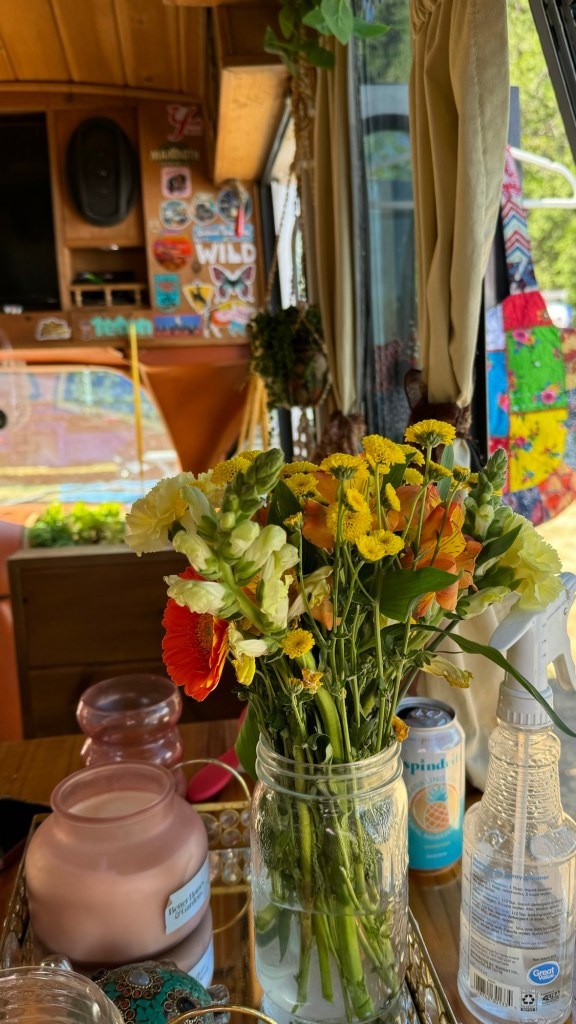
I am pondering next steps, and I am on a learning excursion. After discarding the idea of van- or camper-life, I am reconsidering it with a vengeance. It has been a day that the title of my last post epitomizes: I have met wonderful people and learned a ton of things. On the other hand, I left my prescription glasses behind and have air-tagged them. They are now 120 miles away, and I have not moved. I could write an exclamatory word or two, but that would change nothing. I have marked them as lost and left a phone number. Perhaps the better angels will come to me and karma will work. The air tag is telling me where they are. Someone picked them up, so I am on the mission to get them back.
The weekend here in Oakridge has been enlightening on numerous levels, from a learning perspective to an interactive manner. Certainly, I saw some incredibly tricked-out schoolies as they are called. One in particular looked like and had the ambiance of a home (and I mean that – more of a home than a house). A second one was tricked-out to the degree you could cook anything in that kitchen. While there is much one can say about things being aesthetically pleasing, the mechanical, the out-of- view things are probably more important, and there one can rack up some serious cost. Understanding the issues of solar and how to manage that is foundational. Deciding issues of plumbing and choices about that are crucial, especially for me. Making sure I have a thoughtfully useful kitchen is of significance, and deciding how, why, or what to do in terms of heating and cooling are essential, particularly when considering the heat and cold ranges that are becoming more commonplace. I did make some basic decisions about a couple of things. All of this covers some of the things I am pondering. However, that all is what I have been focused on while here.
This is my first time in Western Oregon. I drove from Portland to Oakridge, and the state is beautiful. Where I am in quite rural, and yet it is Oregon. My understanding of the West Coast, and this is from my honest, but limited knowledge base. It is also a comparison to what I know from Pennsylvania or Iowa for that matter. As a former Marine, I have a strong sense of patriotism, a intense understanding of decorum, and a incredible belief that our supportive behavior of democracy is foundational to the survival of what many are now calling our Republic. In the 15 years (this time) and 4 years prior (in Lehighton), slightly more than 1/4 of my life had been in Pennsylvania. As a history major, and with particular work in the Civil War, I am amazed by the number of Confederate flags I have seen flying in Pennsylvania. In the past when I saw an American flag flying, I saw it from my Military mindset. And now that has changed. When I see an American flag flying in the bed of a jacked-up 4 Wheel Drive, I find myself now uncomfortable (and this is not something I am proud to say). When I see people with a placard that says “Support the Blue,” I find myself questioning their politics as much as I wonder what it means to support law enforcement. Again, a position that creates significant angst for me. A former student, with whom I shared significant time and had important interactions with over years, even beyond their college years, discontinued their interaction when I questioned the appropriateness of running people off the road during the 2020 campaign. They wanted to argue freedom of speech and patriotism. I could not accept either argument, and they accused me of supporting socialism and be willing to tear down our country. While I will admit that my reaction to former President Trump was, and is, more stridently political than I have ever been in my life, that visceral response is based on three things. I believe he is dishonest; I believe he is disrespectful; and I believe he has been abusive in how he uses power (be that financial or political). Conversely, I have not been a person who believed our former President is stupid; nor do I see him as incapable. He has been rhetorically effective, and he has been surprisingly successful in persuading a substantial section of the electorate he cares about them. That is not an easy thing to do, especially in our present national psyche.
As I ponder how it is the only two people we believe reasonable to run for our highest office are 78 and 81 years old, that too is a profoundly damning statement about our politics and our two-party system. Globalism, which is now foundational to all aspects of our earthly community, often frightens people. And this is about so much more than immigration, about the movement of people or goods, and is about a global backlash against the other. What does it mean now versus what was initially pondered or believed when we were integrally connected to the idea of a government of, by, and for the people. If money is the primary driver, of the rich might seem more apropos; if the first adage is true, we are governed also by those wealthy enough to bankroll a campaign; and finally, as the lack of term limits and name recognition clearly demonstrates ( re-election in the House has not been below 80% since the 1960s and in the Senate, while a little more volatile, is seldom below 80% with a couple strong exceptions in the 1970s) too often those elected are for their re-election. I do realize that is a bit cynical, and I wish I felt less so. I am amazed how many people (and not surprisingly) are deeply concerned what this November will bring.
As a veteran, the idea of patriotism, the expectations of a functioning democracy, and the desire that we are a country, which can still serve as a model society in our larger world, is something that has always provided hope and some sense of pride. And yet, both through experience with other American citizens as well as traveling to Central/Eastern Europe, Western Europe, Central and South America, I am well aware of how much of a beacon America still is for so many. It is ironic for sure that the very things that make us such an incredible place seem to be the things that most divide us. Issues of ethnicity, citizenship, freedom of religion and expression, and what equity means are some of those things. Our inability to look at and accept the other seems to be at the core of our struggles. And yet I am aware from the stories from some of my European friends that immigration is problematic there also. The geo-political situation, one exacerbated by the wars in Europe and Gaza, as well as the growing alliance between Russia and China or Russia and North Korea. As I read, it appears that Russia had created a situation where they have little choice but to reach out to their authoritarian counterparts as the war in Ukraine continues. I am certainly not an expert in Russian history or its current circumstances, but it seems all the work Vladimir Putin did to prepare his county (and here too it is the rich areas of Moscow and St. Petersburg) economically for the fallout of any military provocation has not gone as well as he hoped. Certainly North Korea poses a problem for China as well as with its other neighbors. So the importance or NATO, the EU, and other countries like Australia, New Zealand, or Turkey and Egypt in particular demonstrate how politicized our globalism is.
And yet let me return to us – what is an appropriate role for America on the world stage? Certainly what we did from the end of World War II until the collapse of Saigon in April of 1975 is no longer possible. And yet it seems we have no consistent long-term sense of how to manage it all. As I have mentioned on multiple occasions, we have seldom had an exit strategy to the conflicts we get mired in. When I think about President Obama’s foreign policy, I am not sure he was nearly as effective as he should have been (and I realize it’s complex). I believe President Trump’s actions toward NATO, coupled with his kowtowing to the very people we are mostly like to end up fighting served no good purpose (and I realize this is an opinion). I actually believe President Biden’s actions are more consistent with the American foreign policy of the late 20th century. Is that positive? Again, I want to say yes, but I am quite sure I have no clear sense of tue best outcome in what seems to be a reshuffling of our world order. And as certainly as I am unsure of what is best, and even more sure I would not want to be saddled with the duties of a President, required to make that very decision.
As I read through this, what is apparent in the moment is everything is connected in some way; everything is therefore exponentially more complicated; and as a consequence, it is all political. There is no way to avoid it. One might wish to not think about. One might wish to avoid it. Both are possible, but the consequences of it all are not. So, while I can appreciate a desire to not embrace it, at least thinking about it critically, especially until November 5th might be advisable. Read, question, listen, and ponder. Examine the words, consider the rhetoric, examine the choices. While the demonstrations about Gaza and Israel are somewhat reminiscent of the later years of Vietnam, there seems to be little of the focused strength that much of the country coalesced around from 1968-1972. This song perhaps spoke as clearly as any in that time.
Thank you as always for reading.
Dr. Martin







 thewritingprofessor55