
Hello on a September evening,
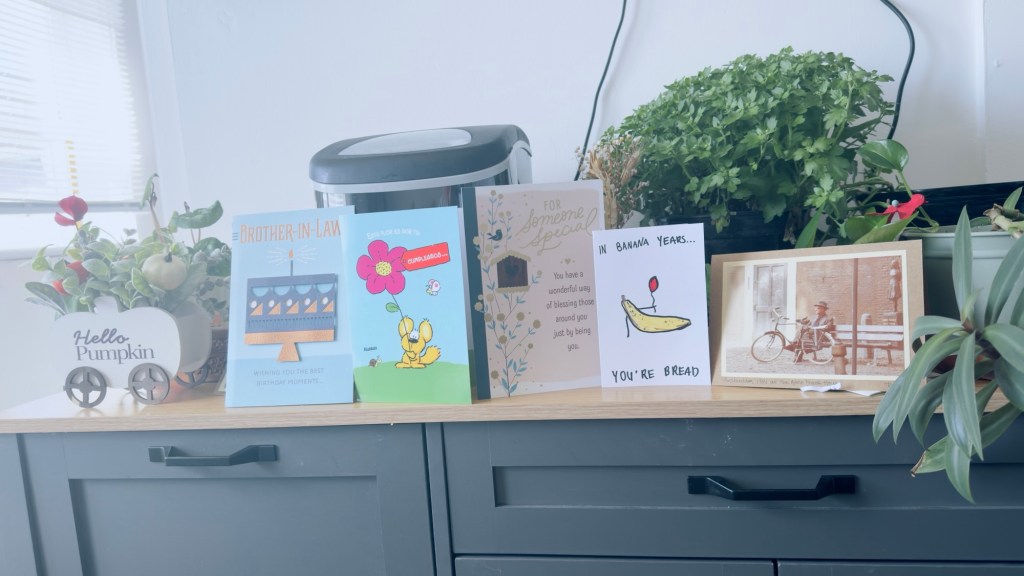
Yesterday was Mexican Independence Day, and it was also my birthday. It was a very nice day, first because the weather was fabulous; and second, because of the incredible number of people who took time out of their busy lives to wish me a special day. Across the various platforms or modes by which people might reach out, and there are a half dozen or so, childhood friends, college and grad school classmates, family, former students, and those from every decade of life sent greetings. What a humbling and cherished way to spend the day. I was blessed beyond words. As I noted elsewhere, when I was young, you thought about presents, perhaps a party, and I always thought about the birthday cake because my grandmother, as oft noted, owned a bakery; she was the cake decorator, so we always had a very specially decorated cake for our birthday, and that was one of the surprises, what would she create for us? Now, being remembered by others is enough. Receiving a greeting in some form is all that seems important. Certainly, two people taking me out to lunch and dinner are not unnoticed, and going to dinner on Friday evening for a belated celebratory dinner is something I looking forward to beyond words. So, simply put, I am exceedingly happy with the week. Hard to believe I’ve made it to this age, and, to some degree, feeling better than I have in years. I did miss hearing from a couple of people who are significant, but people get busy and things get away from us. I know this too well from my own lack of managing life from time to time.
That brings me to the topic of the day. I have realized since I was in seminary that what I thought would be a focus of my call, and the areas of theology I was most comfortable exploring and what has happened are not what I expected. While it is well know I love language and Greek was something I excelled in, Hebrew on the other hand was not the same, and I wish I had done better work there. Biblical studies and church history, two things again I found fascinating during those years at Luther Northwestern, are still something I appreciate deeply, but it appears none of those would push me theologically as systematics did. And that did not happen during seminary, it occurred when I was in the parish, when I was a campus pastor, and even over the last years when I was no longer serving in an ELCA call, but as a director of a Professional and Technical Writing program, and through a literature class, not a religion class. The class titled Bible as Literature continued to teach me about scripture and open my eyes to the complexity as well as the comprehensiveness of that anthology we call The Holy Bible. In fact, if there is a class that I hear more consistently about than the other 9 or 10 I taught it is that one. Just this week a former student wrote in a note, “I . . . want you to know how much I enjoyed your Bible {sic) Literature class at Bloomsburg. It was one of those classes that really stuck with me, and I’m so grateful for everything I learned from you.” It was a class where I would tell students the first day that I hoped their relationship with this “book” would be different than when they came into the class. And that generally happened, and I do not believe it was what I did, but what the Holy Spirit, even in a state university, could do. Systematics is a broad and complex thing. I am reminded of Dr. Paul Sponheim’s drawings in Creation Redemption class or at other times. He was what was called a Process theologian. I wish he were around yet today. I would love to take a class from him today. The way he understood our relationship to the Divine and the grace of said Divine was profound, and yet the complexity of that relation was offered to us in thoughtful and accessible terms. His ability to make the eternal relational was unparalleled. I do not think I realized the breadth of his brilliance when I sat before him.
Luther’s systematic is quite simple because he lays out in one phrase the profound relationship we have with the Creator. His phrase simul Justus et Peccator provided in four words our connection to the world and to the heavens. In that duality both in our nature and in the universe we see the dialectic nature of all. Our righteousness comes from outside of us, is provided to us through water and the word. Our sinfulness is still with us because of the belief we are born into it. In our profession is also a confession; we profess our faith in a loving and gracious God, which states we have been sanctified, made holy not because of our deeds, but the love of God. And as importantly, in our confession we admit our sinfulness, our failings, and even our unworthiness. Again, two things occur simultaneously. I believe the genius, if I can call it that, in Luther’s dialectic continues with his sense of law and gospel. We are aware of the need to obey the law, the Kingdom on the Left as he called it, because therein we find order and the ability to care for and love the other. And again, simultaneously, we are confronted with our failures to do so, the loving and caring for the other as we love and care for ourselves. Or as Luther refers to it in Paul’s letter to the Romans, “the evil I hate, I do.” It is at that point, the grace of God is both needed and apparent. We do not need to depend on ourselves, but rather we need to fall on our knees and accept the mercy and grace of the same Creator who sanctifies us.
I used to ask my freshmen the first day of class, “When you got up this morning with your morning breath, your morning teeth, and your morning hair, what or whom did you see?” I encouraged them to see a scholar. I think the same question is apropos for each of us. Whom did you see in that morning mirror? Do you see the sainted-ness in yourself? Do you see someone sanctified and forgiven? If you do, what sort of freedom and joy have you been given, have you received? What happens in our profession of faith and our confession of since, as noted in the Formula of Concord, is serious. It states, “The damage is so indescribable that it cannot be recognized by our reason but only from God’s Word. The damage is such that only God alone can separate human nature and the corruption from one another.” (Formula of Concord 1:9) and I believe it is here Luther, because of his own journey and his reading of Paul, particularly in Romans, provides this profound perspective of the tension that is our experience, our existence. This is the gospel that while yet less than, while lost, while languishing in our sin, God forgives us, saves us, and sanctifies us. That is the love and freedom of the gospel. It provides a glimpse of what God wants for us, while simultaneously (there is that word again) protecting us from ourselves. It seems it is the simul in Luther’s foundational element of his quad-logical phrase (may I call it that?). We need that simultaneous element because without it we are lost. For in that we experience the immeasurable grace of God. In spite of our failings, within our ability to continually demonstrate our failing short of the mark (which is the Greek word for sin ἁμαρτία), our failings and our inability is countered immediately by the grace, love and forgiveness of the Eternal. While I believe meeting Luther would be an experience like no other, I think he was probably a curmudgeon. His simple systematic, his connection of law and gospel, give me hope in what seems to be an increasingly difficult world that seems to have lost a sense of grace. Recently, I’ve rewatched the musical, Godspell, (1973) and I appreciate its truth and symbolism so much more clearly now. Indeed, we forgive and need forgiveness daily. We love and are love daily. We are saint and sinner both simultaneously and daily.
Thank you as always for reading.
Michael

