
Hello from the road,
Sunday on the road is not a preference, but it’s the reality of my last 11 days. As I begin this post, we are on 80W almost to North Platte, NE. We began the morning in Silt, CO, and today has been somewhat laid back. Yesterday we drove about 650 miles. We did see some snow on a car today in Breckenridge, but we have hit the jackpot on weather most of the trip.
This past Sunday was Reformation Sunday for Lutherans. Even as a child I remember this Sunday for the red paraments that signifies that particular Sunday as well as ordinations and affirmation of baptism. and some Saint Days. This coming Sunday is All Saints Sunday, and I remember when I was a pastor the tolling of the bells and the naming of all those people who have left us since that time a year ago. Both Sundays are significant because they speak directly to the reality of our humanness and its finitude as well as pointing us specifically to the grace of a Creator, upon which we are all dependent. Over the past two weeks, as I have continued to work through the process of of certification, I am reminded of how we understand the role of the laity and the clergy in our church, and as I noted at this time last year, when I was ordained how profoundly overwhelmed I was to become the person to help others in their faith journey, while I was also on mine own. The Reformation established what Luther referred to as the Priesthood of all Believers, changing the relationship between the clergy and the laity. This change led to a change in how the people of the church were both given responsibility for their faith journey as well as prompted the education of the parishoners, a universal literacy of the individual became a necessity. From the establishment of catechisms to the reality that home became the center for the teaching of the faith. In faact the Small Cathechism was meant to be used at the family table daily. More so, that is why in the baptismal liturgy, parents are instructed to bring children to the services of God’s house and as they grow to place in their hands the scriptures, the Ten Commandments, the Creed, and the Lord’s Prayer.
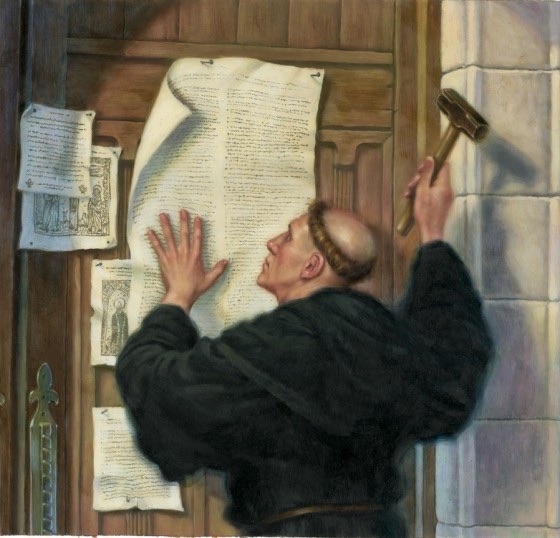
When I was a small child, both of my parents read Bible stories to me, and I realize now, not only did they instill a level of Bible Literacy in me, but they were following the vows given when I was baptized. Likewise, and we do not perhaps imagine it to the level of those in the 1600s, but reading the Bible in the venacular (Luther’s translation of the Bible became the basis for modern German) allow people access to scripture in a manner that had never before been possible. The importance of the catechism and its connection to Christian education was not lost on my confessions professors in seminary. We were required to memorize the Small Catechism and the twenty-eight articles of the Augsburg Confession. We did not have to recite all of them, but we needed to know their substance. The catechism was a different story, we had to memorize it and recite it in an oral exam. Dr. James Nestigen chided us that if we were incapable, he would bring his 5th grade son in to show us how. It’s interesting to me to ponder why Luther might have chosen All Saints as the time to post his 95 theses. It was the biggest day of the church year when Frederick the Wise posted relics for special indulgences. This allowed Luther to specially question the practices of indulgences, and posting on the Castle provided notice to those across the public spectrum, and in particular the academics of the church. Over the next years the number of times Luther would stand in defense of his theses, arguing that he questioned the appropriateness of preaching about indulgences versus questioning the authority of the Pope, were numerous, and the consequences of all would culminate with Luther being excommunicated in 1521.
Luther’s stance to put it simply, but profoundly, was his belief that forgiveness was something founded on internal spiritual repentance rather than some external sacramental confession. It reminds me of how I often pondered the duality of what occurs in worship. Often, I am sure we’ve heard the accusations that people in church are hypocrites. And that is true of all of us, even in our most pious moments, and perhaps most profoundly in our most reverent times. When someone participates in worship, there is always the public and private personas we have. One of the things, whether when I was a pastor or a parishioner, I never believed it appropriate to judge what is in another’s heart. I believe this is the incredible truth of Luther’s law/gospel dialectic. Understanding the dilemma of the human condition, he did not back away from the law and place we exist in as part of society, in our world, but he simultaneously spoke of the hope we have through the grace of God, and the gospel that we come face-to-face with as children of God, and at the moment we leave our earthly existence. The freedom that we have, that we experience through the gospel is often incomprehensible because we still struggle with the reality of the law in our earthly lives. The law shatters any illusion of our self-righteousness, reminding us that we are incapable of working our way to salvation, while the gospel simultaneously clothes us in the righteousness of Christ and Christ crucified. That is sometimes difficult to understand, and even more difficult to accept.
What the reformation did was to make all people able to accept the forgiveness of God through their own hands, to believe that true reconciliation comes from God through our honest confession. As I’ve written in the past, and as proclaimed so succinctly by the other half of my Confessions class teaching duo, Dr. Gerard Forde, what we need to do to receive God’s salvation is nothing. It is not merely that we need to do nothing, it is there is nothing we are capable of to deserve it. And as importantly, it’s already done; it’s completely managed. That is the basis of what Luther would argue. It is the foundation that would transform how we worshipped and how we would understand the Creator, the Christ, and the Holy Spirit. Amazingly, Luther made life both simple and hopeful. Our ability to be simultaneously saint and sinner connects us to the law/gospel dialectic by our fundamental human nature. In that connection, there is hope because there is forgiveness. With all the Saints we can rejoice.
Thank you as always for reading,
Michael

