
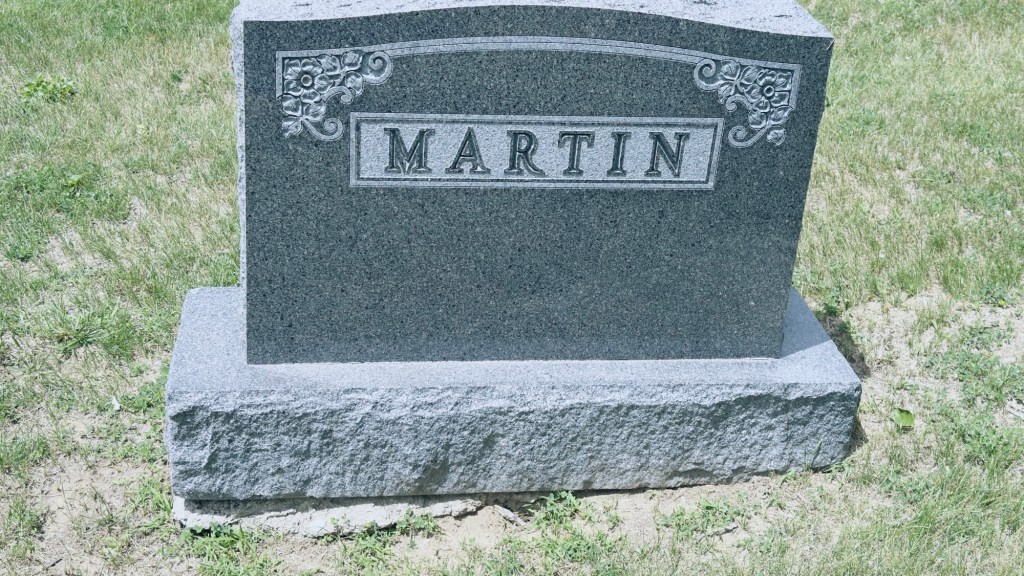
Hello from the resting places of my heritage,
When I grew up, there were things my father did like clockwork, from the time we went to bed and the time he rose to Saturday afternoons or evenings to how we prepared for or celebrated holidays. He was a focused, but nonetheless seemed laid back; he was optimistic and always smiling though I now realize he was always concerned about the bigger picture of things; and he was pragmatic about everything he did or dealt with. And perhaps most importantly, at least to him, he was punctual. He epitomized the adage of you were not 15 minutes early, you were late. To offer some specifics about the above mentioned traits: he went to bed at 10:23 p.m., immediately at the conclusion of the late news, and he was asleep within two or three minutes (you knew this because you could hear him). Each morning he arose to his own internal alarm clock, even after retirement, though the time was now a bit later. On Saturday afternoons, weather-dependent, he washed both cars in our yard, vacuumed them, and had them presentable for church on Sunday. Dinner (supper) was promptly at 5:00, and after dinner, it was my responsibility to polish our Sunday church shoes, using the shining box I had built in wood shop class. Saturday evening and night was special because we were allowed to remain up until 10:00, watching Gunsmoke and enjoying our own bowl of buttered popcorn. The title of this post is about another yearly ritual my father believed necessary. Every year the weekend before Memorial Day, he loaded the car with buckets, brushes, hoses, weed shears, rakes, and towels. We went to both Graceland Park and Floyd Cemeteries to wash, polish, trim and rake around each grave of the extended family of his in Graceland and my mother’s immediate family in Floyd. The following weekend (immediately before that Monday), the graves were decorated with flowers. This was something done years as religiously going to church every Sunday morning. I never really thought about the fact there were other living relatives in the Sioux City area. It was somehow what the Harry Martin household did. I do believe my sister did continue this to some degree, and my living most of my adult life sans Sioux City, I was not as involved.
And yet, as I have come back over the years, visiting the graves, particularly in Graceland, has been a regular part of my return. Some of the graves have been there from the 1950s. On my mother’s side of the family, there are gravestones from the 1910s-20s. I am not sure when the Grandparents bought the plot, but they purchased 9 or 10 lots. Currently, along with my grandparents, an aunt, and a daughter of my adopted parents, the two siblings I grew up with and my adopted parents are all buried there. There is one lot remaining, and it is where I will someday be. However, that is not what is so incredible about Graceland. The Martin family plot is in the Ridgelawn section. Immediately across the street and a little to the left, in the Virginia section (perhaps 50 yards away), you will find the graves of my actual paternal grandfather, grandmother, and my maternal great-grandparents. This is where the connection between my adopted parents and my actual grandparents becomes both interesting (and for some confusing). My grandmother, Louise Lynam, about whom I have written often, describing her as my hero, was a Hannestad. Her father, who is also buried there is named Eilert Hannestad, born in 1871, and the mother of my adopted father, Harry Martin, whose name is Anne Hannestad Martin are buried within that 50 or so yards. She was born in 1876. Eilert and Anne are brother and sister. So this means that my adopting father was also a distant cousin. My sister and I were therefore, though adopted still in the family. From my actual grandparents’ and great-grandparents’ graves, if I walk to the left and up the small hill and across into the Grace section of the cemetery, you will find the graves of Evan and Martha Hannestad. Evan was born in 1869, and he is the brother of Anne and Eilert. Their graves are perhaps within 100 yards of the other plots (Martin and Lyman). This means siblings, while married into three different family units, would be buried with about a 100 yard radius. If you walk back toward the main entrance of the cemetery across the street to the Greenlawn section, about 75 yards or so, on the left side of this somewhat narrower section, you will find my adopted father’s eldest sister Gladys and her husband, Clare, whose family name was Swaby. He was born in 1896, and I believe Gladys was born around 1905 or so.
So what is important is there are four generations of my family within about a 200 yard area. The earliest born is 1866, and currently, the last buried, my sister, Kris, 14 months younger than me, was both the last born and buried ( 1956 and 2008). While I hope it is sometime before I am laid to rest there. If I live into the 2030s, that would be a 170 year span. That is significant, particularly when the earliest born (1866) is only a year after the Civil War. As I write this it is less than two hours before the 250th celebration of the country. I am looking at family graves that cover almost 70% of our nation’s existence in that space. I do have a cousin who has researched the Martins and she notes there are Martin ancestors back to the revolution, so it is likely (in IN and OH) there are graves that go back even farther. Certainly, the importance of a quarter millennium is of note, particularly when we ponder the profound role the United States has had, and while the celebration has been more politicized than I wish, I still feel an important level of patriotism as I imagine the Fourth of July tomorrow. What I will be doing is driving back to Pennsylvania, and I am sure there will be fireworks and other things I might observe if I am still driving after dark. I will drive a good amount of distance across the country, and its vastness will astound me once again. The significance of my family history and the reality that some of those graves I visited again recently belong to people who were born in another country (Norway). Some of the graves in Indiana or Ohio, places I’ve not gone to explore the heritage, were born in England or Ireland. It’s often easy to look at the granite or polished stones, markers, and larger family headstones and brush over the incredible history, the stories they offer, but last Saturday, a week ago as I write this, I walked slowly among the markers and pondered each of my relatives, those who lived in Sioux City before I did. And though a good majority of my life was experienced beyond the Northwest Iowa town I still claim as home, it is where my final resting place will be. I will be the last of my generation to be laid there; no other lots remain. And while my life has been blessed to travel and explore an incredible amount of the world, I will be blessed to be laid to rest at home. And Jennifer, I hope you find this both helpful and informative. I love you.
Thank you for reading,
Michael

