A Decade after the Tornado

Hello from Mallard,

In the last couple days, while driving to Pocahontas for appointments or to Emmetsburg for errands the memories of a decade ago, to the day, came flooding back. I had driven back to Menomonie from the fall semester teaching in Bloomsburg. I needed to take Lydia to a couple doctors’ appointments, and I would be traveling after Christmas for my first visit to Poland, something that had been arranged by a former student who happened to be Polish as well as by her father, who, while also Polish, divided his time between the States and his Slavic homeland. It was the typical much-colder in Wisconsin, and staying in Lydia’s third floor, the Upper Sanctum as I dubbed it, was cold and had a monastic vibe to it.

When I got to Comforts of Home (COH) to see Lydia, I was stunned by the degree her health had deteriorated since a previous visit earlier that fall. And in spite of the strong care by the staff and really thoughtful and consistent communication with the administrator of the facility, I was not prepared for what I would find in the little room at the end of the right back corridor. Dementia had turned the brain this brilliant economic professor and polyglot into Swiss cheese, and those holes caused numerous seizures. This whirling dervish, two-digit midget (no offense meant to smaller people as I called her this in person) was less than a shell of the person I had first met on the Circle a decade earlier. As I took her to her PCP appointment, she was no longer the person who would chase down her doctor if she waited too long. She was no longer the woman, who in spite her diminutive stature, could, and would, control an entire room. In fact, barely two weeks ago I was in Menomonie, and when her name was mentioned, the gentleman noted she had been her professor. He said unapologetically that she was one of the toughest professors he ever had. Lydia was now reduced to sitting listlessly in her wheelchair, covered by her blanket, while the deteriorating brain matter subjected her to mere existence and general exhaustion because the seizures that wracked her body created incredible pain, which zapped her. On an ironic note, the dementia caused her to forget that experience regardless of how many times it happened.

When we arrived at the doctor’s office that day, Lydia’s change from the incredible take-charge person she had once been was on full-display as she was a present, but non-participant, person in her own health discussion. In spite of her physicians continued profound care, she was incognizant of where she was or what was happening. Even now, as had always been my experience with her doctor, his concern was to offer me both the most caring and appropriate advice and counsel possible. Our conversation was honest and informative as I tried to make the most caring choices for her. It was my responsibility (now both morally and legally). He explained options and reasons for everything I could choose to do. What I learned once again was both his medical acumen, but more importantly the unparalleled compassion he held for every person who entered his care. I was her POA, but in someways I was as much of a patient as she was, and he knew that. His care in providing me the best way to supply for her the most thoughtful possibility at such a crucial time has never been unrecognized. His exceptional goodness as a physician, as a human being is something I still see today. He is one of the few Renaissance people I have ever met. Upon leaving his office, I called her care facility and asked both the administrator and staff RN to wait for our return. I wanted them to know what our change for her care would be.

As we returned in the van to Lydia’s home of the past 3+ years, I still struggled with what choice was best. Her doctor had provided a choice, but he also explained what and why the choice was offered. He used his own family’s experience as a basis. The choice chosen was to discontinue some medication, to increase the dosage of the seizure medication to keep them more at bay, and to offer a medication for pain. That was the choice I made. I did not want her to continue having these incredible body-wrenching episodes, and it mattered not if she remembered them. That sort of pain was inhumane for me for anyone. The irony of the next morning for Lydia’s choice for daily life still shocks me. That Saturday morning she went to breakfast as normal. They had helped her dress and brought her to the central gathering place for her morning meal. She sort of picked at her food that morning, and shortly afterwards, stated , non-characteristically, “I want to go back to bed.” Abiding her wishes, she returned to her room; they redressed her in a warm nightgown, and soon she was comfortably in bed. Unbeknownst to us, except to shower or use her restroom, Lydia would not leave her room again. That day her additional medication was administered, and what became a vigil began.

In the days ahead, the Staff and Aides at COH provided the most incredible care to the little tornado who was the second person to live in their amazing facility. They had cared and supported her and me on this tremendously arduous journey, seeing the transformation from a person who wanted to help with everything to a person who needed help with everything. The administrator cared for her as she would her own grandmother, even crawling into the shower to help her bath in those last days. I watched and marveled as Lydia would refuse water to watching her point into the corner and speak in Polish to the apparitions only she could see. It was during that time this blog would become the significant element in my writing it remains today. It was the way I could chronicle the end of a life that began in Austria, grew in the Sudetenland, would move to London, marry a Polish concentration camp survivor, and together immigrate to Chicago with “two suitcases and a hundred dollars.” She lived a commuter marriage and became a trusted and respected faculty member at the university, and left a memorable path everywhere she went. Those next days were both comforting and tragic as I watched her physical body continue to fade, working to catch the mental person who had long since departed, though there were moments she would surprise us with clarity.

On Christmas Eve day, as I sat at her bedside, I wrote about what I was witnessing, expecting (you can actually scroll down in the interface here, and read those blogs from December of 2014) and playing Christmas music softly on my laptop. She began to speak in Polish and pointed to the corner. I asked her if George (her husband) was there and she nodded affirmatively as her “tak, tak” became more insistent. At a quiet moment, I inquired softly, “Lydia, are you ready to go home?” Hoping she might say tiredly, but appropriately (or so it seemed), “yes’.” Instead, she looked straight at me and replied distinctly (and in her Austrian accent), No!” I simply stared at her. In the six days what had transpired since her appointment, she now ate little or nothing, was too stubborn to drink water, and she slept much more, but she still knew what she wanted. Lydia was no a fan of Christmas, and I secretly feared she would die Christmas Day to haunt me forever. That did not happen; she actually died on New Year’s Day, which her accountant noted was the best day tax-wise to pass away. I have noted to some she probably knew that and planned accordingly.

During the 27th and 28th of December, as her fragility became more apparent, I spent 16-18 hours a day in her room, both because I did not want her alone, but also because I knew I soon had to leave for Poland, the country of her husband. Fortunately, the co-caretaker of her, a former student of mine, a member of the USCG, and his incredible family drove up from North Carolina to take over the vigil. As I spent my final hours with her before I would drive to MSP’s airport, the reality of what was to occur hit me hard. She had become my parent; I had become her chauffeur, her yard boy, her snow-removal person, her personal chef, and perhaps most of all, the never-existent child; I was her guardian, her companion, and in someways the spouse she had lost 20 years before. Before I left a final time, I sat on the floor next to her bed, softly weeping for the loss that was unavoidable. She had slept a great majority of the day, but suddenly, I felt her hand on my shoulder. With tear-filled eyes, I turned to look at her. She smiled faintly, and rubbed my head. I said, haltingly, “You became my mother.” She simply said, “I know.”Then I said, “I love you,” and she responded, “ I love you too, and she closed her eyes. There were no better words we could have exchanged. As she went back to sleep, I went back to the house on the Circle to get my things (already packed). It was snowing steadily, so the trip to the cities would be a little concerning. As I left the house, I decided to return to COH on more time. Tears streamed down my face as I walked to her corner room. I entered quietly and she was sleeping, her breathing shallow. I walked softly to her side and gently kissed her forehead, whispering, “Goodbye, Lydia; I love you.” I walked out of her room and sat in the gathering room that was outside her room where I sat and wept. There was no way I could drive in that moment.

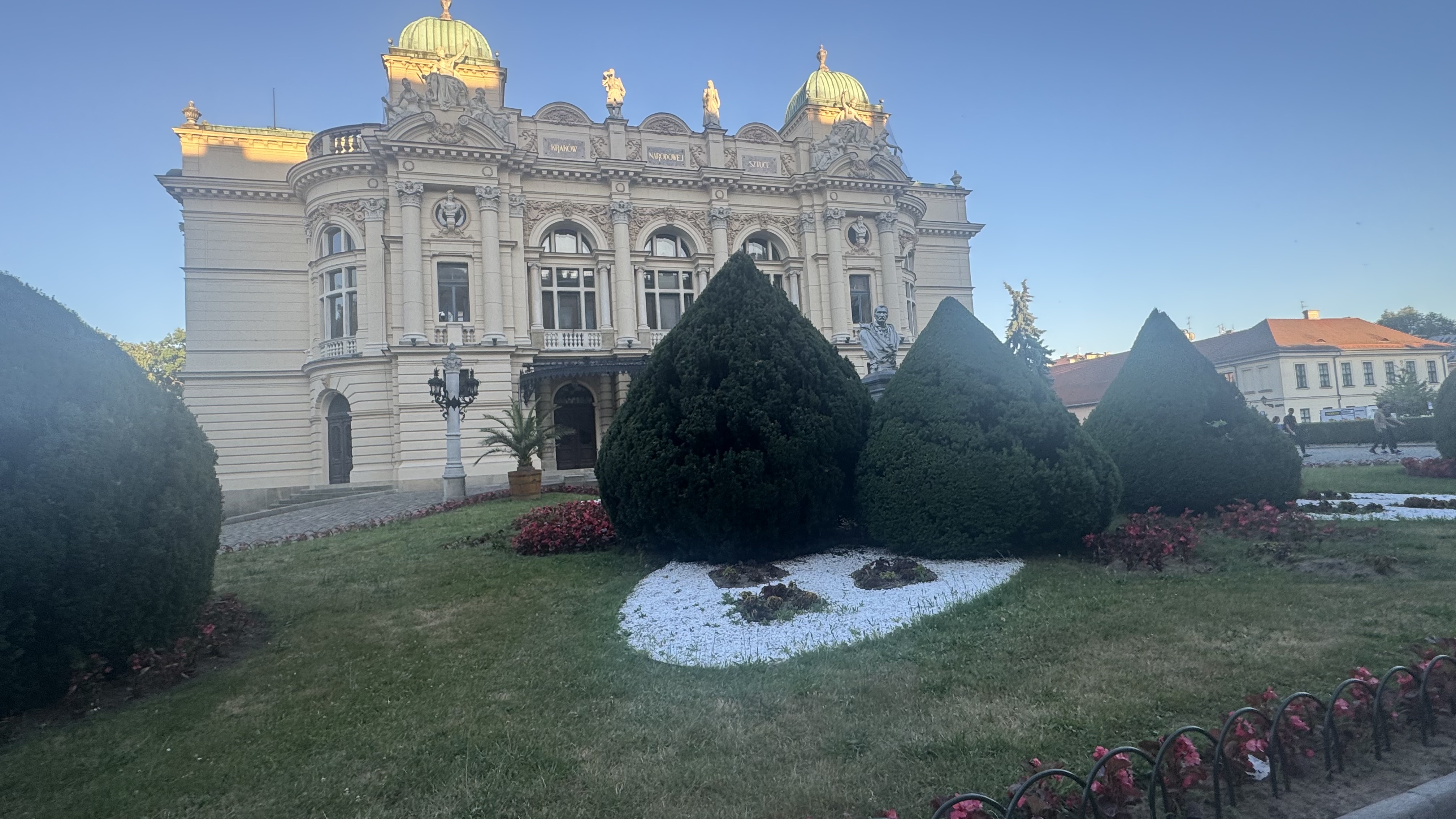
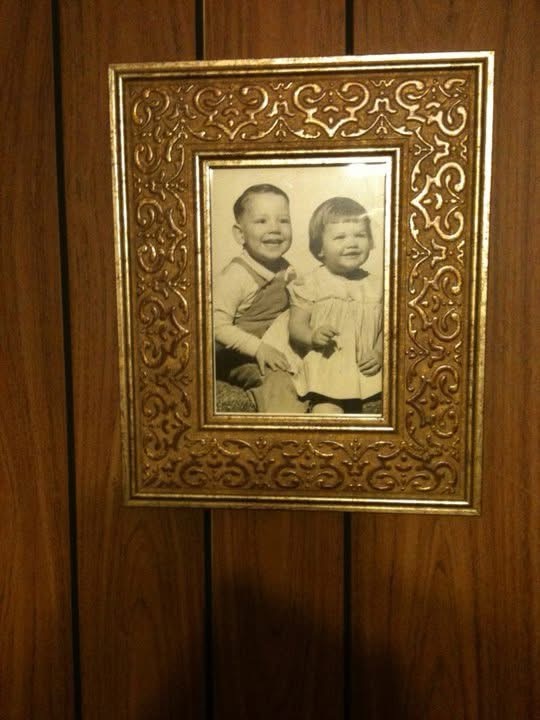
New Year’s Eve day, I was in Kraków, Poland, and standing in the church where Pope John Paul II had served as Cardinal Karol Wojtyła, the Archbishop of Kraków. As I stood before one of the auxiliary altars in the beautiful church, I lit a candle and I prayed a simple and fervent prayer. I knew back in Menomonie, some 4,725 miles and eight time zones away, Nathan and family had taken over the vigil. In fervent supplication, I asked, God, and George, please convince her it is time to come home.” I left the church believing I was heard. Early on the 2nd of January, but still New Year’s Day in Wisconsin. Lydia passed quietly in her sleep with both Nathan and the wonderful administrator by her side. In the decade since her passing, my life has been transformed in many ways, but as she was transformative for me in way too many to count. I still miss her. One of her favorite groups, of course, was the Vienna Boys Choir. The video below is in her honor. I found a picture of her from 10 years ago to the day, but the picture above is how I prefer to remember her.

I hope the memories of those you love will bring you comfort in this season of Advent, and this Sunday of the Angel’s Candle. Thank you as always for reading.

Michael

Anyone can be Average

Hello from the couch on an icy December evening,

It is before 6:00 p.m., and it’s been dark for an hour or more. We are rapidly approaching the winter solstice, the shortest day of the year in the Northern Hemisphere, but the cold and dark will be here for some time, and it is easy to want to hibernate. I understand why people went to sleep much earlier in the past. I find my desire to be up and doing something later, particularly when it is so dark, quickly wanes when there is neither light nor heat. I am still acclimating to the daily constant and gusting winds, the flatness of the area (which, of course, contributes to the wind), and temperatures that I did not experience in North Central Pennsylvania (single digit temps and below zero windchills already); And we are not technically in winter yet. The weekend saw freezing rain and this morning had schools on a two-hour delay, which always pleases students. Additionally, there is the aroma of agriculture, a farm ambience, which is not unfamiliar, but it is also not recently experienced. Simultaneously, there is a beauty to the rich, harvested fields as the sun rises and sets. Some of the most brilliant reds, oranges, and yellows are stunning on those clear days.

One of the things I struggle to respond to appropriately is mediocrity, the willingness of people to be content to merely get by. Before I travel too far down this path, let me admit up front: too often in my early life, I was that person. I did just enough to stay out of my mother’s oversized doghouse. What I learned was Cs were sufficient. I did not get scolded for that. In retrospect, that became my modus operandi. If I enjoyed the class, or, more likely, the instructor, I would do quite well. In fact, I did really well in AP classes and average – and sometimes below – which would open the door to the doghouse. However, I seldom remember anyone pushing me to change my process or raise my own bar to increase my effort. The irony of some of that became apparent when I went back to my 50th high school reunion two summers ago. There were classmates who found it completely predictable that I ended up in academe. I was stunned and they told me I was so intelligent. That was not the word I would have expected. Small, good natured, personable would characterize what I thought. Smart, perhaps, but intelligent . . . Not so much. My first memorable indication I might be more than average was when I was in the Marine Corps. I did exceptionally well in communication and electronics school, so well I was initially accused of cheating, and my military test scores were high enough I qualified for the Platoon Leaders Course, which would have set me on a path to a commission. And yet, none of that stuck and as I’ve noted in other posts, I failed in my first attempt at college. My father did admonish his 16 year-old underachieving son at one moment with a simple, but pointed statement. As I lounged on the couch one day, he stood above me with his matter-of-fact manner. And with a level tone, he calmly stated, “Anyone can be average, that’s why it is.” And he turned and walked away. That was the only time he would ever really say anything related to academics, but for him this was as much about life as any book I would ever open.

Looking back with a more critical eye, there was one particular educator, one I had almost every year in a class from 8th grade until I graduated, who inspired me to learn and excel. He was a history teacher both at Riverside and West High School. Immensely proud of his Norwegian heritage, and as passionate about the Minnesota Vikings, Mr. Larry Flom imparted wisdom, kindness, and humor into every class, as well as every day you had his class. Many of his quirks, his sayings, and his interchanging of word for another remain with me a half century later. The Union was the onion; his standing up in the middle of class and puffing out his chest to bellow, “Norrwayyy” is as clear to my mind to day as it was in his class. His given place as the chain gang in a football game or his participation in the Siouxland Male Nordic Chorus offered insight into the other ways he offered his kindness and talent beyond the classroom. To this day, I owe him a debt of gratitude for being able to reach a wandering, directionless, undersized, and often frightened kid. It is his work that created a life-long learner and lover of history, which would become one of my majors in college.

And yet, the seeds that Mr. Flom planted would remain dormant for some time. My desire to move beyond that long-practiced “it’s good enough” would not really change until I was a freshman at Dana College. By that time, I was in my mid-20s; I had failed in my first foray into academics, and I was petrified I was not “smart enough” to make it. That first semester my fear focused me to study like crazy. Second semester, my Humanities 107 course, and my interest in an incredibly talented and brilliant other freshman led to study hours in the library and her ability to be a strong student pushed me to work even more diligently. I actually remember someone in the Registrar’s Office noting how profoundly capable she was when they found out I had been spending time with her. And so, by the end of my freshman year at Dana, I, for the first time, actually engaged with my academics. My sophomore year, while a bit bumpy, immersed me in the humanities program at Dana, and my travels to Europe for interim changed my life. Education was being a sponge; it was so much more than memorizing facts, formulas, and dates. It was soaking it up and thinking about how it all fit together. It was thinking critically, analyzing things carefully, and it was attempting to understand its relevance. Dr. John W. Nielsen’s humanities program, and his mentorship set me on the path of scholarship. I did not realize it at the time, but that traipsing around Europe with the Pope in January of 1981 would change me forever. My father’s admonishment finally made sense.

Throughout my time in the classroom, from my first experience with an exchange student when I was in high school until my last experiences as a host for exchange students, I can state with certainty that European students I have encountered have been much better critical thinkers and integrators than we as American students seem to be. I have often wondered why that is, and I do not believe there is a single answer, but I do believe their work to integrate and their general lack of busy work and merely meeting standards, their work that integrates everything into a final exam. This integration requirement is essential to life, I believe. It appears, and I saw this regularly in the last years teaching, that our willingness to spoon-feed requirements and then teach them how to pass has created a generation of too many wanting a recipe-card for their life. This fosters the average-is-good-enough, the very thing my father rejected, and leaves us with some really nice people with no idea of how to think critically, analyze thoroughly, or integrate what they know carefully or intentionally. That is concerning.

And yet, in spite of my concerns for many things, I wonder if some of the geniuses being tapped by the President-elect might use their extraordinary talent for the good of all. That would be a phenomenal thing. Perhaps that is my own idealism. Perhaps this is a mere pipe dream. As I move into the last days of the calendar year, I find myself finishing a year of profound change, but also one of opportunity. The next months will push me to think in ways I never have, to learn things I have never attempted, and hopefully, next summer, the bus and I will be on the road. Last night, Julie, my incredible cousin, and her talented and humorous husband, Gavin, and I went to see Pentatonix. It was spectacular. The initial picture is my teacher, Mr. Larry Flom, and the video below, though old, is one of my favorite pieces of the Pentatonix repertoire.

Thank you for reading, and I wish you a blessed Christmas.

Michael

Best of Intentions

Hello from the Family Restaurant,

It is almost a month since I began my trek back to Iowa with my loaded shuttle and the bug in tow. As I look at the process, there is progress on a number of fronts, but what one sees might belie the actual achievements. Likewise, settling in, managing daily needs (e.g. meds, daily basics, logistics), and imagining life in the coming weeks and months take up more time than anticipated. The past weeks I have been time reading the thoughtful reflections of other retired academics in the edited collection by my first chair, Dr. Susan Turin, titled Retiring Minds: Life After Work. Knowing some of the contributors makes it even more meaningful. It was humorous as I put names to some of the nameless references; it was optimistic seeing how involved and intentional some were following retirement; and it was poignant and gut-wrenching as the editor shared the dying journey of her husband. Life is all of these things to be certain.

I chose the word intentional in the previous sentence on purpose. There is certainly the cliché about a path and intentions, but I’ve thought a lot in the past month about how intentions affect both what we do and what we think. I wonder how often we carefully think about what we do and how it connects to our intent. In my more optimistic, idealistic moments I want to believe that normal people seldom intend to harm another. And yet, one does not have to look very far to see incredible amount of harm we inflict on the other. What allows for use maliciousness? It is merely accidental? I do not believe that is the case. Is it selfishness? Certainly one could make a case for that, but I see selfishness as more of an individual thing versus something societal, though I presently feel compelled to reconsider that position. While, in my humanness, I have moments where my anger might wish something less than beneficial to another, I have to really think hard as to when my actions might have been committed to intentionally cause another person harm. I did address a specific time in my life when my anger caused harm in a previous post, and those moments were due to my inability to manage my own hurt. Additionally, the consequences of those moments were significant.

What informs intent? That is something that needs some examination. Certainly words like goal, aim, or purpose come to mind. A bit of research, beyond the etymological, notes it is often used in legal or military situations. As someone who considers the rhetorical, I wonder how often our intent is more a sort of rhetorical (unspoken) element of who we are, or even more what we embody because of our life experience? Certainly in the legal realm, intent is an essential piece of the proceeding. In a military situation it is more the goal or aim of an action. It seems much more quantifiable. I am not sure our individual thoughts are generally so. And if I am correct, what creates the difference? I believe too often what we intend and what transpires does not logically follow. The quadratic equation does not occur as assuredly as it does in mathematics. Is there some sort of unrealistic expectation we hold when dealing with the other? Perhaps too often we expect of them what we fail to manage in ourselves. I think the holiday season is one of those times we most intend to do what is best for others. The number of requests I get either in the mail, online, by text, or social media asking that we give to those less fortunate is stunning. And yet it seems too often we forget their needs the rest of the year. Is the intent to do something good or to feel better about ourselves?

When I was growing up in Sioux City, I participated in the Sioux City Community Children’s Theatre, and our yearly gift to the community was our rendition of Dicken’s incredible story, but how many of us really know the intention of it? Dickens was asked to speak to a group known as Athenaeum to address some of the prominent issues in England (his address was in Manchester) at the time. Those issues included a working poor that was largely uneducated, powerless and exploited. The slums of the country continued to bred this poverty, and as a recognized successful novelist, he penned this famous tale in only six weeks (Britannica). Of course, in the infamous story, the rich needs to see how poor live or subsist. The issues of want from the one side (the Cratchit Family) and the ignorance on the other (Scrooge’s loss of compassion and his miserly attitude) are at the center and placing it in the season of giving makes it all that more distressing. Having participated in numerous seasons, and having parts from small parts to Bob Cratchit and eventually Scrooge himself, I still have many of the disturbing lines committed to memory. “What do you expect me to do, buy enough coal to heat the whole outdoors?” or ” A poor excuse for picking a man’s pocket every 25th of December?” – of course eventually he would say, ““I will honour Christmas in my heart, and try to keep it all the year. I will live in the Past, the Present, and the Future. The Spirits of all Three shall strive within me. I will not shut out the lessons that they teach.” The degree to which Scrooge transforms is, of course, miraculous, but it takes the work of both the human and those beyond. Sometimes, I wonder about the role of the Spirit, the spirit that we confess in our Creeds. As I grew up in a sort of Norwegian pietism (though I did not know it), the role of the 3rd Article was certainly downplayed. Furthermore, my experiences with 3rd Article dominant congregations scared me. It would not be until after seminary and during my time in parish ministry that I would grow to appreciate the significance of the Holy Spirit. Be it the spirits in Dicken’s Christmas tale or the gift of the Spirit that comes to us (most often in baptism – there is my Lutheran piety coming through). What I realize as I ponder the idea of intention is we are dependent on something beyond our own will.

Intent, even when we want to do well, often needs help, favorable circumstances, or more if the consequence is to be efficacious of all involved. I learned the hard way that standing on principle and doing the right thing can still lead to undesirable outcomes, particularly when there is a power differential. Telling the truth, even if it is mean to be merely honest and fair, does not always end well. Is it because we fail to consider intent or is it because we have different understandings of what is honest or truthful? Because we have different understandings of what we expect from doing the right thing? There are points in my life where my failures, in spite of intent, had profound consequence, and affect even now what has become of my life. That is not to say I am unhappy with how things are, but there were certainly some difficult times. Even recently, what was intended and how it turned out has created hurt and sadness. There is so much we can avoid if we merely step back and ponder, think, and consider the outcome before we speak or act. All too often the best of intentions are not enough. Seldom do things turn out exactly as we intend. And yet, does that mean we should quite trying? Certainly not as the Apostle Paul says again and again in the book of Romans. In fact, his certainly not is a command, not a suggestion. As we continue through this season of Advent, I am reminded of the joy that this season of preparation can impart to us, if only we allow. Much like Scrooge’s proclamation at the end of Dicken’s tale, “I will honour Christmas in my heart . . .” It is when our hearts are pure, when we are willing to love the other as ourself that intent might actually do what we hope. As we are now in the third week of Advent, the candle for the week is the candle of Joy. Joy is infectious, and it can change lives. If we meet others with a joyful heart, the result is palpable. While the song below is not a Christmas song, and it speaks about the difficulty that our best laid plans can face, I remember when this song first came out. Travis Tritt did a lot for the veterans and his trilogy of videos did a great deal for those who struggled with PTSD and other things veterans often face. I wish you all a week of joy.

Thank you as always for reading and I wish you a wonderful end of the year.

Michael

Clouded Memories

Hello from a driving break,

I am a creature of habit, of that there is little room for doubt. Therefore, I am in a Starbucks on Duff Avenue in Ames, Iowa, on my way over the hills, with little or no woods, and to the relatives’ house we go. As noted by a seminary classmate by phone earlier this morning, and certainly as experienced since my return, memories can be a double-edged reminder of who we were versus who we are. They can transport us back to that time. Yet, how we remember things versus how others see that time can be quite different. There is nothing wrong with those diverse perceptions, those retrospections, but the divergence can catch us off guard. Too often our hopes or expectations are colored by our individual attempts to gratify ourselves by those previous experiences, be they with a place or a person. I know I am guilty of this, not as a sort of conscious reframing of the past, but wishing most often for the best possible spin or outcome of our past. The propensity for such might be elevated at this time of year because of our romanticism of the holiday season. Lines of Dan Fogelberg’s “Auld Lang Syne” are rolling through my head at the moment. Undoubtedly, there is a wish the fairy tale we believe or chosen to create, to remember, is possible. Too often I find myself remembering only specific things that make the reminiscing enjoyable, believing it can be the same. Seldom, however, is that the case. Indeed, Fogelberg’s lyrics are poignant reminders “lost in our embarrassment as the conversation dragged” . . . “And tried to reach beyond the emptiness . . . Just for a moment . . . And the snow turned into rain”.

As many know, I love Christmas decorations, creating the fairy tale home where giving has no boundaries. Of all the things I have purchased, there is one 2’x2’ square somewhat barn-board style painting of small boy dragging a Christmas tree back to his home in the snow, which is my favorite. It is my fairy tale in image form. Christmas vacation as an elementary-school-aged boy meant spending a week at Grandma’s house following Christmas. Snow, new presents, toboggans, and hanging out at the bakery, each of those memories is delightful. Morning breakfasts of poached eggs, bakery bread, and a half of grapefruit, which remains my comfort food to this day, began each morning on a positive note. What made the holiday time so special was the generosity and love displayed by my grandmother. It was limitless. I think it was her way of asking for some forgiveness that she found it necessary earlier in life that adoption was a more likely path forward for my sister and me. Part of that adoption was she would remain our grandparent, and she embraced that role with every ounce of her being. My grandmother’s home was not extravagant; it was a two bedroom, two story house at the end of a street in a decidedly blue collar section of my city, and there were more fields than houses around her. Those hills and fields were our playground and our safe haven. As I write this, it is the first day of Advent, a season of preparation, of hope, and of light that shines into a darkness that covers both more hours of our day, but it can also illuminate a world that seems to struggle with the ability to exhibit kindness. Kindness is not always an easy thing to manage; I know this in my own life, but it is a necessary trait if we are to be hopeful as we go about our life.

What I realize now is my grandmother’s indubitable charity is who she was. It was always there in how she treated her bakery employees, in how she gave to her church and her chapter of Eastern Star, and in how she loved us all unconditionally. In spite of the fogginess of other memories, which come with time, the clarity of her graciousness shines through as the brightly lit Advent wreath that adorns houses and sanctuaries during this season. It was my first trip to Europe with Dr. John W. Nielsen, which opened my eyes to the reality of Advent and the idea of preparing for the true Christmas season (those 12 days from the 25th of December until Epiphany, January 6th). The reality of allowing each liturgical season to do what it does can be helpful for the soul. The truth of preparedness is something I’ve come to appreciate. In all of life, we will be hit with the unexpected. We will be tested when our memories of someone or someone do not fit with the given we experience in the present. This is painful and disconcerting. It requires us to reimagine, to rethink, the past, or more precisely to let the past go. That is not something easily achieved, especially when we like what we remember. That gets me to the title of the post. As time passes, are all memories merely our perceptions of what was? Is there only a minimal degree of actuality to those childhood recollections? Is it our way of minimizing the disappointments we might have experienced? These are difficult questions, but necessary if we are to be honest with ourselves and with others.

Sometimes it is easy to become disillusioned by the struggles of our humanity, by what Paul calls doing the evil we hate. And yet, the promise of Advent is there is a light on the horizon, a light that the darkness cannot overcome. It is in that hope I can find some comfort, some belief in a sense of peace that transports me back to that childhood of Christmas magic. The memories of a giving grandmother who epitomized the true spirit of generosity, of kindness, and actions that backed up her boundless love for us. As I woke this morning, there was an unexpected layer of snow, gentle, light and glistening. The air was crisp and the cold was noticeable, but manageable because of the calmness. There was a pureness to the morning as the snow covered the empty fields, as it lay undisturbed yet by our humanity. While it is also a harbinger of the colder Midwestern temperatures I know typical, the morning transported me back to the memories of the hills and fields I noted above. Often we think of the winter as a time of hibernation for plants and animals, but I think some of my fondest memories are found in the snow. My colleague’s son, who attends Michigan Tech, where I spent so much time and received my PhD, sent a picture with a measuring tape in the snow. They were at 30” and counting. I loved that part of living there. With an average annual snowfall of over 8-9 feet, living with and in the snow was a fact of life. For the better part of a decade I lived in the snow-globe world of the Keweenaw, and I learned to both respect and revel in its winter beauty. I remember during my first year, my Toyota 4Runner slid off the road while driving to preach one Sunday morning. In spite going down a rather steep embankment, the 4Runner, which was buried to its windows, sustained no damage because the snow was light and fluffy. Even more amazing, someone took me to the church, and when I came out from the final service, there was my vehicle waiting for me. Two parishioners and a semi had pulled it back onto the road and delivered it. This still amazes me almost 30 years later.

As we work our way through this first few days of the Advent season, we think about the ending of a calendar year, but it is the beginning of the church year, and the year of Luke for those who follow the 3 year lectionary. Perhaps that is apropos for a world who seems so in need of healing. Much of our traditional Christmas story comes from Luke’s gospel, and those are the memories of our childhood, if you were church-going, where we stood in our bathrobes as shepherds, wondering who would be chosen to be Mary, or perhaps, like one Christmas Eve, I was asked to read from the Bible in front of all those people. For me, winter and Advent are inseparable, and they bring me joy and hope. In spite of the extensive darkness that is part of our upper Northern Hemisphere, I am not sad. I am reminded that often it is only in the darkness we can truly appreciate the light and what it offers. This is not some cliché that I write, it is a realty for me. While there can be a degree of fogginess to our holiday memories, I hope you find blessedness in them and may you create some new ones that will bless you and those around you. This piece by the incomparable Mannheim Steamroller bring those blessed memories to me like few pieces do.

Thank you as always for reading,

Michael

More than a Prodigal

Hello from the farm,

The reality of typing that is setting in as I look out the windows of my cousin’s farm house. I see harvested fields as far as the eye can see. Gone are the mountains and the topography of the Poconos, where I have spent (in total) about a third of my life. Indeed, looking that up, I have spent more time in Pennsylvania than I have in my home state, the place I call home. That was a bit of a shock when I thought about it. Certainly the number of people I know most intimately, have spent the most time with, and have shared more than just moments with are far more numerous than my Iowa connections, and yet those Iowa connections know the boy I was. Recently, as many know, I posted my high school senior picture, I was certainly a youngster. That summer I worked two jobs and lived at my grandmother’s house in Leeds. It was the beginning of when I started to detach from my adopted home. It was the genesis of when I began a journey that still continues, though much has been achieved. I realized for the first time, and to a great degree that I felt alone, as if I had no home. Certainly I had a house in which I stayed, and a family (or people) around me every day. At that time, I am not sure I could articulate what I can now. What I knew is I spent much of my time walking gingerly . . . treading lightly to avoid the wrath of the mother in the house. Too often I failed, but I learned to remove myself even though present. That senior year I was learning to navigate a new school, finishing my studies, and trying to imagine what post-graduation would bring.

Now it is more than a half century later. That reality in itself is a bit mind boggling. My perception of the world, of my life, and yes, my memories of Iowa are very different from that 16-17 year old child, and indeed, I was a child. When I take the time to ponder my Iowa departure, it was a time to run away. It was a time of searching and trying to figure out where I fit, where I belonged, and perhaps if I belonged anywhere at all. One of the reoccurring threads in my blog is having a sense of place. Iowa is home for me, but what makes it so? It is about more than geography, and it is certainly more than experience. As I come back, I wonder how I fit into this more rural location, what a country song refers to as a fly-over state. Sioux City, when growing up was the 2nd or 3rd largest city in the state. I am not sure where it stands now, but I am sure the Quad Cities, Cedar Rapids, and, of course, Des Moines are larger. And while I did some work on farms, I was not a farm kid. And yet, in the few days here, I am feeling comfortable, relaxed, and still focused.

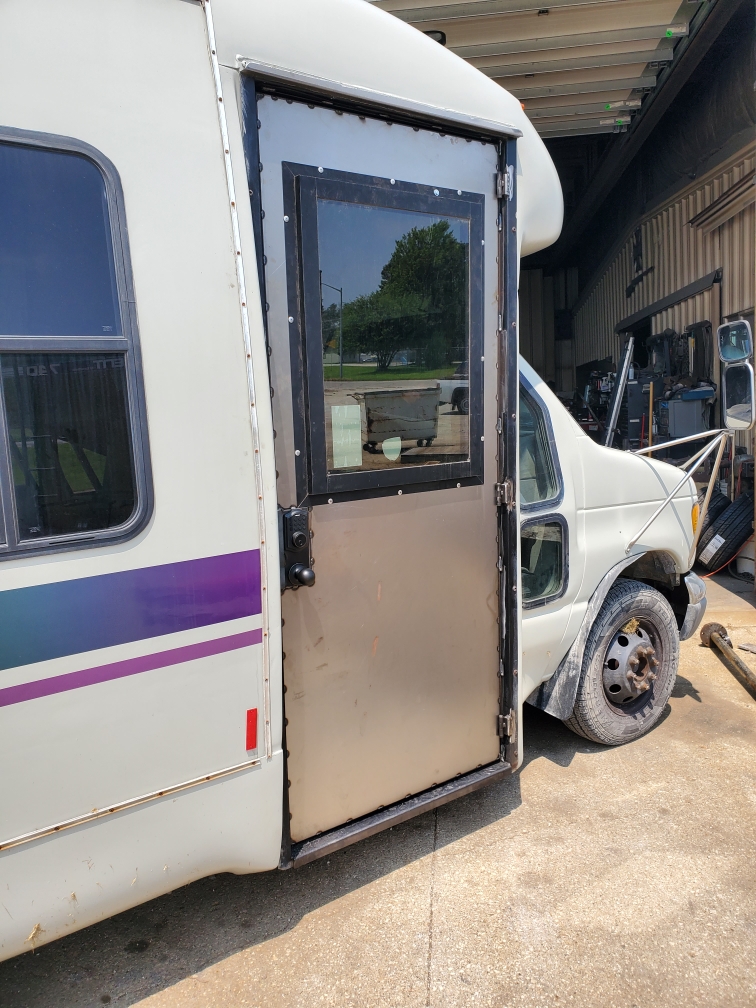
Today, the bug is off the dolly; the dolly is in the horse barn, and the bus is sitting outside it’s soon to be home for the next months. The first few days of administrative necessity is done and it seems all those things are managed. There are some things like Starlink, that has been activated and need to be set up. There is the cleaning out and rearranging the shed (Audrie’s temporary home) to prepare the build space, and there is the actual unloading of the bus. All of that will happen over the next couple days . . .

A couple days have passed and I am still working on the project above. Hopefully today, but since I last worked on this post, I have driven to Waukesha, WI, back to Menomonie, and at the end of the week, I am back in Mallard. Completing some visits, surprising long-time friends, sharing times in a cemetery, and reminiscing were all parts of the last few days. It was (appropriate for the time of year) a cornucopia of events, emotions, and experiences. I did experience, and it was emotional for me, the new movie, Bonhoeffer: Pastor, Spy, Assassin. It is an incredible film that does a really masterful job of managing the complexity of Bonhoeffer’s life, theology, and choices. Of course, writing a dissertation about him affects my perspective. For those who do not know of Bonhoeffer, it might be easier to misinterpret to fall into some particular perspective of his work and intention.

Much of what I am experiencing, not only in my recent trip, but in my daily existence, seems to be a full-circle return to my roots, not just in multiple geographic places, but through people, in my emotions, or likewise in some of my wrapping it all together experientially. Additionally, in the midst of it all, we have less than 40 days left in a calendar year. My return to Iowa was a possibility at the beginning of the year, and imagining travel was also rattling around in the ether of possibility, but the decision to buy a shuttle and embark on a bus build was not really anywhere in my thought process. I will admit I am both excited and overwhelmed by such a process. I can appreciate the space needed to undertake such a project, and preparing both in terms of tools and physical space is what I am working on this week. Even arranging tools in a way to expedite my work is part of my consideration. I probably need to purchase a couple things to manage safety also. A good pair of wrap-around safety googles are a first piece. Considering a good pair of coveralls to save on daily clothing too. As I have noted, I am treading in new waters, feeling a little like dog paddling.

As I continue to write from the Iowa cornfield, now dotted with turbines, I will be going to my brother’s side of the family for the Thanksgiving holiday. Earlier this year, I stayed at my sister-in-law’s home. There was a moment as I sat in her dining room, at my grandmother’s dining room table, looking at the buffet I remembered as a child. I will be around that table this week, and that connection to the earliest moments of my life will not go unnoticed. Leeds, and 4547, as it was known by my grandmother’s elder , sister, are my first memories of life, even though I was probably close to two. It was the home where I felt more loved, cared for, and safe than any other time in my life. That table and the people gathered around it are perhaps my most precious recollections of my entire childhood, if not my life. The evocation of drives to the South Dakota farm known as Happy Acres (ironic I just connected it to calling my house in Bloom the Acre) for holidays or vacations are important to me as I find myself back in rural America. There is the recollection of a 1957 Chevy blowing a piston on the way to Volin, South Dakota (I think that might have been one of the last Chevrolets my father ever owned.). There are other significant growing-events that are swirling through my head at the moment, but they bring joy as I consider my Midwestern roots. Perhaps the difference, besides the obvious ones of time or aging, is the appreciation I have that was not anything that occurs in the moment. As we gather, I am reminded of those I know who might spend this week somewhat isolated, feeling less than thankful. It reminds me that our world can be difficult; it can be tough and seemingly uncaring. There are moments we do not respond as thoughtfully, productively, helpfully as we might or should. As I return to my roots, there are those times I am unsure of the path, unprepared for what is to come, but returned I have. Whether I am a prodigal is perhaps up for debate, but it’s nice to be home.

Thanks as always for reading,

Michael

Carpe Diem and a Field of Dreams

Hello from the farm,

After a number of missed departure dates, managing hurricanes, freight companies, and other unexpected events, I have made it to Mallard, IA. and my dear cousin’s and husband’s farm. It is not my first time here, as they have been gracious to host me before, but this time is for an extended period. The anticipated bus-build begins. I arrived yesterday, after a 2 1/2 day drive of a little over 1,200 miles. It was uneventful for the most part, but driving a 1999 Ford E350 Shuttle, and pulling the Beetle, is a tad different than anything I have done for a while. The last time I was towing things around, it was it a 5 Ton with a 155 Howitzer in the Marine Corps, and I was 50 years younger. There might be a couple of other minor issues (perhaps an injector control pressure sensor or oil pressure sensor). I also learned about how low I am willing to allow the gas tank to get. However, I am here and today, I am getting my bearings a bit and then it is on to getting things accomplished.

It was certainly fall as I headed across Iowa, the majority of crops were harvested and the fields empty. The second half of yesterday’s drive was cold and rainy, but that is certainly better than snow. The trees are mostly bear, and it reminds me of that sort of normal pre-Thanksgiving weather I knew as a child before we would go to the relative’s farm in South Dakota. I am sure there is a lot of pheasant hunting going on as the season began about a month ago. As I ponder today, I am reminded that today is my sister’s birthday. It is still stunning at times to believe she has been gone since that April day almost 16+ years ago. There is so little we are actually prepared for when it come to big picture. I spent some time on Tuesday night actually working on some of this with my niece (access to things, decisions, and yet, what happens if something happens to me). When Kris passed there was nothing in place. That was difficult for everyone. That is not an uncommon occurrence, as I remember from when I was a pastor. People do not like to have those conversations. Today, is a going through mail, managing a couple of other issues with logistics, and making sure I have all the things in place.

One of my favorite movies, in spite of some of the issues with Mr. John Keating, is Dead Poets Society. Certainly the 1950s are a different time than what happens in either preparatory schools or colleges and universities today, but pushing critical thought and thoughtful analysis is very important. Part of the title is the Latin phrase that Mr. Keating shared with his students, Carpe Diem (Seize the Day). It seems like a simple adage, but it is not such an easy thing to accomplish. We get caught up in the routine of our lives, and too often we become the epitome of the tail-wagging-the-dog. It is easy to believe we are the victim of circumstances, either immediate or long-term, but seldom is that true. We choose to be the wagged dog. We choose to feel victimized by our circumstances. I am well aware of the differences in personalities and how we are more “wired” to manage our lives in a specific style or manner, but I do not believe we are pre-determined in how we end up or what we can or cannot do. There is incredible pressure in our world to know what we want, where we are going, and how we are going to pay to get there, and most of that begins far too early in people’s lives. When I left Sioux City as a 17 year old, I have little idea where I was headed, with the immediate destination of MCRD. Even when I left my tour of duty, coming back to Sioux City was merely a stopping place. In the 40 years, which is the last time I spent more than a month there, I have traveled the world, changed professions, was married and divorced (twice), and achieved some status in my profession and retired. And there were moments, events, and situations where needing to seize the moment was inescapable and necessary. During those times I allowed someone to take charge of me, the consequence was generally less than optimal (e.g. a Bishop, a former spouse, a Dean, a President – of an educational institution). And yet, each time, I was able to pick myself up and imagine what next, to dream of a new possibility. That did not always happen instantaneously. There were some dark moments. Indeed, there were times I felt overwhelmed and directionless, but it is not necessary to remain in that space. It requires an inner-fortitude that refuses to quit. I am not sure where that came from or how I managed to hold on to it with such tenacity.

Part of it is an unfailing belief in the possibility of hope. While I do not believe I am an idealist (earlier in life, that accusation or claim would’ve been more accurate), I am still an optimist. I want to believe in some innate goodness in our corporate identity. What I realize (and even more so in the last days), there will always be those who believe in the good and bad of something. There will be those pleased and displeased with how things turn out, but we all still dream and hope of something better, something more satisfying, something where possibility can become reality. I have pondered the idea of place and identity for most of my life, and my next adventure is taking the time to ponder both. Recently, while going to the movies (I saw the new movie, Conclave.), Nicole Kidman, who has been doing PSAs for AMC Theaters offered another one. She notes that we come to the theater “for magic – not just entertained, but somehow reborn – stories feel perfect and powerful, because here, they are.” I am not sure I will be always entertained during the coming months because I believe the learning curve will be significant, but it is an opportunity for learning a lot of practical skills that are significant for life in general. I think I will be looking at a lot of YouTube and doing a lot of researching. Some of that was part of this morning. I know the process for the build will be something outside my wheelhouse, but I will be watching the process of others, asking questions, and listening to my cousin’s husband, whom I believe is quite knowledgeable about all sorts of things I am not. Additionally, we will learn together. If you think about the second movie mentioned in the title here, “If you build it, they will come . . .” is the mantra that Ray listens too, much to the chagrin of many. I must say people have either looked at me with a degree of wistfulness or some with a greater degree of “you are a bit crazy.” This was particularly the case when I worked diligently at selling most all I owned. In the movie, the watchers are reminded “people will come for their dreams; they will come for the peace of days remembered; they will come to watch their heroes.” It is a dream for sure to be here building something that is still conceptual to some degree. Taking a trip to another place once it is operational is also a dream of sorts. Some of my best memories are coming together as I land (at least temporarily) in Mallard. My girl cousins are some of my most blessed memories from my childhood. It was not only the incredible joy of six sisters, but the kindness of their parents, Don and Virginia. They were always so supportive. I took that for granted for too long. Perhaps it is because of their enduring kindness, which I have experienced these last few years that gives me the trust that in these cornfields, much like a baseball diamond, a rather non-descript 1999 Ford shuttle that someone latex painted will turn into an incredible tiny home on wheels. Assuredly, there is a need for a vision of the possible. There is the practicality of making what is imagined something that will be usable. It requires my willingness to depend on those who know more than I do, but not merely in a way that I stand back and watch. I need to be involved; I need to get my hands dirty. I need to fill my mind with a new skillset that is both thinking and doing. I am quite excited, though I know there will be moments of frustration and times I feel quite inadequate. What the last months have taught me is while there are regrets, I cannot change what has happened, and wallowing in regret eliminates hope, which is essential to life. I think hope is what makes us unique in creation. We can imagine the possibilities. We can fathom the unfathomable. My days are becoming a combination of two movies: one from my life as a professor and what it meant (and will be) to seize the moment; the second returning to my Midwestern roots and believing in the dream that life holds adventure and possibility. Regardless our past we are capable to moving forward and living with a sense of hope and progress. Amazing what Ethan Hawke did in his first movie . . . little did he know where it would all take him.

Thank you for always as reading.

Michael (the wandering, learning, builder)

When its All Counted

Hello from a little restaurant in Danville (PB&J),

We are less than 24 hours from the official opening of election day here in the country, and if I were to say it has been a national cycle like no other, most would say that is an understatement. Like many Americans, I cast an early Mail-in ballot. I did not believe I would still be in here in Pennsylvania, though I am. According to the NYT, over 75 million people have already cast their ballot. The total number of ballots cast in the 2020 Presidential Election was 155, 507,476, which was the largest percentage of the electorate since 1900, and 46% of that vote was mail-in (it is important to remember this was during the height of COVID). If we get the same overall turnout as last election, that would mean over 48% of the people voting did it by mail. The change in that mode since 1996 is incredible, which 89% of the electorate voted in person. My figures come from both Wikipedia and the AP. Even since the last election, where former President Trump argued vociferously that mail-in was fraudulent, the Republican Party has certainly moved toward at least a cautious embracing of the “absentee” mode. What are the consequences of a wider swath of the electorate moving to this mode? First, the likelihood of having a clear winner on November 5th is virtually impossible. Second, the longer it takes, the more suspicion there will be about the veracity of our process.

It is important to understand why it takes so long to count. First, there is the mere volume of votes. Second, there are those states whose laws do not allow for the counting of mail-in ballots until election day. My state is one such state, and as the rather top tier battleground state because of electoral votes, it is completely impossible to have the votes all counted by the end of Tuesday evening. The managing of the envelop within an envelop and then signing the outside envelop, which does not see that difficult to me, has proven to be a problem. And a problem to the level that the SCOTUS just ruled on a Pennsylvania challenge in the last 48 hours from the last election. There is the possibility of submitting a provisional ballot, which means it is not counted until there is no doubt there is no second vote out there. All of that takes time. One still needs to vote in their assigned precinct. Last election, I believe there were over 2.5 million mail-in ballots cast in the Commonwealth. The other state, which does not allow early counting includes Wisconsin, which is also a battleground state. The 2020 election saw a 90% turnout in Wisconsin and a 71% turnout in Pennsylvania. I believe this election will see similar results. Why do I consider all of this? Because I want to understand the process versus casting stone and dispersions about what we are doing. I believe the people who have committed to working the polls deserve our respect and our support. I believe we still have an incredible democracy in spite of the significant volume of commentary that asserts otherwise. In the 15 years I have lived in Columbia County, I have been greeted by many of the same people each election cycle. They have committed themselves to our democratic process. Second, I live in an area referred to by many as Pennsyl-tucky. I do not live in a blue county.

What I do find important, in spite of the intense, the extreme level of vitriol during this election is the consequential broadening of people who are paying attention to the candidates and the process. I think the reason for that focus is based on a few important things. When the election was between and 81 and 78 year-old set of declining males, and a rematch, people were disillusioned, and understandably so. The move toward a person a generation younger as well as the gender difference (particularly at the last moment) is unprecedented. Second, former President Trump, regardless what you think about him, is a lightening rod, and certainly some of the things he says when he goes off-message are head-turning. Finally, I believe the sharply divided electorate, which has characterized our 21st century American will continue to create more involvement. This returns me to some of what I wrote recently. The money spent on our political process is obscene. Even in this state, the money spent on the Senate race is staggering (344 million as of 48 hours ago). More importantly, the two major donors to the Republican challenger, David McCormick, are from Florida. The monetary floodgates opened by Citizens United v. FEC has foundationally changed how we manage the election process at all levels. Again, there are consequences for the average American, and it is easy to feel disenfranchised. Nevertheless, I believe the importance of casting a vote has never been more necessary. It is only through our voting that we can begin to quell some of the disinformation, the misinformation, and the international players that seem to increasingly influence our political process. When we turn out and cast our educated vote (note I added a adjective to that), we show that we need to protect our political experiment that Benjamin Franklin was questioned about by Elizabeth Willing Powel. I do believe if we think, if we ask questions, and we analyze before we vote, the Republic is safe, but too often people do not put in the requisite work. The why is an easy question, but the answer to why is complex.

For too long, young people more characteristically have been disengaged with our elective process. While I am hoping some of that will change with a younger person running for President, I spoke with a person I know incredibly well. They are generally thoughtful and engaged, but neither registered nor voted today. They decision to not do so was telling to me. I do not believe they could bring themselves to vote for the former President, but asked what Vice President Harris had really done for them in the past four years. First, I noted the role of Vice President and the reality that the same would have been asked about any Vice President. Then I noted specific places her deciding vote in the United States Senate mattered for things they actually cared about (e.g. first-time home ownership, the importance of the SCOTUS and what the current court did). What I got was a promise they would register and vote going forward. Certainly, there are a number of things that could be said, but getting them to think about this more critically was an important step. Statistics show a regular lack of involvement of the 18-24 demographic that is 20% lower than other voters. That is a stunning statistic, particularly when there are 30.8 million people in that demographic (NCES.gov). When I was in the classroom, I noted the importance of a first time voter because their vote will resonate for them for 60 years or so.

As I finish this blog, it is now election day. All polls, prognosticators, pundits, or other political gurus note this will be the most competitive Presidential election certainly since 2000. What I do hope is by the end of the next 48 hours or so, we will have a clear sense of who the President-elect will be. As importantly, I hope the candidates and the American public will accept the result of the election. I do believe the great majority of the American people want to believe in, trust in, this American experiment. As noted by Dr. Franklin, back at the beginning of the Republic, that we will have a Republic as long as we can keep it. This two-and-a-half century experiment has been a strong example of what can occur when people are given the freedom to decide. Certainly, there are some dents in our shiny armor. Certainly, there are some questions regarding if it all matters. And yet in my heart of hearts I believe it does. May you have good weather as you go to cast your vote today. May our poll workers be safe and secure as they try to assist us in our democratic process. May we believe in the goodness of the American public . . .

Thanks for reading as always. And please vote today!

Michael

Remembering Susan

Hello from Starbucks on the campus,

It is an incredibly beautiful fall day, and the colors are spectacular. I spoke with the women painting the townhouse, and they were impressed at how clean I left everything, which meant a lot because they see a lot of stuff. It is strange to feel a bit homeless at the moment, a bit more than transient, and a future left to possibility. I think the fact that all I own is boxed and sitting in a single garage, and it has some space left, reminds me of the temporary reality that life is. Certainly, we make plans, both short and long-term; we have hopes and dreams, and we have preferences, but as recently pondered, how much power do we have?

At the end of last week I was at the wedding of my former student/surrogate daughter; unexpectedly, the night before, her parents renewed their vows on their 26th anniversary. Her grandfather, who is struggling with advanced cancer, was there to witness both events. The starkness of that contrast did not go unnoticed. We go about life, planning for tomorrow. We imagine the future, often wondering what we might do to make it successful. And yet, what constitutes success? Is by the way we feel, what we are able or not able to do? Is it other people think? I remember a while back asking my morning group if they believed they had achieved the American Dream, that sort of quintessential measure of success? It led to a very interesting discussion. I am not sure if, in a sort of comprehensive manner, what they decided, but it definitely let to some pondering on their parts. As I move toward the reality of what life will be post-Bloomsburg, the fact that I have options and the opportunity to do things never imagined as a child, could be viewed as successful. The chances I have to create something I want is certainly a profound gift, of that I am sure. During this week, I am trying to figure out a schedule that has been rearranged more than a few times already, and while it is frustrating, I have a place to stay, opportunities to see some people that I might not have before I leave. All of those things are positive. I will have dinner with another surrogate hijita yet this week, another person who has grown significantly since that first Freshman Writing Course. Two major goals toward moving will be completed before the end of the week. The windows were installed in the bus last week, and the Beetle, like every other vehicle aspect of my life, had a bump in schedule, so it will be next week before it is finished. The bus continues to be a significant one-step-forward, but serious baby steps. That has proven to be a serious issue. As I now write this, it is Wednesday morning, and I have updates (to some degree) on both vehicles. The transmission has been loaded and is in route from Florida to the Ford dealer. It should arrive on Friday. I did try to impress on them that I need to be out of my garage by next Wednesday or Thursday. I am looking at the calendar, and it is going to be difficult it seems. This has been in process since the last couple days of August. On the Beetle front, the bumper was supposed to be in this past Monday; now they are saying Friday also. That means next Wednesday for the bug also. So much for my initial date of September 20th, the second date of October 5th, and then the 25th. Oh my.

Earlier this week, I found out that one of my former Lutheran Youth Encounter teammates, the persons I traveled with for a year in 1978-79, has passed away. Susan, the talented soprano of our group, has passed from the complications of an autoimmune disease called Neuromyelitis Optica, an incredibly debilitating disease. The unexpected has a way of throwing us off course. This event that caught me off guard, at least to some degree, because while I was away of her health struggles when we last spoke, there is an immortality to each of us. Susan, actually the youngest member of our group and she had experienced some health problems even in teens. If I remember correctly, she had already had back surgery. When I last spoke to her shortly after she was diagnosed and had moved to a care facility, she was honest and thoughtful about what she was facing. We had a wonderful conversation, and when I tried to catch up with her later, I was not able to contact her. It is hard to believe (as I looked back at our FB messages) that it was four years ago. While there were a number of things Susan was fond of, and even more capable of, I think she often understated most of those abilities. From her angelic voice to her stunning ability to understand numbers, from her incredible creativity to her love for those she cared for, she was profoundly capable at anything she decided to do. When I returned to St. Paul after getting married a different Susan, she helped Susan, my wife, get her first real professional position in the investment world.

After I had failed out of Iowa State University, a year that saw two people in my immediate family pass away, I was lost and troubled. It was somewhat on a lark that I applied to be a member of an Lutheran Youth Encounter team. Little did I know that I would be selected. Little did I know that traveling with four other people would be so instrumental in changing my life. Three of my teammates were from Bethany College located in Lindsborg, KS. Gloria, John, and Susan, in order of age, had been recruited together I imagine. What was evident is they brought incredible talent, character, and ability to our little group of five. Susan, John, and Gloria were all PKs, which was a bit disconcerting to me at the time as a Marine Corps veteran. And yet, the Bethany contingent made Ruth and I feel welcome. As we traveled that year, I remember saying it felt like we were all married to 4 other people at the same time. As noted, it was a year that changed the direction I would go, and each member of the Daybreak team were instrumental in developing what we were able to do that year. When I think of Susan, she probably had the most capable voice of all of us. Her clarity and tone were very strong, but she was also a person that was able to blend and offer such a clear and wonderful soprano to our little ensemble. I had a puppet, a blue headed frog named Maxwell. One of my favorite memories was a sketch she and I did called “Grumpy Day.” That is the picture above, and Gloria is holding the curtain and John is sitting off at the right side (dark hair and a beard). Susan had the most expressive face, and she could roll her eyes with the best of them. When I read Susan’s obituary on her Facebook page, I learned even more about her. I did not realize she had not graduated from Bethany at the time, I guess if I thought about it, I should have realized that. Yet, she not only went back, but eventually earned a M.A. and was working on her Ed.D. Again none of this surprising as she was a brilliant woman. Her area of writing actually overlapped some of my friends, and I remember one of my colleagues noting they were at a conference together.

As I pondered the year traveling with John, Ruth, Gloria, and Susan over the last couple days, I still realize how much I learned from all of them. While I had experiences they had not, nor will they ever, they taught me a lot about the world, about myself, and about things I could not have anticipated. Each of them offered insight into a world I had little experience with. In someways, they became the first surrogate family that really knew me and accepted me, in spite of my faults. I had so much to learn about being open and vulnerable to the other. I believe there were ways they understood me better than I knew myself. In spite of my struggles, my stubbornness, or my fear, they loved me in spite of myself. I see that much more clearly even now than I would have ever been capable of back then. John and I would eventually be seminary classmates. Nothing I ever imagined when I first arrived for LYE training at Lake Wapogasset in Amery, Wisconsin. Gloria was the teammate who kept us guessing as we never knew what she would say next, but in someways, she was the keyboard glue that kept us together at times. John and Ruth became that match sort of destined to be together, and I am beyond grateful for their continued contact through the years. There are people like Lee and Judy Swenson, John’s and my first host family in Newton, IA. We have been in touch now for over 2/3 of my life. As I think back about the traveling, the theology, and all that went with that year, I see it quite differently than I did then, and it is a sort of mixed bag, but I have no regrets about choosing to travel with Daybreak that year.

The passing of Susan is a poignant reminder of our mortality and the way that people move in and out of our lives. In spite of one’s absence from our daily thoughts or existence, what they did and the influence they had is more of who we are than we often realize. It was our visiting Dana College (twice) that would set me on the path to return to college there the fall of 1979. My involvement in campus ministry teams at Dana was a direct consequence of my being on Daybreak. It would be a profound part of my decision to eventually attend seminary. And my being a campus pastor would eventually lead me to attending Michigan Technological University, where I earned a PhD. It is not difficult to connect those proverbial dots. I would attend church in the Twin Cities where John and Ruth were, continuing that connection. John’s being at seminary when I attended was very difficult than living together (often with the same host family because there were only two males), but the connection maintained. That connection has maintained in that I had dinner with them in Illinois when was back in the Midwest this past winter.

Susan, I am grateful to you for many reasons, but mostly how you put up with me during our traveling year on so many levels, when you were kind and welcomed me into your home the summer following our travels, for sticking up for me at times when it was probably difficult to do so. Thank you for the kindness and honesty you had regarding Susan, mmany wife, and what you shared with me years later was more important than I ever acknowledged. I remember the last time we spoke, and in spite of your struggles, the same brilliant Susan was still present. I am suspecting this terrible disease took its toll on you in many ways. I am sorry you are gone, but also glad you are no longer suffering. There is a bit of an irony to the date of my passing, and it is another one of those dates that had a significance in my life. To Gloria, wherever you might be, I wish you well, and I still smile about things you said or shared. John and Ruth, thank you for being in touch with me. Your influence on my life, as well as your continued presence, is more of a gift than I can put into words. Life is fragile and fleeting. Susan I can imagine you singing your way through those pearly gates, and heaven, indeed, has an amazing soprano stolling its streets. The year we traveled, there were two groups that were brought in, most often for larger gatherings. One was the Washington/Seattle area called Spiritbourne, and the other was three characters from Concordia, called Brethren. The video below is from Spiritbourne, but I would put the three women of my team up against them anytime.

Thanks as always for reading.

Michael

Onions or Ogres

Hello on a Saturday evening,

I remain in Bloomsburg certainly a couple weeks beyond my expected departure date, and with perhaps two more weeks to go. The subjunctive mood perhaps is because I honestly have no real concrete, predictable, date of the installing of a correct transmission and what will follow to be on the road. I am hoping by November 1st, but I will not hold my breath. Without an iota of doubt, I know I am at the mercy of schedules, hurricanes, and freight companies. On a positive note, however, the new windows arrived and are currently installed. That is a major piece of creating a livable space as I travel. Additionally, still being here made managing the wedding that I was part of this week much less arduous. And spending time in Sullivan County (the Northern tier of Pennsylvania) was quite spectacular in mid-October. Spending time with my former student on her special day, being blessed to be accepted as a family member by her parents and grandparents, made the day even more memorable for all.

As I write this we are 17 days from the official Election Day, though I have little confidence we will go to bed that night knowing who will be the President-elect. And let me say this unequivocally, it is not because of any malfeasance, but rather because of the continued data that shows how close the election seems to be. When states like my current state, Pennsylvania, cannot, by law, count early ballots until Election Day (2.6 million mail-in ballots were cast in 2020), it is impossible to do that in 24 hours. If I had even a quarter for every text message or email I have received in this election cycle, I think I could repay myself for much of the money I have spent on the bus build. As much as I enjoy the concept of political discourse, of the function of the federal government, and how we have, until recently, believed that our election process is safe, I find myself exhausted by the tenor, the volume, and the increasingly dystopic reality of our elective process.

It is this that brings me to both the title of my post and the real focus of this blog. The power wielded by the two parties in our federal system is untenable if we want to argue we are a government of, by, and for the people. I can appreciate what Vice President Harris wants to assert that she wants to be for the people, and I am even willing to go as far as saying I think she intends to be that kind of President (and I am also aware that some, even those dear to me, will disagree vehemently). I am also quite aware of their arguments. My reasons for believing her are the onion in my title. There are layers to why I either do, or hope to, believe. And yet not all of it is sweet, and some of the elements might create tears. Since she became a candidate, she has raised 1,000,000,000.00 (that is billion) dollars. That is both incredible, and asinine. Former President Trump has raised about half that amount, but that does not include PACs for either candidate. Open Secrets, an organization that follows election spending, expects that almost 16 billion dollars will be spent in total for the 2024 cycle. That is more than the GDP of around 50 countries. Think about that. And I am well aware that many in either side of our political spectrum believe we are still left with the choice that is the lesser-of-two-evils. I am not there, but I am still disenchanted with what we have become. I should also note I have already voted.

I do believe the political process itself has become an unpredictable monster, the ogre. It is completely understandable why many feel disenfranchised, disaffected, and disappointed. The consequences of these three adjectives is profound. At best people stand on the sideline believing their vote is irrelevant. At worst, they believe there is something much more sinister, more malevolent, at work. And that lesser than positive belief came to the fore following the last election. I am not sure if there is an idealism that I desperately hang on to or if there is a naïveté that allows me to believe we can still move forward in the true spirit of representative democracy or if it is truly that democracy is always messy. When I step back and examine both candidates, there is certainly much more than a difference in vision for the country. It is even more than a blue versus a red dichotomy. It is more complex than Federalism versus States’ Rights. It has become generational; it has become more complicated because of the reality of what former President Trump did and who he is in terms of both his Presidential conduct, which has been ruled on by the SCOTUS, and in his personal dealings, which do overlap his getting into office in the first place. That too is an onion of sorts, and it is dealing with the monster (the ogre) he seemed to create. Again, I realize there is some disagreement with my perspective.

As a rhetorical scholar, I am steeped in the idea of discourse, of coming to consensus, and I have strong feelings about appropriateness, about decorum, and about civility. It is for those reasons I struggle to respect the former President. I believe that truth is essential to creating the character of the person who represents us in the highest office of the country. I believe the Commander in Chief needs to show deference to those who serve in the military, support our allies, and exhibit a character that the American public can readily support. The number of people who say they do not like him, they do not like what he says or how he acts, but will still vote for him boggles my mind. Perhaps he is both the Ogre and the onion. During the last year, the decline of President Biden became such an issue he stepped aside (and I sure the pressure on him to do so was immense). Former President Trump has shown many of the same issues, but many want to say there is no such issue. Again, the job of the President has enormous responsibilities, expectations, requirements, physically, mentally, and emotionally. The reality is the Republican Party has been decimated by this supposed businessman/politician. And yet, while I am comfortable with the move to Kamala Harris, I suspect there are layers to that onion I might not like. The power that either the DNC or the RNC hold is immeasurable. Where does that leave the American public? Perhaps our entire political process is an ogre.It might seem that I am disillusioned, but I am not. This is where the onion comes into play. As noted, I have already voted, and I am adamant that everyone who has the ability to vote should do so. It is the way to make some difference in what happens. The difference in the vote count in Florida in the 2000 election when the Gore v. Bush recount was stopped by the SCOTUS was 537 votes. That was out of 101,450,508 (which Al Gore actually won the popular vote). That is a difference of .000529. The difference was less than 1/4 the freshman class at the university I taught at this past year. There is my numerical reason that argues your vote matters. And the 21st century has shown that we are an evenly divided country in pretty much every election since. The last real landslide in terms of the popular vote was 1984, and four of the most lopsided have been in my lifetime (1964, 1972, 1980, and the ‘84 elections). One of the others was Lincoln’s re-election in 1864 (history.com). The reasons chose for not voting are certainly varied, but feeling it does not matter hovers toward the most common. A recent study showed that over 20 million people do not have or find it difficult to obtain an ID necessary to vote (that shocked me); another significant reason is Election Day is not a federal holiday. Again, not something I thought of. Economic barriers (less than half making less than $20,000 voted in 2012), which can affect everything from issues of transportation to information, are shown to disenfranchise (Rodriguez, 2020). As the person with privilege, which I must admit I am, I seldom realize that my opportunity to vote is not what all experience. The onion is certainly more layered than I often see. The reality of our democracy, of our Republic as some are now wont to call it, arguing they are not the same, is we are controlled to some degree by the Elons, the Jeffs, the Marks, and the billionaires who control our capitalist nation. Have I been successful and blessed in my life? Yes; in comparison to the generations of my ancestors, I have. However, more importantly, those who control the vast majority of our national wealth, those who have incredible influence on our national interests, want me to believe, want you to believe, that. If we are content, they can do what they do. Again, all layers of the onion we have. Perhaps it was not by accident that my incredible history teacher, Mr. Larry Flom, used to refer to the Union (the United States) as the Onion. Perhaps there is more to the satirical news outlet being called the Onion than I first thought.

As we move rapidly (and perhaps not rapidly enough for some) towards Election Day, it is my fervent hope and prayer that we can, as a nation, cast our votes, support our democracy, and believe what we do as an individual citizen matters. In spite of the complexity that is our republic, that is our nation, let us support those who seem to be more vulnerable than ever, the people working the polls. Let us remember they are citizens just as we are. Finally, I need to give the priest at our local Catholic Parish credit for the title of my blog. Music and politics are sometimes strange bedfellows, but I offered this video as a reminder of those who put their lives on the line for our democracy every day. Semper Fi!

Thank you as always for reading, and please vote.

Michael

Understanding Beauty

Hello at the end of a busy, but beautiful, fall weekend,

Slowly, but consistently, things are coming together for my finishing up my time in Bloomsburg. However, things seems to occur both unexpectedly and consistently that thrown the proverbial wrench into my planned process. As I noted in my previous post, there is so little I have power over. My transmission is back in Florida, but there is little that is happening there as they prepare for the devastation of yet another hurricane. Additionally, there seems to be a bit of a curse over my owning of my beloved Beetles, as Bella, the latest of the bugs as been hit twice within a month requiring more body work, which will take additional time. Perhaps there is something good to all of this, but I am not sure what it is. It is providing more time to manage some other things, so perhaps that is the proverbial silver lining in all of this.

In my moments that offer some respite from the daily tasks that require my attention, I have been looking through fifteen years of photos taken around the globe, which were taken during my time in Bloomsburg. There are some reoccurring themes that come to the fore as I peruse the images snapped (mostly on my various phones). Fall colors, winter scenes, Christmas, sunsets across the water, or flowers are predominate. Each of them offer a different perspective on beauty, and each of the themes are not based on a human being, though that is where I think this post is eventually headed. What constitutes beauty? Who decides? It is always subjective or is there something innate? These are things that run through my mind as I ponder the concept of beauty. Indeed there is both an objective and subjective aspect of this integral term that has such power for us as humans. While beauty has both Greek and Roman historical aspects, through time, and as recently as the 18th century, David Hume noted,”Beauty is no quality in things themselves: It exists merely in the mind which contemplates them; and each mind perceives a different beauty”(1757). Immanuel Kant, in his work, The Critique of Judgment, asserted, “The judgment of taste is therefore not a judgment of cognition, and is consequently not logical but aesthetical, by which we understand that whose determining ground can be no other than subjective (italics in original)” (1790). Edmund Burke, a contemporary, would assert, “by beauty I mean, that quality or those qualities in bodies, by which they cause love, or some passion similar to it” (1757). I think for me, this might be where the concept as well as my “feeling” about beauty finds the most tangible reality.

It is something that moves me in the very core of my being, and yet it seems sometimes that can be a thing, something which is momentary. It is fleeting or dependent on a number of factors that come together in an instant. If that is true, can anything be beautiful? If it is momentary, what connects those moments to make beauty something that lasts or affects my spirit? I think about how often beauty is about emotion, about incidences, about physicality, about experience. What allows beauty to transcend any of these and provide something more consistent? What I have realized about myself (and I am not convinced this is an attribute) is often my response to beauty is unexpected, unanticipated, and more significantly ephemeral. I am okay with the first two aspects, but not so comfortable with the last of the three. I know there is an aesthetic to beauty for me, and that is about anything – item, element, situation, or person – I deem having beauty. What I know is beauty gives me hope; it moves my soul, and it can often leave me in tears. Perhaps that is what is most significant to me. It moves my entire being to believe there is something beyond us that provides a goodness. When I look at the changing colors of the Pocono Mountains that are where I now live, there is a profound ability to move me, to believe in the possibility of something beyond myself. When I see the beauty in the stark whiteness of a winter blizzard, there is a purity and cleansing that reminds me of something beyond what we see. The infinite colors, forms, and hues that are revealed in the flowers from early Spring until the mums and asters of the late fall provide a color wheel that is beyond anything we ourselves can create. And yet these are examples that have nothing to do with the physical human.

As I reach a place in my life, questioning to some extent, how I have been single for a quarter of a century, and for all of a quarter of a century in the first third of my life, wondering if or how that could change, I seem to be examining what I found, or find, beautiful. With a critical and serious consideration of the who and/or when such a belief occurred, there does seem to be a couple of connecting threads. The physical attributes are a beginning, which does, I believe, make me quite normal. However, I believe I move on to the intellectual and emotional attributes rather quickly. That is not to say that physical attraction ever disappears, but rather I imagine our perception of the external characteristics changes as we age and change ourselves. What I do find rather consistent is an attraction to more diminutive, but strong, women. I think those who exude a rather plain take-home-to-mom, but still surprisingly seductive sense intrigue me. Why would or might I confess this? It is more to explain my perception of beauty than anything. There is something to be said for aging gracefully, for having pride in one’s appearance, that is also head-turning to me. And then, having a playful and positive attitude does a great deal to enhance one’s beauty.

The attitude is integrally connected to one’s ability to think critically about the world, readily question issues that matter, and a willingness to engage in thought and conversation about things that give them pause are essential to enhancing one’s beauty, at least for me. Being passionate about the beliefs and values they hold dear is also significant. When one engages with the world thoughtfully and intentionally, I believe they slow the aging process. If our minds remain younger, I believe our physical bodies remain younger. As I have noted to some of the gentlemen I share mornings with, I have been carded more than once as of late when I attempted to claim a senior-citizen discount. While I suppose that is a compliment, my immediate reaction is something more akin to “Damn!! Now I am getting carded at both ends of my life!” I do believe that being aware, being involved, and being thoughtful of the world does a lot to keep me feeling and thinking more carefully and consciously than I would had I not been involved with 18-23 year olds for the last three decades. What a unexpected and undeserved blessing. While it might have taken a toll on my eyes, it has helped me evolve; it has helped me ponder and reconsider things that moved me far beyond the NW Iowa boy I was. That is in no way a diss toward my upbringing, either in geography or philosophy. The foundation I received in my Westside/Riverside formative years is something for which I am eternally grateful. Additionally, it is something that I am still coming to understand. There is always a profound thread that connects the various timeframes of our life. We are products of our history, be it in our individual families or the reality of our geographic polis. However, we need not feel victimized by it, though often we find it easy to blame that. I wonder how that life experience has informed my understanding of beauty?

Attempting to understand that, I think back to my first crushes on others, those elementary moments we thought our classmate was the most wonderful, beautiful person in the world. Those times when we hoped we might get to sit next to them, that they might notice us. I was not that noticeable person, as I saw it, though just in the last couple days I found my second and third grade report cards. It was interesting to see what my teachers wrote about me. Often looking younger, being smaller, and struggling to know where I belonged has affected my perception of many things. I am aware of that, but it is only recently that I found myself considering how it affected my perception of others, not merely at that time, but even now. I think there is more consistency to what I have understood about or felt toward others, particularly those I found attractive. certainly, my small stature affected I perception of not only what I thought about others, but it also affected what I believed they thought of me. Often I was the sort of nice little brother at best, and perhaps the mascot at worst. I admired what I found attractive from a distance because I had no confidence they could be interested in me. That perception existed until I was in my mid-20s. Even then, though I was older than most of the people around me, I still lacked any courage or conviction that they could have a reciprocal interest in me. Furthermore, when they were, I was unprepared for such a response. When a person showed significant interest, my general response was one of fear. As I think about it, their beauty was something to be admired from a distance, in a sort of abstract or artistic manner. The consequence was a serious lack of understanding for me, which, of course, was both unexpected and confounding to them. I am sure that is, in part, why being single for a quarter of a century has been manageable for me. Even now, when I find someone amazing, I am generally for a loss of words (unless I found them in an elevator :), and you know who you are). For me there is a purity in the beauty I see in others. There is a goodness. Perhaps because I find such an aesthetic something that comes naturally. I think of a couple of people I have known since they were in their 20s and are now in their 30s and 40s. They are as attractive (and probably more so), and they seeming do little to maintain that. Much of it is who they are as well as their appearance.

Perhaps what I understand more clearly at this point in my life is the subjectivity of our understanding of beauty, but also the totality of what creates a sense of beauty for me. It is everything about the person that extends far beyond the initial attractiveness that might turn our heads or affect our hearts. Beauty is enhanced and maintained through experiences we share with the other. Seeing beauty in the midst of our life events is not always easy, that is most certainly true, but it is essential if we are to understand the true comprehensive nature of what constitutes beauty. I am blessed to know some profoundly beautiful people, and those same two (noted above) in particular continue to bless me from a distance. Both are former students, now amazing mothers, incredible professionals, unparalleled in their goodness, and two who have allowed me to know them now for decades. They both give me hope; they provide me with a sense of happiness; and I am excited to see where their lives will lead them. Managing the gifts we are given is not always something we do well. I pray that I will do this better as I continue along this trek I have been blessed to have. A couple of years ago, I used the show, Glee, to help my students explore their identities. I am still amazed at what Ryan Murphy created and developed in this incredible group of high school choristers. The complexity of relationships and managing beauty comes out clearly in this video.

Thanks as always for reading.

Michael