A Conscious Decision or the Consequence of Many

Dzień Dobry from my little room in Garbarska,

It has been a productive day and a day where I decided to focus on my own work rather than the needs of the group. That is not always an easy thing for me to do, but it is something I should learn to do more often, or at least more effectively. One of the syllabi for the Spring is completed and the course shell for the course will be done yet today. The specific act of solitude today is also something that is relatively new for me. While I have noted for some time that I have learned to appreciate, perhaps even crave, my alone time, there are moments I ponder the consequence of it also. Over the past few days, as those on Facebook can attest, I have posted a couple of scanned photos from my earlier (and some have reminded me “much earlier,” – thanks Michele Meier) lives. I note lives because I am often questioned about how I have done so many different things. I guess I have not really considered it all that different, but rather a sort of a continuum. There is always the need to be looking at or preparing for what is ahead and simultaneously we are reminded of our past and connected to what has made us who we are.

The past couple days I have begun to take stock of what matters most to me, what it is I most value, but also to ponder those things that might have been. I am not sure if it is a growing old thing or if it is wondering at times how it is I am where I am (well I do not it is some of that because I am certainly not where I expected to be, but I do not say that in a regretting or lamenting manner). If I were to address the things that are most surprising to me, the first is this solitariness that characterizes me personally. It is more than merely being single, it is a matter of wondering at times where I belong or where I fit. I have always been, and certainly more than most realized, including myself, the lonely-in-the-middle-of-the-crowd person. I have fit in many places, but often felt like I fit in no where. Generally, it is not something that bothers me, at least, when I am not thinking of it, but there are times like now when I wonder what might happen to me, and for whom that might be an issue. This is certainly not a call for pity or others to tell me I am valuable, so please do not worry. One of the things I have been able to do in three score and one years is understand my strengths and weaknesses, and be pretty comfortable with who and where I am. I guess this is more a pondering of what if something different might have occurred.

If you have read this blog with any consistency, you are probably aware that I get in these rather pensive moods, where I need to figure it out, even when, perhaps, there is nothing to figure out. I can see Melissa staring at me now and then shaking her head. It is that melancholy underpinning that seems to be part of my make up. While I did not get married until later, even then, what I know now is perhaps I was not ready to be married, but is one ever?? What would it mean that you are ready? What I know now is that my first marriage to Susan was done because I thought it was the next reasonable thing to do. That is not her fault in any way, it is mine own. I do believe perhaps the happiest time of being married to her was when we were first in Omaha Village and actually pretty broke, but we depended on each other and I think we believed things were as they were supposed to be. Yet, what I know is the summer before the wedding my CPE unit had raised serious doubts for me in if I could ever be a good husband or father. Perhaps I should have postponed and thought more. There was also my own struggle to understand what it meant to love someone in such a way. I know what I often told couples as a pastor, that the love they had the day of the wedding, which seemed so amazingly complete, was not nearly enough to see them through the remainder of their lives. It is something that has to mature, be tested, and endure. I can say that, but can I do it? I am not sure I learned how, but then again, it is by example or is it from something inside of you? Yet, there was, as many know, a second marriage to Theresa, and if I ever believed I was in love with someone, it was her. She pushed me away more than once, but I returned on both ends of that marriage. Many, to this day, call me a bit deluded for staying involved as long as I did, but then again, I am at fault for a number of things in the failure of that marriage.

Yet, significant time has passed since being involved in either situation. In fact, from the time that I left almost 17 years. In my blogs I have noted that sense of did I expect to be here at this point in my life, and the answer is a pretty unequivocal “no.” Yet, what did I expect, or do we have the right to expect anything? I want to offer a shout out to a few people who give me hope. My undergraduate classmates, Keith and Kathy, Paul and Lisa, Scott and TC, Mark and Kay, they have all made it, so to speak. I know there have been health issues and significant things that I am sure have tested them, but they provide a sense of hope for me. I admire each and everyone of them. I am not sure how I would even begin to think of being married to someone at this point. I did spend significant time here in Pennsylvania with someone I have known for 30 years now. She is a wonderful and beautiful person, but both the distance and commitments seemed to be hurdles larger than we could manage. I wonder if I was perhaps meant to be a single person. Certainly the last decade and a half has taught me how to be on my own and manage it. Certainly a job that consumes me (and I am always astounded by my colleagues who manage families and the academy) does not seem to offer much option to take on something else, and yet there are times I believe it would probably create a better sense of balance than I currently have.

Perhaps it is really a combination of circumstances, inability, limitations, and a lack of knowledge or skill. There are two or three people in my life that have so totally amazed me, and that somewhat complete astonishment has continued over the decades; the four person fits that category, but I have already confessed that failure. One goes back to early in my life, one from when I was in college and one after being gainfully employed. In each case, I can imagine the proverbial growing old with them, but such an imaginary journey is not a reasonable expectation for a variety of reasons. First and foremost, none of them live in Pennsylvania. I also think there is an issue of imagining the person as you remember them versus what might be their present reality. There is only one case where I believe I have a reasonable understanding of the other, but there is still an issue of distance and the need for someone to make a significant change, or that one occurred. All of those things would be hanging on to a dream, and that is certainly not reasonable. I wonder if sometimes, my baring my inner most fears causes others a sense of fear or vulnerability. For me, I do not feel vulnerable, it is freeing to ponder and wonder all of this through my fingers. What it seems to me is that as I have entered this decade, one that I am not completely sure in a more profound manner I might not finish, I find myself reflecting more on the what ifs of my life. I have noted if I could go back to school, doing it over, I would probably go into linguistics and cultural studies (focusing on languages). That is not something I grew up ever imagining. I was never encouraged to know another language or consider life outside of Iowa. There are times my Midwestern heritage still stands strong and I miss the friendly nature of those who I grew up or where I lived in both Minnesota and Wisconsin. It has been too long since I have made my way back to Sioux City. I did make it to about an hour away late last March. I want, desperately, to get back there, perhaps at the end of the academic year and before summer school.

I also have noted the significance of having a very different understanding of what seems important, even paramount, to me and how that differs from earlier in my life. I have learned that I am more of a walking oxymoron that I have perhaps realized. While I am profoundly patriotic, I am more globally influenced and enamored than I was ever aware. While I love to travel and learn, I am wishing, even as I sit here in Poland, once again learning phenomenal things, I would be more content at this moment sitting in my house. I want to learn more and more and keep working, but there are moments, where I wish I could merely retire and relax. I wonder if all people my age wonder some of this. Perhaps I am not as far out there as I sometimes think. Well  . . . so how do I answer my question. I am sure that where I am is a consequence of a decision, or a couple of major ones. It is also the consequence of things that were, and are, part of my flawed humanity. It is my humanity and its flaws that still stupefy me at times. I wish I could manage all the flaws, which seems contradictory of me saying I am comfortable with my weaknesses. What it says is I understand the some of the reasons for the flaws, but I wish I understood them more completely. Perhaps it would be possible to change some of those things, but for the time being, it simply is.

It is now late evening and I am about to sign off, but I had the most wonderful dinner this evening with Robert and Katazyna. I am very blessed to have them here in Kraków when I come here. It was wonderful to see the progress made since two years ago and it was wonderful merely to catch up and spend time. I am looking forward to seeing them again. In the meanwhile, I will continue to ponder and wonder some of my what ifs and merely keep on. As that is what we do.

Thank you for reading.

Michael, the solitary one.

 Questioning the Question

scan-10

Good early afternoon from Costa (the coffee shop with wi-fi and good things to eat, and in close proximity to our accommodations),

The morning was a traveling classroom and lecture and visit to the Galicia Jewish Museum. It was, again, a second time for me to visit this museum and listen to the lecture of  Jakub (Kuba) Nowakowski’s informative and moving lecture on the history of the Jewish Resistance in Kraków, and his stories about the young people who decided stranding up against the Nazi occupation, in spite of the overwhelming likelihood they would be killed, was better than merely being treated in the subhuman manner the Nazi’s characteristically used. Alexander, her main partner-in-crime, Clarissa Hoke, a nursing student as well as an honors student, and I went to dinner at a Georgian Restaurant and spoke about the Jewish question, which is the underpinning of one of our classes. It is typical for all, but perhaps more so for students because they are farther and farther away from the actual time of the Holocaust, to ask how is it that the Final Solution regarding the Jews could be implemented by a country of such cultural heritage and the people did not ask more questions? How it is German peoples, from whom or where we get some of our most amazing biology, chemistry, music, art, literature be convinced that a certain group of people, with a particular religion, were the root of all of their problems? How could they with such an intellectual or educational background be almost duped into believing that the removal and killing of six million people was the answer to their hyper-inflation, their national identity, their struggles from being blamed for the First World War? For most of us, there is little logical about that.

However, is there ever logic that creates a foundation when a group of people regardless their religion, race, or gender is used to decide their fate? Throughout the class, the question that is again pushed to the forefront is what happens with the minority of a society seems to run amok of the expectations of the majority? Dr. Orla-Bukowska continually pushes students to consider this fundamental principle in the lectures, be it in class or as we are on what I will refer to as her walking lectures. Yesterday (the 11th as I am writing this now on the morning of the 12th), we took the tram to Kazimierz, the Jewish quarter of Kraków. The history of this quarter goes back to the 13th century, when Kazimierz, the Great decided to provide a space the Jewish population in Kraków. This is no minor thing when the Jewish people were already being banished from a large part of the Mediterranean basin for a couple of centuries. What continues to astound every one of us who learns about the Jewish plight of a two millennia is how this group of people is scapegoated time and time again because their religious practices that made them both more hygienic and more literate. Of course, what is most relatable to many of the students is that Schindler’s List, the seven time Academy Award winning film, was actually filmed in the streets and in some of the places we were walking. Again, it seems imperative to ask the question, how can such an amazingly advanced society like Germany make the decisions to not only discriminate, but systematically exterminate (kill) an entire group of people based on their faith? What happens when those who are in a position of power, either elected or appointed, are allowed to make statements that deride or affect an entire group, race, or gender? This is not something that should be simply ignored. What happens when that person or a particular party is allowed to legislate in a manner that deride or discriminate against said group, race, religion or gender? Again, if we have elected that person we are societally responsible for what happens.

As we have listened to lectures and watched movies, we have been confronted with our own stereotypic views and attitudes. This is a good thing to learn. When lecturing, I tell my classes, the use of all stereotypes is negative. Furthermore, the practice of employing labels for those different from myself, or the propensity to do such, creates a division that limits or devalues that other person or group. Even if we see the other group as better or more capable. It seems this is what happened in the case of the Jewish people throughout Europe from as early as the 11th century. In terms of movies, students are struggling with this class a bit because the style and subject of movies here in Central Europe are so different that what we are used to watching in America. They are not slick and necessary as glitzy or amusing; they are much more realistic in their portrayal of everyday life, and when considering life in an Eastern-bloc country post WWII and under Soviet rule was a very different time. Then there is the issue of watching a movie that seems very dark and difficult in another language with subtitles. There is something very good in all of this because it compels us to think, to ask questions, to ponder the nature of the movie and to ask what it is we might learn. Art is not the same in all places, and art is a reflection of the culture that has created it. It is very interesting to me how we might go about analyzing a particular film for their final paper, which is what is required. Yesterday in class, you could begin to see some of the concern as they tried to wrap their heads around how to take on such an assignment. Indeed, there were questions on the question.

During the last two days, conversations asking what has been the most significant or important learning moment up to this point has provided a number of enlightening answers. Not surprisingly students have noted just the scope of history and how it is so profoundly different from what they know. There is an enormous difference between something that is “old” from the 1790s and something that is “old” from the 1405. There is something different about almost everything they see or experience from breakfast to walking up the sidewalk. There are questions about the “why of something” most every moment of the day. Why do they just pull up on the sidewalk with their cars? Why do people actually wait for the walk sign to turn green? Why do we not drink the tap water here and why do so many people drink sparkling water (water with gas)? How much is that exchange rate? 4.2 to 1 or 25 to 1 or 292 to 1, mathematics and calculating becomes a required skill. Some students have taken time during free time to manage going out an exploring on their own, be it an extra day in Prague or a day trip to Warsaw. Some have found their ways to little places to eat and to sample local cuisine. Even those experiences create questions. As we returned from Prague after the 6th of January, the Christmas Market and the hordes of people have gone, while there is still a presence on the town square, it is nothing like what they experienced during the New Years celebration. One of the things many students have commented on is what it might be like to come back in the summer. I too believe it would be beautiful.

It is interesting to see how the personality of each group is different. This is the third year I have been around some of the students and the difference in both numbers as well as the difference in composition creates for new experiences. That is perhaps the most interesting thing for me. It is in the sitting and speaking in small groups that you actually get to understand how the students are learning and something about what they are learning. I always remember my first trip as a sophomore when I am conversing with them. I am still amazed at what Dr. John Nielsen did on a yearly basis by himself. He did not have another professor with him. There are three of us here this time and, at least speaking for myself, there are still times I feel stretched. What is a classroom? We are in a classroom that is older than any room I have ever been in, at least to do more than walk through. Is a classroom a place of desks, a projector, and now a computer? The inclusive classroom here has names like Dom Profesorski, Bydgoska, utica Garbarska, City Centre, ulica Golębia, Prague, Budapest, and Vienna. The professors are certainly the known ones, but also the people students interact on a daily basis from the clerk at Rossmans to the vendor at the Christmas Market. This year’s group has a number of personalities and there is a wonderful eclectic collective disposition. That is also part of the learning. How do you manage a small space in a foreign land with a person who reacts to the stresses of everything being different, everything being a question? For the first time in their lives, at least for most of them, they are “the other.” In spite of the fact that most of them do not know or realize it, that is the case. That is part of the learning that goes on behind the scenes. It is the thing that many might not realize for years. The reality of this trip, of this class, is that learning occurs 24/7. It is transformative. That is the beauty of it. No one can leave here unchanged. Questions will come to light and they will be pondered. Sometimes they will be pushed to the background, but they will reappear at another time and another place.

Tomorrow students will board the bus for a trip to one of the places for me that has been most life-changing. They will go to Auschwitz, the death camp of all Nazi death camps. Fortunately, it will be a bit warmer than it has been much of the trip, but I know that both times I have been there, it was the coldest day of the entire journey. If that is the case tomorrow, it will be beyond brutal. I think last Wednesday was that day for me this year, at least I hope it was. As I am writing now, we have made it into yet another day. It is the 13th and about midmorning. Students have the morning off because they had two classes on Wednesday. As such it has been a bit quiet here, but I do not mind that solitude. Again, as I have noted in the past, I have learned to appreciate my alone-time. It offers a respite and the ability to reflect. That is rejuvenating for me . . .  I know those earlier in my life would be shocked. Two years ago, after my first trip to Auschwitz, I could not get beyond the idea of evil that had occurred and how that was something that had occurred in a country with such a civilized and cultural history. Those ideas or questions still confound me. It will be interesting to see what their responses are when I see some of them later Saturday night. In the meanwhile, I am working on Polish and working on the possibility of affiliating and working with people in the multimedia area here at Jagiellonian. I am hoping to hear more over the weekend. When I am not doing that, I will be continuing to work on my Polish language tutoring and my own work for second semester that will be upon me before I know it. The picture is of me when I was a student at Dana College. I ran across it recently, it is quite resembles what I looked like when I came to Europe as a student with Dr. Nielsen.

Thanks for reading,

Dr. Martin

Do Prahy a zpět (To Prague and Back)

Good chilly morning from back in Kraków,

Since last writing, the itinerate Bloomsburg students and professors traveled by bus to the capital of the Czech Republic, Prague (Praha), and early this morning returned to Kraków. It was the coldest it has been for any of the 5 years (around -5F) and this morning in Kraków it is about -22C, which is about -8 on the Fahrenheit scale. That is quite cold for here. At breakfast this morning, our breakfast person, who was in his mid 20s, said this was the coldest winter of his life. While we know to bundle up in the cold, that process is very different when you are walking around a city center for 6 hours or so. It also has a different effect when you have been traveling on a bus for about 11 hours and you got up in the morning after a nap of about 3 hours or so. Yesterday as Dr. Polyhua and I were going to visit the Charles Bridge Museum, I got a senior discount on admission, so I am now officially able to note the importance of needing my sleep.

We left Kraków on Thursday night about 7:00 p.m. on the bus Prague-bound. It is amazing how many game of 20 questions can be played between various groups of students on an 11 hour bus ride. After a quicker-than-most-wanted turnaround, we were up and out to visit the castle complex in Prague, where there is a metro and a subway, the exchange of money and a pretty tight schedule did not allow for availing ourselves to those options and so after a quick breakfast this past Friday morning, we forest-marched our way across part of Prague to meet our tour guide at Prague Castle (parts of it built as early as the 9th century) for a tour. We toured the castle, which had stricter than usual security because the President was on the grounds, managed to get across the bridge in spite of the swarms of people, toured various parts of the city, including the Jewish section . The picture gracing this posting is the Prague Castle taken from the market square at sundown. The temperature was not as chilly as this morning, but it was certainly cold. Twice we made a small detour to spend a bit more time inside; however, in spite of a few with sniffles and some a bit worse, it is a hearty bunch and we walked up and down the steep hills of Prague learning the complex and eventful history of this capital city of the very center of Europe. While in the past the tours have occurred over two days, this year our tours were back to back after a break for lunch because sunrise of Friday begins the Sabbath and most of the sites we would have visited the second day would have been closed. The good and the “less-than” for some tired a chilly explorers was Friday was long, but Saturday would be a more free day for small group discovery.

Prague is a beautiful city, but it certainly caters to tourists and we happened to be there on Epiphany, the 12th day of Christmas, so the market square was still bustling on Friday with all of the things you could imagine, as well as a couple of surprises like three wisemen and real camels. In case you are unaware, which is not the case for many students, the Czech Republic is known for its beer, and particularly a pilsner, but between tours a quick lunch just outside the main square with 8 of us offered the possibility to sample both amazing food and beer. Spicy goulash with potato pancakes and a Kasteel Rouge (a cherry flavored beer that was not as fruity as a Lambić) was amazing. The fruit is hearty and flavorful, and while it might seem a bit heavy, managing to walk over 11 miles and up more than 20 flights of stairs burned off more calories than consumed, or at least my legs and the holes in my belt seem to indicate such a result. Experiencing the culture of the different places never grows tired, and as you listen to the dates of when things were established, you cannot help but be awed. When guides speak of things more recent, they are speaking about 3-5 centuries old; often when they speak of the old part of things, it is possible that it is as much as millennia since it was first started.

Students are amazed by both the ability of most people to speak two or three languages as they are by the differences from country to country, which are in close proximity. That is what, of course in part, creates both the likelihood and necessity of being multi-lingual, but it also begins the process of understanding why students from Europe, who might study at Bloomsburg University, have a much more astute worldly view. As humans, in spite of our ability to see beyond ourselves, the hectic pace of living seems too often to close us off to the astounding opportunities for growth that cross our paths. Speaking with students, listening to their conversations, and watching their faces, taking trips like this, and many of the others offered by the Study Abroad Office, make it impossible for us to not be changed by the immersion of learning which occurs on a 24/7 basis. As noted in an earlier post, from street signs to conversations, from transportation to food, everything you take for granted on a daily basis as you walk from your dorm to the commons, from classroom to town, while attending school at Bloomsburg is called into question because you are mandated to rethink it all. That is the gift of taking the chance and traveling for a January term or summer session.

This particular program, however, carries 7 credits, 6 of which come, as previously noted, from the second oldest university in Europe. The time spent on those credits is significant, and, for instance, before leaving on Friday paper outlines were returned, with comments from Dr. Orla-Bukowska about their proposals. Another round of consideration with one of the three of their Bloomsburg professors, and students were given their outlines back as we sat in a rest-stop on the Czech and Polish boarder. The classroom is not merely four walls, the classroom is daily living and the experiences crammed into each 24 hour period. Managing things like colds, sniffles, or even worse than what seems to be a common cold sometimes means a person takes a day off and sleeps to regain their energy and there has been some of that, particularly over the last couple of days. Again, those events are not uncommon because the days seems to blend together and the temptation to stay up and experience every minute of the day is hard to ignore. The consequence for many, even when we do go to bed at a reasonable time, is the days blend together. I have had to think more than once, and ask myself thoughtfully, what day is it?

One of the things an individual traveling abroad will quickly learn is to make sure you are ready for the unexpected. Because we had a bit more free time yesterday, and because of the cold, the decision was made to return to Kraków a couple of hours earlier than the original itinerary had noted. This was to help a couple of those who were still trying to shake whatever bug was thumping them to get a bit more sleep back in our dorms in Poland. Things were proceeding nicely, including even a rest stop at a McDonalds (I do not think I have ever seen so many Big Macs and French fries in one place and I am guilty of ordering both also – a first in all my times in Europe), and with about an hour to go and getting ready to go through a toll gate, a car attempted to pull into the lane occupied by our bus. In fact, this vehicle tried it numerous times. Finally, the occupants of the car came up with some hair-brained idea they could push the bus out of the way with their little Volvo. Needless to say, the plan was misconceived and after their mirror hit the bus, they pulled in front of the bus and the father in the vehicle got rather animated in his responses to the driver (and anyone else who might care to listen). Long story, short: for the next two and a half hours after wreckers, Policija, watching the SD card that buses have loaded for just such things, and a very angry family in a Volvo, in spite of their own stupidity, we were finally on our way. Our bus driver, Marek, was calm, collected and professional the entire time. It is the second year he has driven for us. 40 students actually cheered him as he was finally able to take us on our way. However, so much for getting back earlier than our proposed itinerary. By the time we were back in either Bdygoska or Dom Professorski, it was almost 1:30 a.m. As these trips and even my own first journey to Europe as a sophomore in college has taught, on any study abroad trip is it is impossible to plan for every contingency. So today is a free day, at least as far as scheduled events. Some will sleep a bit more; some will work on their papers and their reaction papers that are due for both classes, and some will visit places in Kraków like Schindler’s Factory, which is now a museum. I will work on my Polish language lessons, and syllabi and BOLT for my next semester classes, all of which are coming much too soon.

Thank you for reading and Do widzenia,

Dr. Martin

Understanding Complex Questions 

Good late morning from our classroom,

Today we have been transported from our dormitories to the 19th century and to consider once again the complex question of Judaism and how so many Jewish people are in Poland by the beginning of the Second World War. The understanding of Jewish identity in Western and Eastern Europe is dissimilar and the way Jewish people managed their identity in the two sides of the European continent is also varied. I remember last year when I first sat in on this amazing class; the breadth and depth of knowledge of Dr. Orla-Bukowska is beyond compare. She is a professor, respected world-wide for her knowledge of Jewish history and their unparalleled ability to maintain their identity in spite of being homeless for almost two millennia. It is wonderful to listen to the passion with which she speaks and the willingness she demonstrates in going above and beyond to share what she knows. As I listen to students asking their questions, it is evident that many of them are just as astounded by what is happening in class. In addition, the comments as they are walking the streets of Kraków, sitting at dinner, grabbing a cup of coffee, or gathering together in the two dormitories are just as appreciative. The energy she exudes in class, or when she stayed up until 3:30 this morning to turn around their proposals in a matter of a couple days further demonstrates just how fortunate students are to be in her presence.

The complexity of the Jewish question, for many, returns them to Hitler’s invasion of Poland in September of 1939, but that is all most Americans, as well as American students, know. Perhaps a few have taken the time to go to the United States Holocaust Museum in Washington, D.C. and perhaps a few more have traveled to Europe and visited one of the main concentration camps like Dachau or Buchenwald, or an extermination camp such as Auschwitz, but there is little knowledge of, and even less appreciation for, the plight and mistreatment of the Jews that can be traced to Biblical times. As you might be a person reading this, how many of you, for instance, were aware that the Jewish people were expelled from England as early as 1290 or from Spain in 1492 and Portugal in 1497? How many of you know that in many places throughout the Mediterranean basin Jews were forcefully removed and often blamed for the Bubonic Plague, the Black Death that decimated Europe in the 1350s and beyond? How many of you realized that in 1939, 20% of the Jewish population in all of the world lived in Poland? These are some of the major facts students are learning in this class, but the tapestry that Dr. Annamaria, as some will call her, creates is far more beautiful that the coat of many colors.

Tonight (and it is late afternoon on the 5th as I write this), we will be traveling by bus to Prague, where we will spend the next couple of days. The bus trip there (and back) is long, but Prague is a beautiful city, and one that was spared much of the carnage and destruction of WWII. The history of the Jews in Prague is also significant and most of Saturday will be spent in the Jewish Quarter. Even that term has a significant and complex history. There is nothing about Jewish history that is simple; and there is nothing about the Jewish people, at least for me, I do not find amazing. After returning from Prague, student will also visit the Jewish Quarter here in Kraków, which is where Schindler’s Factory was located. Relatively close by, students will visit Auschwitz during their final weekend here in Poland. There are no words to describe either the museum, which is now housed in Schindler’s Factory nor Auschwitz, where more that 1.3 million people were exterminated in a span of four years, and most of them within the first 24 hours of arriving in this place of death. That is more difficult for me to fathom is that we did not learn from Auschwitz, genocide and ethnic cleansing and hate have not disappeared from this world. In fact, it seems the renewed sense of nationalism that has reappeared throughout the world does not bode well for trust and mutual respect. That too is a complex question.

It is ironic for me that the first time I came to Europe, I was a student just as the 40 who are here now. It was also during January and Ronald Reagan was being inaugurated as 40th president, it was also a tumultuous time in American politics, the hostages would be released from Iran as he was sworn in as an affront to Jimmy Carter. The world was in an economic downturn. Inflation was almost 11% and interest rates were almost 16%, a far cry from where we are now. Gas had gone above a dollar a gallon a year or two before, but had somewhat stabilized. Our dependence on foreign oil was strangling our economy and it is somewhat interesting that someone who came from Hollywood became president. It was the last time such an outsider somehow got to the White House. It was also a bit surprising for me to realize we are only 5 presidents beyond that time and it is 36 years later. Today in class we spoke about the  period that Poland was flourishing and independent. It was a period between the wars. As I have spoken with students here on the trip, it is interesting how often the election of the fall still comes up in their conversations. I have often noted, even before the election, that I was saddened by the fact that the tenor of the election was so embarrassing for their first foray into presidential voting.

It reminds me once again of my initial title; the world is always complex. It is good to try to simplify at times; it is good to step back, but critical and thoughtful reflection will always face complexity honestly. That is a foundational part of this trip. From managing money to managing time, from attempting to understand, be it class or that other language, perhaps one of the most important lessons of the trip for all of us is being willing to open our minds and our hearts to the other. As we begin a New Year, 40 students from Bloomsburg are being inundated with options to learn. It is a complex process, but a gratifying one. It is a once-in-a-lifetime, and you’ll-never-forget experience. Even as the oldest person on the trip, I am still learning, and it is not always simple.

Thanks for reading and soon off to Prague.

Dr. Martin

Watching, Listening, and Learning

img_7218

Good morning (at least it is in Kraków) and welcome to a blog cooperatively composed,

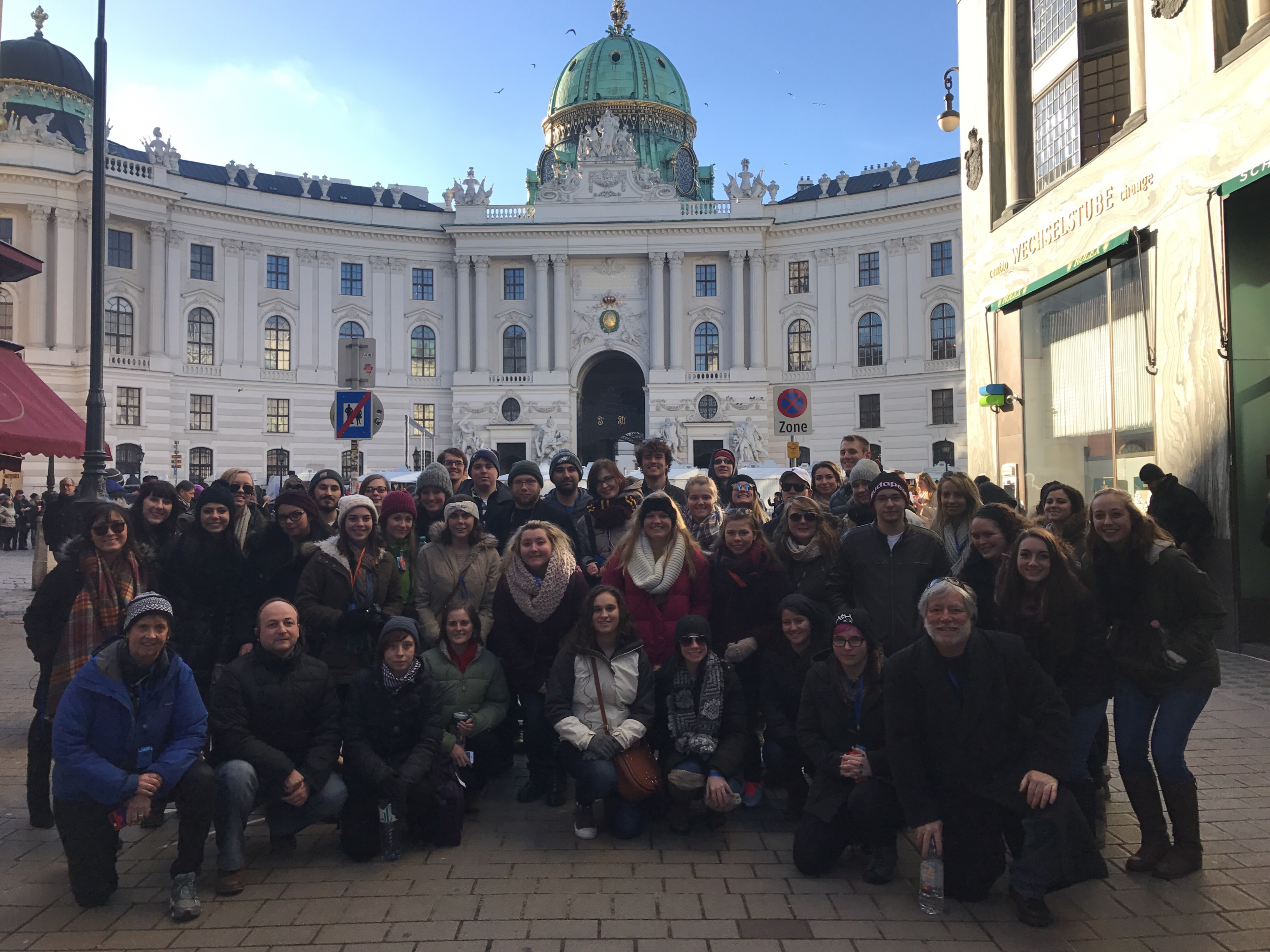
Alexandra Miller, a senior honors student who is studying ASL and Spanish,  is jointly working on today’s entry to provide a dual perspective on this trip to the cities of Eastern and Central Europe and the time spent in classes at the Polish School of Language and Culture. This is the 5th year for the joint venture between here and Bloomsburg University, and the number of students traveling to receive credits for their class work at Jagiellonian University has grown to 40, after a first year of about a dozen. Bloomsburg’s Dr. Mykola Polyuha has almost single-handedly grown this amazing venture in terms of contacts and logistics, and the Global Studies office has provided invaluable assistance. This year a significant continent of honors students are also on the trip.

The first thing many might ask is if they are required to speak Polish. While the classes are taught in English learning how to say things like good morning (dzień dobry), thank you (Dziękuję) and thank you (nie ma za co) are a good place to begin. Having some background in another language is certainly helpful according to Alex, who speaks both Spanish and German. She finds herself wondering about the connections between the different families of languages. Whatever the case, you will certainly be able to manage in English in major cities. It is always strange to not be able to read signs or understand things in the grocery store without a picture; however, when the Polish złotys are about 4.23 to $1.oo, there are two things happening. If currency conversion is something new, it takes some time to get a handle on it, but this exchange rate makes being in Poland very affordable. Alexandra, Clarissa, and I had dinner and a drink along with mineral water for about 30.00 total between the three of us. So . . . finding something to eat at a great price is commonplace. Second, when the Christmas Market is still in full force, the food at the street vendors is beyond anything you might ever imagine at the Bloomsburg Fair, and, not to sound snobbish, both better and cheaper.

The Christmas holiday and New Year’s Eve are quite an experience. First, Europeans celebrate the 12 days of Christmas for exactly what it is: the Christmas season. Encountering one of the most important events of the church year in a country that is 95% Roman Catholic certainly is different than the typical American season. Again, in our conversation today, a reflection of this difference was aptly stated as “while Christmas in America is about commercialism, Christmas in Europe is about culture.” People from around the world, but even more so certainly from around Europe come to Kraków for New Year’s Eve, cramming 150,00 to 175,000 revelers into the main town square. The friendliness of people and the number of languages you will hear screaming out Happy New Year in this relatively small space is unlike anything I have ever experienced and students each year walk away with life-long memories. However, there is more to this experience than food and people. Most days after breakfast, the 40 students and 3 faculty  here this year gather at the university for two classes, which meet for about 3.5-5 hours almost daily, including some Saturdays.

The first class, starting mid-morning is titled History 405 Jews of Europe and is taught by Dr. Annamaria Orla-Bukowska, a world renown social anthropologist for her work in this area. Her encyclopedic knowledge of the Jewish question will astound and captivate you. The second class, titled Russian 214 East European Film, Literature, and Culture is perhaps the more difficult class as the 16 films watched both inside and outside of class are in foreign languages (mostly Slavic), with subtitles. As we spoke at dinner among ourselves, the work to wrap our heads around what some of the films are saying or what we should understand certainly takes work. Certainly some of the challenge is language, but the film genre is so different from the typical RomCom or Drama/Action films to which we are generally accustomed, these films are realistic and much darker than some might find even comfortable. The professor for this class, Dr. Maciej Stroiński, is both avant garde and brilliant. He is considered to be one of the best film critics in all of Europe. Pushed to think a bit differently than many of the classes taken back in their own majors, students are asked within a few days to come up with a significant paper proposal for the Jews of Europe class, with at least a pretty thoughtful outline. In addition, they are to write two critical reaction papers. After returning to the states, there will be a 8-10 page paper due by the end of the month. Similar requirements are due in the East European Film, Literature and Culture course, with a major paper due at the end of the month. The film writing is perhaps the most difficult because very few students understand the significance of a post-Soviet understanding of the an individualistic or transnational Eastern Europe. From my experience last year, however, both professors are simultaneously academic and kind in their responses to the Bloomsburg students.

It is interesting to me as a writing professor to see how students, most of whom are strong students in their majors back at Bloomsburg (if I am not mistaken, all students on the trip this year have GPAs above 3.0), work to manage the compact schedule of academic requirements while trying to experience the remainder of the immersion called Kraków or Prague has. In addition, there is the reality that coming to Europe and spending time is a literal walk through a history book. For instance, Jagiellonian University was established in 1364. That means it has a few centuries on any university in North America. Trips to the Wieliczka Salt Mine in the next day or to the Jewish Quarter, Schindler’s Factory or Auschwitz are not something you ever forget. Too many times students believe that study abroad is too expensive or not worth the effort, but as the three of us spoke at dinner this evening, nothing could be farther from the truth. As I have walked around this city for the third time, and am working on arrangements to come back for an extended period, I have been once again reminded that there is so much that is happening in the world that matters, but we have little to no clue about.

What has happened in our own recent politics, or perhaps not as recent as we might think, actually mirrors much of what has happened in a number of countries here in Europe, and while I am certainly not a social scientist, nor a political scientist, it seems that our sort of xenophobic/right-leaning/nationalism is the consequence of something we use every day. Globalism is more than an economic phenomena; it is a social phenomena and the ability to reach across borders, continents, and time zones effortlessly has had consequences unforeseen and perhaps unimagined. That might be one of the most important things that students on the trip might learn. Whether it be Budapest, Vienna, (two cities added to this years itinerary), Kraków or Prague, most people are merely trying to make their way in the world, but a world that finds people from different cultures, languages, and religions reaching out on a New Year’s Eve or on an U-Bahn, or standing on the corner hoping for a world with less violence and more understanding. Sharing dinner with students who appreciate another language, having breakfast with our Russian Fulbright Scholar (did you know we had one at Bloomsburg right now?) or listening to students who are studying Russian are great reminders that the world is much larger than the drive from your home to school and back, or from home to a major city. We live in a complex and amazing world. 40 students and 3 faculty are living that reality each morning as they face both experiences and classes during this Winter break in Poland.

Dziékujé za przeczytanie i pozdrowienia z Polski.

Alexandra Miller and Dr. Michael Martin

Reisen mit Studenten – Gestern im Wien . . . Heute im Kraków

Guten Morgen aus meinem kleinen Zimmer in der Jugendherberge.

Wir kamen in Wien um 10:00 Uhr am letzten Abend und haben sich in der Herberge. Es ist ein wunderbar komfortables Hotel und sehr sauber und effizient. Ich bin begeistert, nach Wien zu kommen, da wir zum ersten Mal von der Möglichkeit gesprochen haben, vor einem Jahr während der letzten Reise. Wir waren in Europa ein bisschen weniger als zwei volle Tage und gestern Nachmittag, bei knapp 24 Stunden Studenten glaubten, sie waren schon seit Tagen verschwunden. Es ist interessant zu sehen, wie der zeitliche Wandel, sowie Fragen der Kultur, vor allem Lebensmittel und Sprache, ihren Tribut an den menschlichen Körper und Geist. Ich erinnere mich an meine Reise nach Ostdeutschland im Jahre 1985 und in einer Ostblock-Nation zu dieser Zeit. Wir durften nicht wandern, wohin wir wollten. Wir wurden beherrscht in Bewegung, Zeit und sogar wo wir essen konnten. Was mich über diese Erfahrung erstaunte, ist, wie schnell ich mich an den Verlust der Freiheiten angepasst habe.

Als wir zum Frühstück am Morgen gesammelt, war es amüsant, die Studenten, die amerikanische Frühstück mit Pfannkuchen, Französisch Toast, Eier verschiedener Arten, Müsli und große Saftklassen verwendet werden. Die Herberge Frühstück war Brötchen, Fleisch, Käse, Brotaufstrich und etwas Gemüse. Es waren keine Eier zu sehen. Die letzten zwei Tage war es interessant zuzuhören. Doch alles in allem sind sie gut und sie lernen, dass Reisen interessant und anstrengend ist. Natürlich haben sie mehr Ausdauer als ich, aber ich möchte glauben, ich mache Dinge ein bisschen klüger und effizienter als sie. Heute Morgen sprachen wir beim Frühstück über Wien und die Musikgeschichte in Wien, die natürlich eine reiche und abwechslungsreiche klassische Musikszene hat. Das ist etwas, was die meisten Studenten heute nicht verstehen und manchmal leider nicht schätzen. Meine Geisteswissenschaften Klasse und die Vorlesungen der Kunst, Musik, Literatur, Politik und Religion kommen harkening zurück.

Here is a translation of the beginning of my blog, but I felt the need to work on my German, which is both important and a bit rusty. Wish I was here to practice a bit longer.

Good morning from my little room in the hostel.

We arrived in Vienna around 10:00 p.m. last evening and got settled into the hostel. It is a wonderfully comfortable place and very clean and efficient. I have been excited to come to Vienna since we first spoke of the possibility a year ago during the last trip. We have been in Europe a bit less than two full days and yesterday afternoon, at barely 24 hours students felt they had already been gone for days. It is interesting to see how the time change, as well as issues of culture, particularly food and language, take their toll on the human body and spirit. I am reminded of my journey to East Germany in 1985 and being in an Eastern Bloc nation at that time. We were not allowed to wander wherever we wanted. We were controlled both in movement, time, and even where we could eat. What amazed me about that experience is how quickly I adapted to the loss of freedoms.

As we gathered for breakfast this morning, it was amusing to watch students who are used to American breakfast with pancakes, French toast, eggs of various types, cereal, and large juice classes. The hostel breakfast was rolls, meat, cheese, spreads and some vegetables. There were no eggs in sight. During the last two days it has been interesting as I have listened to the sort of cultural overload of the senses for so many who are traveling outside the country for their first time. However, all in all they are doing well and they are learning that traveling is both interesting and exhausting. Of course, they have more stamina than I, but I would like to believe I do things a bit more wisely and efficiently than they do. This morning we were speaking at breakfast about Vienna and the history of music in Vienna, which, of course, has a rich and varied classical music scene. That is something that most students today do not understand and sometimes, unfortunately, do not appreciate. My humanities class and the lectures of art, music, literature, politics and religion come harkening back. . . . it is interesting how quickly time moves. It is actually Saturday morning and the last day of the year. We had our orientation and our first classes at Jagiellonian University yesterday. The first class, presented by Professor Annamaria Orla-Bukowska on the History of the Jews in Central Europe was as stunningly impressive the second time as it was this time last year. Her command of this complex ethnographic history is unparalleled and her ability to connect all the pieces without a single note in front of her impressed students in our group beyond words. After a quick lunch, it was back for the afternoon class on Eastern European Film, Art, and Cultural Studies with Dr. Maciej Stroiński. His rather avant garde style belies his brilliance and the depth of his expertise in this area. Students are literally sitting in the presence of internationally renown scholarship each day as they listen and participate in classes at Jagiellonian. This is the same university where Pope John Paul II attended classes as a student and where students have been learning since 1364.

It is the last day of the year and tonight the New Year’s celebration in the market square here in Kraków will see 150,000 visitors. To say it is quite a celebrationmight be a bit of an understatement, but people will surely be happy. This will be my third year here and plans are to go to the same little pub where I have ushered in the last two years. Two years ago, however, I began the trip on my own, visiting the father and fiancé of a former Bloomsburg student. It was during that trip I got acquainted with the program I am here with now. Yesterday as I met Drs. Orla-Bukowska and Stroiński again, it was like returning home. Their graciousness and hospitality are indicative of the Polish people. One of the students on last year’s trip came back in the summer to take Polish language classes and on this coming Monday, I will begin my own language classes. As I have listened to the Bloomsburg students, a common conversational thread has been present. I wish I knew another language better. For me, it was certainly the case that learning another language improved my understanding of my own language. It was definitely in learning another lanaguge that I found my first genuine appreciation for another person’s culture. Perhaps that is the biggest lesson over the last 4 days as students are settling into their Krakówian experience. During the first four days, it was four languages and three countries. It is easy as we are in Bloomsburg to be caught up in the bubble, forgetting there is a complex world going on all around us. The imersion of this class, and any study abroad program, is unavoidable, but it is also what creates the life-long memories that are being formed throughout each day.

As I return to Kraków the third time, the memories of my earlier visits come flooding back. It was on this date two years ago that I found myself lighting a candle for Lydia in the Basilica. I prayed that she might be convinced it was okay to leave this life for the next. It was profound to be in her husband’s native land and praying that he might reach across time and space to greet her. Before the next 24 hours had occurred, that prayer was answered. As I move toward that anniversary of sorts, I am reminded that we are given opportunities to teach and to be taught. That is what I know as I complete another year. The learning never ceases; there is no discontinuing, there is no avoidance if one takes the time to imerse oneself in the process of life. I am certainly not the same person I was the first time I came here. The conversation with students last evening about their first day of classes was gratifying and reminded me of the opportunities and gifts we are given on a daily basis as professors. We are provided with the experiences of learning from those we teach. When you travel with 40 students, those lessons are varied and continuous. The students here in Poland give me hope. They are ready to be sponges soaking up so much of what is happening around them. The classes, the people, the food, and the culture are creating a new fabric and a covering, one that can create yet another layer to their still burgeoning globalized comprehension. While there is an undeniable populism, both in the United States and here in Europe, 40 students are learning about our interdependency and shared history. It is Saturday and the last day of the year, but will be in classes later this morning and until early evening.

In the meanwhile, szczęśliwego nowego roku z Krakowa. Thank you for reading.

Dr. Martin


Memories of Days and Years Past

img_1636-4

Hello from the Fog and Flame,

It has been a morning of mishaps, but I guess that is to be expected as I am attentively, and somewhat in intensely, trying to make sure I have covered all my bases before the day is out. However, I need to relax and is often the case, my way to do that is to turn to my inner-self and write about it. However, before you read my blog this time, I am going to ask that you do what I am doing. If you have a pair of ear-buds or some other private listening device, please put them on or in and turn on your favorite Christmas or Hanukah music. As I write this, it is both Christmas Eve day and the beginning of Hanukah. The heavens and the calendars have united this year. Perhaps it is the harbinger of good things to come and unity can somehow find its way into other elements of our country and our world.

What are your first memories of Christmas? What made the season magical as is often the word used to describe this season, which is actually the season of Advent until tomorrow for the Christian? What made your Hanukah Celebrations memorable and how does Hanukah with differing dates change the anticipation for those who celebrate this Festival of Lights? My earliest memories of Christmas do not really begin until I was in elementary school. While I lived at the place by fondest memories of Christmas occurred, in spite of the fact I lived in that house until I was almost five, I do not remember Christmases there as a toddler. I do remember living there,  but I do not the holidays. I do remember all the amazing things that were created in the bakery as a small child and I know that the time between Thanksgiving and Christmas were tremendously busy. The pies and pastries, the amazing breads and various things that I somehow never tired of eating were setting out in every direction. What I remember about the Christmas holiday was spending a week at my Grandmother’s house beginning with Christmas, and usually until the end of the school vacation. Mornings of poached eggs, amazing toasted breads, and a fresh grapefruit were, and are, still my comfort food. Christmas Eve was always spent at church with multiple services and singing in choirs and we would open family presents between services. My mother was the most phenomenal Christmas cookie and candy maker and she would spend pretty much every waking moment from Thanksgiving to Christmas making more candy, cookies, peanut brittle, divinity, as she called it, Norwegian Christmas cookies, and anything you might imagine. Seriously, no one could touch her when it came to all of these Christmas treats. Christmas Eve meant getting to bed late, but not too late,  because Santa still needed to come and late nights jeopardized the visit. Christmas morning meant making oatmeal for breakfast and then packing the car to drive to Grandma’s house for a day of amazing food, a Christmas program of carols and music (me playing my trumpet, by older brother playing his trombone, and my sister, Kris, leading the singing of carols. This was our yearly gift to our relatives. Sometimes I must admit I did not want to do it, but at the end I was always glad I did. The Christmas dinner guests were my family of five, my Great-aunt Helen and her husband, Melvin, my Great-aunt Martha, who could still speak Norwegian, my Aunt Martha, my Uncle Claire, and sometimes, a few cousins. What I remember about the Christmas was my grandmother pulled out all the stops and was so happy that we came back to her house every year. She had an acreage and hills and tobogganing was a staple as well as games of hearts after dishes were done and somehow coming back to eat more, usually turkey sandwiches and more pie before everyone would leave, but that really began the holiday for my sister and me as we stayed at Grandma’s house for at least another week. I loved that house. It was not a rich or large house, but it was filled with love. From the old fashioned kitchen to the warm and toasty den, it was the place I felt safe; the place I knew I was loved. I was fortunate to have that through my high school years. I am not sure Christmas has ever been the same. That is not to say that there have not been additional memories that mean a lot to me.

When I was first married, Susan and I were pretty poor, but somehow I began to collect Dickens Houses for Christmas. Somehow they were all lost in a divorce. To this day, I am not sure what happened to them. I have always loved sitting in front of the Christmas tree in the dark with only the lights of the tree and music playing softly in the background. To this day, that has not changed. What has changed is that the holidays are special, but when I get to see the smiles and the excitement on face of others. A second important realization of Christmas for me was when I was in East Germany and Germany before Christmas in 1985. The German Christmas Markets and the fact that they celebrated Advent for Advent really impressed me, but merely as an issue of beauty, but as an issue of piety and appropriateness. Another significant Christmas memory for me was my second Christmas as a pastor in Lehighton, Pennsylvania, not far from where I live now. We did a special service for families called “The Animals’ Christmas” and everyone brought a stuffed animal to put in the chancel area. I did a monologue to my teddy bear and used the first Mannheim Steamroller’s Christmas music. It turned out well and when the lights came back up, parishioners actually had tears in their eyes. It was one of those times I felt the presence of the Holy Spirit at Christmas in ways I seldom have. I remember some Christmases in the Southern Black Hills of South Dakota with Susan’s family. Her parents were always terrifically kind to me and they are very good people. Christmas when I was a pastor was very different because of the amount of work that goes into Christmas services. Christmas Day when I was in the parish was a time to finally relax and decompress. If I was to consider the most important thing I have received from the Christmas holiday is finally a time when people seem a bit kinder, a bit more gentle and a time where perhaps they step back and realize what matters. While the giving and receiving of gifts is always amazing, it is the giving and receiving of care that really makes this time magnificent to me.

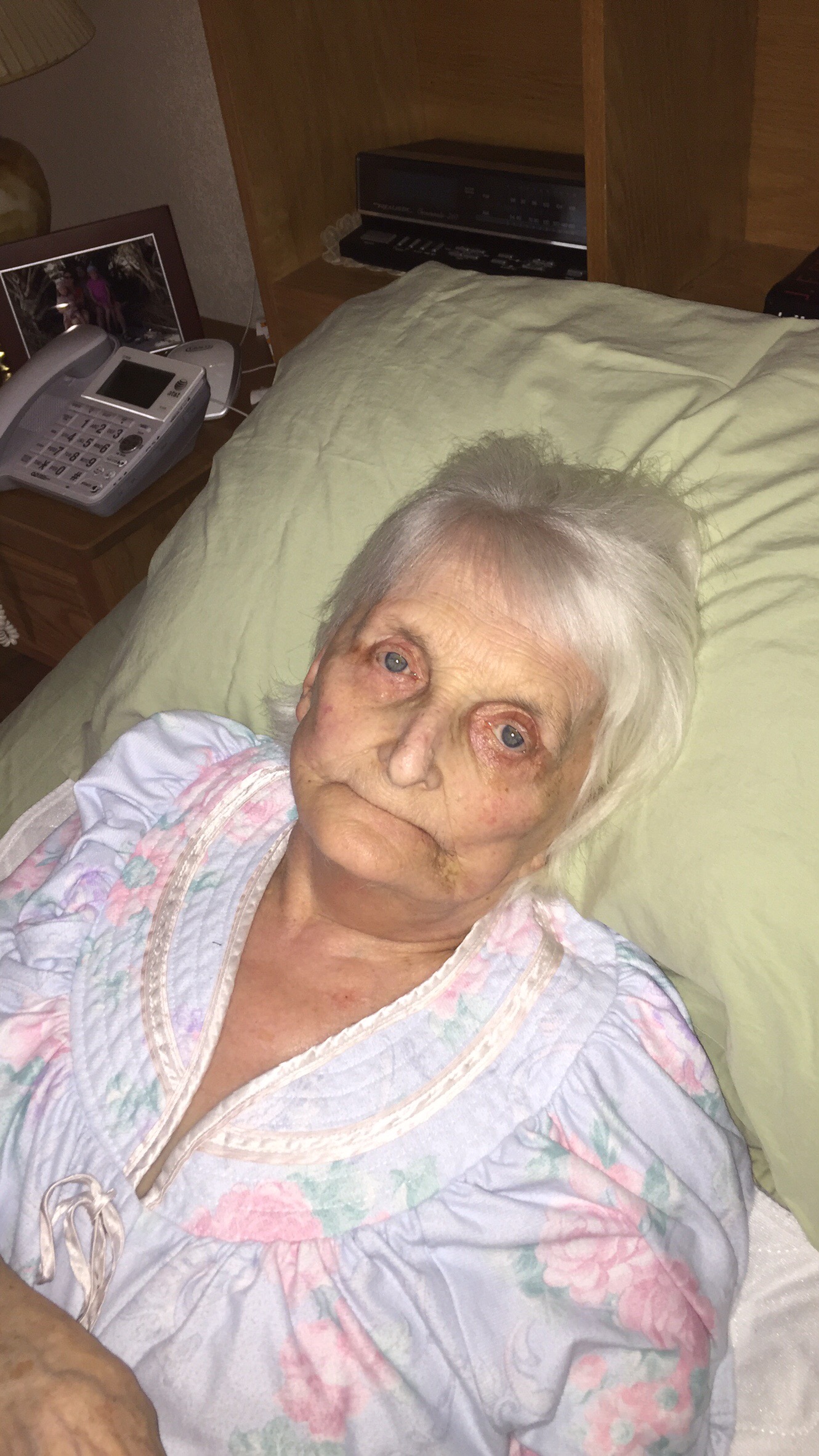
Two years ago today I was sitting vigil at the bedside of one of the most amazing people I have ever been blessed to know. She was actually somewhat Scrooge-ish when it came to Christmas and I think there a number of reasons for that, and not all of them are clear to me, but at this point I had sat by her bedside for about 5 days when it was expected she might live for 3. Instead on this day she laid there and pointed into the corner, speaking in Polish. I asked her George was there for her and she said, yes. I asked her if she was really to go, and she shook her head, rather empathically, I might add, no. During those days, I learned how important another family was, the Menomonie family that had supported me while I cared for her over the years. Then there was her COH family, the amazing workers, cooks, nurses, and administrators, many who had watched her battle with the terrible disease of dementia as this brilliant and forceful little tornado slowly lost her battle to know who and where she was. The one thing she never lost was her forcefulness, her amazing eyes and infectious smile. The vigil I held for that 8 days before I had to leave to fly to Poland taught me as much about myself as it did about others. To allow someone to leave when you desperately want to hang on to them is a difficult thing. I remember thinking she was waiting yet again to do things on her terms. During those days I merely worked on the computer in her room and played John Rutter’s Pandora station. To this day, it is my favorite Christmas station. For me, Christmas is the music; the profound way in which it is able to reach into the core of my being and remind me of the emotions and pull images from Christmases past unto the internal video screen that runs through my mind provides a sense of comfort that is unequalled by any other experience. . . . much like two years ago (and it is now late on the evening of the 27th if you are in Pennsylvania, but early morning on the 28th if you are with me in Budapest), I had to leave to travel. That traveling was to Poland and I would be walking around Krakow (as I will be in a day or two once again) and praying in St. Mary’s that George might convince Lydia that leaving this world for the next was both reasonable and preferable. In the past week I read an article about the increased mortality for ourselves during the Christmas holidays. Why is it we find leaving this world for the next during this sacred time of year? It is for that very reason, its sacredness? Is it because we know that the memories of this time are so significant for many of us? As I write this, it is about 5:40 a.m. and I awoke to the news that Carrie Fisher has left this world at 60. It is interesting how there is this sense of immortality among the famous, and I do not think I realized that she was a contemporary (at least chronologically) for me.

I know that remaining in touch with some of the beautiful people from COH is one of the ways I think we all continue to grieve and celebrate Lydia’s memory and the profound influence she had. I still do not believe she would hold herself in such esteem. She was always stunned that people would still (after 20 years) come up to her and introduced themselves to Professor Rutkowski. “Michael,” she would say, “I do not know why they still recognize me.” I still wonder if she did or not, but she was a force and I told her, always smiling, that I had no problem determining why she was recognizable. Aging is a cruel and uncompromising reality, but she fought it and beat it for most of her 90 years. It was not until those last three years or so (and I will blame it on the dementia) not on her aging. I remember how elegant she was, even after the first year she was in COH. She worried and was, in many ways, both cognizant and petrified of what was to come. She knew and yet she fought it gallantly. Even in her last days she wanted control of what was happening. She was only willing to go when she decided. I believe that is her most lasting legacy to me. She was a do-er and she decided what she was willing or not willing to do. This is not to say she did not have her fears (and some of them were abject or acute), like storms. I think she also worried more about others because of her size and her accent, which I found to be one of her most endearing qualities.

As I sit and compose at my computer again this morning, I am wondering what it was like for Dr. Nielsen when he had all the students with him year in and out. What students learn as they are on this trip is also somewhat fathomless, or should be. I remember the sense of walking through a history book. As Americans our understanding of “old” in terms of buildings, history, or time is so nascent. While those who know me, and my Marine Corps background, should be aware, I have a deep-seated patriotism for the what America does and stands for; however, I am also rather recondite when it comes to how long we have been a country and how dependent we are on the history of those before us. That is where I come back to the idea of memory and our own heritage, be it nationally or personally. Be it in the grand scheme or when it comes simply to my distinctive or particularized experiences of this time of year, I know that I am the cumulative product of the heritage and experiences which came before me. As I often say, none of us gets where we are without the help of another. As I consider once again the heritage of the little tornado  or the national identity of her town when later today and tomorrow I will be in Wien, her adopted home, I hope I might view and experience it with a sense of her elegance. I hope I might feel her walking beside me with her little Austrian accent and that purposeful walk. Lydia, even now, two years later, I am much of what I am and I am able to do much of what I do because you loved me.

Ich kann mich noch an den ersten Tag erinnern, als ich dich fragte, ob du Deutsch sprechen würdest und du sagtest kurz: ‘Natürlich bin ich ein Österreicher.’ Wenig wusste ich, dass meine erste Reise nach Polen und jetzt Wien ein Teil von wem ich werden würde. Wenig wusste ich, dass ich in der Lage war, Ihre Stimme immer noch zu hören. Heute, während ich durch deine Stadt gehe, hoffe ich, dass ich dich in meiner Nähe spüren und mich anleiten werde. Ich sagte dir vor zwei Jahren warst du jetzt mein Schutzengel, und es ist wahr. Du bist. Ich hoffe, dass das Sie lächelt und immer noch bereit ist, mich zu informieren, dass ich Ihr elendes Geschöpf bin. Ich liebe dich immer noch.

For a translation of the last part, I have written: Today as I walk through your town I hope I will feel you near me and directing me. I told you two years ago you were now my guardian angel, and it is true. You are. I hope this finds you smiling and still willing to let me know that I am your miserable creature. I love you still.

To the rest of you, thank you for reading.

Dr. Martin (aka: the wanderer)


Attempting to understand what appears to be absurdity, but perhaps isn’t

IMG_0031

Hello from my getting home after a long . . .

I am not sure if it has been a long couple days, a long month, a long campaign, or seeming to be perhaps a long life. That is my perception of both the election, the campaign, and certainly what will be a terrific amount of prognostication from every corner of the country, if not the world. I actually walked into my bathroom about 7:45 last evening and noted specifically to look at the time when my thought was that Donald Trump was going to become the President-elect. I had said throughout the campaign, even in the primaries that he was not as stupid as people wanted to claim or believe. While I believed the actions of Mr. Trump to be embarrassing and shocking, perhaps I am not as typical in my thoughts as I might have imagined. While I thought his disparaging comments towards too many would have had a cummulatice consequence, that was not the case. That in an of itself speaks volumes about the present atmosphere in our country. I am dismayed, unsurprised by the atmosphere, which is even worse, and as we are two days into the transition watching things I have never witnessed following a presidential election. Certainly I have seen pain and sadness when one’s candidate loses, but I do not remember seeing or reading about such vitriol and protesting (and some that has become a sort of rioting) after the election of a candidate. Then again, I know we have never witnessed the sort of offensiveness or unseemliness in a campaign as we have just witnessed. My niece or great-niece, I cannot remember which noted that the media certainly has a role to play (and I might argue a significant one) in how the campaign unfolded. There are so many ways to consider this, but this is only one blog, so I cannot got into it all. (I am adding to this post on Saturday, now four days out.) I do believe there are more reasons than any one attempt to characterize the rationale for one side’s victory or the other’s defeat. While I am a life-long Democrat, I am fiscally conservative. While I believe in helping the other, I do not believe in free handouts. One of my more conservative friends have noted things about the protesting/rioting (and I do believe there is a difference). I do not have a problem with peaceful protest. I do have a problem with rioting or with destruction of another’s property merely because someone is angry. There are two things I would like to note, but then I will be quiet. I believe it is paramount that we come together as a country and listen – not merely hear the other as some kind of noise, but truly listen – to what our equally valuable citizens have to say. Again, I grew up in NW Iowa. I grew up in what is considered to be rural America and not every farmer or small town person or white person is red-neck, uneducated, and racist. On the other hand not every metropolitan black, Latino, or Muslim is anti-white or an illegal or terrorist. How did we get to the point that we seem to go there before we think or listen, and then think again? The second thing is this: when considering the candidates, I must admit in retrospect that there was a sort of coronation of Secretary Clinton as the only possible standard bearer of the Democratic party after she left the State Department. I feel some of this because of the Wikileaks and the hacking of the DNC or the DSCC as well as the response to Senator Sanders. Arguments made about how the campaign was managed have more credibility that some might want to think. Second, if we are to examine Mr. Trump’s rhetorical strategy in his addressing the issues of race, religion, economic inequality, immigration, gender, and you can probably add to the list, what is evident in light of the result is this, and while I say this with a significant amount of chagrin, and particularly in light of his comment in the last 24 hours (I won), one has to either call him a genius or despicable, or both. It was certainly a winning strategy in that he tapped into the anger of a great number of our fellow citizens. From where all that anger comes is certainly open to discussion and will be the fodder for a great number of pieces, scholarship, and a number of other responses. Second, it can be considered despicable because it appears to have created an even greater divide in our country (or, at the very least, exposed it for what it is). I am the soon to be elderly (and some already say older) white man, but I am educated. I do not consider myself to be an elitist, but that does not mean that others might not see me as such. We understand people for where they are when we meet them and we too seldom take the time to see the more complete or complex picture. The consequence for that lack painted a very different picture, but perhaps a more accurate one of who we are as Americans. The paintbrush of the American electorate is complex, but November 8th we created a picture of ourselves that has our entire civilization shaking their collective heads. Do we know who were are? Our popular vote painted on picture, but our electoral college created a different one. Regardless of where you stand, the final result says something both powerful and conflicted. How will we move forward. It begins with each person from both sides listening to the other. Perhaps that is what we might learn most importantly. It is not merely Hillary Clinton’s job to quell the protest, nor is it Donald Trump’s. It is ours as Americans. The protest is palpable. Rioting or damaging property out of anger is not the answer, and if you did not vote and you are out there rioting (again I see a difference), STOP IT!

(I am back to what has been written previously) However, as I wrote yesterday, it was the 241st Anniversary of the Marine Corps and as I write today it is Veterans’ Day. Both of these things are important to me for a variety of reasons. My adoptive father served in WWII and after my birth father passed I found out that he had been in the Marines as I was. As I noted in my Facebook post, I was a scrawny 17th year old who left my home in Sioux City for my first plane ride to MCRD in San Diego in June of 1973. I think my last posting has my boot camp picture, which illustrates clearly I was still growing into my ears. Sad, but true. For some it was absurd that this squirrely 17 year old boy believed he could make it in the Marines. As some of you know, I did not make weight when I first went in and had to go eat a lot of bakery food and drink water to make the minimum guidelines for weight. I wish I still had that problem. Difficult to accept what age and metabolic change does. It was also the 533rd anniversary of the birth of Martin Luther yesterday. As I sit in my office this morning, I remember so clearly yet my trip to East Germany in 1985 and to many of the Luther places. I remember my trip to Buchenwald, which was where Bonhoeffer, the eventual subject of my dissertation, was incarcerated before his move to Flossenbürg where he was hanged. I remember listening to a lecture about Luther as the first Lutheran socialist. It was actually a pretty brilliant lecture, particularly in light of some of the more disturbing and racist things Luther wrote at the end of his life. Finally yesterday was the 41 anniversary of the sinking of the ore ship the Edmund Fitzgerald, during a November winter storm on Lake Superior. It is interesting to me how this one date has such a varied significance in my life. Today it is 98 years ago, almost a century that Armistice was signed in Versailles, a treaty that would actually led to the rise of Hitler, the Nazis, and eventually create the Holocaust. Again, it is absurd to believe that one person could lead such a cultured country toward the extermination of a particular ethnicity. but it happened. (I am back to writing on Saturday, November 12th.) I have been enamored with the German culture since I first got out of the service and my pastor’s family had come to NW Iowa from Germany. Their decision to continue speaking German on certain days of the week started a love affair with other languages and cultures that continues to this day. In some ways it led to my becoming a Lutheran pastor, to my dissertation and my continued study of this amazing country. The Germans also had a significant event in their 20th century history on November 8th (1923). It is worth considering.

Yesterday I had the opportunity to speak with one of my dearest friends who I have known since I was barely in school. It was a blessing to speak with her and hear her thoughts. Partly because it allowed me to commiserate the week, but she was more liberal and open that I had actually realized. It also helped me understand that we make such assumptions about the other, even those we have known for decades. She noted she was probably the only person of her family who voted for the Democratic and she claims to be Independent, which I do not doubt. I am pretty sure that I am the only one in my family to vote for Secretary Clinton. None of them have said anything to me this week, but then again, I have not said anything to them either. I also realize this is contrary to the other things I have noted earlier in my posting. Part of that is I do not merely want to have a superficial and quick conversation They are too important to me. It was such a breath of Fresh Aire (pun intended for those understand it) to speak with her. I am increasingly cognizant of the magnitude those times in my life meant (and still mean to me) when we have had the opportunity to share time from sitting on a dock the summer of 1984 to dancing at Grandpas or The Jockey Club in the late 70s or early 80s, from chats on the phone to visits during the increasingly infrequent times I have been back to my hometown over the years. Amazing how one of the first recollections of my childhood has provided such a sense of comfort and care. In the conversation yesterday I was surprised to see how similar our philosophical bents are. This is actually a good example of the very disconnect that I address when considering the Presidential election of the past week. It is my narrow-minded elitism that I want to believe I do not have. While I have always known her to be thoughtful and considerate, I have not always given her credit for being as philosophical in her approach as she is. Part of that might be her faith background, part of that is because we have never really discussed things as we did this week. What I have always known about her is her pure and caring spirit, her unequalled love for her son and her family, and her amazing beauty and grace. What a joy to learn more about my life-long friend and sort of soul-mate.

If I return to things I still need to get done, it seems there are more things being added than subtracted, and I am not sure that will change anytime soon. It is where we are in the semester: between a strike, an unparalleled election process, and four preps, the semester is kicking me. I must also admit a good part of it is I am getting older. It is also in that I have been struggling a bit again with my health. This is the consequence of a couple of things. Managing my health, which is always an issue, and then finding that I am allergic to cats, which I did not know. It is amazing how that exposure affects my breathing, swallowing, my eyesight and a tightness in my chest that is different than anything I have ever felt. It has been a difficult time because I am committed to helping my friend,  but trying to figure out the logistics is becoming more perplexing, more indecipherable. Certainly some things have been accomplished, but progress seems to be slow; yet, I am more aware of why that is than some might think. There are so many demons that one must confront and about which one must be honest . . . and while we would like to believe that honesty is something we should just reasonably do, perhaps nothing is farther from the truth. It is so difficult, taking more of a herculean effort that one might expect. It is because honesty requires accountability, something that scares us. While there is much more I could write, I want to get this out and then move to the next thing on the list. It has been an interesting week, and it seems that will not change soon, either in Bloomsburg or in the wider state, country or world. As I finish this post, a couple more days have passed and today would be my sister’s 60th birthday if she were alive, so this is a shout out to her. She did have an incredibly giving heart and she was an even more tremendously intelligent person. Happy 60th Kris. I wish you were still here and we had talked more. She was an enormous fan of Anne Murray, so I offer this video for her in remembrance of her birthday.


Thanks to everyone else for reading.

Michael (aka: Dr. Martin)

Wishing for Something Better

boot-camp-sized

Hello from Dunkin’,

I have been busy doing work and trying to manage a number of issues. I have tried to complete a blog on two or three occasions, but the last month has overwhelmed me in ways I could have never imagined. There are a number of things that have required my attention outside the normal classes, prep, grading, and daily life, but it seems that I have felt more paralyzed by all of it than I ever have. It is hard to believe we have been through an actual strike of faculty within the system; it is hard to believe we as a country have endured a political campaign for president that seems to have created and exposed more hate and discontent than one might have imagined in their wildest dreams (at this point, besides feeling exhausted by it all, I am mostly embarrassed). I actually feel badly for those who are voting for the first time. While I am hoping they believe their vote matters and democracy matters, I cannot blame them if they are feeling a bit disenchanted or disillusioned by what we have witnessed.

As those who know me can be sure of, I have a particular viewpoint on the election and what I hope happens. Yet regardless of what we wake up to on Wednesday morning, if anyone believes the election will eliminate the unparalleled rancor that has characterized this election (be it the primary on one side in particular or the general election), they are sadly naïve. Perhaps what this election has revealed is the deep divisions in this country between those who are educated and those who have not gone beyond a 12th grade education (or less). Let me say immediately, I know this does not characterize every single person, on either side. I have college classmates who are adamant supporters of Mr. Trump, and I still respect and consider them to be intelligent and good people. I also know some persons who did not go to college, but support Secretary Clinton and are also not welfare recipients or on the dole. What I am saying is there are things that do not add up for me at times, but I will always try to respect the decision of another, particularly if they have thought through their position and can articulate why they believe as they do.

While I like politics and the give and take of what is happening in a campaign, what I realize is the last 20+ years of American politics has become an exercise in character assassination and working on most every level to attempt to thwart those with whom one disagrees. Any thought of working across the aisle is something of the past. Any attempt to see what is for the greater good of the country versus working to merely get re-elected is long gone. I believe the  practice that one can disagree with another, but remain civil is also a thing of the past. How did we get here. As I sat here today I listened (mostly because I had no choice) to a table of Bloomsburg sorority students as they were eating a late breakfast. They had language that would shame a group of Marine Corps DIs, and they were not shy about using it. Not very impressed, and there was not thought of what others might think of their vocabulary (or lack thereof). While this might seem of little importance as we move toward electing a President in a campaign that is certainly not like any other in my 60+ years, but I think there is a bigger connection here than one might initially imagine. What does it say when the use of vulgar language is commonplace? What does it say when there is little consideration for how what we might say might affect those who hear it? What does it say when freedom of speech, freedom of the press, or any of our Bill of Rights has become a license to do whatever, whenever, wherever we want? John Locke on his Second Treatise on Civil Government asserted that “[b]y entering into civil society, the individual submits him or herself to the majority, and agrees to abide by the rules and decisions of the majority.” And then goes on to note “[s}ince people are all born under some government, they are not in fact free and at liberty to unite together to change that government.” Furthermore, “[b]y entering into society, people relinquish their freedom under natural law, and their right to execute law. Instead, in this society, they establish a judicial power to arbitrate disputes between members of the society, a set of laws that all the members of the society must obey, and an executive power to maintain and enforce the law” (Locke). I should by extension note that he also says when a civil government has not done its duty, it is the duty of the people to stand against it. While many of us on either side of the political aisle can make our claims, it is interesting how so many “lawyers” who walk the hall of our United States Congress seem to be focused on only what they believe serves their own interests (i.e. getting re-elected and thereby receiving their pensions). Again, as I looked today, it seems Congress has an underwhelmingly dismal approval rate of 12%. The point I am trying to make is when our language, our actions, or our sense of decorum seems to exhibit so much individualism that perpetuates disdain for the other we have a problem. I have often spoke about “the other” in previous blogs. This election has often been about the other, be it the other candidate, the other view, the other person, the other religion, the other ethnicity, the other gender. What is so disheartening is the other has been, almost without exception, regarded as negative. We are a nation of others and have been from the beginning. We were the others that left Britain because we felt we were oppressed. Many others came here hoping that they might be accepted for what their otherness had to offer, but throughout our history we have struggled,  but learned to assimilate and accept. We were willing to incorporate, but many time with some kicking and screaming. Again, what I am noting is that change is always frightening. It is painful. What are the changes you see in our present situation? What are the positives and the negatives? Are we as divided and in such dire straits as some would like us to believe.

My good friend and brother, Jose, with whom I do need to catch up  when I can come up for air (this is my coming up for air for the moment), notes that too many of the 1% want the 99% to fail to think or question and he is correct. I do believe that some of the good in this election, if I can look impartially for a moment, is that there is a lot of questioning. That questioning can be positive, but when people are willing to accept sound bytes for answers, the questions have not really been answering, they have only be placated. There is so much more critical thinking that must occur. While I am willing to subscribe to some of the idea of “throw the rascals out,” I am not willing to jeopardize our democratic process. Questioning and even pushing those questions to make them critical is necessary, fear mongering and claiming things that are simply not true, blaming the other for all of our current difficulties is tantamount to returning to the a post 1933 Germany. I know that is a serious statement and one that might raise both eyebrows and ire, but as I stand as a Marine Corps veteran, I do not make such statements haphazardly. For too long we have blindly accepted what the Congress deems appropriate. It matters not (and I only mean this in this specific situation) who we elect for our executive leader beyond a certain point. When the Congress is willing to make statements like “We will make Obama a one-term President” (McConnell). Or there is already talk of further obstructionism should Sec. Clinton get elected, we need to rethink our legislature. I am a proponent of term limits for anyone in the Congress and I do not think they should get the pension they do. Let them be in SS like the rest of us and let them put part of their salaries into their retirement like the rest of us. I would also be a proponent of a one term Presidency – 6 years and done. I also understand that that might argue that every president is a lame duck when they enter office, but six years is a long time. I am also a proponent of a flat tax. Everyone pays a particular amount or percentage and no one (even if they can claim an almost billion dollar loss) is exempt. There . . . have I fixed all our problems. No . . . probably not.

What I wish is that we might merely be more civil . . . that we might realize that we have a duty to the other. We have a duty as humans to care about our fellow human beings, and I already know what some will argue or question? What does that mean. For me it means that all who are able need to contribute in a meaningful and significant manner. It means that we do need to help those who are less fortunate, but it does not mean merely taking from the rich and giving to the poor in some sort of Robin-Hoodian manner. It does not mean that we stop encouraging an entrepreneurial spirit or invention, but it means that we attempt to conduct ourselves in a manner that sees all people as valuable. I know that is difficult at time. I am reminded of a former colleague who has struggled mightily and consistently made choices that have impacted both the individual and those in even more than arm’s length from them (and I realize some of the syntax issue). This past week, I found out that one of my most important mentors passed away from cancer. Her name is Carol Berkenkotter. She is perhaps as single-handedly responsible for my getting a Ph.D. as anyone. She was the person I met by waiting on her one evening at The Library in Houghton, MI. She unknowingly asked what else I did and that led to an entire conversation that ended up with me visiting her office and getting accepted into the RTC program at Michigan Technological University. Her brilliance, her inquisitive nature, and her willingness to mentor and challenge her students taught me in ways that still influence me. As we move toward in the next 30 hours or so, determining where our country will go for the next term and beyond, I can only hope that we might find our national spirit that will move us beyond what has been nothing short of embarrassing as an election process. Can we accept the will of the majority or the electoral college? Remember in 2000 Al Gore actually won the popular vote and lost the election (and I do not want to get into the entire Supreme Court issue). Bottom line is he lost. What I hope is those who care to vote are able to do so and do so legitimately and without rancor or intimidation from anyone. What I hope is on Wednesday we begin to work toward some sense of coming together as a nation. What I hope is that we know that all people matter and as a country we still have a coveted and valuable society. What I can still say simply is, in spite of all, I still have hope. Even as a young 18 year old Marine, who looked more like he was 12, I had a sense of hope, though I was scared to death.

With that, I offer this video that says I hope we can watch and listen and appreciate the other. Thank as always for reading and I wish you a thoughtful and personally rewarding election day.

Dr. Martin


A Week of Learning for the Professor

IMG_0010

Good Saturday afternoon,

For those who are wondering about this graphic or picture, I think by the end of the post you will understand it more, but I offer this graphic shout out to all who walked, picketed, shouted, or offered support to the cause of higher education this past week. Since my last post, life has been a whirl-wind of events, requirements, obligations and emotions. As I begin to write this I have been working on my courses because of some required revision and an obligation to following through on what is required because of the events of this past week. When I posted the last time, we were forty-eight hours from the first possible faculty strike in the 30+ year history of the Pennsylvania State System of Higher Education (PASSHE); it is now about a week later, the weekend following my Monday post and on the other side of a forty-eight+ hour strike where the 5,500 faculty left their classes to stand up for the quality of education we so strive to maintain in our classrooms. Monday and Tuesday were sort of a blur as I prepared for what turned out to be the inevitable. I spent more time preparing and grading so that if Wednesday turned out as it did, I was prepared and I had done as much for my students as possible. Because there had never been a strike, most of the questions asked from others, or even my own self-pondering, were/was answered by the simple three word phrase my mother so detested if she asked questions, “I don’t know.” There was no template; there was no recipe card; and there were too many variables over which I had no control.

So Tuesday night I spent the last hours in my office tidying up, much like what you do before you go on vacation so you come home to a clean house. I also did the things I could to make sure that someone could not come in an easily take over my classes. I made sure to not do anything that would have gone against the admonishments and warnings from our provost. I went into my office one last time about 3:30 a.m. on Wednesday morning to make sure that I had everything I needed for about 10 days. Again, because I had neither an inkling nor an idea what to expect. I was up by 3:30  and I was nervous. Even though I had a better idea than many what was in place, as a member of both the Public Relations Committee and the Mobilization Committee, I still had little idea what to expect in terms of support on the campus or from the students. We had some indication of wide-spread support because the strike authorization vote that was above 93%, but it is one thing to vote, it is another thing to walk out and have no paycheck and no health insurance. We had also created a strike/picket line sign up with more than 2,000 slots to fill and they were all filled. These things seem to bode well for the chance of wide-spread support among colleagues, but there were other constituencies to consider, the most important being students and their parents. Would they realize our actions were about more than us wanting a raise or no change in our health insurance? The jury was still out on that one. There was the other audience for which there little doubt there would be no convincing or “winning,” if I can use that term, the local 30-second crowd. There is a long history of disenchantment between some of the local people and those “elitists” on the hill (that is the actual term that is regularly used). There is a bit of irony when largest employer of the county brings about 11.00 back into the community for every 1.00 earned. Bloomsburg would not really be much of the only town in Pennsylvania without those of us who work for the university, but also live within the community.

I experienced this disenchantment when a local member of the community named Rob referred to me as an “over-educated asshole” the morning the strike was to begin. When I let him know I was one of those educated assholes who would be striking, he told me “to get the fuck away from him.” Sorry if you are offended by this language, but I am merely repeating the exact quality of his discourse. Long-story-short of our communicative interaction was I did not back down and he got a bit exasperated. I must admit I was also, but I could manage it a bit better than he. What was interesting was Thursday, the following morning, I had breakfast at the diner and Jessica, the owner, asked if I had been involved in a verbal altercation at Dunkin’ Donut the previous morning early. I was stunned. She told me a local came in and noted that someone got in his face when he started smarting off. I should note that the owner and I spoke a second time and he, Bad Hombre, did admit that I spoke passionately, but not crudely. She said she knew it had to be me. What I learned in that moment was simple: there was more of my father in me than I might have realized. I had never stood up so vehemently for the union cause in my life. I had never found myself in a place to stand up for principle and be confronted by such an inappropriately-stated-disdain for what I am so passionate (my teaching). This “somewhat” closed-minded person not only had little idea what I do daily or weekly, he stated in his profanity-laced foolishness that he did not give a shit. Ultimately, it was the tone, his attempt to bully me, and his blatant disrespect that created such a comeback from me, one that not even I expected. I was reminded of what my older brother once told me about the laid-back man I knew as my father. He said on the job or when it was about his union membership, we was a very different person. I guess I have that piece in me also.

Wednesday was an astounding day. As we arrived at Carver Hall to begin picketing that first morning by 5:30 a.m., we were greeted by about 20 students, including two students from my Foundations course, Sam and Eric, to whom I offer this shout-out for coming out so early to support us. I walked at three of the 5 locations that first day and walked from 5:30 in the morning until about noon and then from 2:30-6:00 p.m. The entire day was a bit surreal because of the amazing support we received from so many people. To say that I am gratified and humbled by our amazing students does not come close to what I am feeling within me even today as I am trying to find some sense of normalcy. There were students, signs, bull-horns, chants, a band, drums, the campus radio station, honking horns, music, and a sense of camaraderie that I have never felt on the campus, and perhaps not in my entire life. Throughout that day there were so many people in front of Carver Hall and the energy was infectious.  Thursday I was asked to come in early again, but this time to take a post at the construction site on campus. Four of us stood under the ominous clouds waiting to see what would happen. The foreman for the United Brotherhood of Carpenters and for the United Brotherhood of Operating Engineers took the time to speak with us and ask questions about our reason for striking. By 9:00 a.m. that morning pretty much all unionized trades unions had pulled their workers off the site. What a wonderful demonstration of support and union solidarity for us. As I noted in my last posting, my father was correct about the importance of union brothers and sisters standing together. I saw it in action and I hope you are proud of the stance we took this past week, Dad. Thursday was a long day,  but again between colleagues, phenomenal student support and knowing that 13 other universities were also standing strong, we soldiered on whatever the circumstance might be. Throughout the day more pizza, donuts, sandwiches and coffee continued to flow in reminding us of the support that was present for us. Wednesday’s student band and Thursday’s choir and the deaf students on campus, who were told they did not have the right to signing or an interpreter by Disability Services on campus because they had not given 24 hour notice, when they themselves were not given 24 hour notice of the hastily organized meetings on Wednesday by administration, were out in force and their collective voices were deafening. It was fabulous and we are grateful to the local news station, WBRE, for covering their story. By Friday we knew there was more rain coming, but it did nothing to deter our resolve to stand once again. I should note that Kristin Baver, the local reporter for the Press Enterprise, worked tirelessly to cover the changing story from early morning until we ended our picketing around 6:00 or so in the evening. Also on Thursday, more construction workers left the job, and now, in retrospect, there was more going on behind the scenes than we realized. Mid-morning Friday, a group of Bloomsburg students and a couple of faculty boarded a school bus for the Dixon Center in Harrisburg. We were met by colleagues from Shippensburg and Millersville as well as the amazing APSCUF staff. Bloomsburg students wer3e undeterred by the rain and they were outside the Dixon Center chanting loudly and continuously for their education. Once the rain opened with torrents, they went inside and requested an audience with Chancellor Brogan, himself. What they found out was there were two attorney’s ahead of them. Again, in retrospect, it appears, particularly because of what a student overheard, these attorneys were from the State System’s negotiating team and the end was in sight. There are a number of student to whom we owe a huge debt of gratitude for their unswerving support. I was fortunate to get to know one in particular who took the time to drive around early in the morning in her little bug to deliver sustenance and a smile. She is small, but mighty. It might be easy to under-estimate her because she is a bit shy, but she is passionate and keenly aware of what is just and right. She also understands why it is so. She knows who she is and I am blessed to know her. As we returned to Bloom from Harrisburg, she spoke about returning on Monday in a business suit to meet with the Chancellor in person. She realized that rhetorically she needed to be taken seriously. Not your typical student. She reminds me of another student who has become such an important part of my life since returning from Poland last year. She sat with me today as I finished this blog. She is a phenomenal student and brilliant young person also. We returned to Bloom and arrived about an hour before we would hear that we had a new tentative contract. There is so much I could say about the three days more descriptively, but what I learned is solidarity and being honest about what matters makes a difference. I learned that standing in solidarity for something bigger than one’s self  matters and makes a difference. I learned once again that people who think about and believe in the value of education, both professors and students, can make a positive difference in the face of what seems to be pretty daunting odds. I learned that some things take more time than I wish they did and that a Governor’s support makes an unbelievable difference. To my former colleagues in Wisconsin, it is such a difference. Indeed, the professor learned a great deal this week. I need to give a shout out also to the wonderful owners and family of the Bloomsburg Diner. They have been more supportive than words will ever explain. I am honored to call the entire family, friends. Thanks John, Jessica, Amara, Luke, Ariel, and Lexi.

Today is the 23rd of October, so I actually am working on this for a second day. In 1988, on this day, and it was a Sunday, I was ordained as a Lutheran pastor at my little Lutheran Church in Sioux City Iowa. At that time, I believed I would spend the rest of my life as a parish pastor, and perhaps eventually a professor in a seminary. Well one of the two plans came to be, sort of. I did not expect to be a writing professor or the director of a digital rhetoric and professional writing program. There is an irony in location also because that first parish was in Lehighton, Pennsylvania, only about and hour and 20 minutes away. When I left the state in 1992 I did not believe I would ever come back. It is now the place I have lived the longest since I graduated from high school. That day, after my ordination service, I was so overwhelmed by what had just happened to me that I had to lie down and sleep. It seems like more than a lifetime ago that all of that happened. That twenty-eight years seems a century ago. I was so much more idealistic then. I believed so much more in the goodness of people. I believed that when one was helped or provided help, people were grateful and would respond in kind. While I am still a giver, I know all too well that people will take advantage of your graciousness. That has been a difficult lesson, but the professor continues to learn. As the day continues, I have a number of things to accomplish, but it is manageable. I sit and write with a sense of gratitude for what has been accomplished and for all the people who made a difference this past week and even, yes, in the past 28 years since I was in a different role.

It is back to work and thanks as always for reading.

Dr. Martin
Present Professor and Former Pastor
Proud Faculty Member of Bloomsburg University
Proud Member of APSCUF