Out of the Depths, O Lord . . .

Weathering the Storm

Hello from my study,

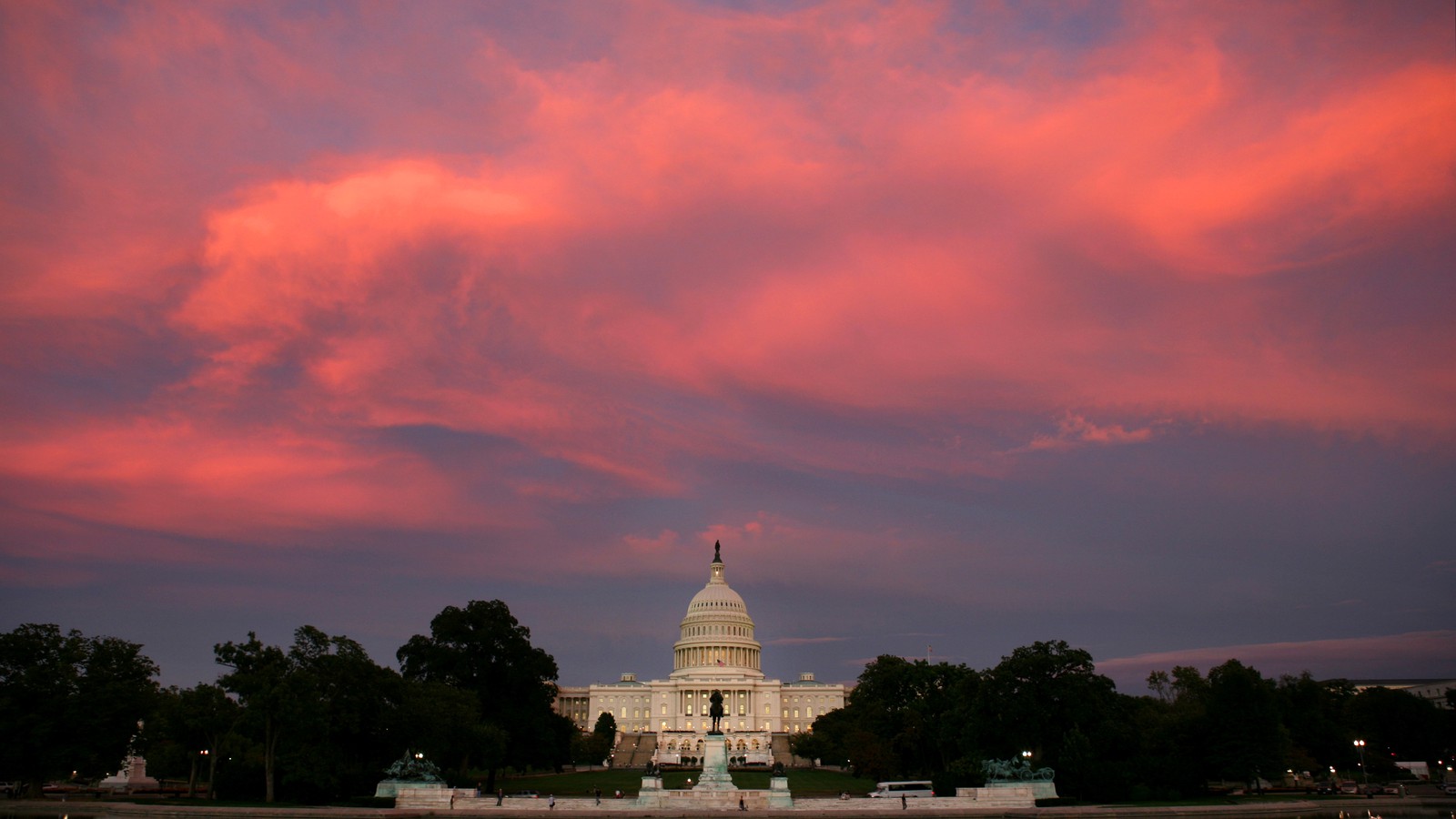
There are a multitude of thoughts, emotions, concerns, and fears as I reflect on the pictures of our national Capitol yesterday. I do not mean that to be a political statement, it is a statement of one single individual, a former pastor, a Marine Corps veteran, a person who has Republican leanings (particularly in terms of finances, fiscal policy, and what has been typical defense policy), and yet, in his practice with others, more Democrat and a strong supporter of social justice, caring for the other, and in terms of our environment and education. I lay all that out because I want to be as honest as possible as I try to compose this blog post. One of my long-time friends noted that I have become more political in my speaking and more pointed in my commentary. And while I will agree with him, to some degree, I do work hard to see the other side. There is one former classmate who regularly accuses me of hatred, but I really am not a hateful person, nor am I a bitter person. I know all too well what either of those emotions do, both to the person expressing them as well as to the people around them.

It is easy to point fingers at the other side at this moment, but I choose not to do that. There are processes and things that will have to play out in response to yesterday from at a number of points as well as in considerations of a multitude of levels. What I do hope is that the majority of the American people find what happened yesterday, at the point they broke into the United States Capitol, unacceptable. I noted here, and in other social media, that the violence or looting that occurred last summer was unacceptable. I would note when others do things that are violent, hijacking what was peaceful, that too is unacceptable. At no point, have I condoned violence either toward law enforcement or by law enforcement. I lost what was a significant friendship because I was unwilling to engage in a shouting match about this. I realize that my opinion about the election does not square with everyone else’s, but it is an opinion that has been supported by former Attorney General William Barr, by Republican Governors, Republican Secretaries of State, and by a number of Federal and Supreme Court Justices, a number appointed by President Trump himself. Again, I offer this as a way to be as transparent about my biases as possible.

So where are we? It would be easy to point fingers, lay blame, and explain, or attempt , why I believe my position is reasonable, correct, valid, and you can insert the next work to provide justification, but I choose not to do that. Instead, I want to look at the consequence of a long list of difficulties I believe we face, again, I do not want to put out a laundry list. Let me merely say something that I believe most can attest is accurate. We are hurting as a county, regardless your political persuasion; we are mistrustful as a people, again, regardless your background, education, or economic status; and finally, we have little sense of how to fix it, arguing too often about why it is the other person’s or side’s fault. And unfortunately, we want to believe this problem is something that is on relatively recent in terms of our country’s persona or fabric. Our struggle with equity, justice, and liberty for all (and I mean all) is an aspiration and yet, seldom more than that. Much like the Israelites as they attempted to follow their role as God’s chosen, they were temporarily faithful at best. If you look carefully at the prevalent pattern in the historical books of the Old Testament, they were faithful when they were happy, when they believed they were getting what they wanted or deserved. The lament Psalms are there or a reason. It is what happens when things do not go so well, or they are held accountable for their selfishness, their desires to be God’s chosen, but on their own terms. Throughout scripture, we are reminded how hard it is to be faithful when our faith is tested, how difficult it is to be charitable when we feel we have been maligned or mistreated. We are pushed to forgive when the people we need to forgive have hurt us and mistreated us, and seem to have little desire to change.

While there is more than enough blame to cast on the events of this past week, I choose to stay away from blame, and I would wish instead to consider my own struggle with what it means to be faithful to God, a God who is the God of Democrats, Republicans, and Independents, and not more or less to any of them, and second what it means to be a citizen of a Constitutional (Federal) Republic. I have realized for some time, even back to when I was on the clergy roster that I was more universalist in my understanding of the Creator than many. To this day, I find it difficult to believe the Creator who is responsible for all of us, is capricious enough to doom the Taoist who might have never heard of Jesus, but practices their faith more profoundly than I could ever hope. If that is the God we have, we are in some serious trouble. Think about it logically for a moment if you will. Even when our country was in the gripes of the Civil War, both sides prayed to their same Christian God, many believing in their heart of hearts they were being faithful. The arguments that have been appropriately made about how many actions of Jesus would fall into what a number of people would deem social justice (and by extension, socialist) are legion, and not in some demonic sense. The Creator will not be put into a box and be used by either side and thinking it is possible is not only foolish, it is dangerous. The righteous indignation on either side of the political aisle at this moment has some appropriateness, but it also has its limits. Perhaps, the greatest of all the commandments needs to be reconsidered carefully, completely, and literally. Love God with all your heart, soul, and mind, and love your neighbor as yourself. That is an extreme commandment. It requires some serious reconsideration of our personal requirements. It is difficult to love others; it is difficult to forgive others; it is difficult to see beyond our own personal blinders. Before you believe I am asking for some naive kumbaya manner, which is not as naive as we might think, I am not. I am asking us all to step back and be willing to listen before we act.

There is little doubt that a significant number of people believe our government has left them behind, and for a multitude of reasons. And yet, how many of us struggle with the role we want the government to play in our lives? Again, before you discount the question, think about it. What do we want our government to do? Social Security, Medicare, any Social Welfare programs that fall under the Federal Government are socialism. That is not a value statement it is merely statement of fact. If you have collected unemployment, assistance of some sort, federal grants for education, it is socialism. It is the government uses the taxes they collect for the social good of the Republic. This is simply what is happening. If you have ever filed for unemployment, if you have received any Federal assistance for your college degree you did not have to pay back, you have been willing to act in socialist manner. Again, I received grants for my education (and there were loans that were paid back). There was a period in the early 1990s where I received unemployment, and I was encouraged by my employer to seek it. Again, I offer these points to try to be transparent in my own participation. When Government offers some Federal program to help the masses, it is socialism. You can justify it however, but it is for the social good, which is the distribution of goods or services regulated by the whole (the Federal Government). Certainly, one can argue they are not part of the Federal whole, but your citizenship eliminate that argument. Certainly there are those who refuse to pay taxes and participate, but they use the things taxes help establish, so again, their house of cards is in danger of falling. What I am trying to say here is pretty simple. We are in this together. We are Democrats, Republicans, Independents, Conservatives, Progressives, and somewhere along the spectrum throughout. Our States’ Rights versus Federalism complicates it all, but it is what we have.

I do believe a number of Americans, even within the almost 71 million who voted for President Trump are aghast at the events of this last week. I am sure that there are those who wonder where we go from here, and I am among them. One of my most ardent trollers, a college classmate, believes I hate Republicans and the President. First of all, I do not hate Republicans, and I believe we need probably more than two parties, but we certainly need a strong, thoughtful, and principled Republican Party. The same can be said for the Democrats, as well as those who find it difficult to claim membership in either party. I’m back to where I began some of this. All American citizens who believe in the power of the ballot box, and I am not trying to get into the arguments of this election, but rather that the argument that the ballot still matters. Again, personally, I do not believe the election was stolen and I am glad that every single case (86 of them at this point) was adjudicated. Again, to be honest, I have found President Trump’s actions difficult to stomach on a number of levels, but this is not about him either. It is about us as citizens, as humans faithful to a Creator, one I believe cares for all people. For the good of the country, for the good of the world, we must step back and cry out as the Psalmist, “How long, O Lord?” If you believe in the power of prayer, I believe it is time we fall on our collective knees and ask forgiveness for our arrogance, for our selfishness, for our own usurping of a gospel that is about all people. Can you pray for the good of all the citizens of the nation and ask that God’s will might be done versus our own? While it is easy with the all the video that has bombarded us, to point fingers and blame. Again, I understand the need for laws, and for consequences, but let’s try to allow all the members of Congress to be heard. While I certainly do not support the entrance of the Capitol Building or the actions therein, I am hurt to my core that a woman, a veteran, lost her life. I am sad beyond words that a Congressional Police Offers was bludgeoned by a fire extinguisher, and subsequently lost his life. If he had a badge on that said I voted for the President would it have saved his life? Just today (and it is now Sunday) a second CPO, has died of suicide. Tragic! Violence begets violence. This is an example of a balanced equation.

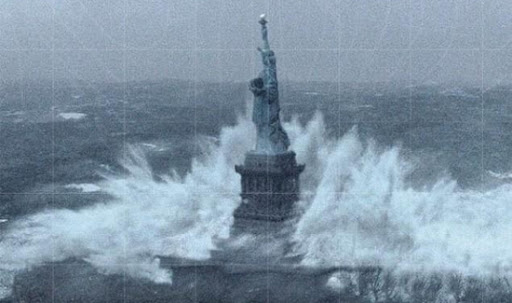
There is nothing that can bring anyone who lost their life this past week back to life. Their families will deal with the aftermath of Wednesday’s events for the remainder of their own collective lives. Their Psalms or cries of anguish and lament are justified and understandable. Those who believe that armed insurrection is the way to manage our differences are, in my opinion, wrong. Do I understand frustration? I do, and for more reasons than I need to enumerate. Do I believe we need to step back and reconsider how we debate, how we speak, how we post, how we come to our own conclusions? Without a doubt. But in each of these things, it begins with us, with a careful, honest, and thoughtful inventory of who we are, and the acceptance that we are accountable for everything we say or do. That has never been more apparent than it is now. At this point, we are our own huddled mass. We are wretched refuse in more ways that we would ever hope to admit. When I grew up as a small child in NW Iowa, I was taught some very simple rules: be honest, be polite, be respectful. Those rules might serve us well now. I had many adults in my neighborhood who served as surrogate parents. They all watched out for us kids in the neighborhood. That was the reality of my life. My father would have put it this way: keep your nose clean. That had nothing to do with my nose, it had to do with my actions and how I acted on a daily basis. As I became a student at Dana College, what I know now much more clearly, and appreciatively, was our Professors pushed us to see beyond the words and lessons. They wanted us to take that liberal arts education and become citizens, and actually global citizens. They prepared us to make a difference in a world that has struggled for equity and justice since creation. It is all connected. Nothing happens in a vacuum. In a conversational thread this past week, one of my FB connections asserted it is too late, we are beyond repair (that is a paraphrase, but it is the substance). My response was I am not willing to give up on us. But it has to begin with me and with introspection. Certainly, I have felt some indignation at some of what I have listened to, read, or watched, but I have my own blind spots. As I cry out with my own lament for the world, I pray I can open my heart and mind to those I do not understand and try to see the validity in their view. As I cry out for the hurt we feel as a country, may I find ways to bind up the wounds of others, particularly the ones I may have caused. It is not too late, if we can dig deep and believe we can create a better world. Again, this is not some polyannish wish. I am not hoping with some idealistic sense of miracles. What I am hoping for, willing to work toward is exponentially difficult, but I wish it for my friends’ children and their future children. I am reminded again of a video I have used before, but out of respect for what my parents taught me. Thank you, Mom and Dad.

The Beauty of Art: It Reveals Our Humanity

Hello from my study,

It seems a bit more than ironic that has I have spent the last 5 days writing all day long, finishing a chapter for publication that I would need to write, but I do. My brain is fried with sentences about gender, chronicity, stigma, IBDs, CRC, hegemonic masculinity, and the list could go on. So I want to write about something more enjoyable, and perhaps as important as this just completed chapter. When I arrived at Dana College the fall of 1979, I was already a few years (or more) out of high school, and even though I had some life experience, I knew very little beyond the basic Three Rs of the educational process, and I am not sure I knew them nearly as well as I had believed. After my first semester, I found myself in the first of a three semester Humanities sequence (Hum 107) and in lectures about early Western Culture that changed my life. It was not only the content of those lectures that fascinated me, it was how the various professors who lectured us helped us synthesize the world of the past, but connect it to the thoughts and actions of our present. That is an incredibly difficult thing to accomplish, but it is a profoundly necessary thing if you are to create a carefully thinking, critically reflecting, and appropriately active citizen of the world in which they live. That is what this almost daily three semesters of humanities did for me.

Yet, as importantly, it exposed me to elements of our life that were not common place in my simple blue collar upbringing in NW Iowa. That is, in no way, to say the education or life I had was lacking for most of the basics, but things like painting, architecture, classical music, or philosophy were not a part of my upbringing. The program developed by Dr. John W. Nielsen, and supported by so many brilliant faculty members as well as the incredible Parnassus staff, provided an education that was literally rated 2nd in the country at one point. Yes, that is true. We were afforded access to a class, a series of classes, or a program that rivaled any Ivy League program in the United States. The title of the class was more than apropos. Humanities are essential if we are to be a society of civilized reasoning people. Those twenty Humanities points required every semester allowed us access to cultural opportunities that helped us see how our lectures occurred in real life. Again, that is synthesizing what you learn, but it also influence who you become and how you perceive the world around you.

What I remember is it was a rigorous class, and because of that rigor, some people treated it with a certain disdain, arguing they did not need to know those things. Little could be further from the truth. If you are going to do more than be an automaton, you need to be part of as well as be able to reflect and comprehend the world in which you live and work. The gift of being an advisee of both Drs. Nielsen and Jorgensen was their ability to both challenge and support you in that challenge at the same time. They taught me how to learn, not what to learn. It is something I work hard to achieve with my own students today. They probably epitomized and lived Luther’s law/gospel dialectic as well as anyone I have ever met. In addition, there were profoundly talented faculty like Jim Olson and Alan Brandes or Sid Kieger. My appreciate for art, music, and theatre was informed by their lectures and their classes. Alan Brandes was a prodigy and one of the most profoundly brilliant, and yet tormented souls, I have ever met. And yet, it was not only the faculty.

We had students around us who exhibited brilliance and talent beyond what most might believe would be at a small liberal arts college on the bluffs of the Missouri River. There was an incredible talented and brilliant student who pushed me in ways more important than I realized, both as I struggled with Greek and hope to retain more for my Brandes’s Music History class. She was more of a blessing than I ever realized for more reasons than I have fingers. There were the men on the floor of the Promethians, they were thinking, capable students, engaging and simultaneously supportive of this 24 year old freshmen trying to figure out his life. I remember getting to know one of our Danish exchange students, between my trip on interim and her, I believe I can trace a line to the fact that Anton was my exchange son last year. She was smart, personable and beautiful, but she taught us all so much more than she realizes. I remember studying in the library with another on my humanities packets regularly. I still have some of the notes we wrote back and forth as I have all those Humanities materials in my office yet.

Art is such a complex, but essential part of who we are. I tell my students that all art reflects the culture that creates it. This is simply the way art works. Our creative minds are influenced by what we see, hear, feel, imagine, or believe. When I teach my Bible as Literature course, one of the things I stress, besides that it is a literature course and not a religion course, it that the Bible is contextual. It was written by real people at a particular point in time, and they were influenced by the world around them. One of the most mind-blowing things for my students to see is a timeline of when things were written and what was happening in other places at the same time. It is again, teaching them to synthesize their world. It is something we need to do regularly, daily, thoughtfully. I think of some of the music I listened to as a high school/ early 20-something person. I remember my mother’s unfavorable attitude toward things like Jethro Tull, Black Sabbath, James Gang, or Led Zeppelin. I wonder what she would have done if I chosen to listen to Beethoven, Bach, Prokofiev, or sometime atonal like Bartok or Schoenberg? I think she would have been more worried, but it was my fellow student who pushed me to be able to identify things like Berlioz or the other classic B named composers with a sort of name that tune. More was done to create an appreciation than they ever knew.

When I went to Europe that January of 1981, it was the time of a new President, it was the time when after 444 days hostages were released from Iran. As I had walked through the crypts of St. Peter’s Basilica or viewed the Raphael paintings in the Vatican, my head and heart raced. I was living Art Through the Ages, the art history text used for so much of our class. Almost 35 years later I would do it again, but this time I would be the professor. It was amazing to me how the feelings of walking in Garmisch-Partenkirken some decades before would return as I walked in the snow of Kraków and spoke with students about the world they were experiencing that day. As Anton came to live with me in August of 2019, I could not help by think back to the Danish exchange students who attended Dana, or my German exchange student friend from high school. I also tell my students that after education, the best or most incredible way to spend your money is to study or travel abroad. It is a cultural, as well as profoundly personal, education. As you work to find your way around, as you take the time to learn to converse in another language, as you eat the food, or sit in a church and listen to the music, your life is changed. You cannot be the same person. Again, I remember when I went to Europe in Seminary and we listened to the incredible organ music of Holm Vogel, the East German, who played Bach’s organ concertos for us in the very church where Bach is buried. While the music was phenomenal, it paled when one realized the person playing it was blind from birth. To this day, I do not believe I have been so overcome with emotion by what I experienced. I remember sitting in the cathedral in Lübeck in Northern Germany and listening to the music of Dietrich Buxtehude, played in the very church where he had served as an organist. There is nothing that can prepare one for such an experience.

Luther once said, “Next to the Word of God, music deserves the highest praise.” I think it is true. And yet the architecture of Europe, of all of Europe, and certainly in Moscow, provides such an insight into the engineering ingenuity of humans. There was no rush to build things, but as that humanities class questioned in a unit essay once, just how did the architecture of the cathedrals reflect the view and reverence people had for God? Certainly, the astounding size, the detail, the geometry and physics involved is mind boggling. The incredible writing of those from Greek and Roman times to the authors of today, it is impossible to not reflect on the world about which they write. Today photography and the eye of the photographer astounds me. They can take the mundane and it is no longer that. Artistry from the kitchen to those who brew or create beverages, there is so much beauty in what we experience, if we will merely take the time to ponder and examine it.

This past month has been a time for me to reconnect as some of my blog posts have noted. That reconnection continues to various degrees, but I am grateful and blessed by each one who has offered that chance or accepted that invitation. I am who I am today because of each of you, and you have blessed me beyond measure. As I write this is it the 11th day of Christmas. This week brings Epiphany and Orthodox Christmas. Each of those events provide a time to again take stock in who we are and what we value. As I write this, here in America, the week will move us forward toward the next step in our tattered democracy. I do not write that with any sense of pleasure, and I am not sure where I currently stand in terms of hope. As one of my mentors from graduate school noted so accurately and aptly. Being a Democrat and practicing democracy are not the same things. The same can be said for Republicans. It really returns us to the idea that we are first and foremost Americans in a Constitutional Democracy. How we make that democracy work will always be at question, but making it work is what we have done for 244 years. It is my hope we can step back and ponder, believe that we are in this together and move forward and do it again. I am not naive and believe it will just happen, it will take every branch of our government, and it will take all of its citizens.

To those who have reached out anew this week: thank you. To my beautiful cousins, family, and friends from all times in my life, I am blessed to have you in my life. Blessed Epiphany. May the light enlighten us all.

Thank you as always for reading and blessings to each of you.

Michael

Something New or Merely Continued

Hello, and welcome to a new blog posting year,

It is the second of January and we are enamored, if you will, at the idea of a fresh start, and in light of our past year, the hope that somehow this trip around the sun might be a bit less traumatic, a might bit less chaotic, and, finally, a return to some idea of normalcy from what the last 9 months unleashed upon our world. It is easy to want a do over, but how much would we honestly change from what we have done? Certainly, television shows and movies have taken on that theme more times than we have fingers, but how much is actually changed? In a written conversation with someone I only know through writing, they noted they are not a big New Year’s Eve celebratory sort of person because they see things as more of a continuum. I would have to agree with them on a number of levels. Part of my desiring to be more of a home body than a bar person on NYE is because I was a bartender. Most bartenders will refer to the 31st of December as Amateur Night. There are way too many people who believe the only way to celebrate a new year is to raise their BAC to a ridiculously unhealthy level and spend the next 24-36 hours feeling like trash. Not for me. That is not to say I have never been there, but it is certainly in my past.

The idea of pushing the proverbial reset button is not entirely without merit, that is for sure, but by extension somehow believing we will automatically turn over a new leaf, be healthier, atone for all of our shortcomings, or finally hit the lottery is about as likely as being able to start our lives over, mentally emotionally and figuratively. If we could even go back to the previous January 1st, I believe we might find we have become Bill Murray or Andie MacDowell in the movie, Groundhog Day, and that is if we are lucky. I have often noted this: I do wish I knew what I knew and understood now about 30 years ago. I think I would have made my life much less painful. I wish I understood the reason for my struggles with various things more clearly earlier in my life and I would not have let them be such a debilitating influence in how I thought or related to other people. One of my students from last semester, one with whom I am working through an incomplete with at the moment noted in her own blog that she wishes she had been allowed to think more independently earlier in her life and lamented the idea that they are taught to believe their parents are perfect or not allowed to be questioned. That was an important insight on her part. I remember leading a seminar for parents about thirty years ago and noting the most important thing we can teach our youth people is to be honest and admit our mistakes. I believe that even more profoundly now. If we are incapable of admitting our failings, we send a message that you must be perfect and anything less is wrong. In addition, we model that lying about something when we fail is a reasonable response. Neither is what we hope is telegraphed to or modeled for others; and yet, too often it is exactly what we do.

While I have noted this before, perhaps it is worth noting again. The word for sin in Greek is hamartia ( I wanted to write it in Greek, but WordPress will not cooperate). It means to literally fall short or miss the mark. Think of shooting an arrow and landing short of the target. That is our lives too often as we have the infamous good intentions, but we do not manage it as we should. The reason we cannot merely start over is our failed good intentions, our less than good intentions, and our simply (or complex) failings never occur in a vacuum. We affect the other. Therefore, even if we had the opportunity to start anew, the consequences of our actions or inactions are there. It reminds me of the confessional part of the liturgy. We confess both the things we have done and left undone. In both cases it is an active voice verb. We are not being made to fall short in some sort of Flip Wilson way. For those who are not old enough to manage that idea, Google away. Someone made you do it. I know of one thing I fell short on this last semester and I need to work on that yet, but I am the one who failed to get it completed. It is no one else’s fault. Mitigating circumstances? Perhaps, but it is still on me and no one else.

There is the continuum if you will. John Locke does not magically appear each December 31st at the stroke of midnight and like some sort of Santa wipe the slate clean so we can begin anew, but that does not mean we have to carry the baggage of failure forward either. While I sometimes believe there might be more deterministic to what happens than we want to admit (Clifford Hanson is probably laughing at me yet for this), we do have a brain and we have freedom of choice. How do they all fit together? In a much more complex manner than I want to delve into at the present moment. Some of my more philosophical colleagues might have a lot to say about this, but they are much better than I to take one such a difficult idea. On the idea of continuum, perhaps I should turn to my mathematics colleague, and incredibly brilliant friend, who continues on his own continuum of navigating more estrogen than he perhaps knows what go do with (and it will become more entertaining as the continuum advances, I am sure). I have thought at times of letting him speak with my cousins and they might have advice for him on a number of realms. Their father was a math professor also and he was outnumbered 7:1. There is some more math for you my dear friend. So, if I cannot get my version of tabula rasa, the chance of my being in a movie with Andie MacDowell is highly unlikely (damn it!), and my failings did not just magically disappear about 36 hours ago, what might the best option be?

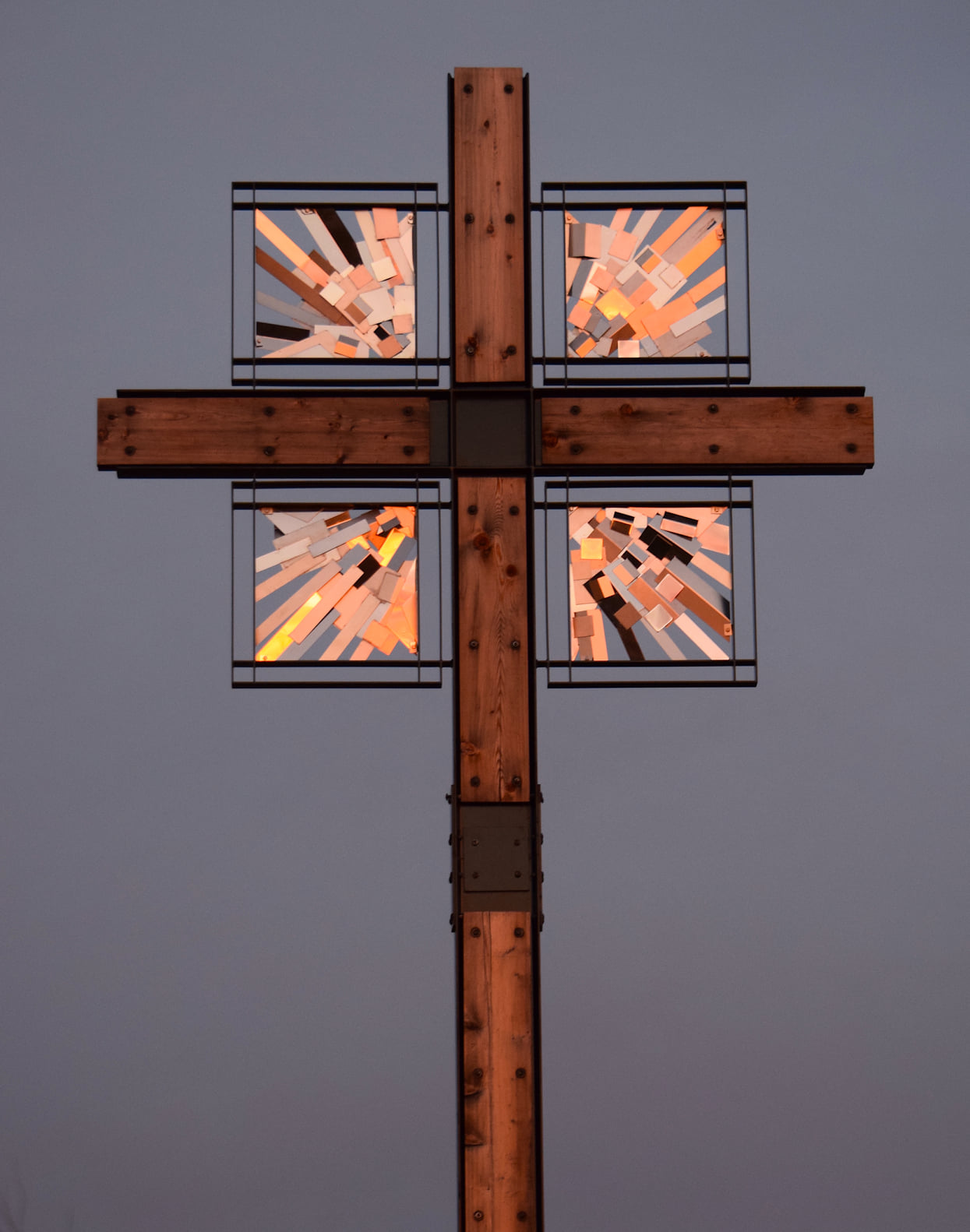
Perhaps it gets back to the idea of honesty and self-reflection. On the backside of one of our campus buildings above a main entrance on that side, the phrase Wisdom is the Fruit of Reflection stands there for all who approach. Reflection requires honesty if it is to truly reflect our situation. I know when I am honest and take accountability, it is both painful and freeing. It is not possible to change our past, but taking the time to reflect and understand is the beginning of wisdom, but it is a process. It seems anything worth reaching or achieving is a process. That makes our impatient selves a bit more frustrated, to be sure, but like most things that mature, once you are there, it is worth the time. All of this sounds cliche to some degree, and perhaps that is why it seems both logical and easy, and yet, it is anything but either of those. The first person to help me understand that was Dr. John W. Nielsen (The Pope). He had this particular way he would peer at you when he inquired about something of substance, and a sly smile would slowly appear on his face, and he would stand or sit quietly as he allowed you to come to your senses. I remember a night in our Eurail coach as he asked me questions about my background and listened intently to every story I told him. When I told him about my older brother’s passing and my exclamatory response of “Fuck!” when the doctor informed us they had lost him. My eyes filled with tears as I recounted that story as it was only a few years in the past then. He looked empathetically and knowingly as only he could, and said, “That might be the most profound prayer you ever uttered.” All I could do was stare. He compared my vernacular despair to the 22nd Psalm and asked me how it was different? It was at that point, I realized both the brilliance and saintliness of that man. Now, exactly 40 years later, I find myself respecting and admiring him all the more. He as much as anyone in my life taught me to think, to ponder, to imagine the possibilities. There is no amount of thanks I can offer for that life-changing teaching. Thank you to Robert Coffey for the picture used at the beginning of this post. The amazing replacement cross above the Dana Campus is a reminder of our faith is something beyond our pain and laments.

As I have reached a mile-stone age, I am continually asked what next, again like there is some new direction or new beginning I need to consider. I am not sure I will ever stop being a professor, a teacher, a pastor, and for some a character. There are certainly things I have failed at in my lifetime. Being a husband comes to mind or is at the top of the list, and I must take my part of the blame for that failure. That failure has created a much different life than I expected. It has kept me from ever being a biological parent, but on the other hand it has allowed me to have an incredible number of surrogate children, and one exchange son. It has created times of loneliness, and simultaneously provided the opportunity to travel and meet people all around the world. It has made times of solitude, but that solitude has offered moments or occasions to reflect and understand things more fully, more completely, more accurately than if I was merely flying by each thing. It made it possible to care for things and people in ways that would have never happened, and even now it allows me to spend time on working to be the best professor I can.

There seems to be a sort of oxymoronic quality. There are times I am melancholy, I remember I student at Stout using that word to describe me, and yet, I am generally optimistic at the same time. Perhaps it is because I see the continuum of things. Perhaps it is because I have no need to start over. I am honest about things, but I believe we continually have an opportunity to reflect and learn from our circumstances, but I simultaneously understand there is no quick fix for much of anything. I think that is some of our struggle now. The continuum we are in seems to be at a nadir level, but if that is so, there is room for optimism. Each day I read about more division, and while I know our current President will neither disappear nor will a new President simply pull us together, I am buoyed by the reality that Congress, in spite of some struggles, will do its job and continue to demonstrate there is at least a hint of sanity inside the Beltway. Our judiciary has listened to an incredible number of questions and as I read today the current tally is 60-1. Our nation is also a continuum, we cannot undo what has been done. We can reflect, be honest with what has occurred and try to learn, regardless our political leaning. Another of my former students, one with whom I have had significant conversations and messages, asked, honestly and inquisitively, if there wasn’t just a simple way to look at all of this. While my answer to her was no, that our political situation is undoubtedly complex beyond words, there is a simple answer. We are selfish. We want our way. We do not want to see the other side. Those are the simple answers, but then there is the question of why we have become so? Then it gets complicated once again.

So I will continue on my continuum and try to make appropriate and thoughtful adjustments to make the lives of those around me as well as my own life better, believing if I do so, the consequence will generally be positive. I wish you each a blessed New Year. May we all be kind in our reflections both of others and ourselves. May we believe that falling short is not the final answer, and may we feel a newness in this year that makes our world a better place for all people.

Bless you and thank you for reading,

Dr. Martin

90 Pounds of Energy, Intelligence, and Sass

Among the Hydrangeas

Hello from my study on the Acre,

There are only a few hours beyond a day before we finish this year, marking a fifth of the way through this 21st century. Twenty years ago we were panicking about something known as Y2K, wondering if our technological world would come crashing down and create mass chaos. As we approach this new year, we have been living mass chaos for months. While some prophesied the somewhat shit-show our national politics are, few could have imagined the lockdowns, the isolation, the quarantines, the remote teaching, the trauma of illness and death that has befallen us like an Old Testament plague. There can be little wonder if the Psalmist might find themself writing a new lament, or perhaps, the words of the 22nd Psalm, cried out by Jesus on the cross are words enough. Because of either the divided nature of our country or the alarming rising death toll from COVID-19, I believe we can aptly recall the words of Shakespeare in his work, Richard III, “[n]ow is the winter of our discontent.” There is certainly more than enough discontent to go around. There are good people (and some not so good) on both sides of the political aisle who argue they care deeply about this country and yet they cannot meet somewhere in the middle on most anything or remember that they represent the American people. Then again, unfortunately, perhaps that is exactly what they are doing, representing our collective spirit of discontent, of suspicion, of unwillingness to engage with the other, or finding it possible to accept the truth of the other, to believe there is some simple answer to all of this. Humans are not simple (at least when it comes to figuring them out). This is not really the purpose of this blog; as the last blog of this calendar year, as I am sitting at home working on a chapter, trying to manage a deadline, and wishing I was once again in Poland for the holiday – but not really because of the present global concerns – I am reminiscing about this time six years ago.

I had barely finished a 12 day vigil at the bedside of Lydia, undoubtedly one of the most profound people I ever met, as she ebbed away from the long-term effects of dementia. The tickets to Poland had been purchased and the reservations for staying five days in Kraków were booked long before I went home that 14th of December. I knew she would have a doctor’s appointment on the 18th, but there was little that could prepare me for the shell of a woman waiting my return. Dementia had hollowed her mind, her body, and her ability to care for herself, but it had not vanquished her stubbornness nor her ability to make her desires known. In fact, it might have heightened both. And yet, this once proud and meticulous Austrian woman struggled to manage everything about herself, and the seizures experienced were debilitating and painful. While she would not remember the pain or the seizure, the way they exhausted her after their occurrence was as painful as an observer, and more so for me because I saw their consequence. I remember that Saturday morning, following breakfast, when she asked to go back to her room; she wanted to go back to bed. This was not her usual routine, though there was little normal to what she did those last days, besides move slowly along in her wheelchair or fall asleep. Nonetheless, she was insistent she wanted to go back to bed. In retrospect, it was amazing because she never really left her room again. However, if you think she merely retreated to her room, nothing could be further from the truth.

While I would stay with her for 10-12 hours a day, one morning as I returned from sleeping on the Circle, I walked into her room to see her with her hands wrapped in a caretaker’s hair and she held the poor girl head, her face smashed into the mattress so she could barely breathe. I asked the caretaker if she was okay, and in a muffled voice, she gasped, “Yes.” I told Lydia she needed to let her up, and she responded with a firm and insistent, “NO!”. Long-story, short, it took me five minutes or more to untangle the young woman’s hair from Lydia’s fingers. Of course, then there were the times she would slap a water glass completely across the room or refuse to open her mouth, or use her now two favorite words, bitch or bastard, to refer to something or someone about which or whom she had some disapproval. I remember on Christmas Eve Day as she looked into the corner of her room and spoke in Polish. I asked her gently if George was there, and she nodded affirmatively. I asked her again, softly, “Are you ready to go home?” She responded with as much energy as she had done in a couple of days and firmly said, “No.” And she meant it. I remember being petrified that she would die on Christmas Day and haunt me the rest of my life. You see, Lydia did not really appreciate Christmas. I never really found out why. However, she would live for another week.

As I walked around Kraków with Robert, Marysia’s father as my tour guide, I met up with Dr. Polyuha and some of the Bloomsburg students, some who are still around after finishing graduate degrees, but on the 30th, 6 years ago today as I write this, we visited the Cathedral Church in Kraków, where Karol Józef Wojtyła (Pope Saint John Paul II) had presided as the Archbishop. There, in spite of my Lutheranism, I lit a votive candle for Lydia and I prayed. I prayed both to God and in hopes that George would hear and believing they could. I knelt and prayed a simple prayer. Please convince her it is time to come home, and with that I raised back up to my feet and walked slowly from the church. Within 36 hours, Lydia would pass. Even today, I do not some times consciously comprehend that external circumstances can make the gift of a day seem to be a burden rather than a something to be cherished. I understand that there are extenuating events that impinge on that block of time overwhelming us and causing us to lose sight of the opportunities which might be presented in that time. Yet, how many times do we, in the normal course of events, lament when a period of time is coming to a close, wishing that somehow we might have managed that time better? I believe this might be how many feel about this year. I remember believing each day I sat beside Lydia wondering if the end would happen that day, but I also remember she waited for me to leave versus waiting for me to be there. I think she desired my presence to tell me she loved me and for me to spend that last Christmas holiday with her. I think the manner in which we choose to leave the world, particularly when something is not accidental, is more in our control than we often imagine. I think about my brother waiting until I came home from Ames and passing that night or my mother holding on until I came back from Pennsylvania. I believe with all my heart Lydia wanted time with me, but refused to die with me there. I remember, during one of her periods of lucidity, telling her I loved her again. She responded in her Austrian accent, “No kidding?” as if my words of care were as she often said, stupid. She understood it, and I will say I remember her eyes lighting up as she spoke her in characteristic tone and manner. Even in her last days, that sass never left her.

Lydia was no ordinary person, and while I did not know her during her earlier life, there are a couple of stories she loved to tell. She came from an educated family as an only child, but I believe she was probably quite precocious. She tells of sneaking up into the pantry to eat the caviar they had in the house. Another time, when she was young, going to Catholic School, she noted she was supposed to kneel at some point, but refused to do so. When she finally slammed herself down in disgust, she cut both of her knees open to the point of needing stitches, but refused to move as she knelt in her own blood in some also stigmatic way. Likewise, I never met George, but there was a significant period of time when he lived in Oak Park, IL and she was in Menomonie. They had a commuter marriage of sorts long before anyone considered such a thing. When her Stout colleagues once asked who George was, her response, “That is Mr. Rutkowski to you.” When he moved to Menomonie, they renovated two houses and he created a deck closer to the lake as well as a path all the way down the hill. She would not go down there, and from the stories, he went there for refuge. Supposedly, he would sometimes walk around the yard muttering, “Oh my God, that woman.” She was going to do what she wanted and no one, regardless of gender or size was going to persuade this amazing two-digit-midget (no offense intended to small people). Likewise in her stubborn, independent nature, she crawled along the gutters of her three story house regularly, intent that you could eat out of them should there be such a need. It mattered not who admonished her or worried about her, she continued to do so. Even the neighborhood dog would walk below the gutters when she was up there in case she fell. One of my many responsibilities was to drive her around (imagine Driving Miss Daisy except she sat in the front passenger seat). When we went clothes shopping, she purchased her polo shirts in the children’s section. Her front closet, in fact most of her closets, could have been an LL Bean warehouse. There is so much to be said about Lydia, and her incredibly brilliant blue eyes and her indefatigable smile were mesmerizing. When she lived on the Circle, she was often up before 6:00 a.m. and the miles she walked with her broom and extended dustpan daily literally wore out her shoes. She made sure every single leaf was accounted for once they fell. If she was behind, she would exclaim with her never-lost accent, “It looks like a slum.” Heaven forbid such a calamity.

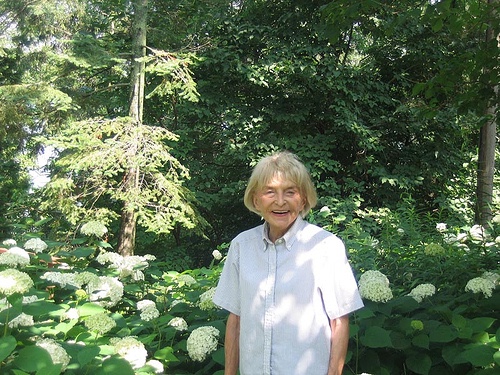
It is hard to imagine she has been gone six years. I am still grateful to Nathan and Theresa Langton and the entire family because they gave up much to care for her too. Without them, undoubtedly, the care accomplished for her, her property, and even for the residents of COH would not have occurred in the manner they did. She might have been less than 100 pounds, but it took two of us to manage her, and that does not include the unparalleled staff at Comforts of Home. She was one of the first two residents in that facility 10 years ago and they, almost without exception, did everything they could to care for her. To this day, I am in contact with some of them, and blessed to have them in my life. One of the things I have thought about many times this year is how many grandmothers or grandfathers, mothers or fathers, or siblings are now isolated from anyone. Carissa, her former administrator and I have spoken a couple of times this year about what it would have been like to get Lydia to wear a mask or manage isolation. Oh my goodness, that would have been a battle to end all battles. Nonetheless, there are tens of thousands of people who are living that struggle now, and my heart breaks for both those confined and those who cannot see them. We need to think about what people need and contact is essential to us because we are innately communal. Again, the deep-seated sadness this causes me is immeasurable. To anyone doing this work as an aide, as a meal attendant, as someone cleaning, please accept my prayers of praise and thankfulness. If you know someone, reach out to them. If your loved one is there, create a prayer circle to support them and yourself. To all those caring for those who struggle with agedness, thank you for all you do. I know you are not paid nearly enough and the thanks you get is seldom enough.

Back to Lydia, as tough as she was, when she trusted someone, by extension, she loved them. In spite of the fact she never weighed more than 100 pounds until the last couple years of her life, and ended her life under 5’0″ tall, her heart must have taken up most of that space because it was incredibly large and strong. I also think it is what kept her alive during her last days. To this day, I am grateful to the entire staff of Comforts of Home, but particularly to Carissa, who treated her as her own relative. Carissa came in on that New Year’s Day and spent three hours on her day off to be with her. What I know from the bottom of my heart, Lydia came to love Carissa and it was evident in the way Lydia looked at her. In fact, Lydia’s entire affect changed when Carissa would come near. Finally, Lydia, as I told you six years ago,”Sie wurde die Mutter, die ich nicht hatte, und ich werde geehrt und demütigt, um einfach und liebevoll zu ihr zu sagen: ‘Lydia, ich liebe dich und auch heute, sechs Jahre später, bist du immer noch meine Mutter.’

Lydia, after leaving the Sudentenland, moved to Vienna. She would grow up there until eventually leaving for London and then to the states. She loved the Vienna Boys Choir. To all of you who read this, I wish you a blessed continued Christmas season, a good new year, and hopefully a 2021 that is safer, saner, and happier.

Michael

Five Hundred Twenty-five Thousand, Six Hundred Minutes

Hello from my study on the Acre.

The first time I saw the movie version of the musical, Rent, I was almost speechless by the end of the show. Since then, I have watched it numerous times, but it still can bring me to tears. While it is well-known, there are certainly those who are probably unacquainted, but based on Puccini’s La Boheme, with a late 20th century upgrade on subject matter, it looks at a group of friends getting ready to face the last year of the millennium and what happens to them in that year. The song most are probably acquainted with is the title of this post. It is the number of minutes that compose a year. Last Christmas I was helping a newly minted seventeen year old try to feel somehow like Denmark was here on some small fashion, but Anton was experiencing his first Christmas in America, but as importantly, he first Christmas away from home. A few days before Christmas, we had a dinner with students and friends, and there was certainly a multicultural flair to it. Anton’s traditional Danish Christmas dessert, called Risalamande, or a Almond Rice Pudding with a Warm Cherry Sauce was quite the hit. In fact, people are still talking about it. And Anton made it himself. His mother would be proud of what he did. In addition to having a very nice Christmas together, we were invited to another home for a Christmas brunch, which was quite incredible and Anton spent a significant amount of time with his friends as they planned what his Spring Semester would be like. During all of this, there were some interesting stories about a virus that was occurring in China, but we did not pay much attention. It seems this was the case at a number of societal levels, and now, at least if what is reported is true, some should have been much more serious about this particular problem. As we all know now, that little virus has changed our world. In the 525, 600 minutes since Christmas a year ago, there is little that seems untouched by all of this.

Yet, there is so much that has continued in our normal daily lives that is simply what we do. We get up; we hopefully have a job to go to daily or regularly; we are able to live our lives with all the restrictions, but somehow life continues affected, but unabated. And yet, 2020 has changed who we are; it has altered our perception of education, of work, of socialization, and expectations (and that is across a wide spectrum of things) of what basic life will be like when we finally find ourselves on the other side of this, which, of course, is still open to interpretation both what it will be as much as when, or even if, there is an other side. This is something I have pondered. Much like what has happened to air travel post-9/11, airports have never gone back to where they were. I am pretty convinced, we are in the same situation now, but we are not sure what all of that means. I know that the consequences of acting like there is nothing to be concerned about has resulted in the infections of millions as well as the death of hundreds of thousands. I am not making a political statement, and I have some people I care for deeply who believe that they have the individual right to refuse a mask. I have others who are incredibly careful, and they are not elderly as I am. I have appreciation for all of them, and I certainly do not care less for them. What I am trying to note is this year has changed our lives in ways before unimaginable. As I try to understand what will happen, I find myself realizing two things. We must try to manage whatever it is, and at the same time, we must live our lives. Again, it returns me to Rent. I remember two scenes that are more poignant for me. The first is when the members, who are dying then of AIDs/HIV, are at a meeting and talking about if they will be remembered. The line “will someone care? Will I wake tomorrow from this nightmare?” The second is when the same members of the group note, “I am used to relying on intellect, but I try to open up to what I don’t know because reason says I should have died three years ago. There’s only us; there’s only this. Forget regret or life is yours to miss. No other road; no other way. No day, but today.” I have used that last phrase as a signature in one of my emails for some time.

Today is the 27th of December. Twenty-three years ago, Kris, my sister, called me to let me know she was taking our father to the hospital. He had been in hospice for a few weeks and he was losing his battle to liver, kidney, and pancreatic cancer. He would pass the next morning. It is, at times, difficult to live with the reality that all of my immediate family, the other four of us are all gone, but that is the life I have. This is not a lament, but rather a realization that for some reason, one that I still do not understand, is I am still here. This is no hyperbole when I have been told by some of my doctors that the reason they do not know what to do with me is that most people with all my issues do not live this long. I remember the first time I heard this. My response was a typical Michael response. I responded to my doctor with the simple statement, “So I am special.” The doctor’s response was as simple, “Yes, you are.” There is so much we can be grateful for, and none it has to do with the stuff we have. I am more amazed at how our bodies are such incredible mechanisms, miraculous in their ability to self-regulate if we allow them. It is not simply cliche to say that from the moment we are born we move toward the end of life, and this year is certainly made it apparent that there are things outside our control that can hasten that process, but we are not merely victims of morbidity. There is so much more in-between. As I have reflected and reminisced on my childhood for a variety of reasons during this past month, there are so many reasons to be thankful.

In the past year, I have remained working, albeit in a different style, and one that takes incredible work and energy, but as with every semester, I am blessed by such talented people in my classes, and their talent is not always represented by the grade they receive. My colleagues, the unparalleled staff who support us, and an administration who works tirelessly to figure out our ever-changing situation make my life much easier. While I have not been able to meet some people in person, Zoom calls, phone calls, and drop-offs of various goodies remind me of their profound presence in my life. Happy voices and wishes for time together mean more than any words can express. Love from the parents, who are both special to me in ways I cannot enumerate, remind me of the goodness this year bestowed in spite of the distance requirements. While March seems long ago, a birthday dinner for a dear friend and with another dear friend, before the reality of a changed world hit full-force, is a reminder that there is another side to all of this. Each minute we proceed through another revolution around the sun is too often taken for granted, taken as some kind of entitlement, but we are never enfranchised to anything. It is a simple and profound gift. It is only through the loss of that time we become acutely aware of time’s giftedness to each of us.

As I finish another year, I have been given the gift of a life that is beyond anything I might have imagined for the little NW Iowa boy. I made it far beyond what some told me I would do or beyond what I was deserving. I know this in such a profound way. I have been blessed beyond measure by so many. Some of those earlier blessings in my life have reappeared and like the beacon of the Epiphany star, I feel a glow and light I have not felt for many years. Thank you to each of you, the five remaining beautiful cousins who have been kind enough to embrace me after all this time. To Jeff, our other cousin, for reaching out. To my nephews and nieces, great-nieces and great-nephews, over the years you have made me feel loved and cared for. I am still grateful for your presence in my life. I realize that family is exactly what you make it. We are all fragile, flawed, and carefully faithful in our belief that we can love in spite of our foibles, but life has demonstrated it is possible, regardless the time that has passed. Five hundred twenty-five thousand, six hundred multiplied since I last spoke to the beautiful Pilgrim daughters would be an astronomical number. It is over 20 million minutes. That is beyond thought. It is about half my life. So many opportunities lost, but I choose to consider the possibilities ahead. As I move in my own spiritual life from the pensive and reflective season of Advent, I find the carols continue to play on my devices. As I begin through this season of Christmas, it is my prayer that I can become a better family member, a better person, a more thoughtful person.

In my piety, and in my understanding of God, it is difficult to not be humbled by the chances we are given daily to make some small difference in the lives of others. I have been profoundly blessed in that most of my life I have been placed in situations where somehow I can make a difference in someone’s day. From waiting tables and serving as a bartender, from being a parish pastor to a college professor, there is always someone who is affected by what I do. I think perhaps it has been a vocational calling to simply make someone else’s life a tiny bit better. It is not about profound or expensive things, it is about simple goodness. As I complete this year, this segment of my life, I am well aware of the profound difficulties in our country and in the world. I am completely conscious of the uncertainty that confronts us as we try to move beyond what this global virus has done. There is little I can do on a big scale to change that situation, but I believe I can do what is necessary to make sure those I love and care for know they matter. That is my commitment as I move into this new year. I am not saddened to despair or overcome by a sense of powerlessness. I believe simple goodness and trying to meet the other where they are is a beginning. Will it always be simple. No, there is little simple in all of this, but I fail to believe all is lost. I will hold on to the love and goodness of this holy season and recommit to my own personal efforts to make the lives of those in my orbit a bit better. To all who have taken the time to read my blog this past year, and there are been more than I could imagine, thank you. May you have a blessed Christmas season. Those friends, who have an Orthodox faith, as you move toward Christmas, I wish you a continued blessed Advent. To all who have other faiths, may your new year, whenever that occurs also be blessed. I leave this version of “Seasons of Love” because of my own work with this incredible show this past year. To all who mourn the passing of one you love, be assured you will never mourn alone.

I wish you all a blessed and successful 2021.

Michael (Dr. Martin)

Deciding to be Solitary or Lonely

Hello from my study,

Today I followed through on a decision pondered for a while, but it is a decision that requires me to be more intentional, more thoughtful, and more disciplined about what I do. After multiple urgings as well as the life-style change COVID has brought, and some thoughts about my own long-term plans, which are certainly not cemented in some non-changeable manner, I sold my BWM 328xi back to the dealer from where I purchased it, and made the decision to function by “ten-toed express” for some time forward. How long, you ask? I am not sure. It will depend on inoculations, sabbatical plans, and other possibilities. However, I realized I was spending a great deal of money on insurance in spite of the very few miles I was putting on my car. Ironically, due to some weird Pennsylvania regulations, it is necessary for me to maintain some car insurance, even without a car. Otherwise, if I am without vehicle insurance for over a certain period of time, I would be put on high risk insurance. What a racket that is!! There were a couple of other considerations too. If I decide to get another vehicle or lease on because of some longer term plans, I will probably stay with the same brand as it was probably the most amazing car I have every owned. I enjoyed it a great deal and while it was a 300 series, it actually got great gas mileage. It is sort of an interesting feeling of freedom and the lack of all rolled into one. This change will also force to me to focus on some things I need to be working on and running an errand to just procrastinate yet again will be much tougher.

This morning, I spoke with another of my cousins on my mother’s side of the family, which created yet another Colorado connection. If I do some real counting, there must be a dozen people minimum who have moved to that state from all across the country. I could probably do a two-week road trip to Colorado and remain busy the entire time. The past weeks have compelled me to understand, or become reacquainted with the fact that someone can always have a profound influence. Often when you least expect it. It is an incredible thing to speak to someone who knew you in your childhood, and then simultaneously try to fill in the blanks for three decades. It was the wonderful work of connecting dots once again. Families are such dynamic, metamorphic, engaging, or even numinous entities. As I face a three decade lapse I must reasonably question how did that happen? There was no falling out, problem, or specific reason we lost touch. What I seem to comprehend was a lack of some mechanism in my immediate family that engaged us with the extended family once the previous generation moved beyond this life. I am not sure why that was, but I must believe it had something to do with my own immediate family in Riverside and some of the difficulties in that family. Perhaps it was because of some of the struggles our family perhaps, innately understood, but no one would ever mention. Perhaps it was because as I moved away from that struggle and particularly from my mother. As a consequence that side of the family was lost and I must take responsibility for my own decision to move away from all of it. What I am coming to terms with is how much I have lost in all of this. Again, perhaps, what I know now is merely that I am fortunate enough in finding it possible to reconnect. What these past three weeks have laid out for me so clearly, so profoundly, is that those decisions, either conscious or subconscious are exactly that: decisions made . . . and like any decision, there are reverberations. And yet, this was no conscious decision in terms of any termination or result. This outcome was a collateral one, and one mostly unrealized, one considered from time-to-time, but as with many such repercussions, how to manage it seemed difficult. So now I am working, as noted in the last blog to connect the dots and the decades.

What I discern more completely at this point might be something quite different. Being family, either by birth or adoption is not something over which we have a lot of choice. In fact, there are a plethora of memes, cards, or magnets that state just such a thing, but what does it imply? It means too often a sort of deterministic idea of “it just is” and deal with it. What I am realizing is family is much more . . . as noted above it is a complicated thing, but, at least for me, it was, and more importantly is, something I need if I am to understand who I am, from where I came, and why I might be the person I am. Certainly there is a lot that can be read into those things, but I am considering it on a more simple basis. As I have chatted with my cousins, they are kind enough to tell me things about what they remember and for me that validates much about my childhood. It is even more treasured and respected because they are speaking their own truths of that time in our lives. That is a precious thing to me particularly when I am the only person in my immediate family still here. I am not necessarily lamenting this, but rather being the solitary one has weighed on me in different ways. I realize I have a sort of tug-o-war existence with being on my own; I am simultaneously comfortable with the sort of control it gives me over my existence and confounded by what it has left me as someone alone at 65. There is a sort of never actually having all we want, which, of course, is incredibly selfish. I have noted that I feel more like my father’s elder brother-in-law at times than I could have ever imagined.

As we begin a Christmas week, memories of childhood naturally come to the fore and I appreciate how the family dinner and the gathering of people are so essential to our feeling of how we matter. For me, and as the theme of being an individual has permeated much of this blog throughout the years, I think it is important to perceive the difference between being solitary and being lonely. Too often we do not imagine or comprehend the important difference in them. One can be solitary, while being content, happy, or even fulfilled, but this is not about things as much as it is about people. It is our interaction with people that creates a sense of community; keeping us from being lonely. I think much of my earlier life I chose to be lonely, though seldom recognized it. Lonely was not something new to me, it was how I often felt growing up. I remember being in Sioux City’s Children’s Community Theatre and each Christmas we would perform Dickens’ A Christmas Carol. Eventually I was Ebenezer Scrooge. I remember Scrooge’s lines when approached about the person collecting for the poor. Having been asked if he wished to remain anonymous in his giving he retorted,

wish to be left alone. Since you ask me what I wish, sir, that is my answer. I
don’t make merry myself at Christmas and I can’t afford to make lazy people
merry. I help support the establishments I have mentioned…they cost
enough…and those who are poorly off must go there.”

A Christmas Carol

What is interesting to me is I have some of the wishing to be left alone part of Scrooge in me, and yet on the other hand, I love the Christmas holidays and giving to other people. Somehow I got some of both. I think the Christmas spirit, as noted many times, comes from my Grandmother Louise. I believe in the magic of this season, and for me, it requires really little effort to make other people’s lives a bit nicer. Simple politeness, a mannerly help with the door, making allowances while driving, or even thinking of the other’s needs before your own is not difficult. I think it merely takes some time to be willing to consider the other before one’s self. And simply, it is putting into practice what we learned as children: share, be polite, use your manners, and be kind. There is nothing too arduous about it, but it seems that such traits are in short supply in our current national attitudes. What I have begun to grasp as I have reflected this month and reached out to my cousins is they had those traits in their immediate household. Don and Virginia were gracious and welcoming, and in spite of the elapsed time, certainly the conversations with various members of the family seem to demonstrate they have carried on that practice with great proficiency. It is really a gift to be included in their conversations and thoughts again. What I am witnessing in my own life is how my choice to be solitary at times created more loneliness than I expected. There is a thread in my life that has that solitary trek of a person searching with no real sense of purpose, but searching nonetheless. I am not generally aware of it, but I remember many times being on my own. Just today, a Jagiellonian University student I was blessed to meet in the Main Square Costa Coffee shop in Kraków, and someone I speak quite regularly on FB messenger, chatted by messenger yet again. Today she reached out asking if I was alone for Christmas and worrying about me. It was incredibly sweet of her, but again it reminded me of my time in A Christmas Carol. When Scrooge is required to see his past he is reminded of his choice to not go home for Christmas and he ends up alone.

Brother, dear brother! (She kisses Child Scrooge.) Dear, dear Fan, Scrooge
answers. She responds, I’ve come to bring you home, home for good and
ever. Come with me, come now. (She takes his hand and they start to run
off, but the spirit stops them and signals for the light on them to fade. They
look at the spirit, aware of their role in the spirit’s “education” of Scrooge.)

A Christmas Carol

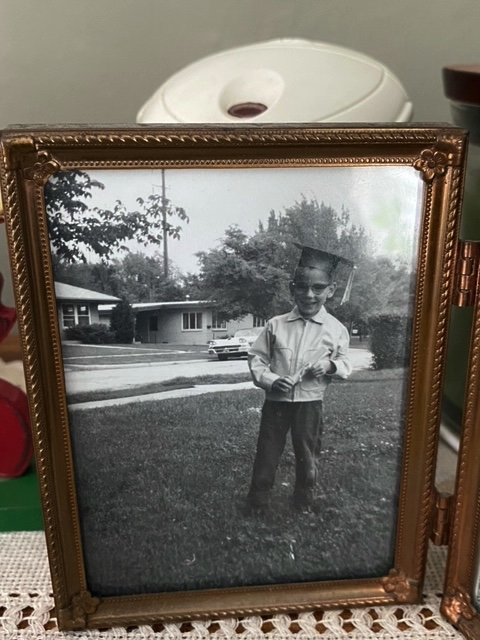
If you are aware of the story, in two different cases, Scrooge ends up alone and sad. The melancholy that is such a part of Scrooge was not because of his being solitary it was because he chose to be alone. Choosing loneliness is one of those things that does something very different that choosing solitude. Solitude is about peacefulness, ironically one of the themes of the Advent Season. Solitude is about reflection and assessment. One of the things I have often considered doing is returning to the Upper Peninsula and doing a spiritual retreat with the Byzantine monks at the Jam Pot. I think it would be a really good thing for me to do. What this month of reconnecting, recollecting, and reminiscing has accomplished is it has pulled me out of a shell that I created, albeit unknowingly. With the exception of a sandbox buddy, there are few people who remember me when I was that smaller-than-normal, spectacled, butched-hair cut, large-eared person who kept a smile on his face regardless what was happening in his life. The picture above is my first graduation from kindergarten. What registers so clearly now is that there was no solitude in my home growing up because there was fear as a prevailing theme too often. I was more often lonely because I was afraid. As I have gone through my life, either married or single, what appeared to be and the reality of the world I saw were very different. Even in my marriages I found it difficult to be unguarded. This is an incredibly difficult admission to make. Likewise, it caused problems because it was not something I ascertained, and certainly did not comprehend at those times. As I reach out now, I do it knowingly, and yet desirous of something that moves me toward a more healthy style of solitude.

In someways it seems my cousins in their kindness and beauty, their honesty and graciousness are like the three spirits who visited Scrooge that Christmas Eve night into the wee morning hours of Christmas Day. While I have never been Scrooge-like in my Christmas spirit, there are certainly times I have found myself wishing to be left alone during other times of the year. As I often say in my Bible as Literature class, God often works in spite of us. And then in my sort of caustic manner I add . . . and sometimes to spite us. I am not sure that there is anything spiteful in the events this past month, but God has again knocked on a door and it is up to us to open it. This season is often a time when people stress because of family obligations. This season of Advent has been a season of joy and peace, of hope and love like none I have experienced in my life. I wish for all of you a blessed week of this Nativity. To Kim, Paula, Julie, Mary, and Martha, and Randy, by extension, but now also to Jeff: Tusen takk fra hjertet for at du tok imot meg tilbake etter alle disse årene, og jeg ønsker hver og en av dere en velsignet jul. I leave this as a call out to our Scandinavian heritage.

I wish each of you a blessed holiday as we finish this unprecedented year of realizing we are never solitary; we need each other.

Blessings,

Michael

Imagining Decades and Connecting the Dots

Hello from my upstairs study,

It is Sunday evening and even though it is barely 8:00 p.m., it seems so much later when it gets dark so early. Over the last couple of days, I was so aware of that rapidly setting sun and when it is cloudy, it is even more apparent. I do not remember this sort of darkness as a child. In fact, I think the first time I remember it was when I was in seminary and would be walking from campus back to the Burntvedt Apartments. It was always dark on the way home shortly after 4:00 p.m. during the winter. Of course, then there was living in Hancock/Houghton and even Laurium in the Upper Peninsula. While the summer was glorious for the incredibly long days, the converse was the case in the winter. I remember driving up the hill past Quincy Mine and you could see the sun setting in the rearview mirror, but by the time I got eleven miles north, it would be dark as if it were midnight. I think this is the first time since then I felt it got dark so quickly. Perhaps it is just the cumulative effect of what 2020 has done to all of us. It is hard to believe that we are 3/4 of a year into this new world.

As I write this, it is less than two weeks until Christmas, but that too will be different. I know there are a lot of people who are trying to figure out how to manage all of this. This weekend, Pennsylvania just reimposed some restrictions on public places and public gatherings. I know there are people all over the board on these things, but I choose to keep myself pretty locked down and do what is necessary to keep myself as safe as possible. . . . As is often the case, I got some things started the other day, but I am behind. It is Wednesday and as predicted a significant snowstorm is baring down on Central Pennsylvania. It has been snowing for about 5 hours and as I sit in my study again, within the last 24 hours I did significant work outside to get things ready for what was coming. I also got all my Christmas decorations out, both inside and outside, made sure the snowblower will work, and finally turned the heat on upstairs during last night. I work up and it was about 63 degrees, so I figured it was probably time. So at this point, I am pretty hunkered down and ready to ride this 18-22 inches of snow out and see what happens about 24 hours from now. I remember when I was small, living in NW Iowa and we got incredible snowstorms. We would build tunnels throughout the yard and with our snowsuits, boots, mittens, hats, and scarves, we could play for hours. We would come in long enough to warm up and our clothes would be thrown in the dryer. After the clothes dried and were warm, we would be at it again. We were heartier people then or what? I cannot imagine that now. Of course, then there was living in the Upper Peninsula, and that is where I really learned about snowfall. I remember someone asking when I moved there if I liked snow. I said, “Yes, it’s nice.” They responded, “No; do you LIKE snow? Because we get a lot of it.” They were not kidding. My first year at Michigan Tech, and I had been in the U.P. for three years then, we received about 346 inches of snow. I lived in Laurium, about 11 miles north of Houghton, and I did not own a snowblower. It was incredible. I remember having a front-end loader in the yard to push snow back because I could not scoop it any higher. And yet, the snow was generally light, fluffy, lake-effect, but it snowed almost every day. Then, as noted above, it got dark very early. There were times I shoveled more than 4-5 hours a day. It was a pretty strenuous workout.

It has already been over 20 years ago that happened. As I have reached out to my cousins these past weeks, I have been keenly aware of the time and the length of time that has passed since we were last in touch in any manner. It is stunning to me how months turned to years, turned to decades. We were kids or young adults and somewhere we missed the entire middle portions of our lives. We are now in 50s and 60s, older than our parents were when we would see each other regularly. That is a shocking reality, but more importantly, we are here to do it, though on both sides of the family there is an entire two generations gone and now even some of our generation. There is the line from On Golden Pond, which again comes hearkening back: “Don’t you think that everyone looks back on their childhood with a certain amount of bitterness and regret? It doesn’t have to ruin your life!” And so it is . . . Do I have regrets? Of course, but when I take the time to connect the dots, I am compelled to remember that I hav been so profoundly blessed throughout my life. I did not take the normal childhood route. Being on my third family before the age of five, struggling too find my place as someone who felt unwanted or frightened more than I allowed people to know, and trying to manage both my professional and personal baggage throughout my life was not an easy task, but I refuse to focus on that. In this season where we hear words like hope, peace, and joy, it is hard to overlook those people who have been there throughout my life. I think of people like Frank and Margaret Sopoci, of Bud and Janet Reese, or Jacob and Marge Goede. These three couples were, along with my grandmother and the cousins that were central in my last blog, were the people who helped me see beyond the things I heard too often. They provided the sense of hope that is essential for human existence. Following high school and the service, I again struggled to find my place. I had returned home, but it was not a place that was ready for me, nor was I ready to be back in it. It was then my pastor and his family that would have such an essential influence on my life. Between having a close friend, being enamored beyond words with his sister, and then having their parents be as much of parent to me as anyone, I had less than an inkling of how important they were. Father Fred, as David and I called him, made me accountable. It is an accountability that has lasted four over decades to some degree, but it might be one of the most important lessons in my life. It is astounding how hurt from someone can create the consequence in a completely different circumstance. I think that is the lesson that has finally become clear to me. What I am aware of in these past couple weeks is how individuals, families, our own family, and those who come into our lives by chance can be influences far beyond what we realize. We absorb their lessons and our mutual experiences into the fabric of who we are, seldom realizing the influence the significance they have become in our own journey. This past couple of weeks in reconnecting with my cousins has been a most unexpected and profound gift. From texts to messages, from Zoom calls to phone calls, the catching up on decades of our lives has been an incomparable joy. It causes me pause and compels me to ask what was it about these cousins? Was it their beauty and comprehensive personalities that were so different among the six of them? Yes, that was part of it. Was it the enjoyable times we shared as children whenever we were together? Yes, again, that is part of that picture. Yet is that enough to connect the dots after decades of losing touch? Perhaps, but I think there is more. It is what has come through in our conversations during these past weeks. They accepted and loved me. They accepted their undersized, rather nerdy cousin with his butch haircut, glasses, and over-sized ears who would not become comfortable with his image until he was in his thirties. That is where the gorgeous might come in. They were so beautiful, but they were also kind, accepting, and gracious. That was what it was. Now, decades later, they are still beautiful. The twins look decades younger than what they are. Kim, the current eldest, is as beautiful and kind as I remember, and conversations with her are such a joy. I have gotten a bit of an idea about Martha and Josh and Mary is stunningly beautiful, but seems to be an observer more than a talker. That is part of what makes all of them so incredible, both individually, but also collectively.

As I sit in my study, listening to Christmas instrumentals, looking out at the snow as the sun sets, my heart is full and my life seems to be blessed beyond measure. It is a very different Christmas than a year ago with Anton, and I miss him, but I know he received his package today. That makes me very happy. I have another one, but it will go out after the first of the year. The other package to Russia should be available tomorrow. I miss Anastasiia also; I remember taking her to JFK about this time to go home for the holidays. It was a time when having people around for the holidays helped make the acre more homey. I love decorating the house, both inside and out. The people here in Bloom tell me they wait to see what I will do. I do not feel that profoundly different in what I do, but I know that I do believe in the magic of the season that seems to bring out people’s better angels. We desperately need all of those angels. In spite of the unparalleled sorrow this year has brought, there is hope. There is an opportunity for peace, and if we search our hearts there is room for joy. That is what the Advent season is for. It is to prepare our hearts. I am reminded of Bonhoeffer’s words when he wrote to his co-conspirators during that December of 1942. In the midst of a regime that disregarded the Jewish people or anyone who did not fit their Aryan profile, engaged in a propaganda campaign that convinced people that the Reich was doing what was best for the German people, and co-opted a good part of the church, Bonhoeffer noted that their actions would need to be judged by history. Instead of absolution he wrote, “Only the one for whom the final standard is not his reason, his principles, his conscience, his freedom, his virtue, but who is ready to sacrifice all these, when in faith and sole allegiance to God he is called to obedient and responsible action: the responsible person, whose life will be nothing but an answer to God’s question and call” (After Ten Years). Bonhoeffer had the opportunity to remain in America, but returned to Germany believing he had little right to be there after the struggle, a different battle than Hitler had written about, if he did not go through the trial with them. In a letter to Bishop Bell in London, Bonhoeffer would lament honestly and bleakly. He wrote, that “freedom is not something that occurs just within the church, but it attacks the very roots of National Socialism. The point is freedom. . . .” He was one of the few in his church to demand protection for the persecuted as a necessary political step the church must take. Confronting the consequences of that alliance would put Bonhoeffer at odds with his church and it was a struggle of conscience. Bonhoeffer would question the role of the church and its relationship to the Jews. This was not a rejection of Judaism as much as it was about the unfinished questioning of the Christian Church itself. The tragedy of the plot to rid Germany and the world of Hitler was not just that they failed in their execution, but that their failure revealed the extent to which they were incomplete in a much larger sense.

In spite of the recalcitrance of many to accept this election outcome, I believe there is much more at stake as we watch those on both sides of the political divide, be it here in our country or in other countries. Freedom and disagreement, even passionate disagreement, are part of our democratic process. My understanding of the Christian message, and by extension the Advent message is simple. We have a Creator that meets us where we are in our brokenness and bids us to come. As I say in my Bible as Literature course, do you do what you do so God will love you or because God loves you?” I choose to be the person I am now with all the dots beginning to demonstrate a pattern, with the decades of loss in contact being erased. Indeed because of so many people I am blessed beyond message. The message in the midst of difficulty for Bonhoeffer was a message of honesty and hope. The message of all Advent is about preparing for each day of our lives with a sense of purpose, a sense of hope, and with that a sense of peace. To my cousins, Kim, Julie, Paula, Mary, and Martha: thank you for the hope and joy you have brought back into my life. I wish you each a sense of peace in this time as we mourn the loss of such an incredible elder sister. To Randy: you remain in my thoughts and prayers and it was wonderful to speak with you too. I wish you all a sense of comfort in knowing how special you were to each other. To our parents and our families from the generations. I hope you are proud of the work you did and the amazing people you created. I leave this song with reminds me of how blessed I am and how I wish I might have shared that better earlier in my life.

To all; as always thank you for reading and I wish you all a blessed conclusion of this most extraordinary Advent season.

Michael

Memories: A Hurting and Yet Joyful Heart

My gorgeous and amazing cousin, Suzanne

Hello on a chilly December morning,

It was a bit of a lazy morning to begin with, but as usual, I seem to wake up some during the night and then fall asleep again somewhere around 4:00 a.m. to sleep for a few hours. So this morning it was after 8:00 before my feet hit the floor. It has been a bit of a pulling the loose ends together and then focus for the remainder of the day. I have managed a few emails, reached out to a couple of birthday people, and texted with one of my cousins again. Holidays are such poignant times, emotionally intense for a variety of reasons, and yet a time if we allow that our better angels might take flight and make a small difference for those we come in contact with through our various subjectivities we all manage, often without realizing it.

In my texts with my now eldest sister of my amazing cousins, she noted the pain and how the absence of her elder sister is such a significant part of her holiday psyche this year . . . and rightly so. I am feeling that pain also, but mine, along with a sense of loss is the years lost where we were really not in contact as well as there is not an option for the eldest of my wonderful, beautiful, talented, and profoundly amazing cousins. It has been a week of reminicsing in my own way about them. I have been able to reflect on why their visits to South Sioux City and their grandparent’s house was so important. There are a few pertinent things that continually surface as I think of them. First, the love amongst them was evident. They squabbled to be sure, but each had their own personality (even the twins), and they were allowed to be themselves. What I know now is I think I desired to be their elder brother as much as they longed to have a brother. And yet, most probably, I would have been overwhelmed by them. They were as talented and enjoyable as they were beautiful. Suzanne, to this day, might be the most soft-spoken person I have ever met, but do not let her shy and quiet demeanor or her simple profound beauty lull you into thinking she was not fierce or brilliant. I am sure each of her sisters can tell of a time when she let them know she was the eldest. What I remember most is her sort of ethereal presence in any situation, an almost omnipotent ability to see what was up and what needed to be done. Yet, from my perspective, she was also profoundly private about her life. She was a see-it-all and say-little sort of a person. I think that was part of her beauty and elegance, but on a deeper level it was the way she chose to treat others with a respect and decency that was so typical of her parents.

Kim, the next eldest, had a different beauty to her; she was the one who could dazzle you with her elegance and the next minute take you down in a rough and tumble sort of way that illustrated a total person. She was intelligent, gentle and aware of things that were well beyond the ordinary scope of daily thought. I refer to her as the earth muffin of the family. I think my affinity for her was because she was incredibly honest and kind, a sort of wholesome goodness we could only hope to emulate. Over this past week, my conversations, both through phone and text have brought be a sense of joy and comfort that are too profound for words. I remember one night while visiting their home in Decorah, she and I sat up until the wee hours of the morning listening to Rick Wakeman and the album Journey to the Centre of the Earth. We marveled not only at the music, but at the long-flowing, almost white-blonde hair of this incredible keyboardist who had played with Yes, as he stood in the middle of numerous keyboards surrounding him in the midst of a full orchestra with long flowing white robe with a rather supernatural aura about him. We were mesmerized as we watched and I remember feeling so comfortable and appreciated in their home. If I remember correctly, I might have even hitchhiked up there to spend some time with them. Somewhere I recall that in the recesses of my ancient memories. I remember another time when they were visiting me in Sioux City and we attended a high school basketball game together. People asked me later who my beautiful date to the basketball game was and I simply said, “Not a date, just my cousin.” But boy was I proud to be seen with her.

Then there was Julie and Paula, an immeasurable amount of energy. As identical twins, they were a force with which to be reckoned. They were boundless in their willingness to engage my older brother and me, begging for horsey-back rides until I could have worn holes in the knees of my jeans. Their parents would try to save our backs with breaks, but in no time, they were ready to go again. And yet they were grateful and kind, enjoyable and always ready for a new adventure. They too were beautiful, but this time you had a double-dose. Incredible in probably the only word I could use to describe the sort of third personality the two of them created. It was impossible to not be caught up in their joy for life. I remember as small children they had their own communicative language only they understood. It was fascinating to me listening to and observing the love they had for each other. Years later, as I had just graduated from Dana and was in my first intensive summer Greek program, I was honored to sing in Julie’s wedding. It was one of the most special times singing in my life. In the past week, as we have reconnected, Julie graciously blessed me with a short snippet of my song in their wedding. As I first listened, not sure what she had sent, I heard my voice and wondered, “who was that?” It was a profound thing to hear my own voice from that time. It was even more emotional to remember those connections. To be with Julie and Paula was the only time in my life I have been around twins, but it brings me such joy to think of the two of them. As I have looked at pictures of them this past 10 days, their beautiful personalities still radiate from their pictures and they look two decades younger than the age they are.

Then there is Mary and Martha, they were young enough that I was well out of high school and trying to figure out the life of graduate school and being newly married that I lost track of them and all the family for that matter. While many things could be offered to make excuses for that path, what I now know is I missed out on so much. Martha has reached out my Facebook messenger and what I know is she is living in the vicinity of where her parents retired after Don left his position as the head of the math department at Luther College. I know she has been in places I want to learn so much more about, so I am hoping to catch up more intentionally. I have not heard from Mary yet, but my searching seems to indicate we might have lived in a similar area at one time. There is so much more I could write about each of them, but suffice it to say that there are new stories to create in some distant manner. Our lives have taken their divergent paths, and families have grown older and members of them are no longer here, so tragically and recently, some longer ago, but nonetheless important. Grandparents, aunts, uncles, cousins, parents, brothers, sisters: none of us are the same people we were.

In the cases of my cousins (and it seems all of them) they have established families and shown the amazing resilience they must have had to manage six girls in one household in their non-ostantaious house just below the college in Decorah. I remember just simple hospitality and welcoming every time I entered their home. Virginia and Don were beyond gracious and kind. They accepted you where you were without judgment and they were willing to share whatever they had to anyone who came to their door. What I realize as I reflect, they were much like my own grandmother, who I have often referred to as my hero. Even more importantly, I see some of those qualities of graciousness, positivity and acceptance in my cousins, which is not really surprising. What I realize more importantly is how much we have missed out on over the years. The discovery that my eldest beautiful cousin lost her life so tragically is still hard for me to fathom, but more importantly, the failure to reconnect with the rest of this amazing group of cousins would be unconscionable to me at this point. It is not just for me, but for generations of Olsons, Pilgrims, Martins, and beyond. I am quite sure that Don and Virginia did much for my sister Kris, as she would have allowed when she was a freshmen at Luther College. I know they invited her for dinner and probably did what they could to help her that year. For Kris, unfortunately, I think there was little that could have comforted her at this time in her life.

It is always a double-edged sword when a family member leaves this world. I remember watching it again and again when I was a parish pastor. The difficulty of changing dynamics and all of the humanity of families comes to the fore, but at the same time we are pushed to remember our humanity and frailty. That is not an easy task, but it is a necessary one. If we allow we can find the goodness in each of us and recall the things that have been the most profound influence in our lives, most often an influence we took for granted, never realizing the goodness and grace we were in the presence of. For me that is all of the Pilgrim daughters, but certainly Suzanne was the model of that for her sisters. In the words of one of her sisters, she was a passionate warrior about justice (and particularly social justice). This is no surprise to me and perhaps why I see such an incredible goodness in her memory. She was kind and gracious, but she was also profoundly tough and resilient. She was also brilliant and fun. She epitomized goodness to me. It is painful and simultaneously joy-filling to remember these things about her. It is also convicting to know that I did not do my part to stay in touch over these years. Again, there are countless excuses for those choices, but the choice to lose touch is a mistake, a mistake that I hope to remedy moving forward. It is not possible to bring anyone or anytime back; I know this all too well, but I can make a different choice moving forward. God is never-ending in his grace and willingness to provide us a second, third chance when it comes to making a change. The words, voices, texts, and pictures from some of my beautiful cousins brings me comfort and hope beyond words. Again, in this season of Advent, the season of the church year I where I find the most meaning, as the candles of hope and peace are lit at this point, I am reminded of those in our families who have left and cling to the belief in a resurrection that this season points toward. Suzanne, forgive me for losing touch with you; forgive me for not making a better choice to stay in touch with all of you. Kim, Julie, Paula, Mary and Martha, thank you for reaching out these past days and reminding me of your incredible love, goodness, and beauty. There is much to share and catch up on. Kris and Bob, we were blessed with so many visits from these amazing ladies. I hope you see from wherever you are that I choose to rekindle that fond memories of Christmas visits, summer visits, Easter visits and move forward with a sense of purpose. Suzanne, I hope you see us all too. I hope you forgive me for losing track of all of you. In the spirit of some music that Kim and I shared, this is from the appropriately named album Fragile by the group Yes, and their induction into the Roll and Roll Hall of Fame. Rick Wakeman, as usual does his keyboard magic. Indeed we are all fragile, but we are resilient and we will hopefully find a joy in each other that provides a sense of memory, of hope and of peace.

I wish you all a sense of hope, comfort, and peace in this blessed season. To my remaining cousins, Kim, Julie, Paula, Mary, and Martha, I love you.

To everyone else, thank you for reading.

Michael

When there are no Words

Hello from my study at home.

As we are almost midway through the month of December, the reality of winter and its inevitable arrival is in the air here in North Central Pennsylvania this evening. There has been a couple of nights in the mid-20s and a dusting of snow; yet it is not terribly cold. However, the reality of those falling temperatures are always a stinging slap in the face. And then for me, there is the difference in the cold here versus the cold I grew up in or spent time in (particularly in Houghton, the Twin Cities, or Menomonie). While the temperature will most likely never reach the frigidity of the Upper Midwest, the cold here in Columbia County Pennsylvania is more malicious than the temperatures back there in the years of my growing up, 20s or 30s. The cold here is a more penetrating cold; it is more humid and all the clothes in the world will not protect you. For that reason, and perhaps it is because I am aging, I find it more unbearable. The thoughts of staying inside where there is a fire and better heat or sitting in my sauna for many minutes longer than recommended seems like a much better plan than going outside. Perhaps I have outgrown my appreciation for that idea of some outdoor invigoration from the nip on my nose and all that sort of wonderful holiday music that so romanticized me freezing my toes off.

And yet this Winter we are being told it might be in our best interest to be outside and learn to manage the outside because being inside around more than our little pod could be problematic for our health. The simple fact is there is very little that is normal at this point in terms of what we must do to manage our health, our individual lives, our country or the world at this point. The fight against the virus is a Tale of Two Cities at the moment. Certainly the news from both Pfizer and Moderna in terms of a vaccine and possible options to fight Covid-19 sound promising. Certainly the continued determination of the incredible heath care professionals across the country, those who put their lives on the line every single day for their neighbors and others are examples of walking saints among us. Those people who work diligently to protect others through their own acts of thoughtful management of trying to not spread this virus are to be commended for their continued attempts to stop the spread of a virulent virus we are still figuring out. These are some, but not all, of the positive things occurring. Of course, there is the other side, the words, actions, or denial of the reality of 275,000 people who have died and counting. I have read this morning, we added a million more cases in 5 days. I understand the number of deaths in that million are lower because of therapeutics, but it appears more and more are having long-term consequences from contracting this virus. I cannot understand why protecting each other from getting it at all seems so unreasonable. There is an administration who continues to deny the reality of an election where they have lost by 7 million votes and the same electoral margin as the last election, and therefore argue they do not have to offer briefings, support for, and critical information about where they are. The consequence of their tantrum is the likelihood of many unnecessary additional deaths from this global pandemic. The lack of a national strategy from the outset has, in my opinion, put us where we are. The President’s prophecy that come November 4th the virus would disappear has seemed to be a false prophetic utterance. This is not the first failure for him viewing into his crystal ball and proclaiming like the savior he purports to be that “Y’all are saved! It’s a miracle!” At this point I know people in every part of the country and from the age of 4 to 80+ who have tested positive. Just on our campus alone, we have had almost 400 cases this semester. It is time to come to grips with the reality of what is happening. It is time for health professionals, State Officials, Governors, and yes, both the President and the President-elect to work toward the same end. It is time to be honest with the what the virus is capable of doing and combat it in a thoughtful, careful, and forceful manner so that both the population and the economy can survive and become a world where we might find some modicum of normalcy on the other side.

Shutting down everything again for weeks into months will probably destroy us, both economically and mentally, but minimizing the chance for transmission until we have a vaccine that is being delivered, administered, and results in measurable positive results seems like a thoughtful way forward. I understand the inconvenience and the “uncomfortableness” of mask wearing. I understand the struggle of consequences when it changes how we act or communicate, both organizationally and interpersonally. I wish it could just go away, but that is not how the virus works. It is not going to “just disappear,” no matter how much I wish or even try to pray it away, and as a former pastor, I do believe in the power of prayer. I know that our local hospitals are at capacity. I know if I were to contract it, there might not be a reasonable expectation I could even be admitted. Step back for a moment and ponder that reality. This is not the American I grew up in. It is not the world I expected to find myself living in at the end of 2019. The last 9 months have profoundly, and unreturnably (if I can create this word), changed who we are as a country, and as a world. That is not an easy admission. It is frightening. It would be easy to give up hope in the midst of a public that seems pitted against one another in some dichotomous manner, most seeming to argue foul from one side and a sort of Kuum-bye-yah from the other. I realize that sounds dichotomous on it’s own, but that is my point. There is no easy way forward. I have people I care for deeply who will go in unmasked just to prove they can and somehow believe that is normal behavior, on the other hand a family that is dear to be beyond words is locked down in ways that go beyond most, but I understand their rationale. I know that change has been difficult to implement and it has been painful. What is a reasonable response?

As the people in Debate and Forensics know, first you have to define the terms and agree on their meaning and implications. Let me begin with the easier or the two: response. I believe response in its simplest form is the reaction to some kind of input or stimulus. Much like Wartenberg’s first dimension of power. If a cue ball hits another ball on the billiard table, the ball which is hit moves, and we understand why. Responding to the other is not some autonomous deterministic reaction. There is always something behind it. There is an impetus, a reason, but we seem, even more often in today’s world, to response in some of sort of knee-jerk, sound-byte (lack of) logic manner, honestly believing we have responded in a proportional manner to whatever prompted our response from the outset. While there is so much in our current national and global situation that begs our thoughtful, critical, and analytical attention, we seem destined to live drinking our conspiracy-laced, kool-aid, believing that if someone disagrees with us, they are deluded, inebriated by whatever flavor the news of the day offers like some sort of cotton-candy or snowcone. To further Wartenberg’s power theory, the second dimension of power is when we do things because we deem them (oops, there is that other word) reasonable. They are part of what we have accepted as an utilitarian option for societal sake or benefit. An example is when I walk into a classroom, and within a week, even though I do not require a seating chart, students will normally sit in almost the identical seat daily (at least that was the case when we were in the classroom). Likewise, generally when I begin to speak, other voices will stop (that is not always the case, but generally). That is what Wartenberg refers to as the second dimension of power. Now certainly, some people will rail against that on general principle. Some will color outside the lines to prove that can. And undoubtedly, there are times doing so might be necessary, even preferable. On the other hand, living your life to confront the status quo, simply because you can, has consequences. Often the problem for the outlier, particularly when they are hit with those consequences, is to scream about the unfairness of their plight. This is where reasonable might come in. Certainly we all have our own set of parameters in which reasonable works or functions. Reasonable, and rightfully so, begins with the idea of reason. The sort of reflexive or self-correcting that demonstrates we are able to consider options, learn from experience, and move forward with a purpose that shows we understand ourselves to be something more than an individual, unresponsive, uncaring, and unfeeling about the other.

Often, I have been the consternation of some of my friends because I seem to be intrinsically logic-bound. One of my former students, the first of many to live on the acre, regularly pushed me to explain my propensity for needing to make sense of everything, and yes, that is a problem, but there are times (and Lord knows, we are living them now) when the course of action seems to have no logic, no reason, and certainly no positive possible result. I am trying to understand anti-vaxers right now, and honestly working to be as open minded as possible. I am trying to understand the consequences of the President, yes, one who detests losing with every molecule of his being, but cannot concede an election, in spite of almost four dozen lawsuits filed on his behalf, only to be told by his own appointees at the Federal Appeals Court level that he has nothing to argue because there is no widespread proof. I am trying to understand how one individual has been able to cow an entire Republican establishment in Washington, DC, save a remnant few who believe country matters more than party. As I began to write this, it was the 79th anniversary of Pearl Harbor. That did not go unnoticed to me. The sort of devotion the Japanese Kamikaze pilots had to the emperor are not that much different from those cruising around in their trucks with their red flags flying like wings not all that different from the rising sun on the wings of the zeros. Blind devotion to a business person, pretending to be a politician, propped up by the power of his office, is exactly that: blind. What President Trump is doing through his inability to admit defeat goes much beyond his simple, but dangerous narcissism. It brings out into plain view the very things the framers of the Constitution worked so hard to curb, a despot who believes himself to be the best thing to happen to a country he has pushed exponentially further down a dangerous rabbit-hole. The Republican party promotes conservative principles in the context of culture and a civilization that was built on a particular moral code of individual freedom. I know much can be argued here, but this is my working definition. Certainly Edmund Burke, who railed against the French Revolution for its excess, but supported the American Revolution only 13 years before. He believed in limiting the power of the monarchy and making sure there was an informed parliament. He spoke out forcefully against those put in place by mere appointment by the crown. The conservative movement of today has little in common with Burke or by extension even Ronald Reagan. There is much to be said about the current struggle between the Democrats and the Republicans, or when looking at the more extreme edges, the progressives and the populists. However, that was not the point of this blog. It is about what I noted in the title: when there are no words. There are no words for what President Trump is doing because it is unprecedented in more ways than I have fingers. It takes most of our national heritage, our traditional democratic ideals, and the role of our country on the world stage and sets them all on their ear. What is a reasonable response? I am not sure; and as such, I am concerned. I do believe we have taken the first step and that was a national election that saw a turn out not matched in a century. Even after today, next week on the 14th and even should we get to January 20th, the role of consequence of President Trump will forever change this country. It is a profound price to pay for believing a self-serving, egomaniac could somehow help us as President. He has been more successful than most of us realize. He will not go away and should we believe he will, we are fooling ourselves. And for that reason, I am back to where this started: there are no words, but I do hope reason might come back as a rule and a response. As I have reached out to my incredible cousins, it seems appropriate I offer something from Luther College where their father, Dr. Donald Pilgrim was a professor. In this Advent Season, I hope we might indeed find ourselves awakened to a more compassionate and peaceful world.

Thank you for reading.

Michael

Imagining a Century

Hello from my office at school,

It has been a “manage-the-details” day. I am the chair of our department sabbatical committee, director of departmental internships, and an advisor to a couple of student groups. Each area needed attention today. I think I have about 95% of all the issues answered, but there is always something more to manage. In addition, I want to come up with a pretty locked-down schedule of how I will manage the time between now and February to get all the things accomplished I believe need to be done to walk into next semester as prepared as possible. While the pandemic has created a number of differences in my daily life, some of them are really pretty helpful. I remember saying that last spring in a department meeting and some of my colleagues were flabbergasted. What I have found is I am focused and more structured and intentional. In part, the focus is being able to isolate and just work on what needs to be accomplished. It has been a good thing because I feel fewer things have gotten lost in the cracks, which is something I often have to confess to. I think there are always ways to be more effective, but it seems I have been able to take this isolationism and make something positive, much more than expected. It is always amazing to me how we can, if we choose, find the positive in any situation. Some will argue with me in the midst of our unprecedented world being turned upside down, but I do believe there are still many positive things.

My adopted mother, Bernice (actually Alene Bernice) Martin was born 100 years ago today. I wonder what the world was like in Sioux City, Ia, when she was born the youngest of 10 children to a very poor family in an area of Sioux City called the South Bottoms. It was a section of town that was inhabited by mostly first generation immigrants (including Bohemian, Irish, Scandinavian, and Mexican families). [They] made their homes in the area along with Native Americans and African Americans. Most did not have transportation and lived close to the factories and packing plants where they worked. Both sides of my adopted family worked in the packing plants and the stockyards industry at some point. The stockyards, which was the third largest in the world in size, often was the largest in terms of yearly receipts. I was small, living in a different area of town in the latter 1950s and into 1960. My grandmother’s bakery was actually a block north of the South Bottoms area, but only a few blocks away from where my adopted mother would have grown up. By 1962 or 1963, that area of town, the area my mother would have called her neighborhood, was no longer there because of the creation of Interstate 29 as well as the rechanneling of the Floyd River. I wish I might have taken time to know some things earlier. What I do know is having an alcoholic, abusive father and ten children did not work well. What I do know is there were times the older brothers were as much more a father to my mother than perhaps her own father was. And I know that the way she witnessed the death of her father at the age of seven had to be life altering. There would be other devastating incidences in her life and it was a time before anyone would have considered counseling. Family problems stayed at home. Being the youngest of 10 could not have been easy either. Then there is the basic time in which all of this happened. While women’s suffrage occurred at the time of her birth, the role of women outside the home would not occur for some time yet to come. She married at the beginning of the Second World War, probably only a few months out of high school, and her husband would leave for the service shortly thereafter.

What I have figured out as I have aged is the experiences in my mother’s life were difficult and overwhelmed her. They left her insecure and frightened. And not surprisingly, they made her angry. They were unfair, and certainly nothing she deserved, but more importantly she felt she had no one to assist her or help her with them. Over the years, it would be her older brother, Elwood, who was a reclusive bachelor his entire life, and her eldest sister, Charlotte who was probably a mother to her as much as anyone. She was incredibly close to her next eldest sister, June, but she lived in Seattle, and that was not driving distance from Northwest Iowa. I think the things she went through physically and emotionally all by the age of 25 had profound consequences on every aspect of her health for the remainder of her life. In addition, I do not think she really ever desired to have children, but she lived and reached adulthood at the beginning of the baby-boomer years. As I look back, I can say with some degree of certainty, it was probably my father who wanted a family. Adoption became their only option and they adopted a son in early 1951 and I am not sure if that was pre- or post-Washington residency. I think the decision to move to Washington at some point must have had some significant push from her because it would put her close to her sister June. Perhaps the return to Iowa had to do with elderly parents. There are a lot of fuzzy pieces in terms of chronology, but certainly not having something stable for the decade of the 40s and what happened to her during that time was undoubtedly overwhelming.

Not probably wanting children and then having three, albeit adopted children, did not really every work well. When my sister, Kris and I would be added in May of 1960, I am pretty sure her general feeling of being required to do something perhaps she was not inclined to do willingly, especially when my father would work out of town as an electrician, was insult to injury. It is not the desire to have children, but I can imagine for appearances sake, particularly as the boomer life was in full swing, she had to “fulfill her motherly duties.” Attitudes about that would probably be a 180 from then, but that did not help her. It is amazing to me, at least in terms of degree, how our past can dictate our future, but I believe too often we believe it to be almost deterministic. That is not how it has to be, rather that is what we allow. This morning, I was blessed to speak with one of my cousins (technically second), but she was the sister with whom I had the most affinity growing up. She was kind, energetic, thoughtful, intelligent and the list could go one. Of course, it did not hurt that she was incredibly gorgeous, but we would stay up at times and listen to music until the early hours of the morning. It has been literally decades since I spoke with her, but it felt as comfortable as it did all those years ago. The reason to catch up after all this time was because I stumbled across information earlier this week that was tragic. However, it prompted me to do some searching and what has come out of it is this reconnection. There is so much that we can lament and fail to do, or we can decide to do something about it. Those of you would know me know I am not inclined to play victim to circumstances. Rather I would prefer to be honest with the circumstance and my responsibilities and then move forward.

As I continue to write, it is now Friday the 4th. It is another remembrance of yet another birthday. My older brother, Bob, would be 70 today. That age seemed so old once upon a time, but he did not even live until the age of 30. In fact, I am the oldest living of any of my siblings, half, siblings, and as noted recently, I have lived longer than my grandmother did. It really is quite astounding to me to consider mortality, but it is a central part of our lives. We live; we love and influence others; we grow, make mistakes and learn; and yes, eventually life continues without us. That is not to be morbid, but it is a simple timeline of our existence. What is much more incredible to me is the reality that the world changes profoundly regardless of our part in it. The world of our parents and grandparents is hard to even remember at times. I remember when I got my first computer (1987). I remember having my first cell phone (1999). I remember my first smartphone (2004, which was much earlier than many). I can imagine my father trying to manage that, and it does not appear to be a show with a happy ending. The same would go for my mother. It would be interesting to imagine what my brother might do. He was mathematical and scientific in his approach to things. He might have done alright.

The point is, our world has changed drastically, not merely in the century since my mother was born, but even within my life time, or more significantly even since I graduated with my undergraduate degree. That was 10 years after high school, but I see 1984 as the sort of opening of the floodgate of technology. That Macintosh Super Bowl commercial pretty well covers what has happened since. And the consequence of it was not what the average person expected, or did they? That would be an entirely different posting, but certainly the dystopian novelists, some of the conspiracy theorists, and most certainly some who have written about the sort of big brother or pandemic-ridden societies that might occur seem less like science fiction and more like doomsday prophets. My mother was not uneducated, and she was not foolish, but she did see things in a very dialectic manner. It was either this or that, and yet she was prone to some conspiracy-grabbing, it you will. My father, on the other hand, was a realist as well as pragmatic and a roll-with-the-flow person. That is not to say he had no opinions; he certainly did, but he was able to realize what he had power over and what he did not. I am sure they would have some interesting things to say about our current world. I would like to believe that I have some of both of them in me (and I know I do), but I think the way I work with others and how I view the world is probably more influenced by my father. I think my mother subscribed, more than she perhaps thought or even wanted to, that the man was the head of the household. I never had any discussions with them, but I could see her voting at some point more as a Republican than my father ever would have. And yet, until actually thinking about it now, I would have said they voted the same ticket always.

As the week has progressed, it is amazing that I have ended up where I have. Thinking about and reconnecting with even more of my family has been an expected and important gift to me. More importantly, one I need to embrace and nourish. There is so much about my life that has been disconnected, and there are reasons, some realized and some circumstantial, but it is not often such profound opportunities come to pass. That is how I feel at the end of this week. I note all these people who hold on to family and many times, I have struggled to do so. Now it seems important to me to see what I should do, how I might become part of something that was lost over time. It is even more important because it is from my mother’s side and there was been little to manage that or even attempt at any management. I am grateful to my cousin, Kim for responding to my call. She noted that she has spoken with some of the rest and hopefully more reconnecting is to come. I am blessed in this season of hope, this first week of Advent. The light can shine out of our darkness if we allow. As I think of my mother and a century since her birth, I am grateful to her and I am glad to be able to say that. As I think of a brother, who left this world all too soon, I am still in awe of your music and your brain. Thank you to both of you for what you have left me. This was my father’s favorite Christmas song, and in the Glee spirit of this past semester, I offer this version.

Thank you all for reading and joy and hope in this season.

Michael