
Hello from rural Mallard,
It’s about the end of the day, the sun is setting, I can smell livestock from the hog containment facility down the road, and yes, there are flies (scads of them). It was a productive day as I got the weather stripping for the main bus door ordered, and the majority of the painting of the two doors completed (e.g. sealing the seams, taping the area, painting the trim, and painting the storage door, and installing the foam sealer on the inside to waterproof it.). The trim and black is painted on the front door. Some additional taping with happen tomorrow and the final green will be done. Also I ordered a replacement mirror for the outside as one of them was cracked (not sure when that happened), and it will not pass inspection that way.
Driving to Spencer, and later to Emmetsburg, I listened to some interesting pieces on Iowa Public Radio, and being back in my home state the reality of farm life is unavoidable. The acres and miles of 8 foot high corn rows and the incredibly clean rows of soybeans (not like I remember when I walked beans for Jake Goede) are in every direction. As you drive by the hog containment facility up the road, the aroma of livestock is unavoidable. And number of flies is unfathomable. As I sit in the wrap-around porch and dusk begins to settle, the different hues of green are tranquil, beautiful, and calming. I hear the locusts, and the chickens and horses have bedded down for the night. Already there is a layer of fog above the beans across the road. The humidity was significant this morning, and did burn off a bit late afternoon, but it is back. The substantial rains from the weekend, which have hammered the upper Midwest, and shut down the Wisconsin State Fair, have created issues here on the farm as the already saturated earth and rising water table has flooded the basement. The removal of water has been constant since Saturday morning. It does seem some progress is happening, but it is an unceasing process at the moment. Certainly storms seem more persistent, more pervasive, and more phenomenal in nature.
As I go to the diner in Pokey (as the locals refer to Pocahontas), conversations from the tables are markedly different than what I hear at the New Bloomsburg Diner. Men sit at one table and their spouses sit at the next table. The conversations are completely different. Often the women speak about family and plans; the men speak about weather, tariffs and how it affects agriculture, or something that is happening in local politics. The politics of Iowa, one of those “flyover states,” is more significant than many realize, and for more reasons than simply having the first caucus in our electoral process for many years. There is an irony in that while the University system is under attack, the importance of the Iowa State System (e.g. ISU, UNI, and the U of Iowa), be it agriculture, science and technology, engineering, computer science, writing or health sciences, has influenced the country and the world through its innovation. From feeding to healing the world, from innovation in technology, engineering, or communicating, the “tall corn” State is much more than fields.
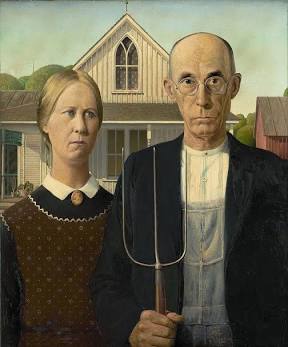
The famous (and for some infamous) Grant Wood painting “American Gothic” has been interpreted in a variety of ways, and the questions of Wood’s intent still create discussion. Looking at the role of farming, whether it be for the State, the Nation, or the World, Iowa has led the way since the the late 1900s and certainly into the 20th Century. Currently (as of 2023) Iowa ranks first in corn, pork, and hides. It is second in soybeans, soybean meal, and vegetable oil as well as turkeys and eggs (which surprised me). The state is fourth in beef production and second only to California in total agricultural receipts. So that dower looking couple (which was modeled by Grant Wood’s sister and his dentist) perhaps should have been a bit more joyful.
Even today as I drove the two-lane highways, the trucks, the livestock haulers, the semis, and the pick-up trucks pulling anhydrous or trailers of hay the reality of agriculture from every corner is unavoidable. The gravel roads and two-lane highways abound and they are a mile apart. The weather can change in an instant, and I experienced some of that late morning as I met a college classmate today. We watched the regional news as we ate and the number of storms cells popping up changed by the minute. Watching the power of nature on the rolling Iowa bluffs is incredible and awe provoking. And yet what makes it so profound to me is it transports me back to my childhood and how we would watch the cloud move and change colors as a storm developed. The tornado sirens would have us scurrying for the basement. It is common to see the cloud bank as the storm rolls across the Iowa fields, hills, and farm houses. Ad I drove to my hometown, away from the storm front, I still found a cell of intense rain that slowed 65 mph traffic to 30. And yet in spite of the weather, the changing markets, the whims of the political winds, the Iowa farmer manages, and as shown above, thrives. It is by luck? Perhaps there are moments, but farmers are scientists, agronomists, botanists, geologists, and pedologists. They are veterinarians, business persons, and mechanics. And they do this with no guarantee of success. This is the world I grew up in. These are the people I went to church with and saw on the street where I grew up. I did not really give it a second thought, and perhaps too often under-estimated the miracle workers they are.
The story of Grant Wood’s painting and the reaction to it was ( and probably still is) varied and complex. As I look at it, I see the intensity of what the farmer must feel almost daily as they survey all the pieces of their daily existence. The gothic church-like window in the house is a reminder that they are dependent on something and perhaps someone outside themselves. The suit coat over overhauls with a white shirt is a stark reminder that it’s all connected and her jumper over a black dress and the small broach with pulled-back hair demonstrates an attempt at femininity with the appropriate understating of any sort of flamboyant gestures. Life was connected to the land , to God, and family. While there is no hint of a family in this picture, most had children who would become farmhands and eventually the person to take over the farm. Generational farming was something normal among my classmates, people in my church youth group, and even in my own family.
My return to Iowa has been enlightening; it has been a time of reminiscing about and appreciating the incredible things I too often took as commonplace. It is anything but. I am grateful for the reminder.
 thewritingprofessor55