
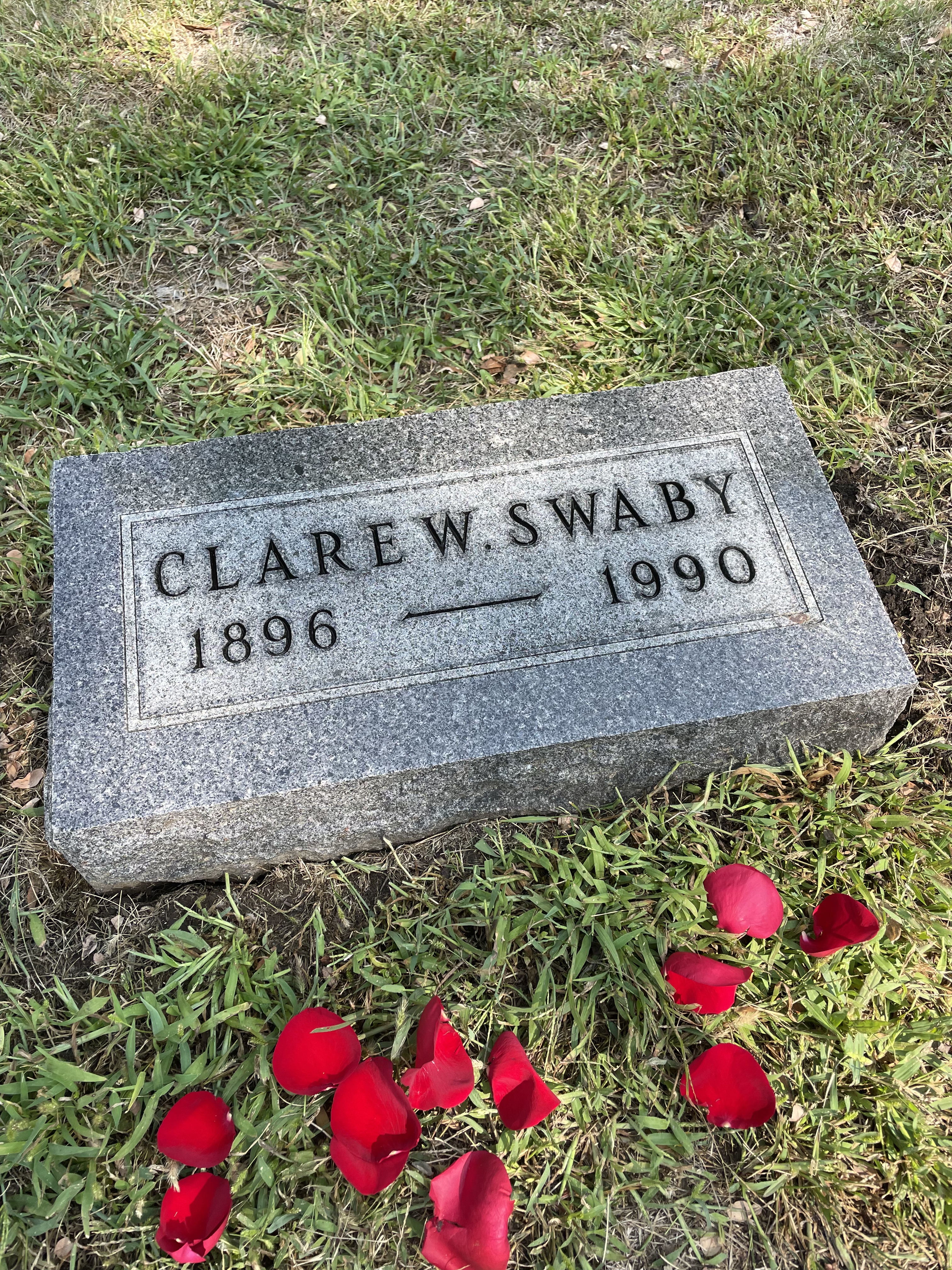
Hello from my abode,
Today would be the birthday of my adopted father’s eldest brother-in-law, Mr. Clare White Swaby. He was born in 1896, and he was the proverbial Sunday dinner guest when I grew up. He was, by any measure or thought, a character. He dropped out of elementary school in 5th grade, but taught himself to read. When you went to his home, which was only about 100 yards from the house his eventual wife, my father’s eldest sister, Gladys, lived in, you would see scores of National Geographic, Field and Stream, or other things that had to do with hunting, fishing, or the outdoors. He loved to garden; he had the best asparagus or rhubarb patches in our entire area of town, and he loved his Martin birdhouse, which was built, not bought, and his peony bushes were immense.
He was one of the kind. By the time I remember meeting him (and I do not remember the first time), his wife had tragically passed away, and he was retired from his work, which as I understand had been in a hardware store, though in the 1920s he was a guard on an armored car (and in fact, had a functional Thompson submachine gun in his basement. He had been a bugler in WWI, and he was a 32nd Degree Mason and a Shriner. I think he was also in some of the other lodges (e.g. Elks, Moose). And yet I did not know much about all of that. I do still have his Shriner’s Cap. What I remember the most, as noted, he was always working on his yard; he was our perpetual Sunday dinner guest; he was at every holiday meal; and he was the first person to take me out to shoot a rifle and shotgun.
What I imagine now on this occasion of his birthday, where it is 130 years ago he was born, is the profound changes he saw in his life time. The United States was moving toward the Gold Standard. It was changing from an agrarian society toward urbanization. The term the Gay 90s refers to this time in American history, and Plessy v Ferguson upheld the concept of separate but equal. So racism was the rule of the date. America had added a 45th State (Utah) and the move toward progressive policies would be born. That is the world my Uncle Clare was born into. He tried to enlist in the Marine Corps, and he also wanted to fly, but his eyes would not let him. Sioux City had grown to 60,000 people and the well-known Combination Bridge, something that caused fear in any new driver (because of its metal grates) was opened. Riverside Amusement Park (the area of town in which he lived) was a major attraction, and the growing stockyards and meat packing industry were an essential economic engine for the city, which by the 1920s was referred to as Little Chicago.
After the war, as best I can find, Uncle Clare worked for the Lewis System, which was both armored cars and security. I am not sure how long he worked there, but when I imagine him as a person in his 20s and 30s, I can see a somewhat pushy hot-headed person, and perhaps not the best person to be carrying a gun on one level, but then again, I am pretty sure no one wanted to mess with him. He was not tall, perhaps 5’7″, but he was a little stocky. He was bald and had a significant nose, and he wore glasses. I am looking for a picture of him. but not sure I will find it in time for this post. I do believe, and this is a bit of conjecture, that Gladys, his wife was quite elegant, probably made more money than he did as she worked for AT&T for many years. Sioux City in the 1930s continued to grow in spite of the depression with the stockyards and meat packing leaving the way. The Sioux City Airbase would train bomber pilots for WWII, and the neighborhoods were know for the ethnic diversity. Norwegian, Swedish, and Lutheran Churches were across the city as well Orthodox and Catholics as more diversity moved into the area. As I have noted in other blogs, the town was very much segregated by both ethnic background as well as socioeconomically. What I realized it was a great place to grow up.
The stories I have about Uncle Clare are legion, and most would need to be edited for appropriateness. He had an active four-letter vocabulary and little or no filter when he was in his own space. That is not to say he had no sense of decorum, and in spite of his ability to be curmudgeonly, he was genuinely grateful when someone did something for him. He and my adopted mother were the proverbial oil and water mix, but she religiously invited him to dinner every Sunday. My cousins, Jim and Joanne Wiggs, were also caretakers as was Joanne’s father, my Uncle Roy, who would come from Storm Lake Iowa on a regular basis. They would sit at the kitchen table and have a whiskey together (Old Grand Dad). In his later years, he remained in his house though he would slowly drive his 1965 Chevrolet Impala around, serving as a menace to anyone who crossed his path. I remember riding with him one time when he stopped at a stop sign, but about half the car was out into the intersection. I mentioned he might want to stop sooner, and he responded, “But I need to see if anyone is coming. ” I responded, ” You will when they run into your door.” His response was something less than kind. One time when I was perhaps 7 or 8, we were out shooting and he took a break to relieve himself. He handed me his binoculars, and said he would be back shortly. A group of three high school kids happened to be there a few moments later, and they took the binoculars from me. I hollered and he came hustling out of the woods. He saw that they had done, and told them to stop. They saw an elderly short man and disregarded his command. He reached into his field jacket pocket (his normal jacket out in the woods) and pulled out a 38. He told them to put the binoculars down gently or they would be “shitting out of holes they did not know they had.” He got his binoculars back, and I merely watched. This is one of many stories I could tell.
What I think about now is how he might react to all of the changes the world has experienced. I know he would never be at a loss for words. When he passed away, the idea of computers at home were something new. All of the changes since would probably aggravate him, and yet he was more open to possibility that people might have thought. The last time I saw him alive, I was visiting my father, and he was in a nursing home. At the age of 94, he got into a physical altercation with his roommate, and he had some lacerations on his wrist and hand from his wristwatch. My father, his POA, asked me to go check on him. When I arrived at the home, I could hear his vocabulary down the hallway. Every word you could imagine. When got him settled down, the nurse thanked me. He told my father that if we was buried from the church he would haunt my father, and then about two weeks before he passed, he noted perhaps he should be buried from the church. If I could do anything it would be to sit with him and ask him about how he understood life as well as the changes he experienced in his life time.
He was a 5th grade educated, brilliantly thoughtful, and even graciously kind curmudgeon. I still miss him. Happy 130 birthday, Uncle Clare. I remember him singing this song (poorly, but he sand it). The title in Germany, in spite of the measurement of score being Norwegian, is in honor of his background.
Thank you for reading, and take the time to remember those relatives who made our childhoods special.
Michael
 thewritingprofessor55