
Hello from my little corner of the world.
While a part of me loves the political of the world, another part is continually surprised (to some extent) and dismayed at how the human lust for power and the seemingly insatiable need for resources (e.g. greed) seems to determine what we do, be it individually or collectively. As I write this, I am trying to come to terms with some of my own health issues, with some of my thoughts about where I am going as well as who I am. Those are individual things, and they are of immediate significance. Then there is the collective of who we are be it nationally, globally, as a species, if I can push it out to that level. In the past 36 hours, the actions of both Israel and the United States (and probably others in terms of covert intelligence) has resulted in the removal of another leader of a country, and certainly one who is the enemy of both countries as well as those who question the theocratic rule of the Iranian Revolution. Again, before you think I support what the late Ayatollah did to his people, I do not, and I can say that unequivocally. And certainly the extended removal of what appears to be a significant number of his apparatus (supposedly more than 40 people), creates even more uncertainty about what will happen in the coming days and beyond. Hearing of the death of American service members will undoubtedly have consequence in the coming week as the Administration hopefully speaks with all the appropriate individuals in Congress (I do still believe there needs to be a separation of powers, and that each branch has to step up and be true to its constitutional responsibility).
One of the most important things I have learned about myself and life in general is while we generally work hard to be ethical, to practice our morals, our values in some consistent manner, few of us really understand what ethical methodology we employ, and even more are unaware of what an ethical methodology is. That is not to be arrogant or pompous in any manner, but it is the reality of our humanity. I would continue that even when I do know them, figuring out where I fit is more difficult that I sometimes realize. The two basic methodologies: teleological or deontological are pretty straightforward, and while I find myself more a deontological ethicist, there are times I find I might waver toward the teleological side of that dichotomy. I am not sure I would ever believe myself to be a situationist, and I generally believe situational ethics a lack thereof, has our transactional world, our secularism, made situational ethics the only possibility? Has the relativism that seems to be the order of the day created an atmosphere where the only thing that matters is money and power? I would note that I am differentiating between relativism and moral relativism, where as moral relativism might argue for some degree of tolerance, it seems the relativism I see exhibited has little appetite for any tolerance; in fact, it is often just the opposite (e.g. diversity or now anti-DEI, any religious acceptance that falls outside an increasingly narrow understanding of Christianity, openness to any sense of the other, the invoking or passing of policies and laws that marginalize groups of people who are not sufficiently sympathetic to the administration, rolling back of long-held precedents that supported undervalued or denigrated individuals – including an attempt to disenfranchise those citizens protected by the 14th Amendment).
Again, inherent in much of this a push of executive power that is not something new, believing such a push can be traced back to President Reagan. The belief that American influence and power are for the benefit of the country is also not unique to the homeland, but history is littered with the consequences of such actions as well as the demise of such users of those actions. What makes this idea of using power so indiscriminately, or with such commonality, is its connection to an incredibly arrogant idea that God is always on the side of the America. It is a parallelism of politics and faith that has been often used underpinned by the belief that we have some inside track to a moralism or the most fundamental inside track to a Creator. The foundational hubris, the unparalleled pomposity of that position resulted in the Executive Order titled Restoring Truth and Sanity to American History. The consequence has been an unprecedented attack on the signing at our National Parks, a profound attempt to whitewash (used intentionally) any part of our history that makes us uncomfortable. Cicero, the Roman orator, once said, “Not to know what has been transacted in former times is to continue always a child.” As a student of history and a lover of history, I am always amazed how complex our history is; but only in that complexity are we able to see how we have changed or transformed to “create a more perfect union.” The teleologic system that is all too common among us, from individually to societally, from community to state, from nationally to globally has a consequence to be sure, but when you add a transactional element, those consequences are compounded.
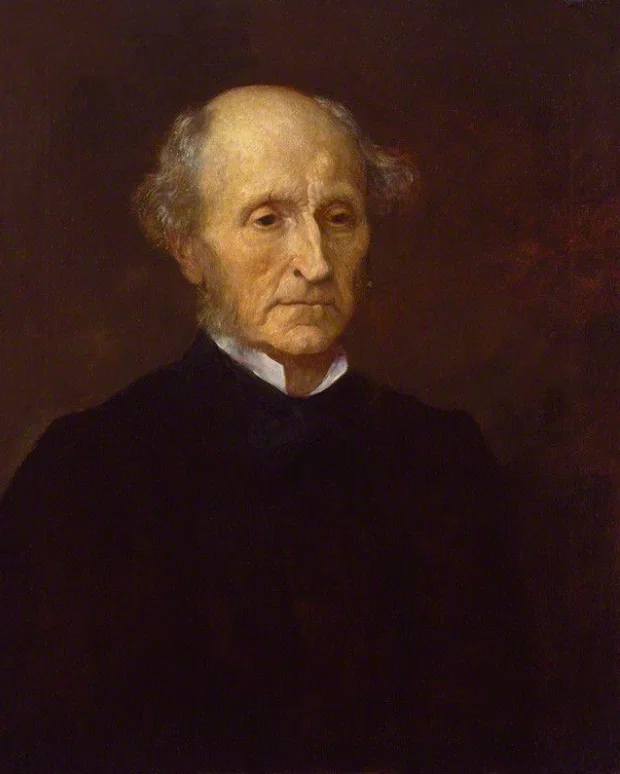
There is little (and I would assert no) chance that anything is done for the greater good as a starting point. So the larger idea of utilitarianism is eliminated (The photo above is of John Stuart Mill, the philosopher and economist who is credited with utilitarianism). Certainly, rhetorically, the appropriate language will be employed asserting that the actions taken are for the good of the collective, but seldom does that seem to occur. Trickle down economics is a great example. The percentage of those in the county who fall in the middle class is down 10% from 1971 (multiple sources). And while the number of individuals who are in an income bracket above has grown, and all brackets have seen a rise in income, the increase of the wealthy median income is 78% compared with 60% for middle income and 55% for lower income. Additionally, in 1970 the middle class held about 62% of the total aggregate income, and in 2022 that fell to 43%, while upper income, over the same period rose from 29% to 48%. So much for trickle down (multiple sources). And as the ability to invest in the stock market, cryptocurrency, or other investments demonstrates the possibility of incredible return, the gap will continue to grow.
In the spirit of disclosure, as a single person in a professional position for the last 25 years, I did well, and while I fell squarely into the middle class – perhaps upper middle class, never did I believe I would ever be a person who did not have to worry about what one unexpected event might do to my security. Additionally, I worked quite diligently to give to others. And I believe I probably should have done more. This is where a horizontal theology is more appropriate than a vertical First-Article dominant practice that believes we have some corner on God’s favor. Practicing something that is essentially greedy or self-centered and arguing a gracious loving Creator of all somehow ordained it seems to be more than an abomination. I would argue it is evil.
Is there a way we can use our incredible abilities in a manner that it is truly utilitarian? Is it possible that people can make money and yet share their profits in a manner that it makes a real difference for the other? Is it possible, returning to the concept of altruism, is it possible we could move toward an altruistic nature in our dealings with the other? How might that occur? I believe that question is a difficult one, particularly for us as Americans. We are used to, attached to, defined by, our individual freedoms. We have been convinced that in that individualism we have God on our side. This might be a topic for another time. I do not have answers, or so it seems, only questions and concerns. How do we begin by taking time for the other? The following video is a compilation of incredible musicians playing a cover of The Guess Who, one of my favorite bands in high school. We need to take the time.
Thank you as always for reading.
Michael
 thewritingprofessor55