
Hello on a sunny and hopeful day,
While it is a sunny and warmer day, any thought that Spring has sprung is not really something I believe to be true. And yet, we are easily spoiled. As I have aged, I find myself wondering what it was that offered such joy or excitement when snow stopped us in our tracks or when the cold was actually dangerous? Certainly my years in the Keweenaw when I was in my 30s and 40s acclimated me to snow in ways never imagined (my first year of graduate school, I believe we had 340+ inches of snow). Even now, unless the snow is over a foot per storm, I think of it as pretty insignificant. Now I believe it is more the cold and wind that makes the winter much less enjoyable or tolerable. What I did realize last night was it is light later and that is something that give me hope.
In my last blog, I focused on one particular book of the multitude of books either written by or about Dietrich Bonhoeffer. This morning I spoke with my mentor and comprehensive exams professor, Dr. Dale Sullivan about this profoundly influential, incredibly principled pastor, the focus of my dissertation. We both pondered what his moving, but unrealized, concept of religionless Christianity might have looked like, how it might have been practiced in the typical church or denomination. What I still find myself examining is how he focuses on the suffering of the other was so foundational to what provided a sense of justification for his decision to work for the Abwehr. Bonhoeffer’s faith was based on two important concepts, both distinctive and yet interwoven: community and discipleship.
In his small book titled Life Together, Bonhoeffer pushes the human understanding of community out the door, arguing the only lasting community we can hope for as a Christian community is a spiritual community, an alien community because it comes from God and not from our own ability. The importance of that is not merely that it creates a new understanding of what it means to live together in this world, but it connect intimately to his understanding of discipleship, and what it means to truly follow Christ, and Christ crucified (which is a suffering Christ). Michial Farmer, a professor teaching in Minnesota who has been influenced by Karl Barth and Søren Kiekegaard, notes that if one takes Bonhoeffer’s Cost of Discipleship seriously, few of us can claim to be Christian (“Christian Suffering . . .” 5JAN2011). He continues, “The earth-shattering revelation in The Cost of Discipleship is the extent to which suffering is necessary for the Christian life. (Obviously, Bonhoeffer was not the first to point this out, but he points it out more stridently and effectively than anyone else I’ve ever read.) Suffering is for Bonhoeffer the immediate requirement of the Gospel, ‘not the terrible end to an otherwise godfearing and happy life, but it meets us at the beginning of our communion with Christ. When Christ calls a man, he bids him come and die.’ The Christian life always already demands suffering” (Christian Suffering . . . para.2). The significance of this is that it is not simply some personal piety that exists in an ideal Christian following, but that it is grittier; it is dirtier if you will. Bonhoeffer argued that God allows Himself to be edged out of the world and onto the cross, showing that God is not a “working hypothesis” for escaping pain, but a weak, suffering presence alongside humanity. The death of Jesus on the cross is an incredible example of the suffering necessary in discipleship.
This is not something something we want to hear, and it is not something we openly hope in which we want to participate. The salvific power of Jesus is in his suffering. “Christ is Christ only in virtue of his suffering and rejection, so the disciple is a disciple only in so far as [they] shares his Lord’s suffering and rejection and crucifixion Discipleship means adherence to the person of Jesus, and therefore submission to the law of Christ which is the law of the cross” (Cost of Discipleship). There is no reciprocation, if you will, this is done not out of the expectation of receiving something back, and it is not some tragic existence, but rather it is what it means to be exclusively a disciple. This is not something we want to hear, and perhaps, even more so, not something in which we hope to actively participate. Jesus prayed in Gethsemane that the cup of suffering might be taken from him, but it was only through the suffering the cup would pass on. Without suffering Farmer argues we find ourselves in a “divine alienation” from God. Instead what God requires is a divine alienation from the world. That is not something most practicing Christians want to hear, let alone become an active participant. There is no reciprocity in this. It is a requirement, and the necessity of it leaves our thought of God on our side, which is something rampant in American Christendom, as an impossibility. What happens is something that the Danish philosopher and theologian, Kierkegaard referred to as a leap of faith. By its very nature, a leap of faith is solitary; it is an individual action, and in solitude there is no reciprocation, unless it would come from God, and that presupposes that we can influence God to such a degree. That is a question for another time.
Matthew Erickson, in his piece titled “The Must of Suffering in a Christian Life . . .” asserts, “The cross is laid on every Christian. The first Christ-suffering which every man must experience is the call to abandon the attachments of this world. It is that dying of the old man which is the result of his encounter with Christ. As we embark upon discipleship we surrender ourselves to Christ in union with his death-we give over our lives to death.” For those from the Upper Midwest, and perhaps in their late 40s or beyond, you might remember Garrison Keillor and his monologues on the show A Prairie Home Companion, about his hometown Lake Woebegone. In one particular sketch, where the infamous sad, but pious, Lutheran Pastor Ingqvist is in a discussion with his wife, after being guilted into giving up a family vacation to Disneyworld. He knows he has been less than thoughtful, and he has disappointed the family immensely. After their discussion, his wife (who ironically and sadly did not ever have a name . . . .hmmmmm) says to him thoughtfully, “Martyrdom is a gift of the spirit, but you only use it once, and you do not take your wife and family with you.” So it is with faith, and Kierkegaard’s leap. It is something you do, and as noted, we are called to do if we are truly disciples.
The struggle with community and our attempts to connect it to issues of faith, of life in the church is a difficult one. I think back to my visits with people, parents, grandparents, sponsors, when someone came to me about baptism. Too often most did not understand what happened in baptism; they did not understand who was acting; and they did not understand the implications of what they promised to do. What does it mean to be baptized into the death and resurrection of Jesus? What does it mean when the primary acting power is the power they do not see? What happens when they, as well as the congregation makes promises about the life of the one being baptized? This was something I did not really understand myself until I was implementing the sacrament. In the liturgy, the congregation accepts the baptized as a fellow believer in the Church of Christ, a member of a group committed to being disciples, but when most are Sunday Christians, working to understand how the one hour affects the other hundred-sixty-seven. That is not mean to slight the community of believers, but it does push the idea that with most having little more than an eighth-grade religious education, it is not surprising that discipleship is such a foreign concept, particularly when it comes to Bonhoeffer’s argument for what discipleship is. In a sermon on Psalm 63:3 (and Bonhoeffer had memorized the Psalter during his incarceration), the verse is powerful: “Your steadfast love is better than life.” It was only through the suffering lament the writer could come to such words about the love of God. It was only when all was stripped away, the Psalmist could or would encounter the God who was always there. It was not in some dogmatic ritual or even in the Torah itself, it was in the suffering that the Psalmist finds God. It is not in the goodness of our lives; it is not in the stuff of our lives, in our comfortability, but it is when we are at our most vulnerable, our most painful, our most unworthiness that we can come face-to-face with the true depth of the love of God.
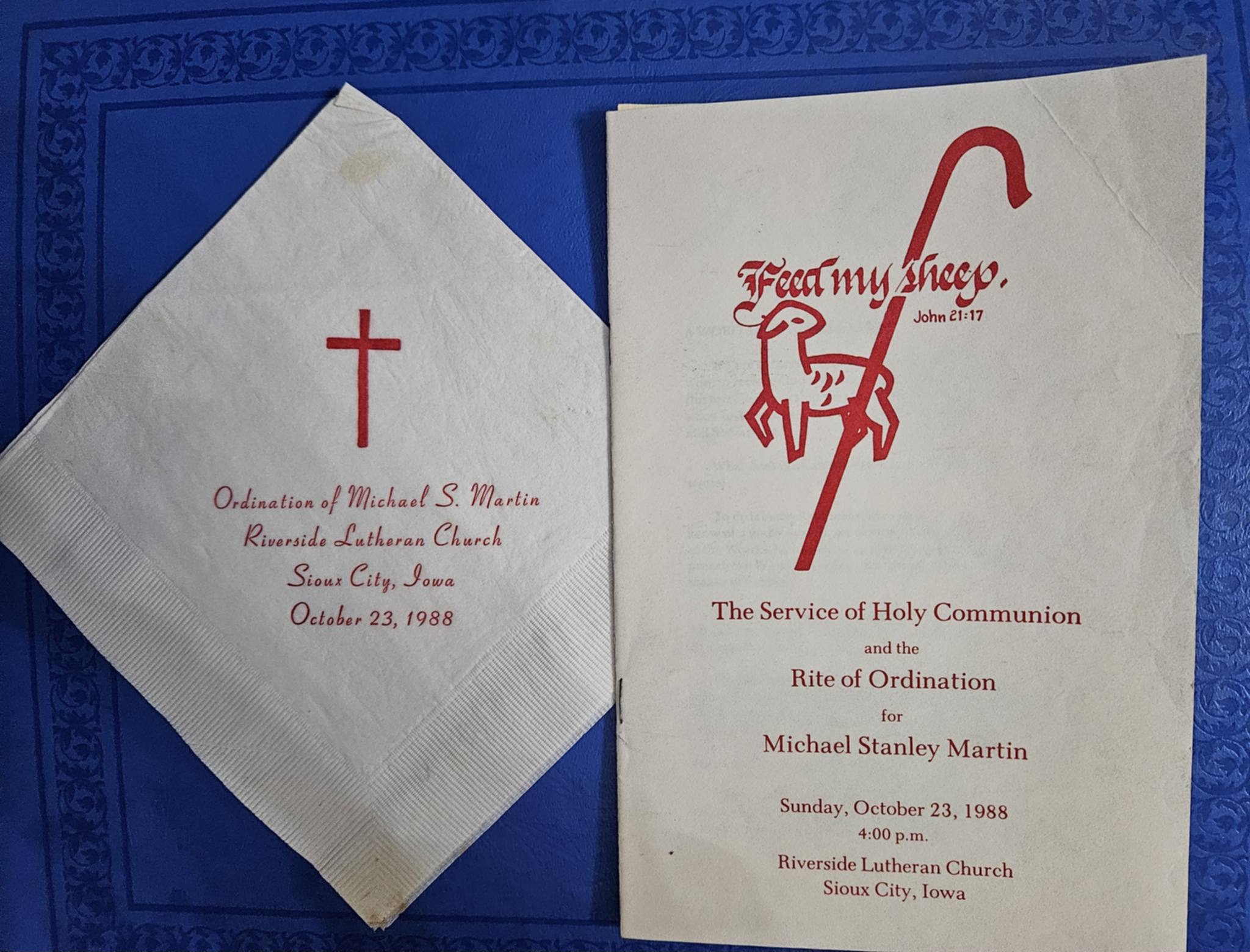
So where does that leave one in terms of community? How do we create an honest community based on discipleship? I think of monastic communities, and perhaps they have some real sense of this sort of commitment, but what about mainstream living and a sense of community. Much like I have noted lately that AI would profoundly change how I would teach only two years later, what I would hope for a congregation, and how I would understand my role as a pastor would be. How would I lead differently? How would I become more of a servant that I was, and I am not sure I did that well to be honest. So much I see differently now. Recently a childhood friend (we are from the same church and I was a classmate of her brother’s) sent me a picture of the bulletin from my ordination. While I remember it clearly (it was created for just my service and the scripture used, and was designed by a friend and printed by my incredibly kind and talented father-in-law at that time), it was nice to see it. Perhaps understanding community and the seemingly contradictory nature of needing solitude is the next part of this discussion. More reading and more consideration. While I have used the following before, it seems apropos here as it too was sung at my ordination by my childhood best friend, Peter Goede. I remember him saying it was not an easy piece to do, but he did it fabulously.
Thank you as always for reading. I am grateful to each of you, and I wish you a blessed continuing Lenten journey.
Michael
 thewritingprofessor55