
Hello as the wind howls outside my window,
The winter cold front is blowing through, and while we did not get the snow, whiteouts, or ice those north of us experienced, it is down right cold, and we’ll see what the morning brings. Those even straight West or minimally North are seeing zero visibility and road closures, we are faring much better. Those in my old Keweenaw stomping grounds are experiencing a typical storm with lake-effect snows and snow emergencies. I am reminded of the first year I was in graduate school (30 years ago right now) and the snowfall for that winter was over 340 inches. That was a shock, particularly when we could have 3 or 4 feet more accumulation than 11 miles south. I remember when arriving a few years earlier someone inquired kindly, “Do you like snow?” When I responded, “Sure.” Then again, they asked, “No; do you LIKE snow? Because we get a lot of it.” They were certainly correct.
One of America’s most notable authors, intelligent authors, and perhaps most misunderstood writers, but to me one who understood our human frailties, is Ernest Hemingway. The title of this post is the initial part of one of the well-known quotes. I think the truism of it (at least for me) is both societal and individual. While I believe there are moments we are more aware of it, I do believe there are those times we feel we are more capable of managing life’s trials than others. Certainly the reality of aging, of successes and failures, of not escaping our finitude, to use the words of William Tremmel, can be a harsh reminder of who we are, of our limitations, and as I have been open with struggling with my own personal reflection or experience of life post retirement, it appears that Hemingway knew of such things. For some, those who might assert his characters are either one dimensional or his rugged settings discount women, I would disagree. While his writing style is minimalistic, unlike Faulkner or Irving, his characters, like most, are flawed, but emotionally honest and sincere. Some might go as far as to assert they are relatable, even endearing as they struggle to understand their own frailty. The psychosis of most of them makes one examine their own life as they read about Fredric Henry or a Catherine Barkley, a Jake Barnes or Brett, Lady Ashley. Hemingway’s consideration of people in a war setting cannot be easily dismissed because war is about dying. When someone is facing their own demise, especially when looking down the business end of the other’s weapon, seldom does one feel patriotic. As we face the end of something that defines us, be it change of occupation, the ending of significant relationship, retirement, or life, often we are facing a place of profound fragility, a moment when our identity and sense of worth are called into consideration.
Lately, I have found that my propensity to be honest with my thoughts and emotions have been more damaging than helpful. Be it meant as truly complimentary and nothing more, be it (as I will specifically say) bear with me as I am thinking out loud, there is little I can do about how it is received, or so it seems. For someone who tried to use words appropriately and adequately, lately, and too often, I seem to be most unsuccessful. The consequences have been painful, and perhaps long-term. I have felt the reality of Hemingway’s quote. Whether or not those points will become a place of strength is yet to be known. Whether this breakage is reparable is something achievable, or if I even want it to be, is currently undetermined. Much like the character’s created in his novels, The Sun Also Rises, Farewell to Arms, or For Whom the Bell Tolls, I find myself wondering if what I have believed most of my life is an illusion, or what I was duped into believing? Am I speaking out of my failures or is there something I am still incapable of understanding? Can I move from the place of feeling broken to a place of mended albeit scarred?
Failure is an incredible equalizer. I can think of a handful of times where I have felt the searing sting of falling profoundly short of what one would hope. Most often it’s been on a personal level or in my personal life, though a couple have been in the professional realm as well. Likewise there are those personal failings, which had professional consequence. I have addressed them from time to time in this very platform. In each case, undoubtedly, I bear some level of responsibility. Regardless my intentions, the resulting misunderstanding, the perception of the other is, in part, due to my failure. Where I presently struggle is whether it is worth the effort to repair the situation or relationship, or at this point in life to merely move on? Is there a point where I am too old to worry about it? Each case deserves some consideration, that much is obvious by the very fact I am writing this. But much like the howling wind that was heard when I started this post, it dissipates, and while there might be remnants left in its wake, life continues to move forward. Is my moving forward with it a strength or an avoidance? I am unsure in this present moment. Perhaps what needs to occur is my own self-examination: where do I see a pattern or where are my own character flaws, those traits that seek to open me to being misunderstood, misperceived?
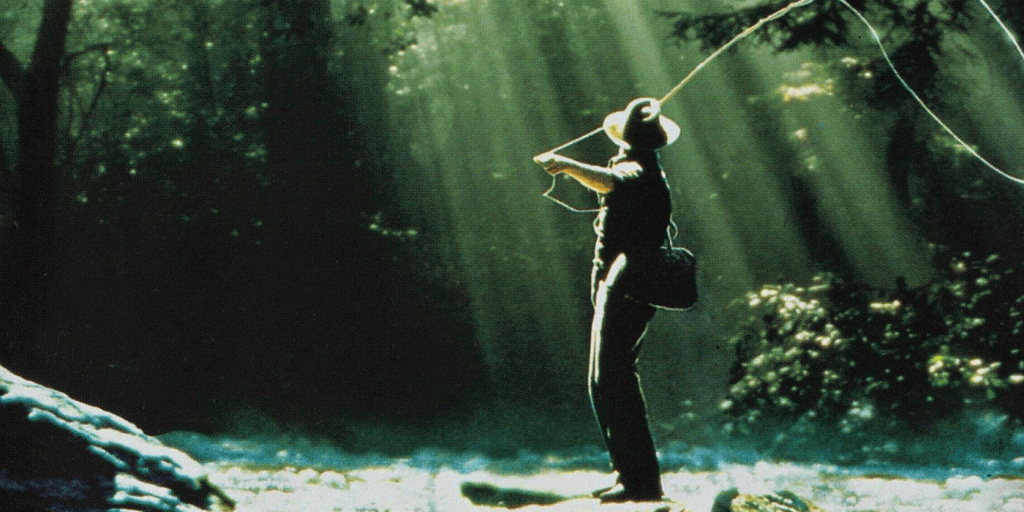
I have often described myself as lonely-in-the-middle-of-a-crowd. That has been true for much of my life, and as I aged I perhaps even embraced that as something I desired. Now the crowds are not around as much, and when they are I find myself withdrawing. Have I changed or have I become less resilient, less capable? I am not sure I can answer that question at the present moment. As we come to the end of a calendar year, I find myself withdrawing even more in spite of being in the midst of family. I find myself wanting to undertake some significant introspection, trying to understand where life has taken me, as well as where it is going. Recently, I had a conversation about sacraments with a friend. The importance of water in the sacraments is undeniable, unavoidable. Water is something I both love and yet it frightens me. It is necessary for life, but its power can also take life. When I first taught, I co-taught a Creative Writing course with an incredible writer named Timo Koskinen. He used the novella A River Runs Through It. Those 104 pages by Norman Maclean are perhaps the most wonderfully written pages I ever read. The end of the book, which I have noted in their movie form are as important to me now as when I first read them.
Thank you as always for reading; and for your comments, responses, and likes. It means a great deal. Blessed New Year.
Michael
 thewritingprofessor55