
Hello from Starbucks,
It’s been a few days beyond two months since I drove across I-80 to make my way back to Bloomsburg, and the path has been anything but predictable. I am busy working, but not at what was expected. The bus is still in Iowa, while I try to remain patient with the process of fabricating the two metal doors that are needed to replace what was there and make the bus safe, waterproof, and more usable. So the reality is there is little to nothing I could be doing in Iowa at all, so working at the restaurant is keeping me more than occupied. In fact, two phone calls have put more on my plate. Organization and management seem to be the catch words of the day.
Some of my personal growth work of late has focused on the importance of my sacramental cognizance. I remember the day of my ordination feeling overwhelmed to the point of being sick to my stomach by what I had just vowed to do. It seems a bit akin to what was written about the first time Luther presided over the sacrament of Holy Communion. Rather than this mass being a celebration of his ordination, he was so filled with fear and trembling that he almost dropped the bread and chalice. The vows of ordination are still part of who I am in spite of my no longer on the clergy roster. I would dare say I probably practice those demands more precisely today than I did almost 4 decades ago. One of the most significant things in those vows, at least for me, was to “institute sacraments with integrity.” To do that I think it is essential to understand what a sacrament is. Both in terms of essence as well as significance. Sacrament is etymologically related to sacred and for good reason. As outward symbols of the grace of the Creator, as tangible experiences of God’s graciousness, the importance of a sacrament cannot be overstated. They are both the easiest and most complete way to participate in a personal faith journey. In a recent blog post I noted my own somewhat roller coaster struggle with church attendance, but I do know without regular attendance, participation in the sacraments is limited. Experiences the most visible, tangible elements of grace are lost, or certainly missed out upon.
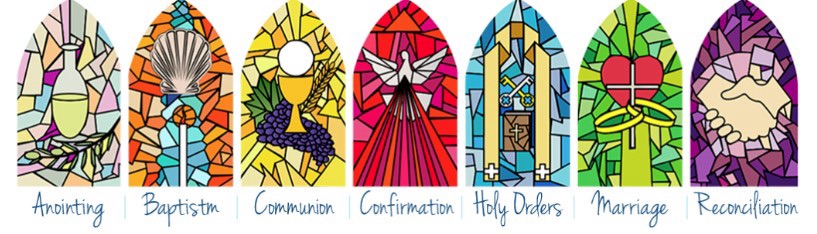
As I have considered the idea of sacrament in the Roman Church, where there are seven rather than two, the sacraments correspond with inflection points in someone’s life, when participation in that sacrament changes the relationship with the Creator; it transforms the relationship. The clichés about life and its process are legion (relational pun intended), but matching a sacrament with those significant point when life’s moments move one into a new stage, a new understanding of their identity and potentiality. Think the work potentiality is integrally related to transformation. We are continually recasting or remaking ourselves, sometimes consciously and other times perhaps more unaware. As we approach Transfiguration in the liturgical year (which was the first text I ever had to preach on in preaching class) it’s perhaps apropos that I consider transformation and its connection to the transfiguration of Jesus. Perhaps, even more important that the sacraments are visible examples of God’s grace as our Lord is no longer visible as He was in the first decades of the change from BCE to AD.
When I think about those transformative moments, confirmation was that time I felt important because in the Lutheran church it meant the time you gained an opportunity to experience the Eucharist. And while marriage was (and is) not a sacrament in the Lutheran Church, I think I appreciate that sacramental importance placed on those vows. Furthermore, the irony of that position is not lost on me as a person twice-divorced. I think about my adopted parents and their marriage and I am conflicted when I ponder what they had or did not have, but there is some profound admiration for their loyalty to their vows. I actually wrote quite a revealing blog about my perception of their marriage in a blog the summer of 2014. There are moments I struggle to imagine what I believe demonstrates a healthy marriage. I did address my own emotional connection to ordination earlier in this very blog, and I remember that I cried when I gave my stoles to a seminary classmate after resigning the clergy roster. That was a difficult day. The Sacrament of Reconciliation, and the very action of being penitential is also something I find deeply personal. Luther speaks of the Office of the Keys, and the power one holds in the act of forgiveness. Certainly, one of most important things we can do, both for ourselves and those we meet, is ready admit mistakes as well as working hard to forgive those who have wronged us. Life would be far less dramatic. Too often we discount apologies, which is an act of contrition. We respond with an understated, “no worries” or “it’s okay” which undervalues their request for forgiveness. We inadvertently fail to free the other, failing to unlock the door. Perhaps the act of penance when viewed sacramentally might help us realize the importance of forgiving the other.
When my father passed away, I was still on the clergy roster, and I presided at his committal service. it was a bitterly cold early January day. I still find the point in that service where, as you stand at the opened grave, you recite the scripture, “This is the gate to eternal life.” The stark reality of both death and life beyond are connected at that point like no other time. Perhaps what was once called Last Rites, also known as Extreme Unction, or now Sacrament of the Sick, might be one of the times we most need the visible grace of God. I think the idea of God being visible in the daily elements or experiences of life offers a sense of comfort to the search for faithfulness in such wonderful simple way. Faith is an incredible exercise, folly for some and necessary for others. As I work to find a deeper meaning in the sacraments for myself, I feel a fervor about my own faith process that has been missing for some time. The renewed appreciation of these inflection points pushes me, calls me to care about others more thoughtfully or intentionally than I perhaps have. Where will it lead, I am reminded of the song sung at my ordination, the song by the John Michael Talbot, “Prayer of St. Francis.” It is a song that has instructed me many times, and a song for which I have particular affinity.
Thank you for reading and blessing to you,
Michael
 thewritingprofessor55