
Hello from Mallard,
In the last couple days, while driving to Pocahontas for appointments or to Emmetsburg for errands the memories of a decade ago, to the day, came flooding back. I had driven back to Menomonie from the fall semester teaching in Bloomsburg. I needed to take Lydia to a couple doctors’ appointments, and I would be traveling after Christmas for my first visit to Poland, something that had been arranged by a former student who happened to be Polish as well as by her father, who, while also Polish, divided his time between the States and his Slavic homeland. It was the typical much-colder in Wisconsin, and staying in Lydia’s third floor, the Upper Sanctum as I dubbed it, was cold and had a monastic vibe to it.
When I got to Comforts of Home (COH) to see Lydia, I was stunned by the degree her health had deteriorated since a previous visit earlier that fall. And in spite of the strong care by the staff and really thoughtful and consistent communication with the administrator of the facility, I was not prepared for what I would find in the little room at the end of the right back corridor. Dementia had turned the brain this brilliant economic professor and polyglot into Swiss cheese, and those holes caused numerous seizures. This whirling dervish, two-digit midget (no offense meant to smaller people as I called her this in person) was less than a shell of the person I had first met on the Circle a decade earlier. As I took her to her PCP appointment, she was no longer the person who would chase down her doctor if she waited too long. She was no longer the woman, who in spite her diminutive stature, could, and would, control an entire room. In fact, barely two weeks ago I was in Menomonie, and when her name was mentioned, the gentleman noted she had been her professor. He said unapologetically that she was one of the toughest professors he ever had. Lydia was now reduced to sitting listlessly in her wheelchair, covered by her blanket, while the deteriorating brain matter subjected her to mere existence and general exhaustion because the seizures that wracked her body created incredible pain, which zapped her. On an ironic note, the dementia caused her to forget that experience regardless of how many times it happened.
When we arrived at the doctor’s office that day, Lydia’s change from the incredible take-charge person she had once been was on full-display as she was a present, but non-participant, person in her own health discussion. In spite of her physicians continued profound care, she was incognizant of where she was or what was happening. Even now, as had always been my experience with her doctor, his concern was to offer me both the most caring and appropriate advice and counsel possible. Our conversation was honest and informative as I tried to make the most caring choices for her. It was my responsibility (now both morally and legally). He explained options and reasons for everything I could choose to do. What I learned once again was both his medical acumen, but more importantly the unparalleled compassion he held for every person who entered his care. I was her POA, but in someways I was as much of a patient as she was, and he knew that. His care in providing me the best way to supply for her the most thoughtful possibility at such a crucial time has never been unrecognized. His exceptional goodness as a physician, as a human being is something I still see today. He is one of the few Renaissance people I have ever met. Upon leaving his office, I called her care facility and asked both the administrator and staff RN to wait for our return. I wanted them to know what our change for her care would be.
As we returned in the van to Lydia’s home of the past 3+ years, I still struggled with what choice was best. Her doctor had provided a choice, but he also explained what and why the choice was offered. He used his own family’s experience as a basis. The choice chosen was to discontinue some medication, to increase the dosage of the seizure medication to keep them more at bay, and to offer a medication for pain. That was the choice I made. I did not want her to continue having these incredible body-wrenching episodes, and it mattered not if she remembered them. That sort of pain was inhumane for me for anyone. The irony of the next morning for Lydia’s choice for daily life still shocks me. That Saturday morning she went to breakfast as normal. They had helped her dress and brought her to the central gathering place for her morning meal. She sort of picked at her food that morning, and shortly afterwards, stated , non-characteristically, “I want to go back to bed.” Abiding her wishes, she returned to her room; they redressed her in a warm nightgown, and soon she was comfortably in bed. Unbeknownst to us, except to shower or use her restroom, Lydia would not leave her room again. That day her additional medication was administered, and what became a vigil began.
In the days ahead, the Staff and Aides at COH provided the most incredible care to the little tornado who was the second person to live in their amazing facility. They had cared and supported her and me on this tremendously arduous journey, seeing the transformation from a person who wanted to help with everything to a person who needed help with everything. The administrator cared for her as she would her own grandmother, even crawling into the shower to help her bath in those last days. I watched and marveled as Lydia would refuse water to watching her point into the corner and speak in Polish to the apparitions only she could see. It was during that time this blog would become the significant element in my writing it remains today. It was the way I could chronicle the end of a life that began in Austria, grew in the Sudetenland, would move to London, marry a Polish concentration camp survivor, and together immigrate to Chicago with “two suitcases and a hundred dollars.” She lived a commuter marriage and became a trusted and respected faculty member at the university, and left a memorable path everywhere she went. Those next days were both comforting and tragic as I watched her physical body continue to fade, working to catch the mental person who had long since departed, though there were moments she would surprise us with clarity.
On Christmas Eve day, as I sat at her bedside, I wrote about what I was witnessing, expecting (you can actually scroll down in the interface here, and read those blogs from December of 2014) and playing Christmas music softly on my laptop. She began to speak in Polish and pointed to the corner. I asked her if George (her husband) was there and she nodded affirmatively as her “tak, tak” became more insistent. At a quiet moment, I inquired softly, “Lydia, are you ready to go home?” Hoping she might say tiredly, but appropriately (or so it seemed), “yes’.” Instead, she looked straight at me and replied distinctly (and in her Austrian accent), No!” I simply stared at her. In the six days what had transpired since her appointment, she now ate little or nothing, was too stubborn to drink water, and she slept much more, but she still knew what she wanted. Lydia was no a fan of Christmas, and I secretly feared she would die Christmas Day to haunt me forever. That did not happen; she actually died on New Year’s Day, which her accountant noted was the best day tax-wise to pass away. I have noted to some she probably knew that and planned accordingly.
During the 27th and 28th of December, as her fragility became more apparent, I spent 16-18 hours a day in her room, both because I did not want her alone, but also because I knew I soon had to leave for Poland, the country of her husband. Fortunately, the co-caretaker of her, a former student of mine, a member of the USCG, and his incredible family drove up from North Carolina to take over the vigil. As I spent my final hours with her before I would drive to MSP’s airport, the reality of what was to occur hit me hard. She had become my parent; I had become her chauffeur, her yard boy, her snow-removal person, her personal chef, and perhaps most of all, the never-existent child; I was her guardian, her companion, and in someways the spouse she had lost 20 years before. Before I left a final time, I sat on the floor next to her bed, softly weeping for the loss that was unavoidable. She had slept a great majority of the day, but suddenly, I felt her hand on my shoulder. With tear-filled eyes, I turned to look at her. She smiled faintly, and rubbed my head. I said, haltingly, “You became my mother.” She simply said, “I know.”Then I said, “I love you,” and she responded, “ I love you too, and she closed her eyes. There were no better words we could have exchanged. As she went back to sleep, I went back to the house on the Circle to get my things (already packed). It was snowing steadily, so the trip to the cities would be a little concerning. As I left the house, I decided to return to COH on more time. Tears streamed down my face as I walked to her corner room. I entered quietly and she was sleeping, her breathing shallow. I walked softly to her side and gently kissed her forehead, whispering, “Goodbye, Lydia; I love you.” I walked out of her room and sat in the gathering room that was outside her room where I sat and wept. There was no way I could drive in that moment.
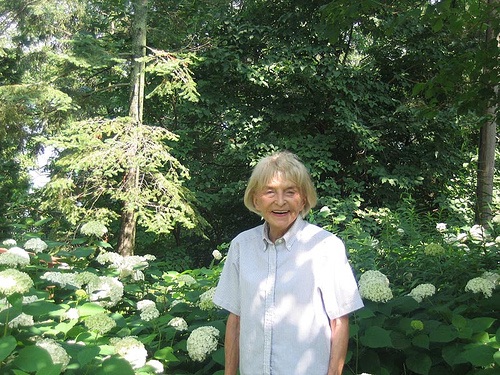
New Year’s Eve day, I was in Kraków, Poland, and standing in the church where Pope John Paul II had served as Cardinal Karol Wojtyła, the Archbishop of Kraków. As I stood before one of the auxiliary altars in the beautiful church, I lit a candle and I prayed a simple and fervent prayer. I knew back in Menomonie, some 4,725 miles and eight time zones away, Nathan and family had taken over the vigil. In fervent supplication, I asked, God, and George, please convince her it is time to come home.” I left the church believing I was heard. Early on the 2nd of January, but still New Year’s Day in Wisconsin. Lydia passed quietly in her sleep with both Nathan and the wonderful administrator by her side. In the decade since her passing, my life has been transformed in many ways, but as she was transformative for me in way too many to count. I still miss her. One of her favorite groups, of course, was the Vienna Boys Choir. The video below is in her honor. I found a picture of her from 10 years ago to the day, but the picture above is how I prefer to remember her.
I hope the memories of those you love will bring you comfort in this season of Advent, and this Sunday of the Angel’s Candle. Thank you as always for reading.
Michael
 thewritingprofessor55